- The paper demonstrates that spatial self-phase modulation effectively measures anisotropic nonlinear refractive indices along the crystallographic c-axis.
- Methodology involves analyzing far-field diffraction patterns and using the nonlinear Schrödinger equation to fit experimental data.
- Findings highlight that precise characterization of photorefractive crystals requires anisotropic models, guiding future optical applications.
Anisotropic Nonlinear Refractive Index Measurement via Spatial Self-Phase Modulation
Introduction
The study presented investigates the nonlinear refractive index modification in photorefractive (PR) crystals through a spatial self-phase modulation (sSPM) approach. PR crystals have been extensively employed for nonlinear optics due to their modifiable photoinduced properties, which can be controlled by external electric fields and incoherent illumination. This paper outlines a practical method to measure refractive index changes using far-field diffraction patterns from a laser beam propagating through a PR crystal under spatial self-phase modulation conditions.
Photorefractive Model and Nonlinear Laser Propagation
The paper elaborates on the photorefractive effect in crystals, emphasizing the modification of refractive indices due to charge carrier mobilities induced by light intensities. The study incorporates the nonlinear Schrödinger equation to model the propagation of linearly polarized laser beams within the crystal. Significant factors include the inherent anisotropy due to the crystallographic axis and saturation effects at high laser intensities. By fitting experimental data to isotropic models, the study offers insight into controlling the refractive index modification effectively (Figure 1).
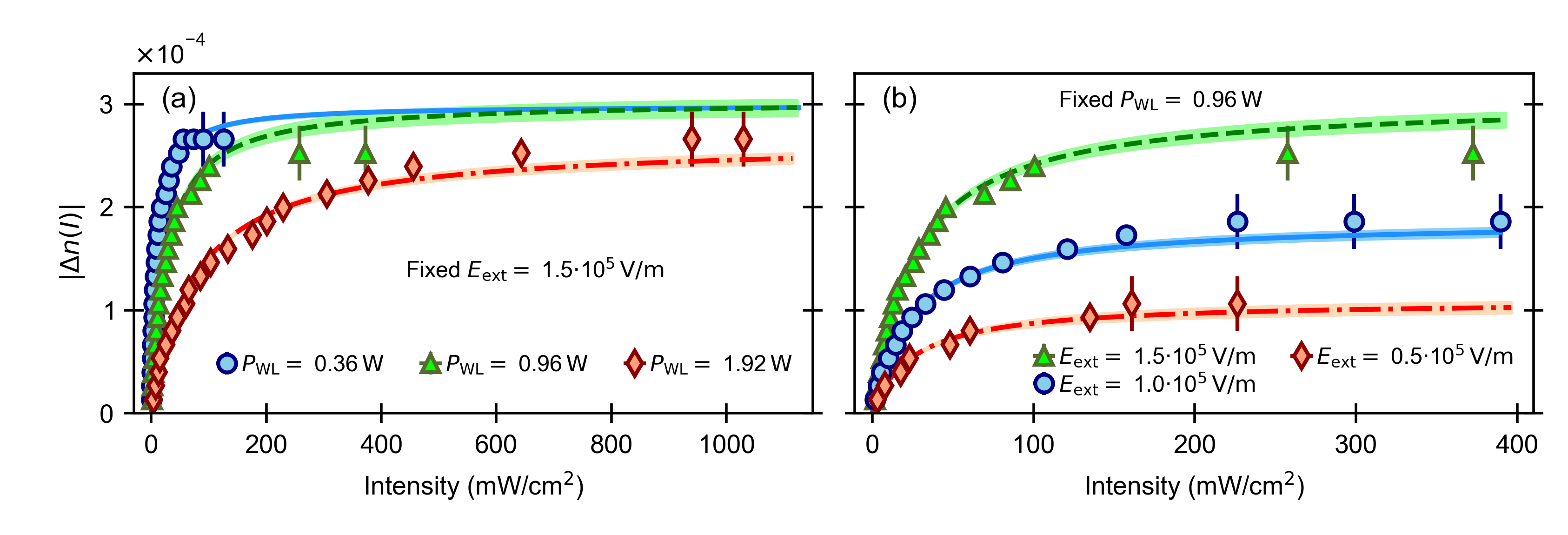
Figure 1: Nonlinear index of refraction along the c-axis for a given set of parameters of white light intensity and external electric field with respect to the incident optical intensity and corresponding fits using an isotopic saturable model.
Spatial Self-Phase Modulation (sSPM) Approach
Spatial self-phase modulation is applied as a diagnostic tool to quantify the nonlinear refractive index by observing interference patterns in the far-field. This nonlinear effect is caused by phase modulation proportional to laser intensity variations across the transverse plane. The generated concentric ring pattern is analyzed to extract the nonlinear refractive index through phase shifts measured during propagation. Experimental validation shows that the observed anisotropic distribution is consistent with theoretical predictions (Figure 2).
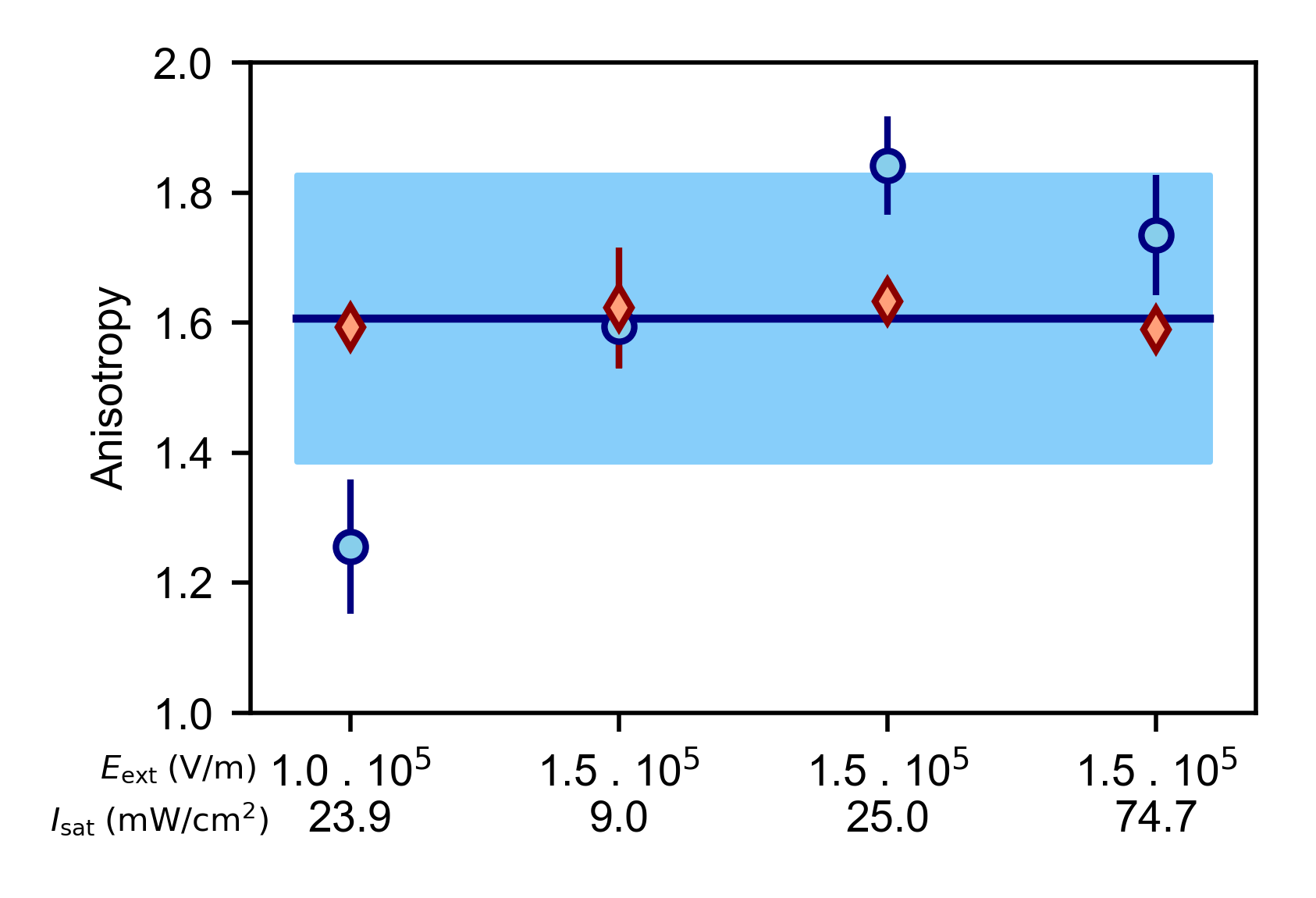
Figure 2: Measurement of the anisotropy of SBN. Blue circles: ratio of the fitted $|\Delta n_{\text{max}|$ along the kx direction and the orthogonal direction.
Results and Discussion
Experimental observations indicate that the nonlinear refractive index variation aligns well with theoretical models when assessed along the c-axis. This is significant for applications requiring precise refractive index determinations to compare experimental results with numerical simulations. The anisotropy detected reinforces the need for an anisotropic model for accurate characterization. Tables of extracted parameters such as maximum nonlinear refractive index and saturation intensity show consistency across varying electric fields and illumination intensities, reinforcing the robustness of the proposed methodology.
Implications and Future Perspectives
This research demonstrates that sSPM is a viable technique for measuring and characterizing PR crystal refractive indices effectively. The findings have profound implications for enhancing the understanding of light transport properties in nonlinear media, potentially guiding future studies in transient PR response regimes and nonlinear dynamics probing. Future work might explore the transient photorefractive response, enriching the analysis of nonlinear light dynamics further.
Conclusion
In summary, the paper successfully implements sSPM to measure nonlinear refractive indices in SBN photorefractive crystals. This study not only provides accurate measurements consistent with theoretical values but also explores the anisotropic characteristics crucial for characterizing nonlinear optical systems. By employing this straightforward and effective method, researchers can achieve precise calibration necessary for advancing optical applications in PR and other nonlinear crystals.