- The paper introduces a novel quantum Wasserstein semimetric that adapts classical Wasserstein distance for stabilizing GAN training on quantum data.
- It employs parameterized quantum circuits and entropy-based regularizers to enhance robustness and scalability, even on noisy NISQ devices.
- Experimental results demonstrate effective learning of pure and mixed quantum states, reducing circuit complexity while maintaining high fidelity.
Quantum Wasserstein Generative Adversarial Networks
The development of quantum generative models, especially Quantum Wasserstein Generative Adversarial Networks (qWGANs), offers promising directions for both quantum machine learning and quantum chemistry. This approach improves robustness and scalability for adversarial training of quantum generative models, even on noisy quantum hardware. The key contribution is a novel definition of the Wasserstein semimetric, which can be efficiently implemented on quantum machines. The paper showcases improved numerical performance using classical simulation of quantum systems and demonstrates the potential of qWGAN in reducing the complexity of quantum circuits.
Introduction
The concept of Generative Adversarial Networks (GANs) has been instrumental in advancing generative models by setting up adversarial frameworks between generators and discriminators. In the quantum field, the potential for quantum speedups arises from the power of quantum generators and discriminators. The burgeoning interest in Quantum GANs (qGANs) is catalyzed by their applicability to quantum systems in fields such as quantum chemistry and condensed matter physics, as well as their compatibility with near-term devices like NISQ machines.
Devising qGANs for quantum data presents challenges, especially in designing loss functions between real and fake quantum data. Training instabilities observed in classical GAN models are exacerbated in quantum contexts as the system scales, highlighting the need for stable metrics like the quantum Wasserstein semimetric.
Quantum Wasserstein Semimetric
The cornerstone of qWGANs is the adaptation of the Wasserstein distance for quantum data, termed the quantum Wasserstein semimetric qW(⋅,⋅). Quantum states are represented by Hermitian density operators, with pure states being rank-one projections and mixed states as probabilistic mixtures thereof.
For quantum data described as density matrices P and Q, qW(P,Q) is developed to offer stability and smoothness similar to the classical Wasserstein distance. A key innovation is leveraging the symmetric subspace of quantum data via the SWAP operation to ensure correct metric properties. The cost matrix C is defined as:
C:=21(I−SWAP)
This choice guarantees that qW(P,P)=0, ensuring the semimetric nature.
Limitations and Comparisons
While qW(⋅,⋅) effectively stabilizes training, it does not satisfy the triangle inequality and lacks an explicit cost function derivation. However, it aligns with the geometry of quantum state space, offering a feasible model for GANs in quantum computing.
Regularized Quantum Wasserstein GAN
The qWGAN architecture addresses quantum adversarial training by applying a parameterized quantum circuit as a generator and leveraging quantum entropic regularizers. The dual form, incorporating entropy-based smoothing, expedites convergence and enhances differentiability of the training objective.
Implementation Considerations
In practice, the implementation of qWGANs involves:
- Generator and Discriminator Parameterization: Utilizing parameterized quantum circuits composed of one and two-qubit gates that are feasible on current quantum hardware.
- Training Complexity and Efficiency: Although computationally intensive, quantum operations like circuit evaluation and Pauli measurements are manageable on quantum systems. The gradient of the loss function is efficiently estimated via quantum circuits.
Experimental Results
Simulations of qWGAN on classical platforms have validated its stability and robustness in learning quantum states for systems up to 8 qubits and mixed states up to 3 qubits.
- Pure State Learning: Demonstrations for 1, 2, 4, and 8-qubit systems show smooth fidelity convergence to near-perfect states within a reasonable number of iterations.
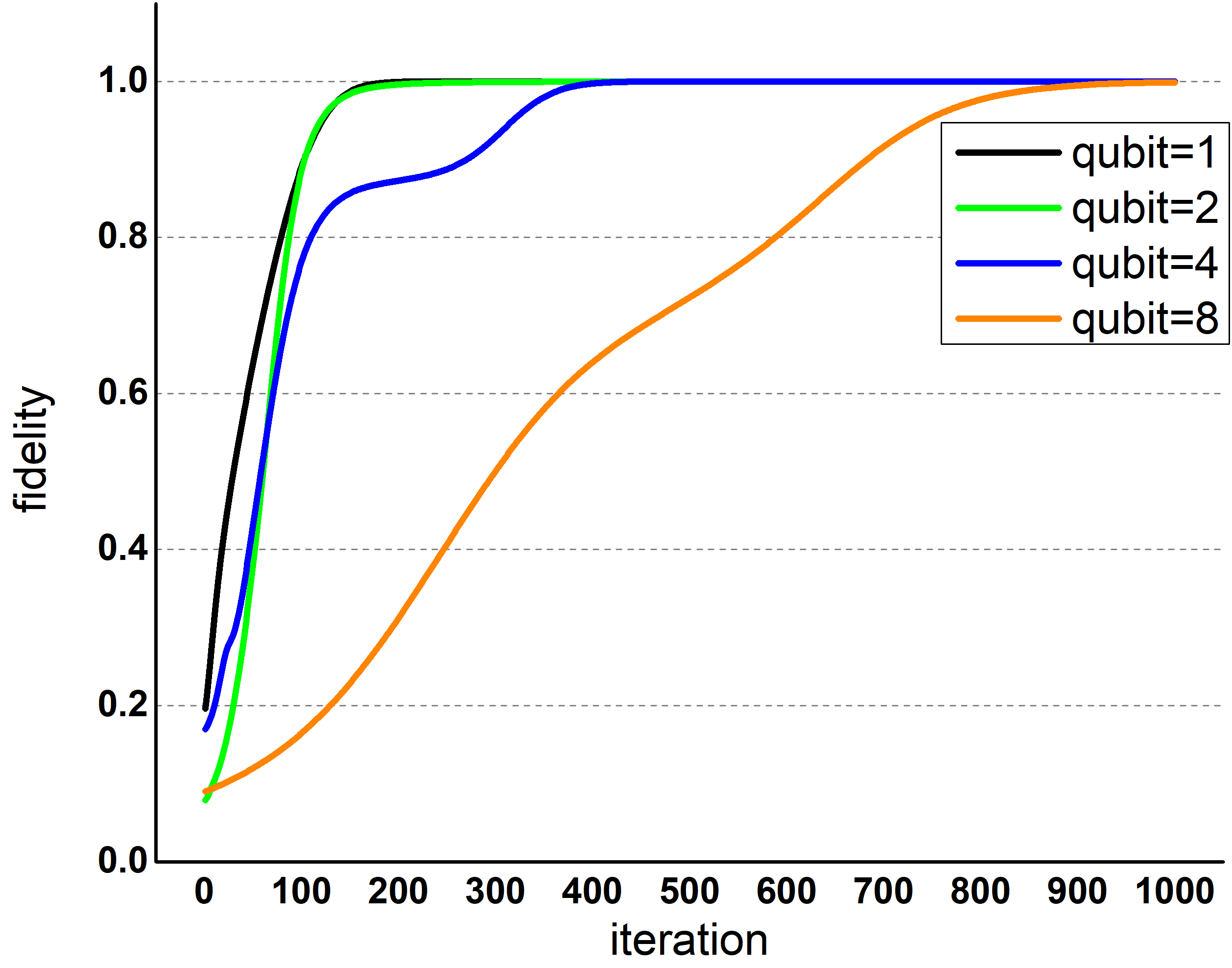
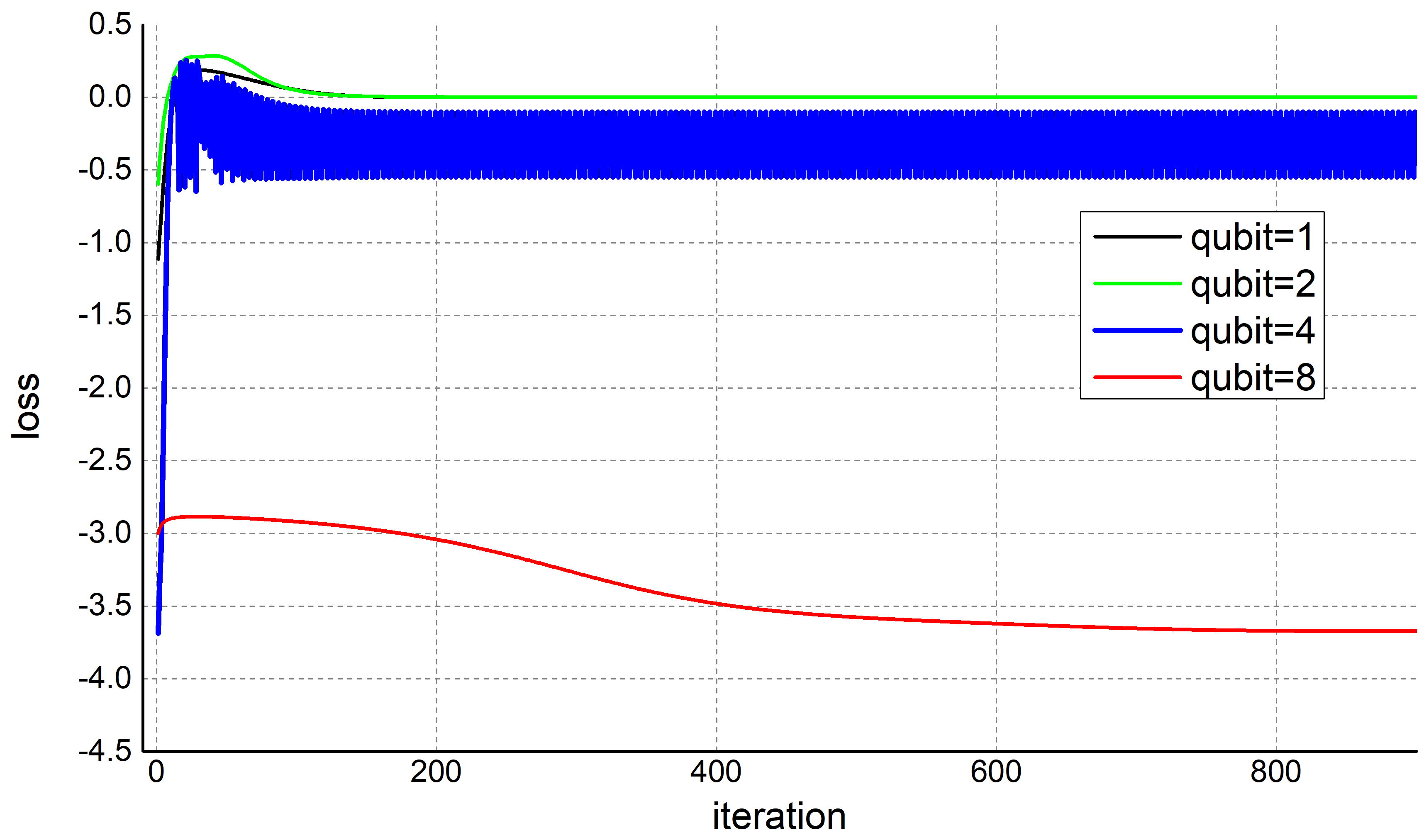
Figure 1: A typical performance of learning pure states (1,2,4, and 8 qubits).
- Noise Resilience: Training simulations with noise models appropriate for NISQ devices indicate the ability to learn effectively in a noisy environment.
Practical Applications
The qWGAN framework shows potential in approximating quantum circuits efficiently. For instance, a quantum Hamiltonian simulation circuit was approximated using a drastically reduced number of gates while maintaining high output fidelity. This application underscores the feasibility of qWGANs in rendering complex quantum computations tractable with simpler quantum circuits.
Conclusion
The design of qWGANs marks a significant stride in the efficient training of quantum generative models capable of operating under real-world quantum constraints. Future work will focus on scaling to larger quantum systems and enhancing theoretical understanding of quantum Wasserstein metrics. The promise of implementing these models on actual quantum devices reinforces the relevance of qWGANs in advancing quantum computational techniques.