- The paper presents a Wiener-Hopf based analytical solution for water-wave scattering by submerged elastic and poroelastic plates.
- It employs Cauchy-type integrals to simplify the dispersion equation's root-finding, enhancing computational efficiency.
- Numerical simulations reveal differing wave attenuation and energy transfer behaviors, validating the model's relevance to coastal engineering.
Wiener-Hopf Method for Water-Wave Interaction with Submerged Elastic Plates
The paper "On the Wiener-Hopf solution of water-wave interaction with a submerged elastic or poroelastic plate" presents an analytical solution using the Wiener-Hopf technique to the problem of water-wave scattering by submerged thin plates, addressing both elastic and poroelastic variants. The derivation deviates from traditional methods by employing Cauchy-type integrals to simplify the root-finding process associated with dispersion equations. The study investigates the scattering process, revealing insights into how plate porosity affects wave behavior through numerical simulations.
Governing Equations and System Configuration
The study considers wave propagation within a fluid over a horizontally submerged semi-infinite elastic plate, formulated by the three-dimensional Laplace equation governing potential flow. The fluid interacts with an elastic Kirchhoff-Love plate, leading to coupled mechanical response, addressed through:
ΔΦ(x,y,z;t)=0,for (x,y,z)∈Ω,
where Ω describes the fluid domain. Boundary conditions at the sea floor, the free surface, and the submerged plate edge help define the problem setup. Incident surficial waves are idealized using a potential field, leading to a modified plate bending equation when poroelastic considerations apply.
Wiener-Hopf Technique Application
The Wiener-Hopf method stands out due to its domain decomposition approach, facilitating a semi-analytical solution otherwise reliant on numerical root-finding for dispersion, avoiding complications associated with finding zeros of the dispersion equations. The paper effectively decomposes the kernel function to achieve analyticity across complex half-planes, further simplified by Cauchy integrals.
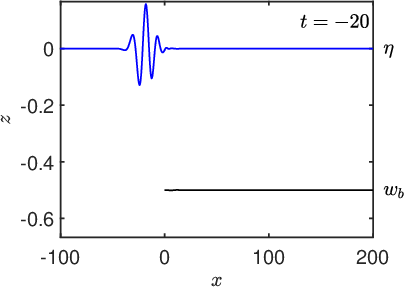
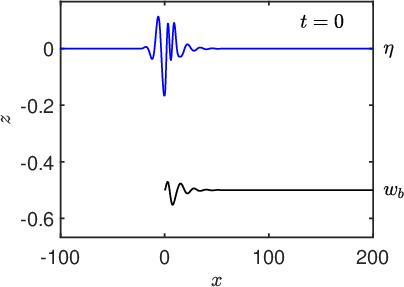
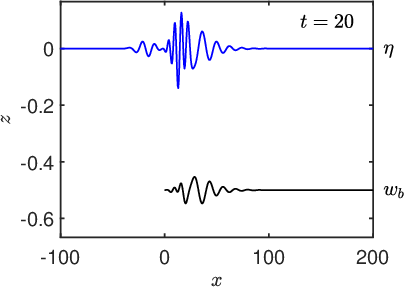
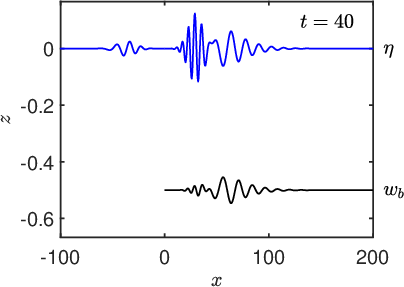
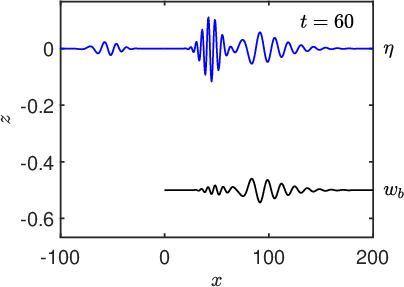
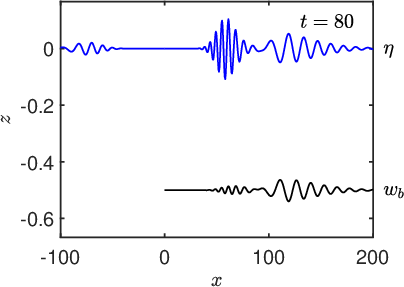
Figure 1: The time-dependent motion of the fluid surface (eta) in blue and submerged elastic plate (wb), relative to its rest position, in black with clamped leading edge for a Gaussian incident wave pulse for parameter values μ=α×10−2, illustrating energy transfer through fluid-structure interaction.
Numerical Simulations and Energy Balance
The method includes energy conservation checks via Green's theorem, ensuring proper modeling of the system's physical behavior. Reflection and transmission coefficients are calculated across different boundary conditions, elucidating wave amplitude behavior. Simulations demonstrate dissipation effects inherent in poroelastic plates compared to elastic counterparts, showing strong suppression in shorter-wavelength pulses.
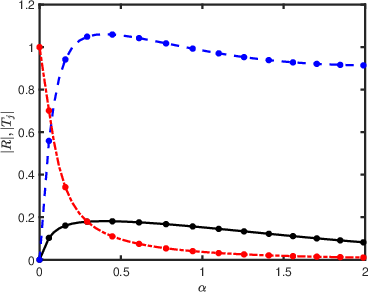
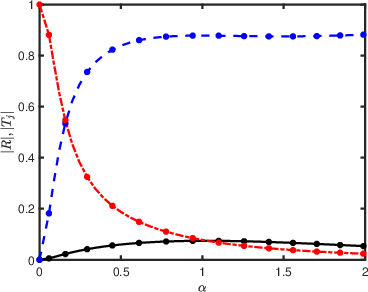
Figure 2: The reflection coefficient with high wavenumber transmitted mode and low wavelength transmitted mode for an elastic plate, highlighting the dependency of wave suppression on plate parameters.
Implications and Future Directions
The study's robust handling of submerged plate interactions using the Wiener-Hopf method prescribes practical applications, notably in coastal engineering, by offering a precise model for attenuation properties due to porosity. Future studies may build on this framework, exploring non-linear interactions or extended porosity models that account for variable pore sizes or complex geometries. Exploration into potential applications in the aeroacoustics domain remains promising, where similar porosity-driven attenuation behaviors could mitigate environmental noise.
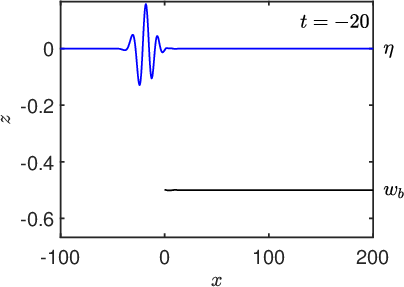
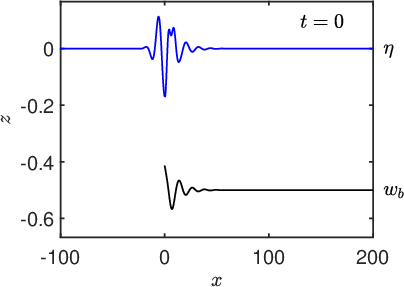
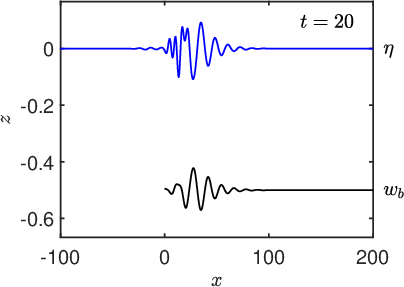
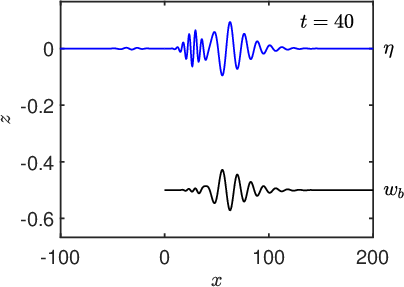
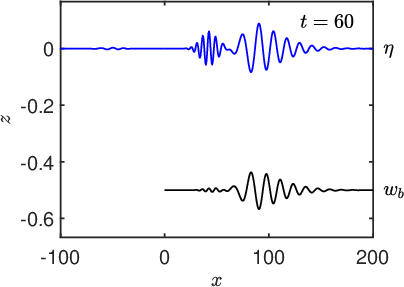
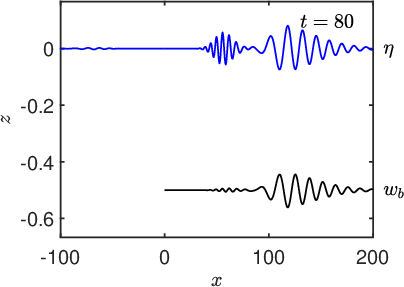
Figure 3: With porosity, wave attenuation shows significant decay in transmitted waves along submerged plates displaying energy damping potential, particularly notable for short wavelengths under fluid coupling conditions.
Conclusion
The paper effectively demonstrates a principled approach to addressing wave-structure interaction using advanced analytical methods, providing a comprehensive framework that resolves complexities via Cauchy integration. By eliminating numerical challenges associated with traditional root-finding, it opens avenues to versatile applications, with notable implications for engineering solutions in oceanic and aeroacoustic environments.