- The paper introduces a novel hybrid IFS that combines lenslet and slicer technologies to provide enhanced spectral resolution for exoplanetary studies.
- It employs a 6x6 lenslet array and a pseudoslit rearrangement technique to increase the packing factor by around threefold, while minimizing optical aberrations.
- Initial prototype tests using laser illumination confirm the design's capability to deliver detailed chemical characterization of exoplanet atmospheres.
From Colors to Chemistry: A Combined Lenslet/Slicer IFS for Medium-Resolution Spectroscopy
Introduction and Background
The paper introduces a novel lenslet-slicer hybrid integral field spectrograph (IFS) design, aimed at enhancing the spectral resolution for the study of exoplanets. Traditional lenslet-based IFSs, such as those used in instruments like GPI and SPHERE, provide spatial and spectral data but result in low spectral resolution. Slicer IFSs, on the other hand, offer higher spectral resolution but introduce optical aberrations, leading to degraded spatial information. The hybrid design—dubbed "slenslit"—intends to amalgamate the best features of both technologies, enhancing the imaging capabilities of future instruments such as SCALES.
Slenslit Concept
The slenslit concept emerged from the necessity to improve the spectral resolution of the SCALES instrument, utilized for imaging exoplanets. By rearranging the lenslet images into a pseudoslit before light reaches the disperser, it increases the spectral resolution without additional penalties in optical aberrations. This slenslit design enhances the 'packing factor' by an approximate factor of three, leading to higher spectral resolution and a detailed chemical characterization of exoplanetary atmospheres. The prototype opts for a 6x6 lenslet array to demonstrate effective interleaving.
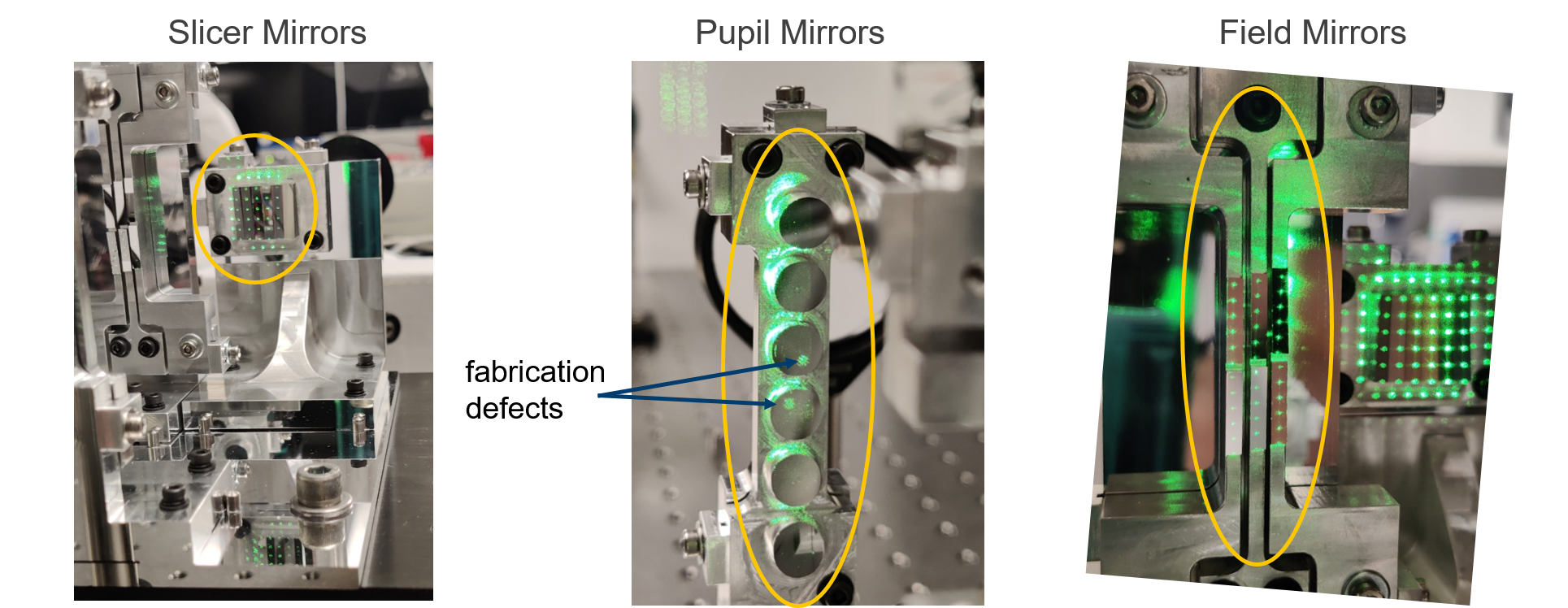
Figure 1: The slicing optics, illuminated with laser light through a 10x10 patch of lenslets. The two patches identified as fabrication defects are obvious areas of high scatter and discussed in the text.
Slenslit Prototype Design and Construction
The design and mechanical construction of the slenslit involve a meticulous optical and mechanical design process using Zemax and SolidWorks. The slicing optics are formed of monolithic constructions aimed at reducing complexity in alignment. An innovative 'bolt-and-go' approach allows for effective assembly, balancing precision with practicality. Fabrication challenges, such as those arising from edge requirements and potential surface defects due to diamond milling, are addressed with strategic engineering solutions to maintain optical integrity.
Upon its setup at the Laboratory for Adaptive Optics (LAO), the slenslit prototype exhibited successful prototype interleaving, verified using a green laser setup and recorded outputs on a tablet screen. The effective slash reduction in lenslet-to-lenslet distance ensures non-overlapping spectra and demonstrates the prototype's ability to provide enhanced spectral resolution without sacrificing image quality. Future integration with white light sources and dispersers will allow testing over the full optical bandpass.
Implications and Future Directions
The slenslit offers significant potential for enhancing exoplanetary research by transitioning from low-resolution color differentiation to mid-resolution atmospheric chemistry analysis. The approach aligns with forthcoming space-based missions where spectral resolution is critical for studying bright targets. Future steps involve integrating the prototype with high-contrast AO instruments to quantify spectral resolution improvements under realistic observational conditions, potentially catalyzing advancements in exoplanet characterization technologies.
Conclusion
The introduction of the slenslit hybrid architecture signifies a significant progression in IFS design, effectively merging the advantages of lenslet and slicer systems. By addressing the inherent limitations of both traditional designs, the slenslit enhances spectral resolution while preserving spatial fidelity, thus advancing the capabilities for exoplanetary atmosphere characterization. Continued development and experimentation promise further refinements and integrations into future observational platforms.