- The paper finds that gravitationally mediated entanglement via both Newtonian fields and gravitons supports the empirical case for quantum gravity.
- The analysis refines decoherence metrics from Alice’s recombination and Bob’s measurement to reconcile causality with maintained quantum coherence.
- Implications include designing tabletop experiments to probe gravitational radiation and clarify the necessity of graviton quantization.
The paper "Gravitationally Mediated Entanglement: Newtonian Field vs. Gravitons" (2112.10798) explores the conceptual and technical nuances of gravitationally mediated entanglement. By re-evaluating a gedankenexperiment proposed by Belenchia et al., the authors examine whether the entanglement of massive particles can provide insights into the quantized nature of gravity through interactions with the Newtonian field or gravitons.
Theoretical Background
The intersection of general relativity and quantum field theory has remained a fundamental challenge. Despite the conceptual framework for linearized quantum gravity on a fixed background, nonperturbative approaches are fraught with difficulties. This paper addresses the longstanding debate over whether gravitational interactions can—or must—be quantized, challenging classical notions and investigating the graviton's existence as an essential aspect of quantum gravity.
Building on prior analyses, the authors argue for the necessity of quantum features in low-energy gravitational experiments. The notion that a massive body in quantum superposition requires quantized gravitational radiation to avoid contradictions with causality and complementarity is pivotal.
Gedankenexperiment Analysis
The gedankenexperiment revisits the idea of a massive particle placed in a quantum superposition by Alice. Bob, at a spacelike separated location, measures the gravitational field to deduce Alice's particle's path, raising potential paradoxes concerning causality and complementarity.
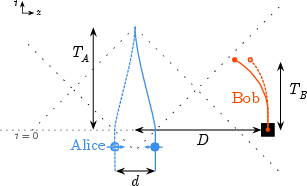
Figure 1: The setup for the gedankenexperiment of \cite{Mari2009}.
The core of the gedankenexperiment (Figure 1) lies in whether an entanglement is mediated through the Newtonian gravitational field or via gravitons. Belenchia et al. previously posited that to maintain quantum coherence, quantum gravitational effects—like vacuum fluctuations and quantized radiation—are indispensable. The authors of this paper enhance these arguments with a rigorous analysis of decoherence processes, laying broader conditions that invalidate objections regarding experimental setups.
Decoherence Mechanisms
The paper dissects decoherence processes into two components: Alice's recombination-induced decoherence and Bob's measurement-induced decoherence. By refining estimates, their calculations depict scenarios where Alice's particle emits entangling radiation during recombination, thus maintaining coherence or causing decoherence independently of Bob's measurement actions.
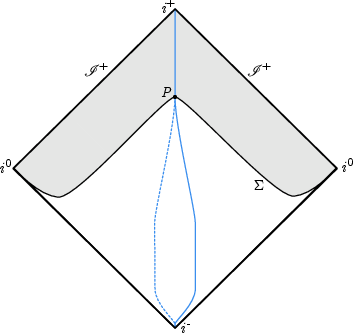
Figure 2: Alice recombines her particle at event P, subsequently maintaining inertial motion.
The authors' precise characterization of these processes reveals that Bob's potential to acquire which-path information is fundamentally limited by radiation entanglement from Alice's recombination. They establish that any significant deviations resulting in contrast to earlier conclusions would either breach causality or complementarity, ensuring consistency with quantum principles.
Implications and Future Directions
The findings illuminate the indistinguishable nature of entanglement through Newtonian fields or gravitons, suggesting that experimental validations of gravitationally mediated entanglement could empirically substantiate graviton existence. The paper challenges researchers to design experiments that hinge upon these principles, potentially advancing the quest for a unified gravitational quantum theory.
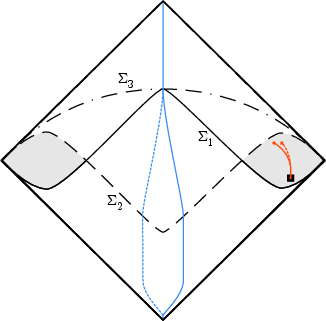
Figure 3: Spacetime diagram of the gedankenexperiment with key surfaces illustrated.
These insights pave the way for deeper inquiries into the quantum field of gravity, encouraging focus on tabletop experiments that could spark revelations about gravity’s quantum characteristics. The research underscores the integral relationship between Newtonian entanglement and graviton presence, prompting considerations for future observational strategies and theoretical frameworks.
Conclusion
The investigation into gravitationally mediated entanglement provides a significant perspective on the quantum aspects of gravity. By showing that Newtonian field-mediated entanglement might imply graviton existence, the research reasserts Einstein's legacy, fused with quantum principles, as an avenue for unlocking answers to gravitational quantization. This work invites further experimental exploration to conclusively determine the gravitons' role within the paradigms of physics.