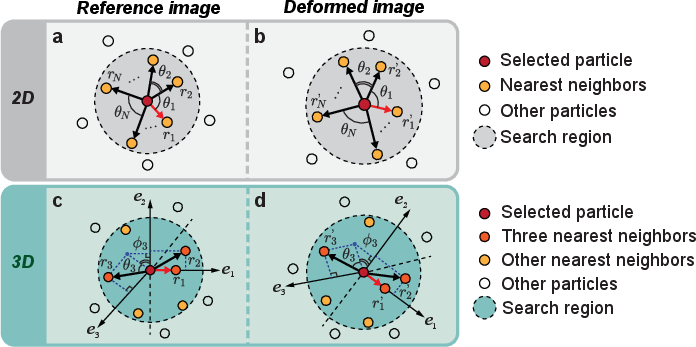
- The paper introduces a robust tracking framework that combines scale- and rotation-invariant descriptors with an augmented Lagrangian global optimization.
- The method consistently achieves tracking ratios above 95% in 2D and 85% in 3D under large affine deformations and rotations.
- The approach integrates multi-scale iterative matching and image warping for both 'hard' rigid particles and deformable 'soft' markers, ensuring accurate motion field recovery.
SerialTrack: A Scale and Rotation Invariant Augmented Lagrangian Particle Tracking Method
Introduction and Motivation
The manuscript introduces SerialTrack, a robust particle tracking framework specifically designed to address the limitations of existing SPT and PTV algorithms in resolving large deformations and rotational fields in 2D and 3D experimental image sequences. Conventional particle tracking pipelines suffer from trade-offs between computational tractability, tracking uniqueness, the ability to process large-magnitude motions, and the handling of variable seeding densities or particle shape changes. SerialTrack combines topology-informed, local and multi-scale descriptors with a global augmented Lagrangian optimization, resulting in consistent, accurate recovery of motion fields, even under substantial image deformation and rotation. Additionally, the method can distinguish and optimize for "hard" invariant particles and "soft" deforming markers.
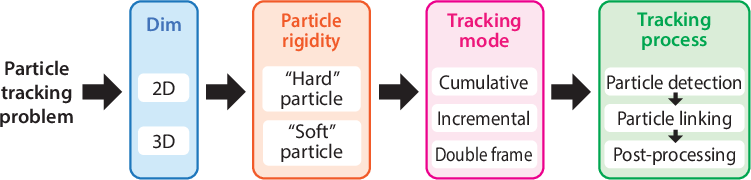
Figure 1: Schematic of the SerialTrack workflow spanning dimensionality, particle rigidity, tracking mode, and core detection/linking/post-processing strategies.
SerialTrack operates with an architecture that fully integrates particle localization and tracking, supporting flexible detection routines, diverse experimental designs, and advanced motion field recovery modes. The central innovations include:
The algorithm is implemented efficiently, supports both incremental and cumulative frame-to-frame tracking, and is extensible for user-defined detection and filtering routines.
Quantitative Assessment and Results
SerialTrack demonstrates strong tracking performance on both synthetic datasets and experimental modalities. The evaluation utilizes metrics such as particle tracking ratio (fraction of correctly tracked particles) and RMS displacement error.
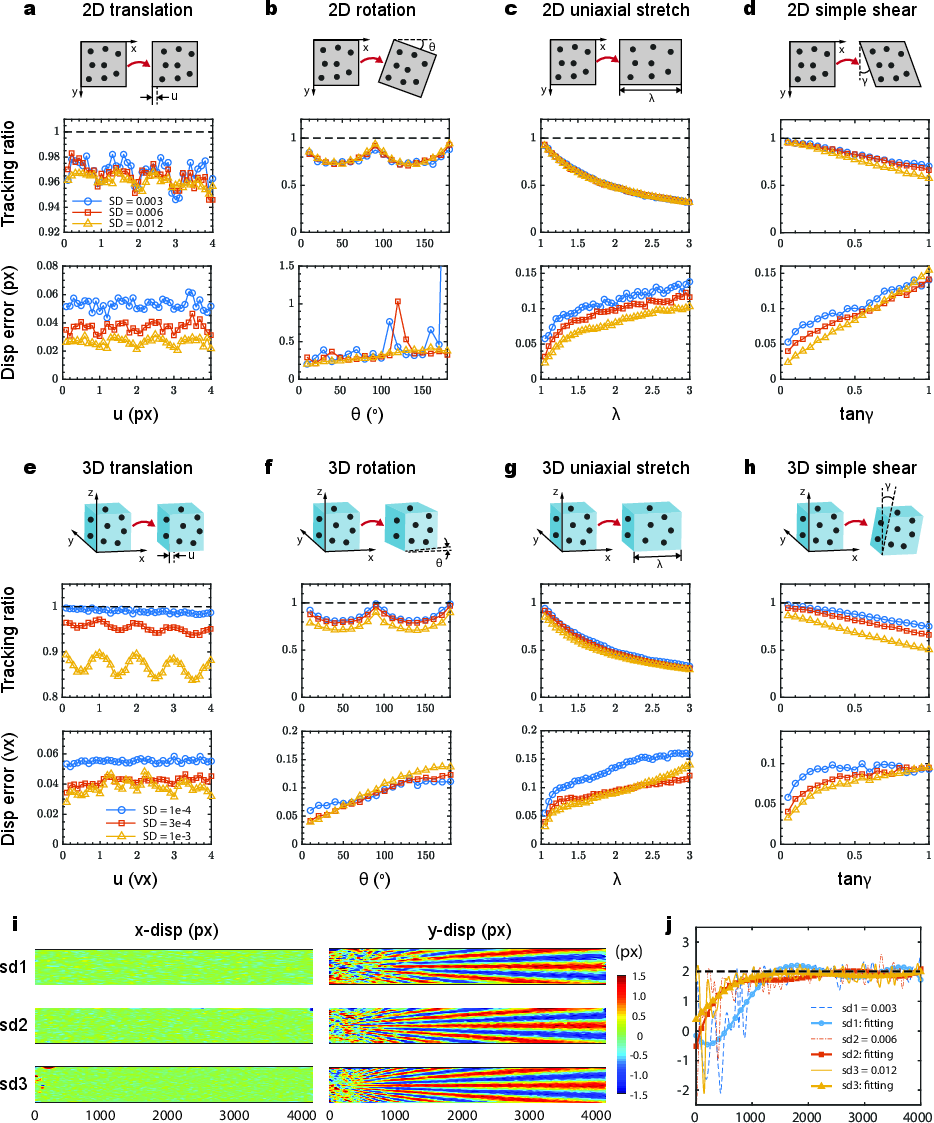
Figure 3: Particle tracking ratios and RMS errors versus applied deformation for synthetic 2D and 3D scenarios, as well as performance under highly oscillatory heterogeneous fields.
- Under synthetic affine transformations—translations up to 4 pixels/voxels, rigid body rotations up to 180∘, uniaxial stretches up to 3×, and shear up to 45∘—SerialTrack consistently achieves tracking ratios above 95% in 2D and 85% in 3D, with RMS errors at or below 10−2 pixels. The limiting factor for lower ratios is primarily frame overlap reduction, not identification errors.
- For heterogeneous deformation fields with spatial resolution approaching the inter-particle distance (star displacement test), SerialTrack accurately reconstructs high-frequency displacements for dense particle fields, outperforming subset-correlation-based DIC in both sparsity tolerance and computational cost.
Experimental Demonstrations
The method's broad practical utility was validated with 2D and 3D experimental datasets:
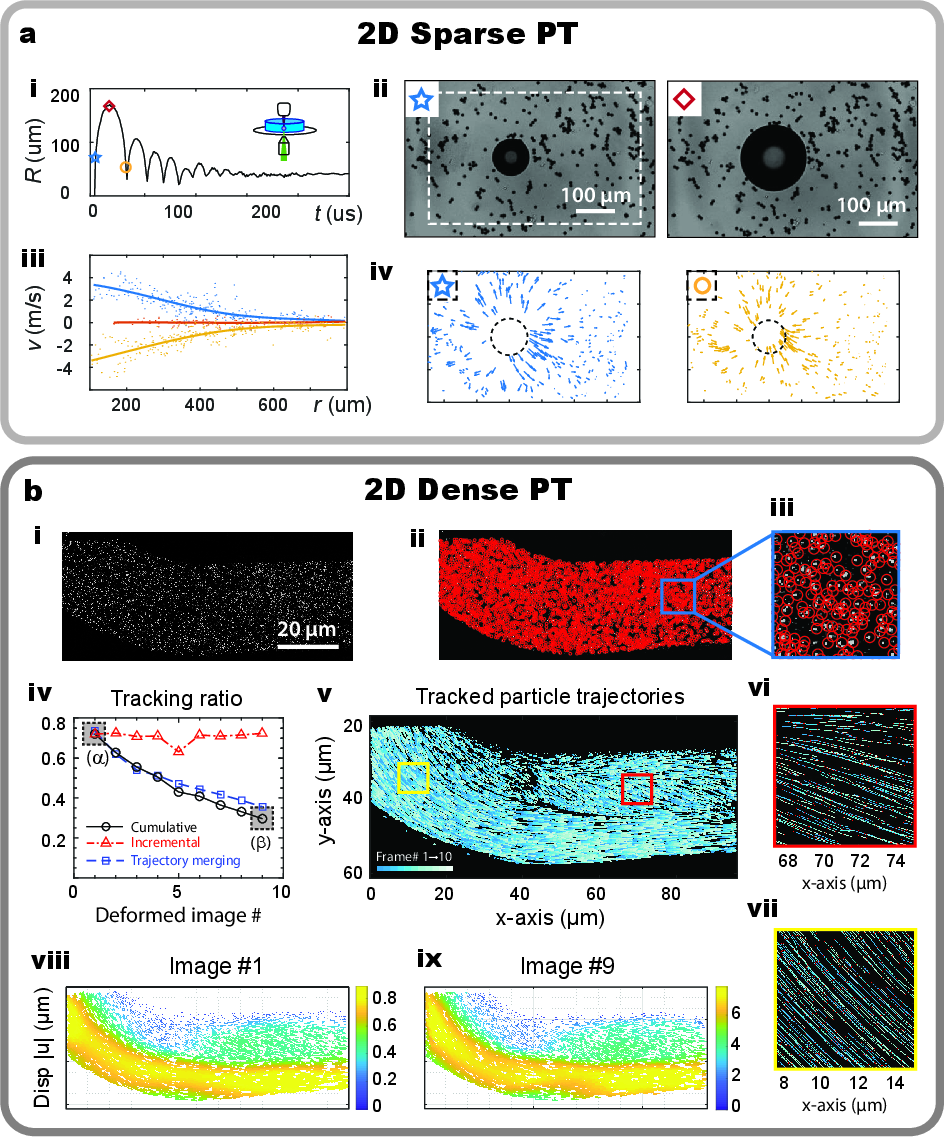
Figure 4: Application to 2D sparse (inertial cavitation in hydrogels) and dense (pipe flow) particle tracking experiments.
- 2D Hard Particle Cases: SerialTrack reconstructs dynamic velocity fields post-cavitation in hydrogels, and cumulative particle trajectories in dense pipe flow, maintaining high accuracy and detection ratios across both sparse and dense seeding.
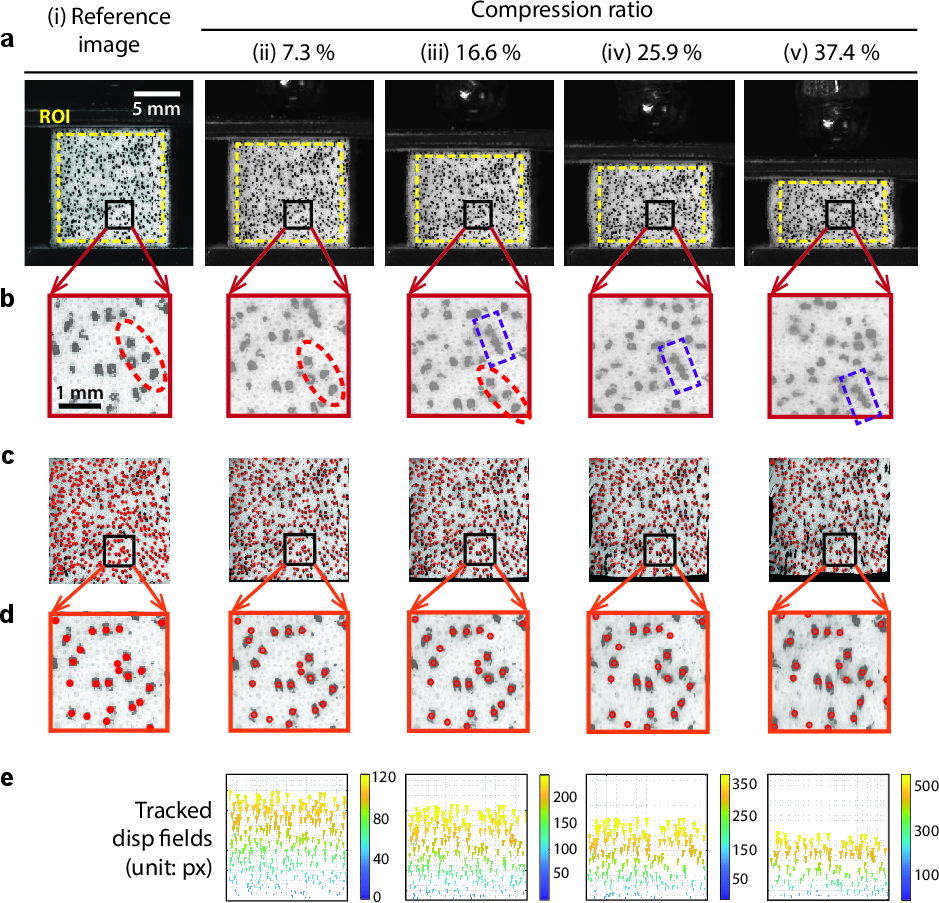
Figure 5: Performance in large deformation soft matter compression, illustrating both image warping and final displacement fields for "soft" particle tracking.
- 2D Soft Particle Example: In open-cell polyurethane foam under large compression, the method tracks deforming surface markers through warping and iterative detection, producing reliable displacement fields despite severe local shape changes.
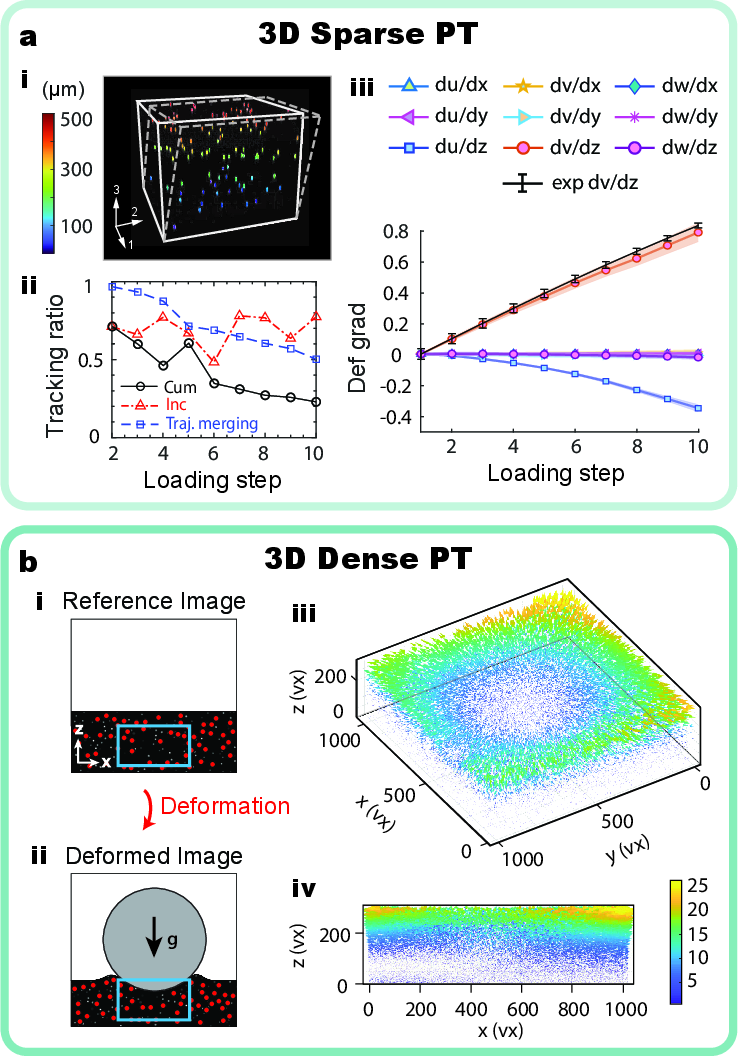
Figure 6: Tracking of 3D deformations in hydrogel shear and spherical indentation experiments, highlighting displacement field reconstructions and compatibility with high-density and high-deformation regimes.
- 3D Applications: SerialTrack accurately recovers 3D motion fields in both sparse (hydrogel shear with embedded particles) and dense (laser microscopy of spherical indentation) datasets, and reconstructs deformation gradients consistent with mechanical test ground truth.
Implications and Future Directions
By unifying scale- and rotation-invariant topology descriptors with global consistency constraints via ADMM, SerialTrack advances the robustness and generalizability of particle tracking methodologies. It enables routine high-fidelity recovery of displacement fields from challenging imaging scenarios in experimental mechanics, soft matter, and biomechanics, with unique support for both sparse and dense labeling, rigid and non-rigid features, and arbitrary frame sequences.
The open-source implementation facilitates rapid adoption and adaptation across scientific communities. Potential future enhancements include further integration with data-driven initial estimators (e.g., learning-based predictors for seeding in cumulative mode), extension to multi-modal imaging settings, and real-time GPU-accelerated versions for live experimental feedback.
Conclusion
SerialTrack (2203.12573) provides a mature and extensible platform for scale- and rotation-invariant, globally consistent particle tracking. Its thorough performance evaluation under diverse deformation regimes and marker types establishes it as a benchmark tool for quantitative imaging studies requiring reliable, high-resolution Lagrangian motion field reconstruction. The conceptual synergy of local topological invariance and global compatibility constraints represents a robust strategy with ongoing applicability to emerging experimental modalities.