- The paper demonstrates the formation and tuning of Dirac plasmon-phonon-magnon polaritons in TI-AFM bilayers via a comprehensive analytical and numerical scattering matrix approach.
- It employs Maxwell’s equations combined with Drude-Lorentz and tensorial magnetic models to capture anti-crossing behavior and quantify coupling regimes.
- The study provides practical guidelines for achieving strong THz coupling by optimizing TI film thickness, gating, and minimizing losses in Dirac plasmons and AFM magnons.
Surface Plasmon-Phonon-Magnon Polaritons in Topological Insulator–Antiferromagnetic Bilayer Structures
Introduction and Context
Hybridized surface polariton modes in strongly correlated quantum materials present a platform for realizing highly tunable and coupled electromagnetic excitations with applications in photonics, spintronics, and quantum information processing. In the study "Surface plasmon-phonon-magnon polariton in a topological insulator-antiferromagnetic bilayer structure" (2205.07367), To et al. address the formation, manipulation, and detection of hybrid plasmon-phonon-magnon modes at the interface of a topological insulator (TI) and an antiferromagnet (AFM). The key result is the identification of surface Dirac plasmon-phonon-magnon polaritons (DPPMPs), collective excitations arising from the coupling between Dirac surface plasmons, optical phonons, and AFM magnons, with clear tunability via material, geometric, and electronic parameters.
The authors adopt a semi-classical electromagnetic framework, solving Maxwell’s equations with boundary conditions tailored to multilayered heterostructures. They develop generalized analytic and numerical methods using both scattering and transfer matrix formalisms, yielding robust algorithms capable of handling arbitrary layer sequences and interface conductivities.
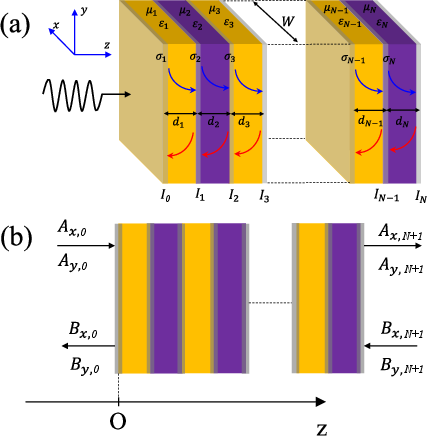
Figure 1: Schematic multilayer heterostructure and labeling of interface, layer parameters, and scattering directions.
Maxwell’s equations are solved for each region with appropriate dielectric and magnetic response tensors, including full tensorial permeability for AFMs and Drude-Lorentz models for TIs. The approach is comprehensive, allowing direct calculation of the surface polariton dispersions and enabling extraction of observable characteristics—transmission, reflection, and emergence of hybridized modes—by computing zeros of appropriate determinants in the matrix formalism.
Microscopic Constituents: TIs, AFMs, and Collective Excitations
Surface Dirac plasmons in TIs (e.g. Bi2Se3, Bi2Te3, Sb2Te3) are characterized by highly localized, low-loss charge oscillations with THz-scale frequencies, tunable by surface Fermi energy via gating. AFM materials (e.g. NiO, MnF2, FeF2) support narrow-linewidth magnon resonances, also in the THz range but with distinctive magnetic dipole origins. The Drude-Lorentz dielectric formalism captures multi-phonon landscape and associated optical loss mechanisms for the TIs, providing realistic, frequency-dependent permittivity input (Figure 2).
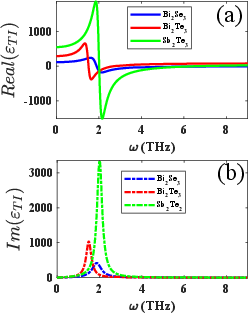
Figure 2: Frequency-dependent dielectric functions for Bi2Se3, Bi2Te3, and Sb2Te3, showing contributions from multiple phonon resonances.
Surface DPPMP Dispersion: Analytical Structure and Numerical Solution
By applying their formalism to a BI2Se3/FeF2 structure, the authors extract the DPPMP dispersion for various film thicknesses and electronic conditions. The DPPMP branches display pronounced anti-crossings at intersections of the uncoupled Dirac plasmon-phonon and magnon modes, manifesting directly in the ω(kx) dispersion. The magnitude of the splitting at the anti-crossing, Δ, serves as a quantitative measure of plasmon-magnon coupling.
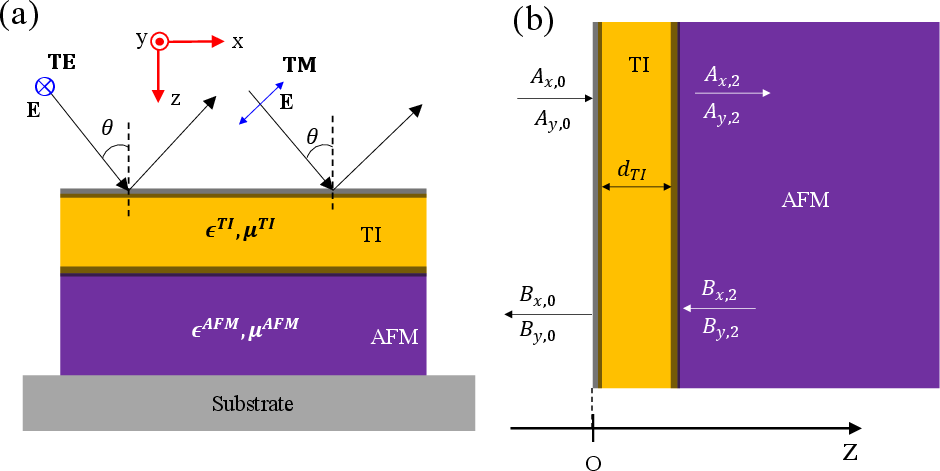
Figure 3: Surface DPPMP dispersion in Bi2Se3/FeF2 for dTI=10 nm (a) and dTI=200 nm (b), with anti-crossing signifying strong hybridization.
Strong dispersion dependence on geometric parameters is observed. For example, with increasing TI thickness, the lower polariton branch redshifts, eventually pushing the anti-crossing below the magnon resonance. This sets an upper critical thickness for observing hybridization, in the Bi2Se3/FeF2 case, approximately dTI≲120nm.
Furthermore, the Fermi energy of the TI surface states strongly tunes the DPPMP resonance; blueshifting the Dirac plasmon via doping or gating can enhance coupling strength and optimize overlap with the magnon band (Figure 4).
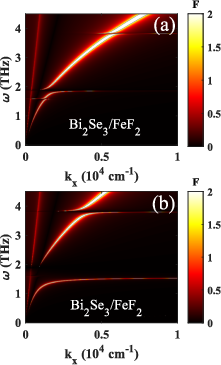
Figure 4: DPPMP dispersion in Bi2Se3/FeF2 as a function of Fermi energy at fixed wavevector, illustrating energy tuning of the hybridization.
The interaction is highly sensitive to the AFM’s dipole matrix element (parameterized by the anisotropy K and magnon linewidth), with FeF2 showing the clearest and strongest anti-crossing, consistent with its higher magnetic dipole moment compared to NiO or MnF2 (Figure 5).
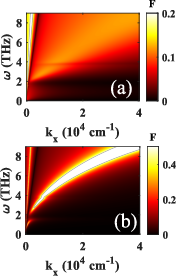
Figure 5: Surface DPPMP anti-crossing magnitude Δ in Bi2Se3/NiO, Bi2Se3/MnF2, and Bi2Se3/FeF2 indicating tunability by AFM species.
Role of Dissipation and Material Quality
The model explicitly incorporates loss via phonon and magnon linewidths. It is found that the strength and observability of strong coupling is fundamentally limited by the loss rates. For experimentally accessible coupling (Δ clearly resolved), linewidths of TIs and AFMs must be commensurate with or less than the anti-crossing energy scale. As shown in Figure 6, increasing the Dirac plasmon linewidth suppresses and eventually eliminates the observable anti-crossing, with a critical plasmonic linewidth Γ<1 THz for Bi2Se3 to maintain strong coupling.
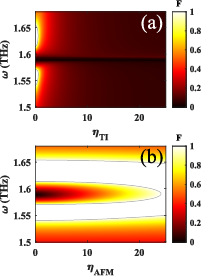
Figure 6: DPPMP dispersion in Bi2Se3/FeF2 showing the effect of increasing Dirac plasmon linewidth: strong coupling (b) is only recoverable when the linewidth is sub-THz.
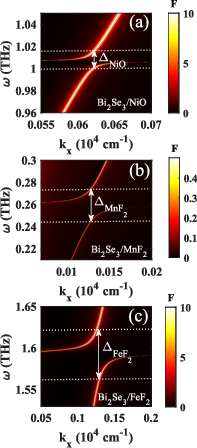
Figure 7: The effect of increasing TI and AFM loss rates on polariton mode splitting; DPPMP splitting persists for low loss, but vanishes when magnon linewidth exceeds coupling energy.
Implications and Future Developments
Theoretical
This work rigorously establishes the parameter space where strong plasmon-magnon (and plasmon-phonon-magnon) coupling is achievable in TI/AFM heterostructures. The analytic and computational approach provides a template for evaluating similar hybrid systems, including extensions to quantum emitter–plasmon and phonon–magnon–photon systems in more complex geometries or material stacks. The identification of tunable anti-crossings and precise coupling dependence on interface quality, film thickness, carrier concentration, and material loss highlights the necessity of multimodal materials optimization in experimental design and device fabrication.
Practical
The results prescribe clear guidelines for experimental realization of hybrid polariton modes in the THz regime:
- Achieving sub-THz linewidths in both TI Dirac plasmon and AFM magnon modes is mandatory.
- Thickness of the TI film must remain below a critical value to enable resonance overlap.
- Gating or doping can be harnessed to adjust the hybridization point dynamically within a given device.
These DPPMPs represent a candidate mode for THz photonics, magneto-optical switching, and quantum hybrid systems where both spin and charge manipulation are crucial.
Conclusion
This study provides a comprehensive theoretical analysis of hybrid surface plasmon-phonon-magnon polaritons in TI/AFM bilayers, leveraging advanced transfer and scattering matrix methods. The work delineates the boundaries of strong coupling in realistic structures, elucidates tunable parameters, and emphasizes the paramount importance of material quality and electronic control. The presented methodology and their findings supply a robust framework for interpreting and designing next-generation hybrid polaritonic systems, with significant implications for THz photonics and spin-charge coupled quantum technologies.