- The paper identifies trap-induced ac Zeeman shifts as the dominant systematic error in Th-229 nuclear clocks.
- It analyzes hyperfine transitions under rf magnetic fields, uncovering significant shift magnitudes that can exceed expected uncertainties.
- Mitigation strategies, including tuning trap drive frequencies and leveraging zero-crossing techniques, are proposed to restore clock integrity.
Trap-induced ac Zeeman Shift of the Thorium-229 Nuclear Clock Frequency
Introduction
The discussed paper investigates critical systematic frequency shifts in a proposed thorium-229 nuclear clock, attributing them predominantly to the trap-induced ac Zeeman shift. The work emphasizes the parasitic effects resulting from rf magnetic fields inherent to ion trapping and proposes methods to mitigate these shifts, which could otherwise overshadow the clock's projected systematic uncertainties.
Hyperfine Structure of Thorium-229
The thorium-229 ion (229Th3+) clock operates based on transitions between hyperfine manifolds. The system is illustrated with distinct F and mF values for associated states, defining clock frequencies through specific transitions:
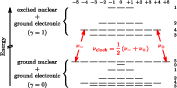
Figure 1: Hyperfine manifolds of the 229Th3+ system, with states labeled by F (right) and mF (top).
These manifolds are sensitive to external rf magnetic fields that induce significant ac Zeeman shifts, thereby impacting the clock's accuracy and positioning it as a principal factor in systematic shifts.
Mechanism and Impact of ac Zeeman Shifts
To confine ions, rf electric fields are used, which concurrently produce rf magnetic fields. These fields induce second-order ac Zeeman shifts that affect energy levels and transition frequencies significantly:
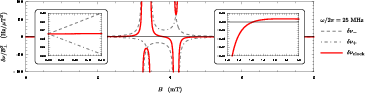
Figure 2: Trap-induced ac Zeeman shift to the clock transition frequencies and the clock frequency.
The study outlines that under typical trapping conditions, these shifts could dominate and surpass systematic uncertainties expected from other sources by orders of magnitude.
Reduction and Management of Zeeman Shifts
The authors suggest that the shift sensitivity can be modulated by leveraging certain operational regimes such as modifying trap drive frequencies and magnetic field strengths. Placing specific emphasis on trap-induced frequencies, zero-crossings in δνclock can be exploited to minimize shifts:
- At Resonance: By optimizing the drive frequency to around 25 MHz and tuning magnetic fields, resonant behaviors were observed which enabled potential for zero crossings and minimized sensitivity.
The zero-crossings effectively reduce sensitivity to external perturbations, making practical operation feasible. Additionally, advanced spectroscopic techniques from other groups are cited as potential solutions for evaluating and managing this shift.
Conclusion
The thorium-229 nuclear clock holds promise for achieving unprecedented accuracy. However, managing the formidable trap-induced ac Zeeman shift remains crucial. Employing zero-crossing techniques and leveraging strategic spectroscopic evaluations presents viable pathways to minimizing this effect, hence restoring clock integrity for sensitive fundamental physics tests. These advancements highlight the potential of nuclear clocks as robust standards in timekeeping and precision measurements.