- The paper demonstrates that anti-resonant fibers can deliver 5 GW, 40 fs pulses with up to 85% transmission and peak intensities reaching 3 PW/cm², overcoming bend loss and modal mixing issues.
- The paper details a methodology involving careful dispersion pre-compensation and rigorous vacuum management to suppress plasma-induced pulse distortion.
- The paper shows that scalable fiber design, via increased core size, enables mJ-level energy delivery while maintaining mode quality and adherence to silica damage thresholds.
On-Target Delivery of Intense Ultrafast Laser Pulses through Hollow-Core Anti-Resonant Fibers
Introduction and Motivation
The integration of high-energy, ultrafast laser pulses with advanced beam delivery platforms represents a critical bottleneck in extreme photonics, particularly for strong-field and nonlinear optics experiments requiring precise spatial and temporal pulse properties. Gas-filled, hollow-core anti-resonant fibers (NC-ARF) have emerged as leading candidates for such applications, owing to their low-loss, broadband guidance and negligible nonlinear and thermal contributions from the host material. Traditional hollow fibers and capillaries suffer from excessive bend loss and modal mixing, limiting their flexibility and practical utility. The work under review addresses these challenges and demonstrates reliable delivery of 5 GW, 40 fs, 800 nm pulses through a 10 m-long, tightly coiled (6 cm radius) anti-resonant fiber with a 28.3 µm core, reaching on-target peak intensities of up to 3 PW/cm² and supporting further energy scaling by increasing the core size.
Experimental Design and Pulse Delivery Strategy
The essential experimental apparatus (see Figure 1) consists of a Ti:sapphire femtosecond laser, spectral phase and power control optics, a spatial filtering capillary, and a precisely mode-matched input configuration for the anti-resonant fiber. The fiber's nested structure affords ultra-low attenuation (<1.5 dB/km at 800 nm), robust bend tolerance, and effective guidance of the fundamental mode even under strong coiling. The fiber ends are mounted in independently evacuable cells equipped with MgF2 windows for optical access and robust vacuum sealing. The entire system is purged and evacuated to 1.5×10⁻² mbar, with extended pumping and He flushing to ensure homogeneous gas removal along the 10 m length—a process limited by the slow diffusion rates through narrow cores (see Figure 2g).
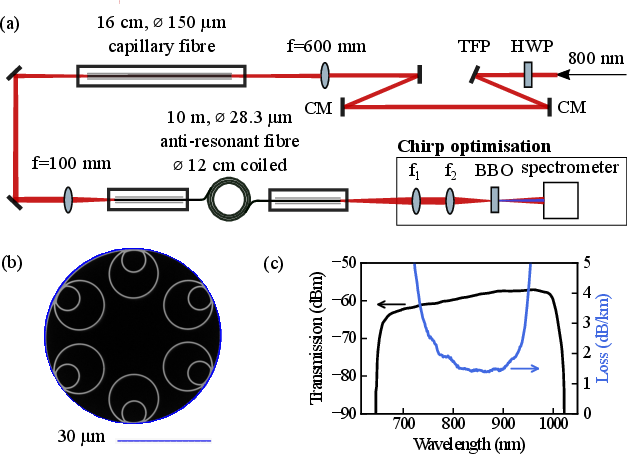
Figure 1: (a) Overview of the pulse delivery experiment. (b) SEM image of fiber cross-section. (c) Measured transmission and calculated attenuation.
Critical to achieving compressed, high-quality output pulses is the careful pre-compensation of the fiber's anomalous dispersion. The initial pulses are positive-chirped to offset the fiber's -663 fs²/m group-velocity dispersion. Output pulses are characterized using spectrometry and SHG-FROG, with fine optimization of the grating compressor and chirp mirrors for best compression at the fiber output.
Plasma Effects and Vacuum Management
Propagation of high-intensity ultrashort pulses in even low-pressure gases can rapidly induce full ionization, significantly altering both temporal and spectral profiles through plasma dispersion and absorption. Detailed simulations (Figure 2) show that with plasma effects active, the output experiences reduced peak power, temporal stretching, and strong blue-shift and narrowing of the spectrum—a scenario rigorously supported by the intense plasma signature seen in the output spectrum prior to “pre-pumping” the fiber with intense pulses. Achieving the necessary sub-10−3 mbar pressure throughout the fiber is essential for ionization-free delivery.
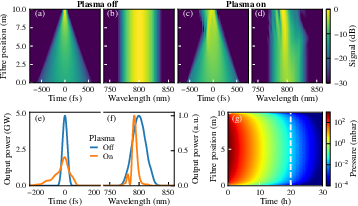
Figure 2: Simulated propagation showing severe pulse distortion in presence of plasma, and long time (hours) scale for complete fiber evacuation.
Transmission Efficiency, Damage Threshold, and Energy Scaling
Measurements of throughput and pulse autocorrelation/tracing (Figure 3) show up to 85% transmission for input energies up to 210 µJ and compressed 37 fs pulses, reaching peak intensities at the input facet close to 3 PW/cm² and core-wall fluence near the established 40 fs silica damage threshold (∼3 J/cm²). Catastrophic damage to the fiber, initiated at the input core-wall interface, is consistently reproduced at and above this fluence, as corroborated by direct microscope inspection (Figure 4). Extending input pulse durations to 470 fs (by positive chirp), as expected, slightly elevates the damage threshold (fluences) as the silica limit scales with pulse duration.
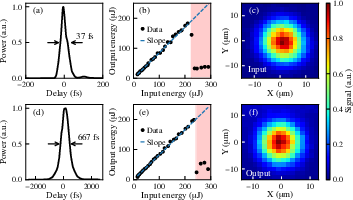
Figure 3: Energy transmission and pulse duration for input pulses (compressed vs. stretched), beam profiles, and energy transfer characteristics.
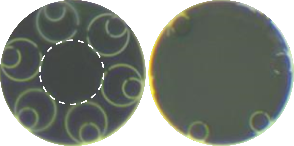
Figure 4: Microscopy images—pristine fiber input (left) and after damage (right), with the core-wall boundary highlighted.
Scaling up to millijoule-level delivery is pursued by increasing the core diameter. In larger-core (79 µm) fibers (Figures 7, 8), the authors demonstrate coupling of 1.8 mJ, corresponding to 20 GW peak output, before loss of guidance and damage occurs at fluences consistent with the smaller core fibers. This empirical scaling closely matches theoretical trends for Gaussian input beams and core sizes. The limits are dominated by the fluence at the silica walls, confirming that further scaling is feasible via fiber engineering rather than fundamental nonlinear optical constraints.
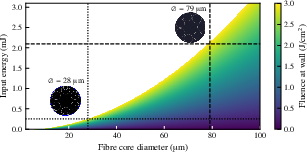
Figure 5: Map of fluence vs. energy and core diameter, annotating calculated damage thresholds and practical guidance regions.
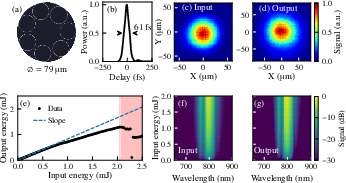
Figure 6: Large-core fiber performance: cross-section, beam profiles, transmission scaling, voltage spectra, and output characteristics.
Long-lived Gas Suppression through Pre-pumping
A crucial, novel effect emerges upon prolonged “pre-pumping” of the evacuated fiber with high-intensity pulses. Initial propagation after standard evacuation produces high spectral broadening in the output, but continuous irradiation leads to spontaneous “relaxation” of the spectrum back toward the bandwidth-limited input, a process that completes over minutes and persists for days so long as the vacuum is maintained. This relaxation is attributed—based on indirect evidence and supporting diffusion kinetics considerations—to the migration or surface adsorption of residual gas ions/molecules onto core walls (possibly via plasma/surface recombination), resulting in a persistent, quasi-permanent removal of ionizable species from the fiber core.
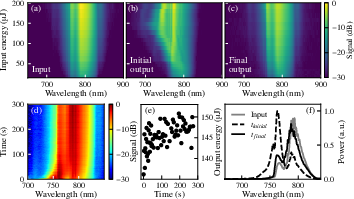
Figure 7: Output spectral dynamics show suppression of spectral broadening and plasma signatures with sustained pumping. The “relaxed” spectrum is robust until vacuum is broken.
Notably, this pre-pumping effect is energetically thresholded—requiring >20 µJ pulses—and is reversible only by intentional re-filling and evacuation. After relaxation, the output pulses are compressed, intense, and free of plasma distortion, as verified in SHG-FROG measurements (Figure 8).
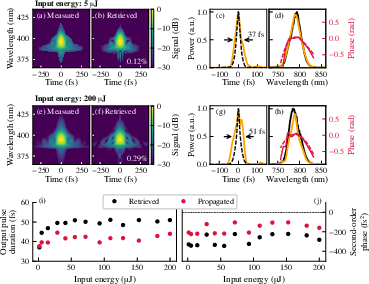
Figure 8: Complete SHG-FROG characterization of output pulses before and after pre-pumping, showing retrieved temporal and spectral phase profiles.
| Parameter |
Small Core (28.3 µm) |
Large Core (79 µm) |
| Max Input Energy |
210 µJ |
1.8–2.1 mJ |
| Max Output Peak Power |
5 GW |
20 GW |
| Pulse Duration (on-target) |
40 fs (after comp.) |
— |
| Throughput (pre-damage) |
85% |
up to 83% (falling at high E) |
| Max Peak Intensity |
3 PW/cm² |
2.5 PW/cm² |
| Max Wall Fluence |
3 J/cm² |
3.5 J/cm² |
| Guidance Length |
10 m (coiled) |
Short pieces only |
The overall transmission efficiency, beam quality, and resistance to tight coiling are superior to conventional hollow-capillary designs, positioning ARFs as promising flexible delivery platforms for extreme field, high-intensity, and nonlinear optical applications at meter-scale distances. The demonstrated pre-pumping technique is critical in realizing plasma-free propagation for on-target high intensity, which is a prerequisite for nonlinear optics leveraging bandwidth-limited femtosecond pulses, high harmonics, self-compression, or strong-field physics.
Theoretical and Practical Implications
From a nonlinear optics and high-field delivery perspective, the major implications are:
- Scalability: Peak power and energy scaling is limited principally by silica damage at the core-wall interface, not by nonlinearities or plasma effects in the guided field, as long as wall fluence is kept below threshold—feasible by increasing the core diameter.
- Mode Quality: Anti-resonant guidance suppresses higher-order mode excitation and supports robust single-mode delivery, even under strong bending.
- Gas Suppression via Pre-pumping: The phenomenon of plasma-driven gas removal from the core is potentially generalizable and may offer a route to ultraclean, plasma-free delivery environments in other hollow-core architectures and wavelength domains.
- Application Enabling: mJ-level, high-quality, ultrafast pulse delivery over tens of meters, compatible with tight coiling, directly addresses needs for compact high-intensity pump/probe experiments, nonlinear conversion stages, laser micromachining, and remote strong-field or attosecond light–matter interaction setups.
- Model and Simulation Guidance: The correspondence between empirical scaling and Gaussian-theory-based estimation for wall fluence and damage indicates that standard field/beam engineering tools remain valid up to the highest intensities demonstrated, providing guidance for system designers.
Future Prospects
Future technical developments can exploit larger core diameters (recent records in ARFs with core sizes >100 µm), improved fiber materials, and better evacuation protocols to push the accessible pulse energies into the multi-mJ, multi-100-GW regime. Combined with sophisticated on-target dispersion management, this will enable even more demanding applications including single-cycle delivery, high-order harmonic generation, laser-plasma acceleration, and precise remote light–matter interaction. Comprehensive in situ studies of plasma/gas-surface interactions in hollow fibers are warranted to clarify the underlying mechanisms of pre-pumping-induced vacuum purification and their stability or reversibility, which could have broader ramifications for persistent ultralow-pressure operation in gas-based photonic devices.
Conclusion
This study demonstrates pulse delivery performance in anti-resonant hollow-core fibers at a level required for strong-field and ultrafast scientific applications, with documented path to further energy scaling. The systematic identification of damage mechanisms, elucidation of plasma suppression strategies, and robust empirical-theoretical agreement provide a rigorous foundation for future high-intensity beam delivery infrastructure using anti-resonant fiber architectures. The results should be directly translatable to mJ-level nonlinear optics, advanced laser source development, and potentially to industrial high-power beam delivery, provided that the core-size scaling and vacuum handling requirements are appropriately addressed.