- The paper introduces a data-driven coarse-graining method that integrates stochastic sampling and memory terms to replicate dynamic behavior in condensed matter systems.
- It employs splitting methods with the ABOBA integrator to accurately capture equilibrium distributions and state transition dynamics in various potential models.
- The approach enhances computational efficiency by bypassing full solvent dynamics while maintaining high fidelity in reproducing mechanical and statistical system attributes.
Data-driven Dynamical Coarse-Graining for Condensed Matter Systems
Introduction
The paper presents a novel approach for coarse-graining simulations of condensed matter systems. Traditional methods often struggle to incorporate dynamics accurately while achieving computational efficiency, especially methods relying on simplifying systems by focusing on a few distinguished components and omitting the full dynamic integration of all system components. The approach integrates a stochastic data-driven methodology inspired by the Mori-Zwanzig formalism, effectively blending macroscopic variable descriptions with noise and memory terms derived from detailed simulations.
Coarse-Graining Methodology
Data-Driven Model
The proposed coarse-graining method involves constructing numerical integrators for distinguished components, whereby the interaction terms between these components and other system aspects are substituted by random samples derived from a data-driven model. This model leverages the stochastic data-driven approach to model unresolved processes, integrating aspects of fluctuating noise and historical memory found in the Mori-Zwanzig framework.
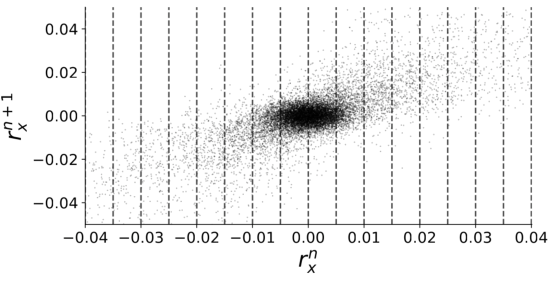
Figure 1: One-dimensional binning example demonstrating conditional distribution sampling for dynamics.
Numerical Integrator
A key aspect focuses on aligning with the Langevin dynamics framework, using splitting methods for integrator accuracy and efficiency. Specifically, the paper utilizes the \textsf{ABOBA} integrator scheme due to its ability to handle velocity integration in one full-timestep operation, thereby facilitating streamlined implementation of coarse-grained models complete with data-driven sampling.
Application Examples
Harmonic Potential System
The first application involves a distinguished particle subjected to an external harmonic potential. Using simulations validated with benchmark models, the coarse-grained approach reproduces equilibrium distributions and dynamic properties effectively.
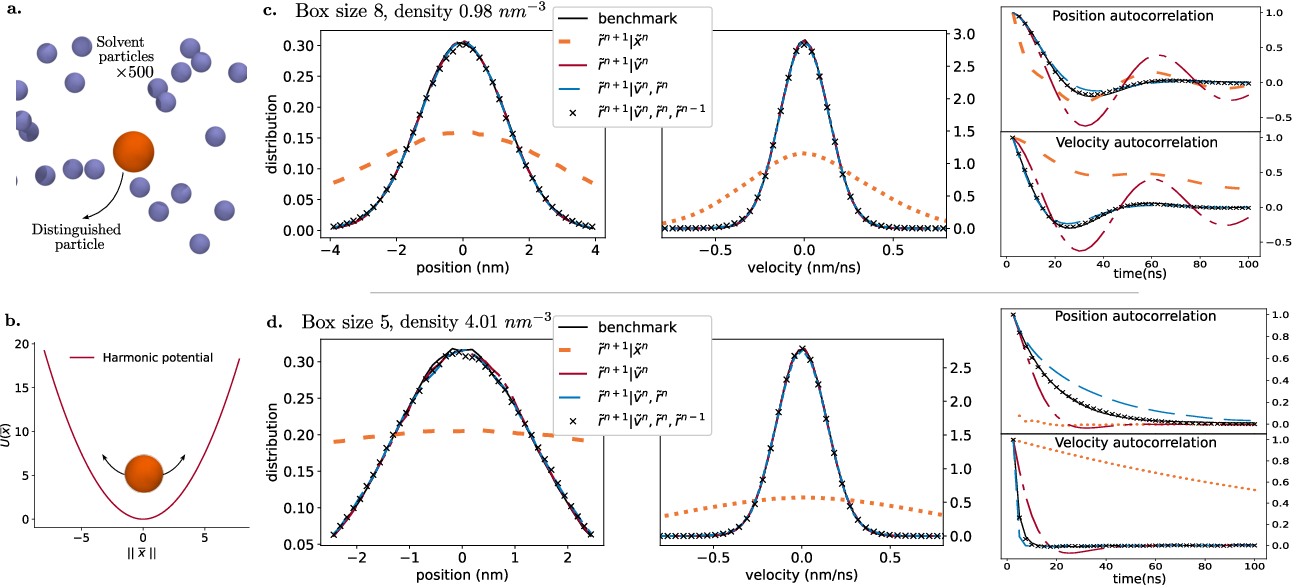
Figure 2: Harmonic potential example demonstrating distribution and autocorrelation comparisons.
Bistable Potential System
In the bistable potential scenario, the coarse-grained model successfully predicts transition rates between states, maintaining both position distributions and relevant temporal correlations.
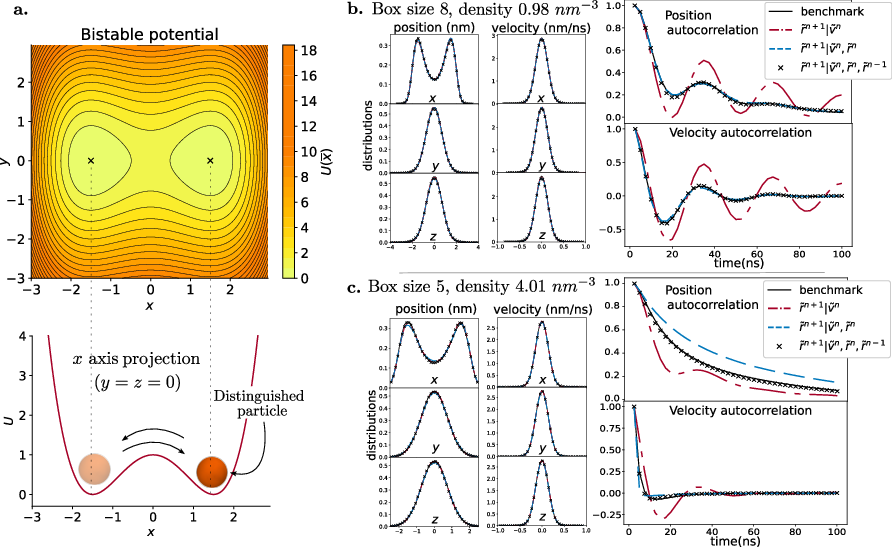
Figure 3: Bistable potential example showcasing distributions and temporal correlation matches.
Dimer in a Solvent System
Finally, for the dimer system undergoing metastable state transitions, complex conditioning variables are leveraged to achieve precise reproduction of statistical distributions and mean first passage times.
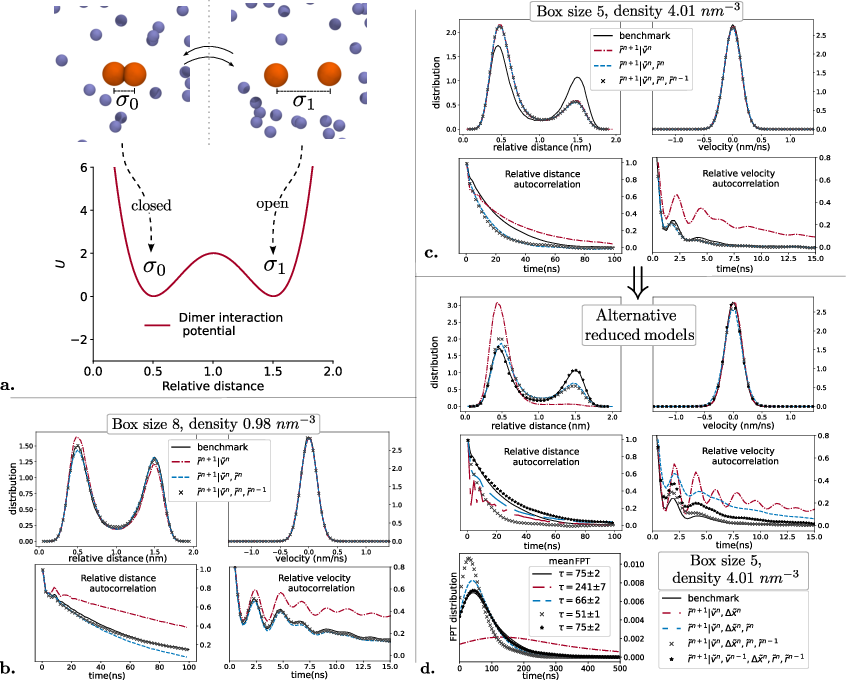
Figure 4: Dimer model comparison demonstrating accurate distribution and autocorrelation performance.
Discussion
The primary advantage of the data-driven methodology is computational efficiency, where avoidance of direct solvent dynamics integration results in significant time gains. The reduction in dimensional complexity increases speed while maintaining high fidelity in reproducing essential mechanical and statistical attributes.
This methodology opens various avenues for future research, particularly in handling high-dimensional cases through deep learning frameworks, potentially further elevating coarse-grained modeling in complex systems. The approach paves the way for applications in molecular dynamics, climate modeling, and other fields requiring sophisticated complex system handling.
Conclusion
The paper successfully demonstrates a data-driven approach to coarse-graining that retains dynamic fidelity while providing computational gains. Future work should explore more complex systems and enhance the adaptability of the data-driven models to broader interaction frameworks. Integrating deep learning for sampling and conditioning variable optimization holds promise for advancing coarse-grained dynamics further.