- The paper introduces both linear and non-linear projection methods to derive generalized Langevin equations for dynamic coarse-graining.
- It demonstrates through simulations that non-linear interactions significantly affect memory kernels and noise distributions.
- Findings suggest that incorporating non-linear approaches improves model fidelity in representing complex environments.
Introduction
The paper explores dynamic coarse-graining in chemical and biological systems through the lens of the Mori-Zwanzig formalism, with a focus on the impact of non-linear interactions. It presents a simplified model featuring a tracer particle in complex environments, aiming to derive generalized Langevin equations (GLEs) encompassing both linear and non-linear coarse-graining procedures. Traditional projection operator methods are complemented by computer simulations to evaluate the influence of non-linearities on dynamic coarse-grained models.
The Stochastic Non-Linear Caldeira-Leggett Model
The SNCL model describes the interaction between a tracer particle and its environment. Equations of motion incorporate both harmonic and anharmonic potentials, with simulations examining the effects of varying non-linear strength. Importantly, the model applies both linear and non-linear projection operators to derive CG equations of motion, enhancing understanding of non-linearities in the system.
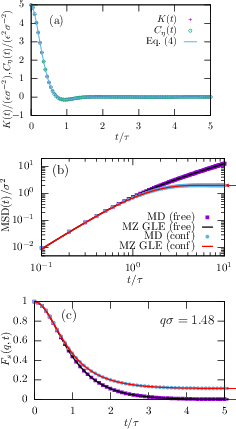
Figure 1: Dynamical correlation functions for a free ($a_{\text{e}=0$) and a harmonically trapped particle ($a_{\text{e}=1 \epsilon \sigma^{-2}$).
Generalized Langevin Equation and Memory Kernels
Two types of GLEs are discussed: the Mori-Zwanzig GLE, derived from linear projections, and the NL GLE, from non-linear projections. The NL GLE analytically incorporates memory kernels, revealing how non-linear forces influence reconstruction in coarse-grained models. Equations are solved to show both instantaneous fluctuations and long-term behaviors.
Influence of Non-Linear External Potentials
The paper demonstrates that linear projection methods do not accurately reproduce complex descriptors like the non-Gaussian parameter under non-linear external potentials. By separating the noise and memory kernel contributions, the authors analyze discrepancies between exact and projected models, showcasing significant deviations in position distributions and dynamic correlation functions.
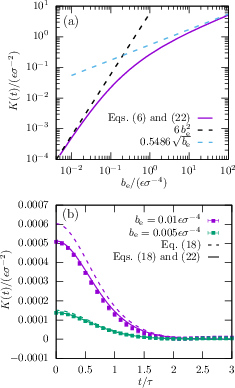
Figure 2: Non-linear contribution to the memory kernel for varying strengths of non-linearities of the external potential.
Effects of Anharmonic Coupling
Anharmonic coupling introduces non-Gaussian noise distributions that challenge the assumptions of standard GLE models. Through numerical simulations, it is evident that increasing the number of coupled oscillators mitigates these discrepancies, pointing to potential applicability in systems where tracer interactions are numerous.
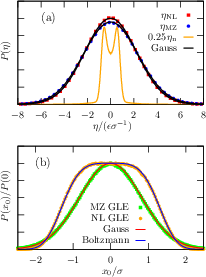
Figure 3: Probability distributions of thermal fluctuations eta and non-conservative forces $\tilde{F$.
Discussion on Practical Implications
The findings underline the importance of accurate representation of non-linear potentials in dynamic coarse-graining techniques. Incorporating non-linear projection methods can enhance the fidelity of GLE models, particularly in non-Gaussian systems. The paper suggests future research avenues, such as complex noise protocols integrating non-Gaussian processes, to address existing limitations in the modeling framework.
Conclusion
Through analytical and numerical approaches, the paper provides insights into dynamic coarse-graining using GLEs in non-linear systems. It emphasizes the need for methodological advancements to accurately capture complex interactions, paving the way for improved modeling techniques in soft matter physics. By incorporating non-linear projection techniques, the research highlights the potential for enhancing the predictive power of coarse-grained models in realistic scenarios.