Cascade-DETR: Delving into High-Quality Universal Object Detection
Abstract: Object localization in general environments is a fundamental part of vision systems. While dominating on the COCO benchmark, recent Transformer-based detection methods are not competitive in diverse domains. Moreover, these methods still struggle to very accurately estimate the object bounding boxes in complex environments. We introduce Cascade-DETR for high-quality universal object detection. We jointly tackle the generalization to diverse domains and localization accuracy by proposing the Cascade Attention layer, which explicitly integrates object-centric information into the detection decoder by limiting the attention to the previous box prediction. To further enhance accuracy, we also revisit the scoring of queries. Instead of relying on classification scores, we predict the expected IoU of the query, leading to substantially more well-calibrated confidences. Lastly, we introduce a universal object detection benchmark, UDB10, that contains 10 datasets from diverse domains. While also advancing the state-of-the-art on COCO, Cascade-DETR substantially improves DETR-based detectors on all datasets in UDB10, even by over 10 mAP in some cases. The improvements under stringent quality requirements are even more pronounced. Our code and models will be released at https://github.com/SysCV/cascade-detr.

Paper Prompts
Sign up for free to create and run prompts on this paper using GPT-5.
Top Community Prompts
Explain it Like I'm 14
What this paper is about (in a nutshell)
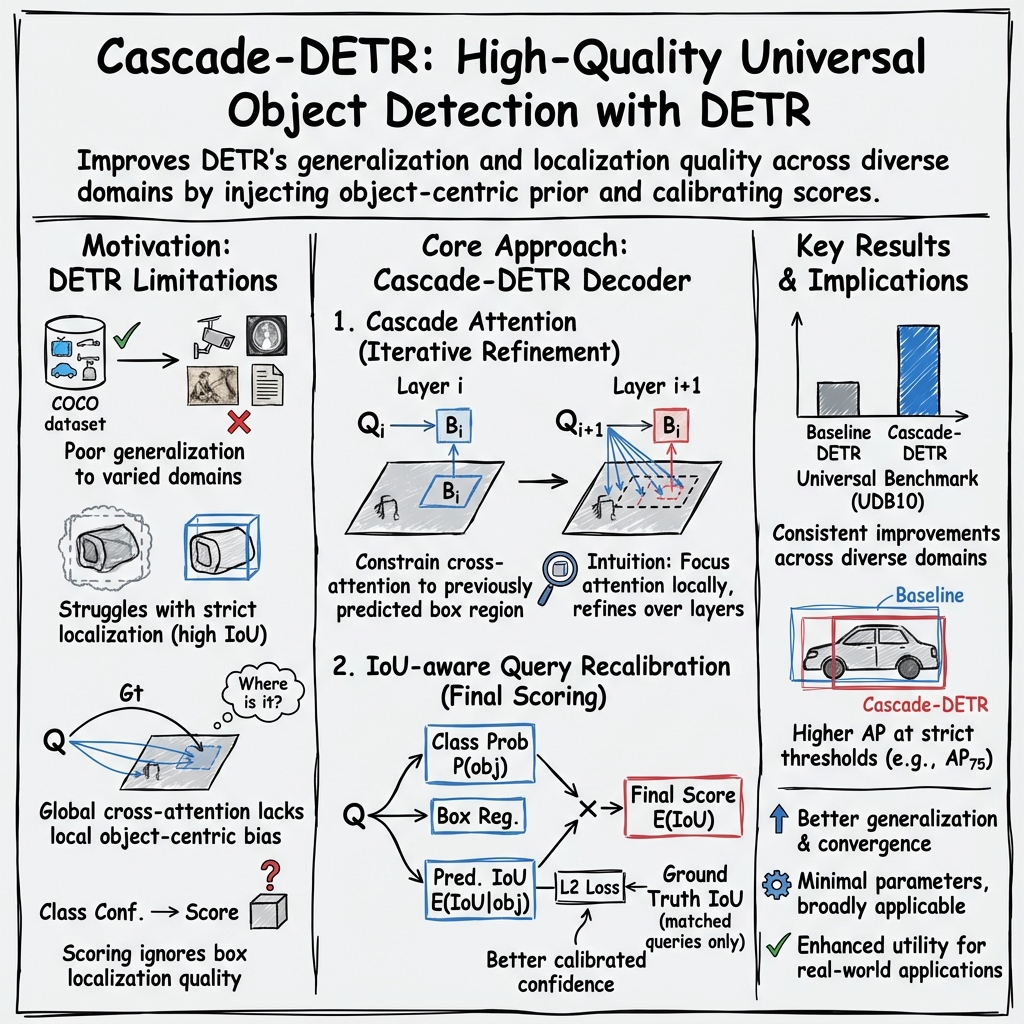
This paper is about teaching computers to find and draw boxes around objects in pictures—like people, cars, or tumors in medical scans—more accurately and in many different kinds of images. The authors introduce a new method called Cascade-DETR that makes these “object detectors” both more precise and more reliable across many real-world settings, not just the usual benchmark datasets.
What the researchers wanted to find out
They focused on two big questions:
- How can we make modern Transformer-based detectors (like DETR) work well beyond the popular COCO dataset—for example in traffic scenes, medical images, documents, or paintings?
- How can we improve how tightly and accurately the detector draws the boxes around objects (not just “finds” them, but finds them precisely)?
How they did it (explained simply)
First, two quick ideas you’ll see:
- Bounding box: a rectangle around an object in an image.
- IoU (Intersection over Union): a score from 0 to 1 that says how well two boxes overlap; 1 means a perfect match. Think of it as “how much two rectangles overlap divided by how much space they cover together.”
The method builds on DETR, a Transformer-based detector. You can imagine DETR as a team of “smart spotlights” (called queries) scanning an image to find objects. The paper adds two simple but powerful upgrades:
- Cascade Attention: narrowing the spotlight step by step
- Imagine trying to find a cat in a messy room. At first your search is broad, but once you spot something cat-like, you zoom in and look closely there.
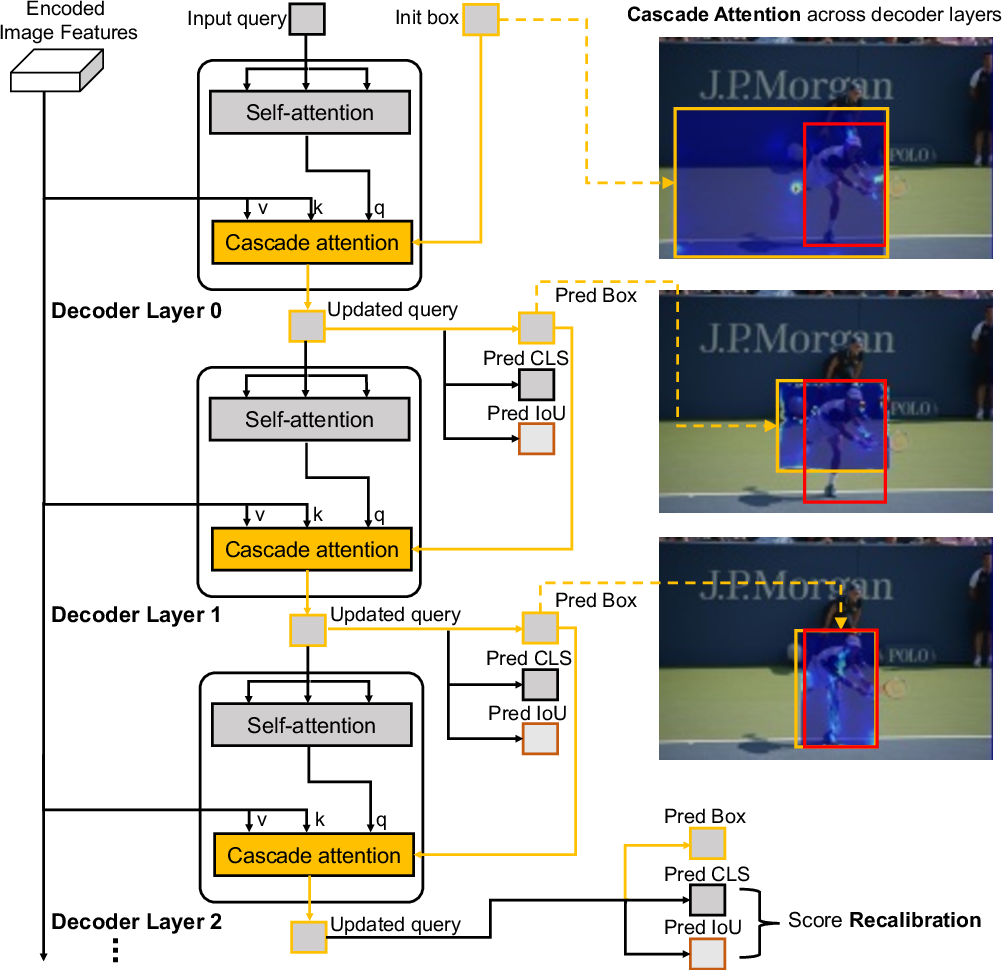
- Cascade attention does the same. Each “spotlight” first looks at the whole image, predicts a rough box for an object, and then in the next step limits its attention to just inside that predicted box. With each step, the attention region shrinks to where the object likely is, making the box more accurate.
- This adds a built-in “object-focused” habit to the detector, which helps especially when there isn’t tons of training data.
- IoU-aware Query Recalibration: scoring boxes by quality, not just confidence
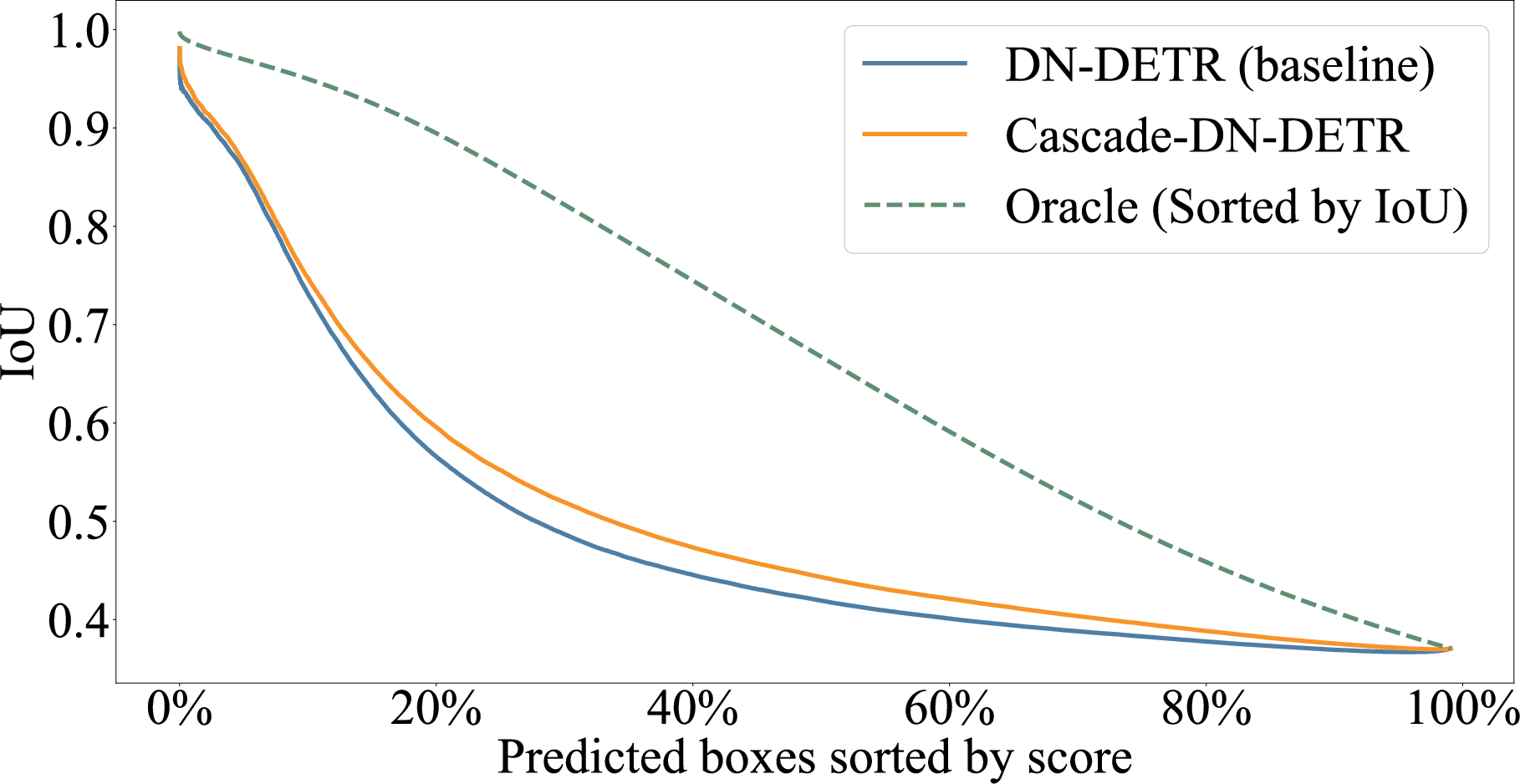
- Standard detectors rank their results by “how sure am I this is a cat?” But that doesn’t say how well the box fits the cat.
- The authors add a small branch that learns to predict how good the overlap (IoU) will be with the true object.
- Final score = “probability it’s an object” × “predicted IoU.”
- This means high-scoring results are not only likely to be the right object type, but also tightly and accurately boxed.
They also created a new benchmark called UDB10 with 10 very different datasets (traffic, medical, documents, art, open-world, etc.) and a simple average score called UniAP to measure “universal” performance.
What they found and why it matters
Main results (big picture, with a few numbers to show scale):
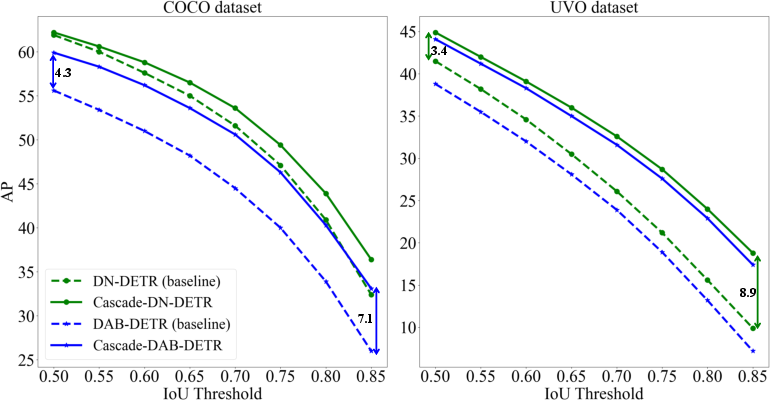
- More accurate boxes, especially under strict checks: On tough settings that care about tight boxes (AP at IoU 0.75), Cascade-DETR shows big gains.
- Better across many domains: On their UDB10 benchmark, Cascade-DETR improves by +5.7 UniAP over a strong baseline (DN-DETR), with gains sometimes over +10 AP in specific datasets like Cityscapes (traffic) and Paintings (art).
- Still better on COCO: Even on the standard COCO benchmark, it improves by about +2.1 AP (with ResNet-50) and +2.4 AP (with ResNet-101) over the baseline.
- More reliable scoring: Ranking results by “expected IoU” (quality-aware scoring) selects better boxes than ranking by classification confidence alone.
- Fast and simple: These improvements come with little extra computation or model size.
Why this matters:
- In real life, object detectors face different image styles—dashcam footage, scanned documents, medical images—which often look very different from the photos used to train them. This method makes detectors more “universal,” so they work well across many kinds of data.
- Tighter boxes can be crucial—think surgical planning (precise tumor boundaries) or self-driving cars (exactly where a pedestrian is).
What this could mean going forward
- More dependable detectors for real-world tasks: from self-driving to medical imaging to document processing, you get more accurate and better-calibrated results, even with smaller or specialized datasets.
- Practical, easy-to-adopt ideas: Cascade attention and IoU-aware scoring are simple changes that plug into existing DETR-style models with minimal overhead.
- A better way to evaluate “universal” detection: The new UDB10 benchmark encourages the community to look beyond a single dataset and build detectors that are truly versatile.
In short, Cascade-DETR is like giving the detector a smarter search strategy (zoom in where it matters) and a better report card (score results by how good the box really is), leading to more accurate and more widely useful object detection.
Collections
Sign up for free to add this paper to one or more collections.