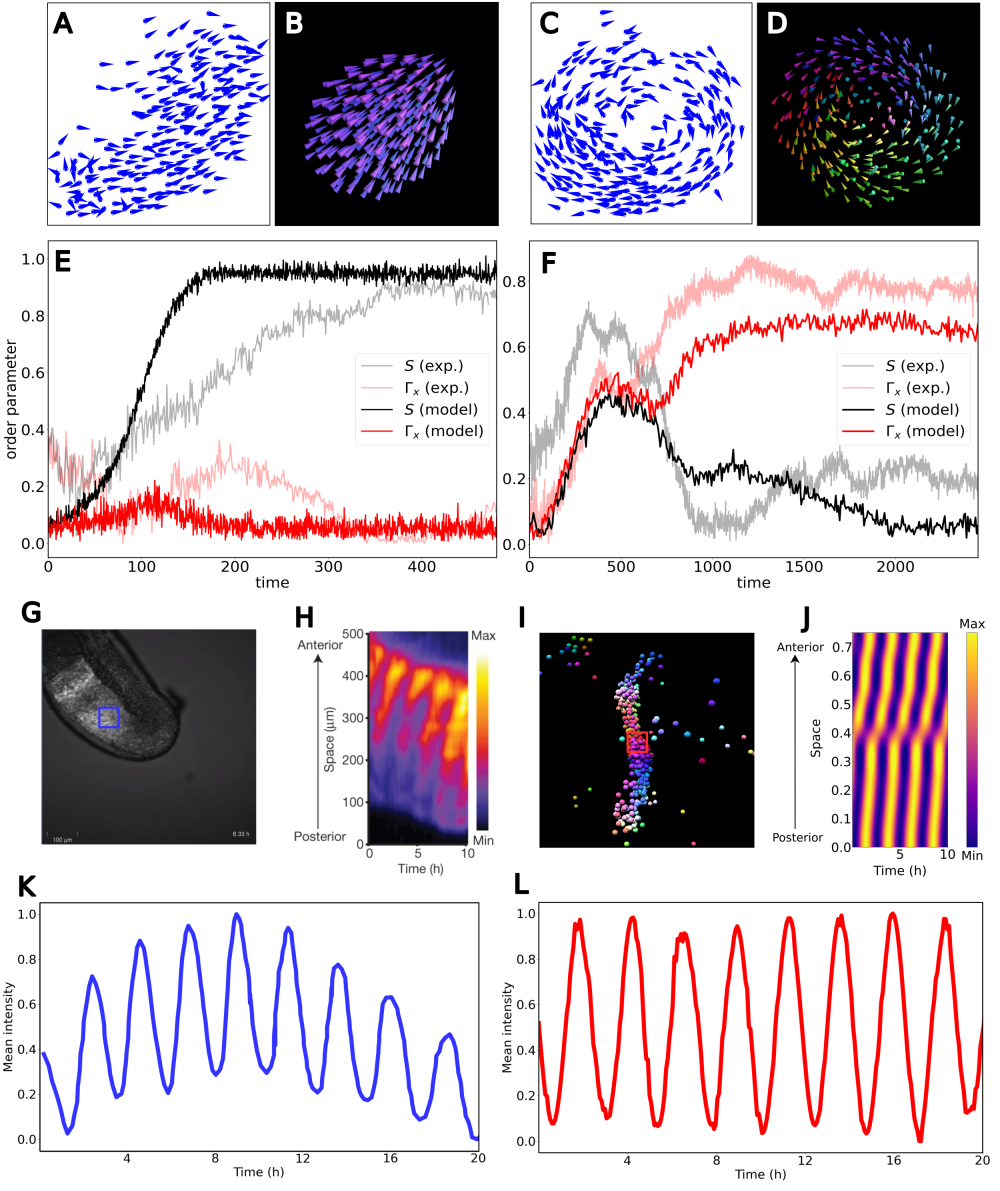
- The paper demonstrates that extending the swarmalator model to high dimensions introduces diverse dynamic states, including static synchronized, asynchronous, and dynamic chimera formations.
- It employs a D-dimensional unit hypersphere to model orientation vectors, effectively generalizing the classical Kuramoto model and distinguishing local attraction from global repulsion.
- The model's insights have practical implications for simulating real-world behaviors such as fish schooling, gene expression waves, and microrobot collective dynamics.
Exotic Swarming Dynamics of High-Dimensional Swarmalators
Introduction
Swarmalators, entities capable of both spatial aggregation and internal synchronization, offer a compelling framework for simulating complex self-organizing behaviors observed in natural and engineered systems. The paper "Exotic swarming dynamics of high-dimensional swarmalators" presents a comprehensive extension of the swarmalator model into higher dimensions, allowing for the exploration of intricate synchronization phenomena influenced by the interplay of spatial positions and orientation vectors. This model captures behaviors relevant to diverse fields such as active matter physics, developmental biology, and robotics.
Model and Methodology
The introduction of a D-dimensional extension to the swarmalator model significantly increases its applicability to real-world systems. Specifically, the orientation vectors of swarmalators are modeled on the D-dimensional unit hypersphere, where σi represents the orientation vector of the ith swarmalator. This formulation effectively generalizes the classical Kuramoto model into higher dimensions, incorporating angular velocities and distinct coupling strengths for attractive and repulsive interactions. The model equations are defined as:
- Spatial Dynamics:
x˙i=vi+N−11j=1∑N[{1+J(σi⋅σj)}∣xj−xi∣αxj−xi−∣xj−xi∣βxj−xi]+ξxi(t),
where J modulates the interaction based on orientation alignment, and α, β control interaction ranges.
- Orientation Dynamics:
σ˙i=Wiσi+j=1∑NKij[∣xj−xi∣γσj−(σj⋅σi)σi]+ξσi(t),
which accounts for interaction-dependent phase adjustments.
Results and Observations
The multi-dimensional model reveals a rich taxonomy of dynamic states across various parameter regimes. Key findings include:
- Competitive Interaction: Varying the balance between attractive and repulsive couplings, the model displays transitions from static synchronized (SS) to asynchronous (SA) states, spiky formations, and dynamic chimeras. Intriguingly, an active core emerges in certain conditions, characterized by a dynamically evolving coherence surrounded by incoherent behavior (Figure 1).
- Influence of Angular Frequencies: Introducing orthogonal angular frequencies results in oscillatory states such as spinning spiky (SSP) and synchronized spinning (SSS) states. These dynamic states illustrate the model's capacity to simulate rotational behaviors akin to those observed in biological and robotic swarms (Figure 2).
- Local and Global Interactions: The paper differentiates the effects of local attractive versus global repulsive interactions. Purely local attraction fosters states transitioning to stricter synchronization as proximity increases, while global repulsive interactions result in more diffuse and asynchronous behaviors (Figure 3).
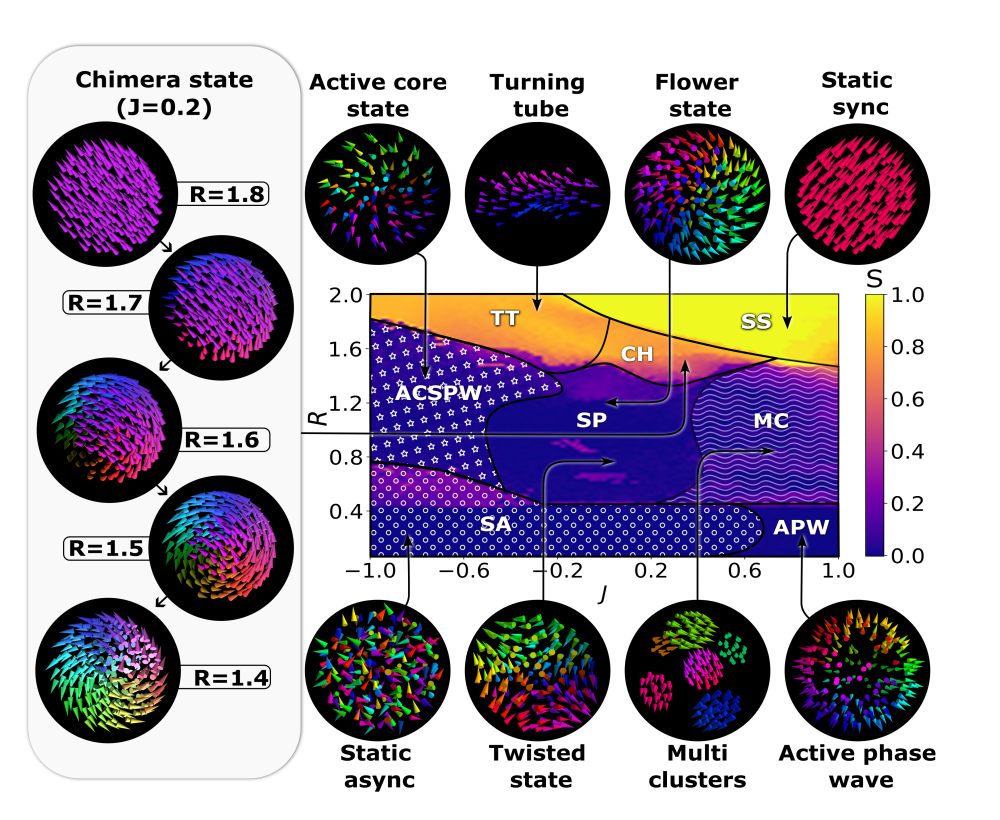
Figure 1: Synchronization order parameter S is depicted as the heat map for εa=εr=0.5 in the (J,R) space. Refer to the text for details.
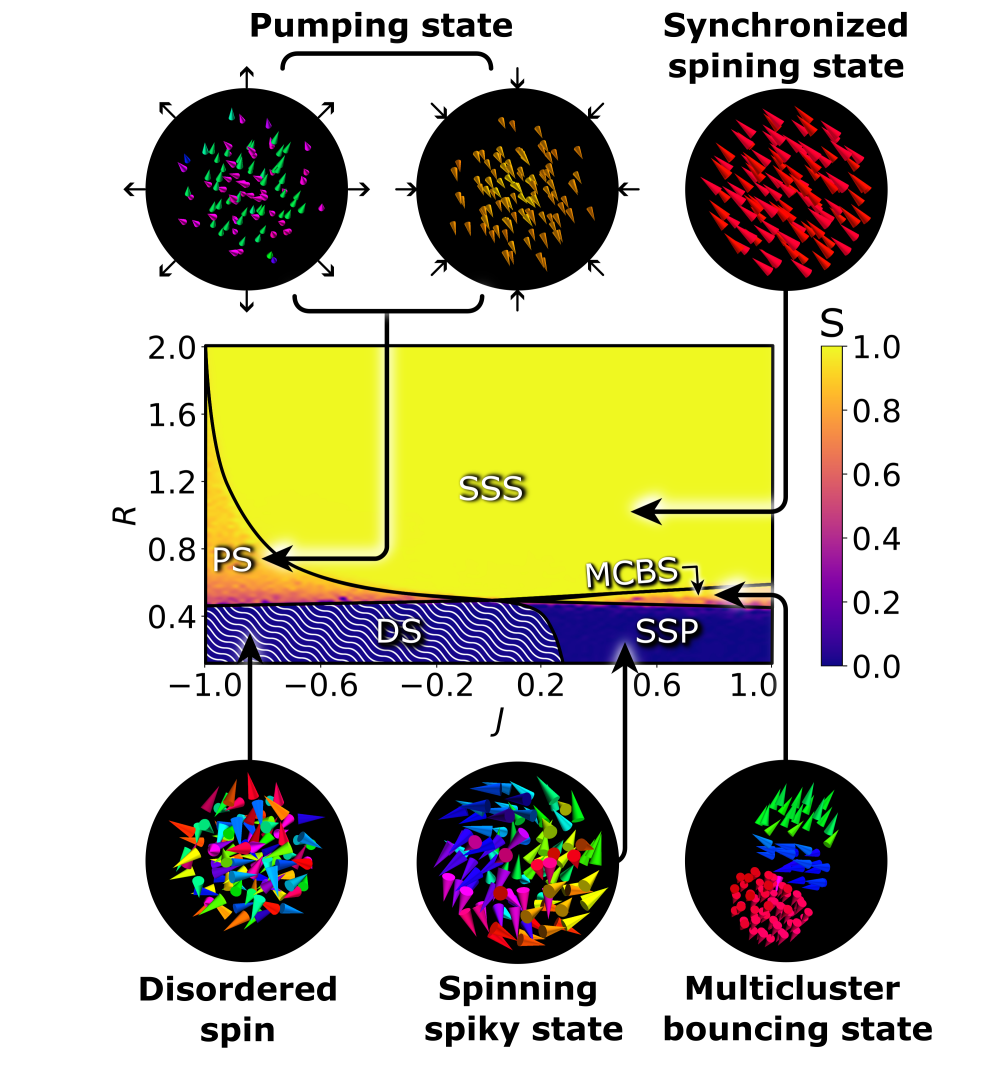
Figure 2: Swarmalators with orthogonal angular frequencies. Simulations are performed for N=100,εa=0.9,εr=0.1. The pumping state is a dynamic state in which swarmalators compress and expand in a rhythmic pattern reminiscent of the beating of the heart.
Real-World Applications
This model is particularly adept at simulating biological and technological phenomena:
Conclusion
The proposed high-dimensional swarmalator model serves as a versatile tool to investigate a broad spectrum of self-organizing behaviors in nature and technology. By expanding upon existing swarmalator models, it introduces vital aspects such as multi-dimensional orientation dynamics and diverse interaction regimes that are crucial for accurate simulation of complex systems. Future research could refine model parameters and incorporate adaptive mechanisms to further elevate its predictive capabilities in emergent phenomena across different domains.