- The paper introduces a method that integrates LLMs and transformer-based NER to automatically derive signed business networks from unstructured news articles.
- It employs entailment-based zero-shot classification and NLI to capture both collaborative and competitive interactions between firms.
- Preliminary results, including a case study on Apple Inc., demonstrate the system’s potential in enhancing competitive analysis and predictive market trend analysis.
Introduction
The integration of generative AI, specifically foundation models, into business strategy formulation offers a novel approach for decision-making and market analysis. This paper, "Generative AI for Business Strategy: Using Foundation Models to Create Business Strategy Tools" (2308.14182), proposes a methodology for leveraging LLMs to derive signed business networks from unstructured data sources such as news articles. By synthesizing data using advanced models like GPT-4, transformer-based Named Entity Recognition (NER), and Entailment-based Zero-Shot Classifier (ZSC), this approach aims to create dynamic graphical abstractions that map the competitive and collaborative interactions among firms.
Methodology
Data Sources and Models
The methodology involves the extraction of business relationships from unstructured textual data. The data sources, primarily news articles, provide current and pertinent information regarding corporate interactions. Utilizing models like XLM-RoBERTa for entity detection and ZSC for label prediction allows for the construction of semi-dynamic signed business networks—nodes representing companies and weighted, signed edges denoting the nature of their interrelations.
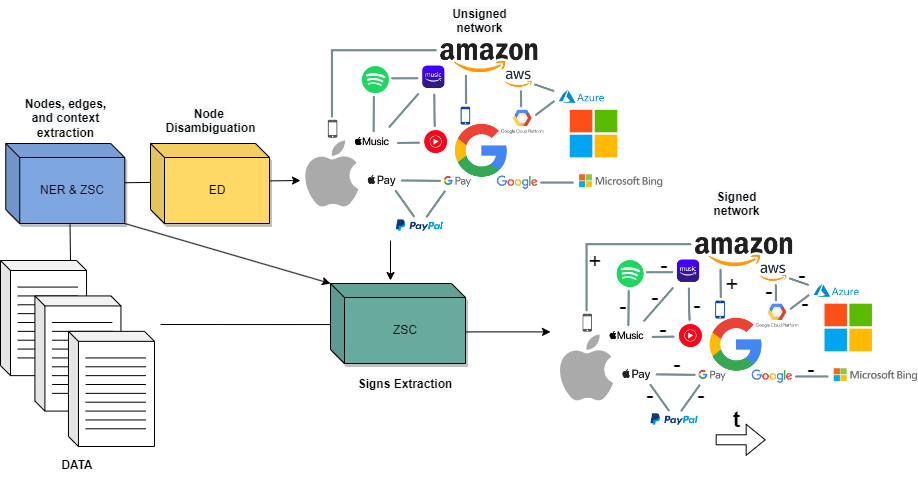
Figure 1: Computing signed business networks using multiple foundation models.
The pipeline constructs these networks without explicit training data on the relationships, relying instead on the generative capabilities of ZSC, which employs Natural Language Inference (NLI) methodologies for classification. The extracted entities are linked to form sub-networks that reflect complex business relations, informed by both collaboration and conflict dynamics.
Business Network Construction
The approach incorporates multiple foundation models to annotate these networks with derived sentiments and explanations. Instruction-tuned LLMs like GPT-4 are used to augment the network with narrative descriptions, potentially enhancing interpretability for stakeholders.
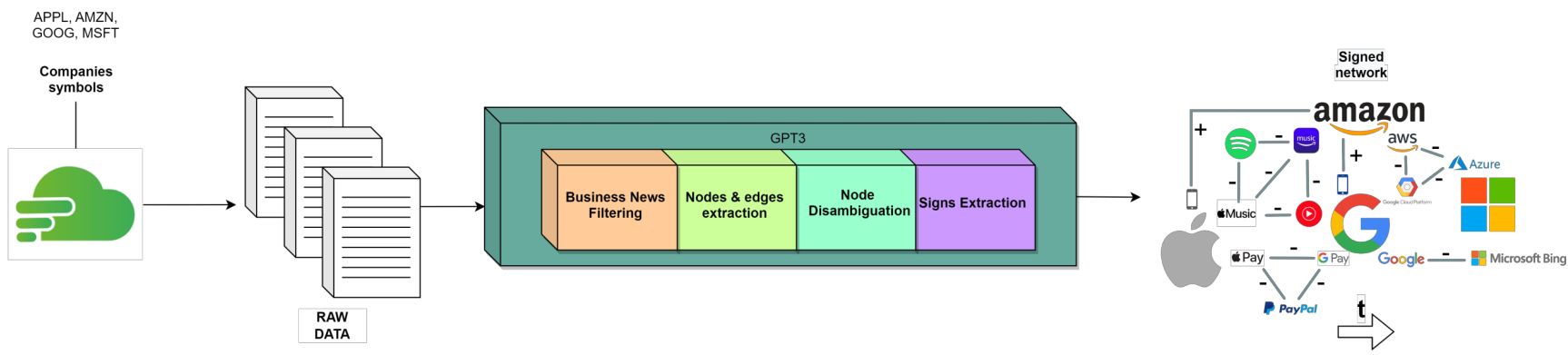
Figure 2: We also build a parallel pipeline using Instruction-tuned LLMs. The goal here is to augment the signed network with explanations.
Preliminary Results
The preliminary results illustrate the system's capability to accurately interpret relationships from headlines, correctly identifying positive and negative interactions in various contexts (Tables 1 and 2). Notably, in scenarios featuring complex syntax or ambiguous phrasing, the integration of NER and ZSC models yielded robust classification outcomes, demonstrating efficacy in nuanced sentiment analysis.
Moreover, a case study involving Apple Inc. highlighted the network’s ability to dynamically capture changes in market strategy, illustrating shifts in alliances and competitive stances following strategic decisions (Figure 3).
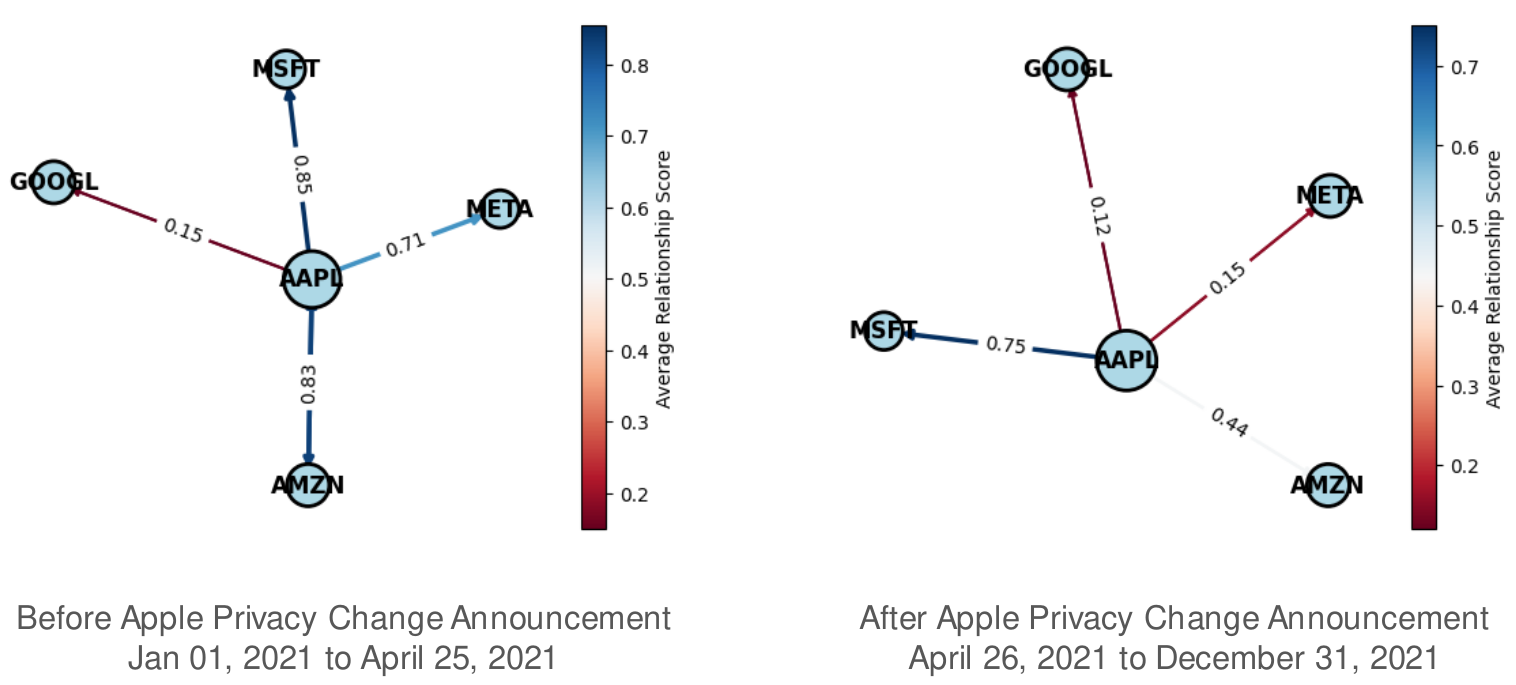
Figure 3: Illustrative example: network changes before and after a business strategy change by Apple Inc., identified in a completely data-driven way using foundation models.
Implications and Future Work
This research provides a strong foundation for future explorations into AI-driven business strategy tools. The ability to model business environments through dynamic network representations presents opportunities for enhanced decision-making processes, predictive analysis of market trends, and the exploration of hypothetical strategic scenarios. Potential future work includes enhancing model accuracy by incorporating more contextual data, and developing predictive frameworks for network evolution using sociological theories such as Balance Structure Theory.
Conclusion
The integration of foundation models within business strategy frameworks introduces a powerful tool for visualizing and analyzing corporate dynamics. These graphical abstractions offer significant promise for improving competitive analysis, strategic planning, and decision-making processes. Pursuing further advancements in this field could yield substantial benefits across multiple strategic domains.