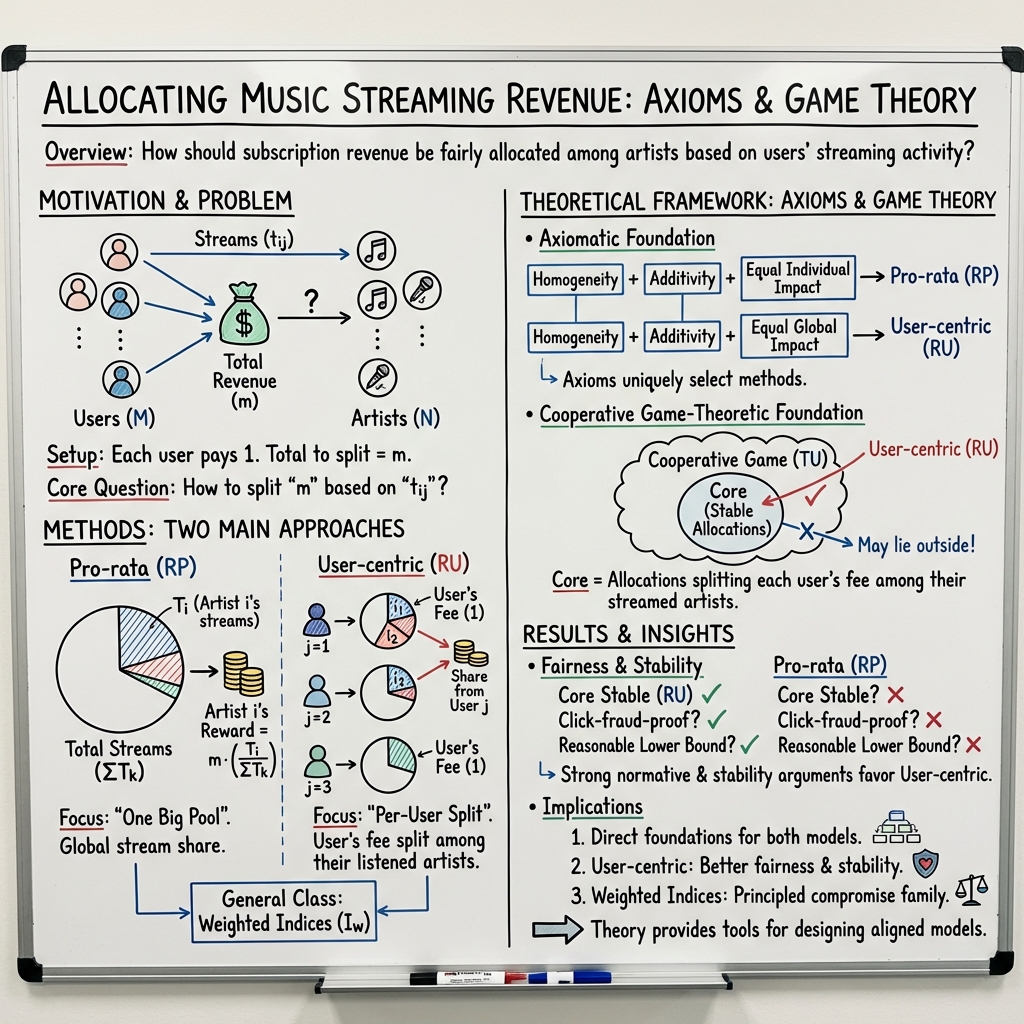
- The paper presents foundational axiomatic and game-theoretical analysis of pro-rata and user-centric revenue sharing methods.
- It employs a stylized streaming matrix and indices to model artist payouts and assess fairness in allocation.
- The study proposes hybrid, weighted allocation schemes that integrate user engagement to achieve more inclusive artist remunerations.
Introduction
The paper "Revenue Sharing at Music Streaming Platforms" (2310.11861) explores the complex problem of distributing subscription-generated revenues among artists on music streaming platforms. It focuses on two prevalent methods: pro-rata and user-centric. The pro-rata method allocates revenue based on the total number of streams an artist receives, whereas the user-centric method divides each user's subscription fee among the artists listened to by the user. This paper offers pioneering foundational insights into these methods through axiomatic and game-theoretical approaches while also introducing a spectrum of hybrid methods aimed at striking a balance between the two main approaches.
Axiomatic and Game-Theoretical Foundations
The authors present a stylized model with three core components: artists, users, and a streaming matrix. The paper employs axioms to underpin popularity indices used in revenue sharing. These indices measure each artist's importance based on streaming data. Two key indices highlighted are the pro-rata index, rewarding artists proportionally to their total streams, and the user-centric index, rewarding artists based on individual user contributions to total streams.
The axiomatic approach introduces several principles. Homogeneity ensures index scaling relative to user streams. Additivity supports decomposition of problems into smaller solvable units, which can aggregate back to a larger solution. Unique to this analysis are axioms like equal individual impact of similar users and equal global impact of users, emphasizing fairness and balance in user contribution.
Game-theoretical analysis aligns each streaming problem with a cooperative game, highlighting how convex games guarantee broader core allocations, favoring coalitions and user-centric methods. The core-selection concept underscores the resilience of user-centric allocations against artists' potential exit scenarios from platforms.
Revenue Allocation Strategies
Beyond the foundational methods, the paper explores weighted indices that accommodate more nuanced revenue distributions based on user profiles and streaming behaviors. This family of allocation schemes potentially addresses industry concerns about aligning artist, fan, and platform interests. A proposed framework enables revenue allocations to transcend traditional stream-count metrics, incorporating user engagement depth and breadth.
The authors propose that this approach could redefine artist payouts more equitably, minimizing biases inherent in existing methods and enhancing fairness in the consumer-artist economic relationship. This is seen as a step toward more inclusive remuneration models that de-emphasize stream monopolization by popular artists.
Practical and Theoretical Implications
The implications of this research are both practical and theoretical. Practically, user-centric pricing aligns better with evolving consumption patterns favoring diversified, niche musical choices over blockbuster hits. Theoretical underpinnings suggest that user-centric models can democratize the digital music landscape, prompting streaming services to reconsider artist remuneration rules fundamentally.
These insights invite further exploration into hybrid models integrating user-centric principles into broader bundling and pricing strategies. Such strategies could transcend music and apply to other content-streaming platforms.
Conclusion
The paper compellingly advocates for a shift toward user-centric revenue distribution models, underpinned by rigorous axiomatic and game-theoretical arguments. While the pro-rata method has historical precedence, technological advancements enable more sophisticated user-centric methods that promise to mitigate long-standing industry issues.
Final remarks underscore the broader industry movement, exemplified by collaborations like the Deezer-Universal Music Group initiative, to innovate streaming revenue models. This paper opens paths for robust future research into weighted allocation systems that optimally balance user engagement and artist compensation, establishing normative groundwork for equitable transformations in digital content distribution.