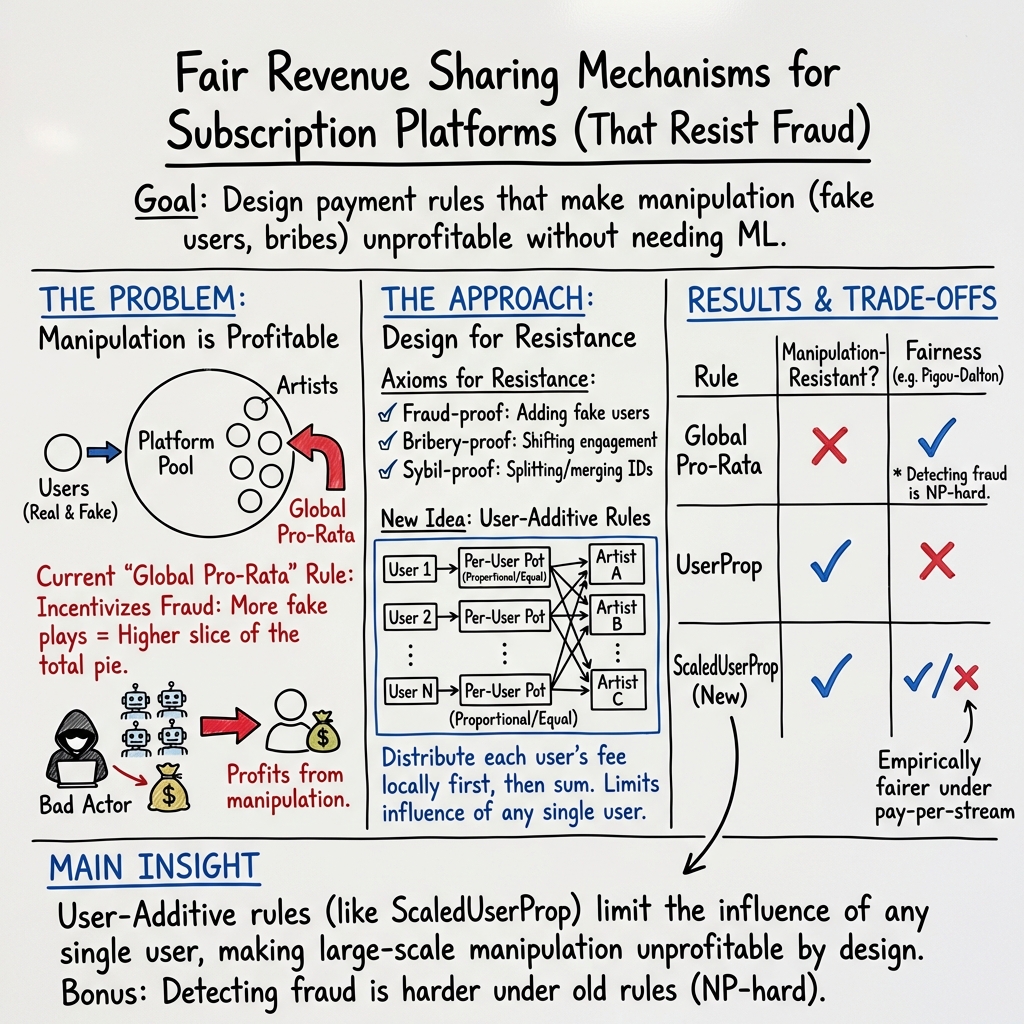
- The paper introduces ScaledUserProp, a novel mechanism that uses capped engagement metrics to mitigate fraudulent revenue manipulation.
- It employs an axiomatic approach with fraud-, bribery-, and Sybil-proofness proofs, validated through experiments on both real and synthetic data.
- The results show enhanced fairness and reduced manipulation compared to GlobalProp and UserProp, offering actionable insights for regulatory improvements.
Introduction
The paper "Fraud-Proof Revenue Division on Subscription Platforms" (2511.04465) explores mechanisms to disincentivize fraudulent activities on subscription-based streaming platforms. The study highlights the limitations of machine learning methods in detecting fraud and proposes a novel rule, ScaledUserProp, that addresses fairness and manipulation resistance more effectively than existing rules. The authors argue that current platforms, most notably those utilizing the GlobalProp rule, struggle with fraud detection and ensure fairness in revenue distribution among content creators.
Problem Statement
As the subscription-based streaming industry grows, platforms distribute revenue based on user engagement metrics. However, this model is vulnerable to manipulative activities like using bots to inflate engagement. This paper examines the challenges of creating fraud-resistant revenue division mechanisms that reduce reliance on complex machine learning models for fraud detection. The prevailing rule, GlobalProp, allocates subscription revenue proportionally to streams, leading to easily exploitable vulnerabilities. The researchers also critique UserProp for perceived unfairness.
Methodology
The paper presents a thoughtful axiomatic approach, introducing and analyzing several manipulation-resistance axioms: fraud-proofness, bribery-proofness, and Sybil-proofness. These aim to disincentivize fraudulent behavior such as creating fake users, bribing genuine users, or splitting artists into multiple entities. The proposed ScaledUserProp satisfies these axioms by introducing a payout mechanism that balances engagement influence and fairness, avoiding disproportionately rewarding those with fraudulent engagement through capping techniques.
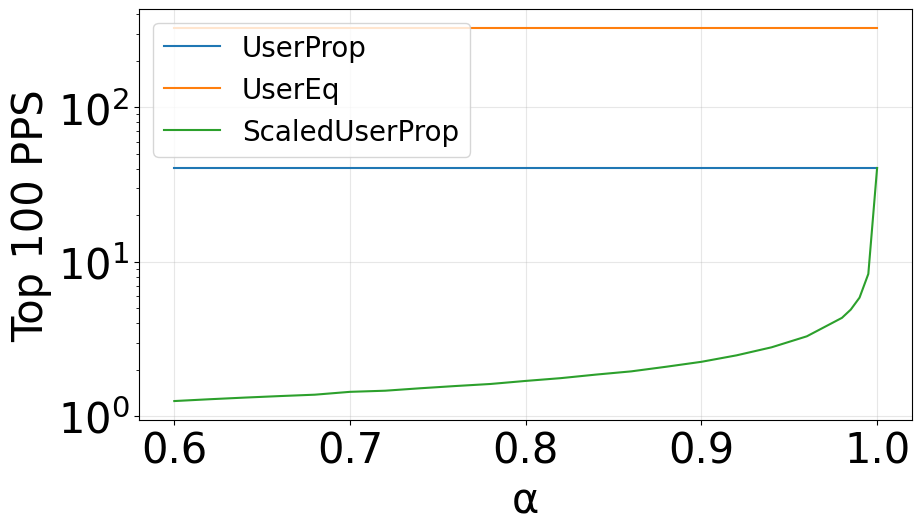
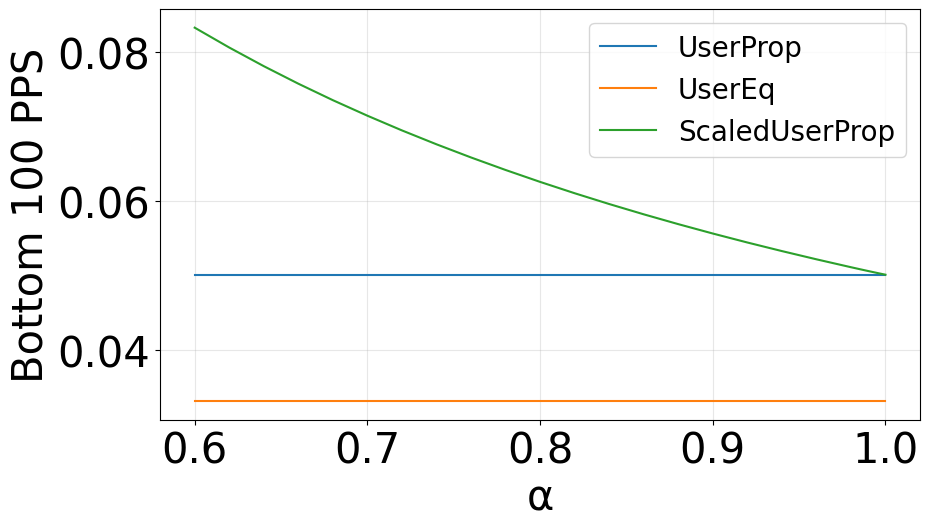
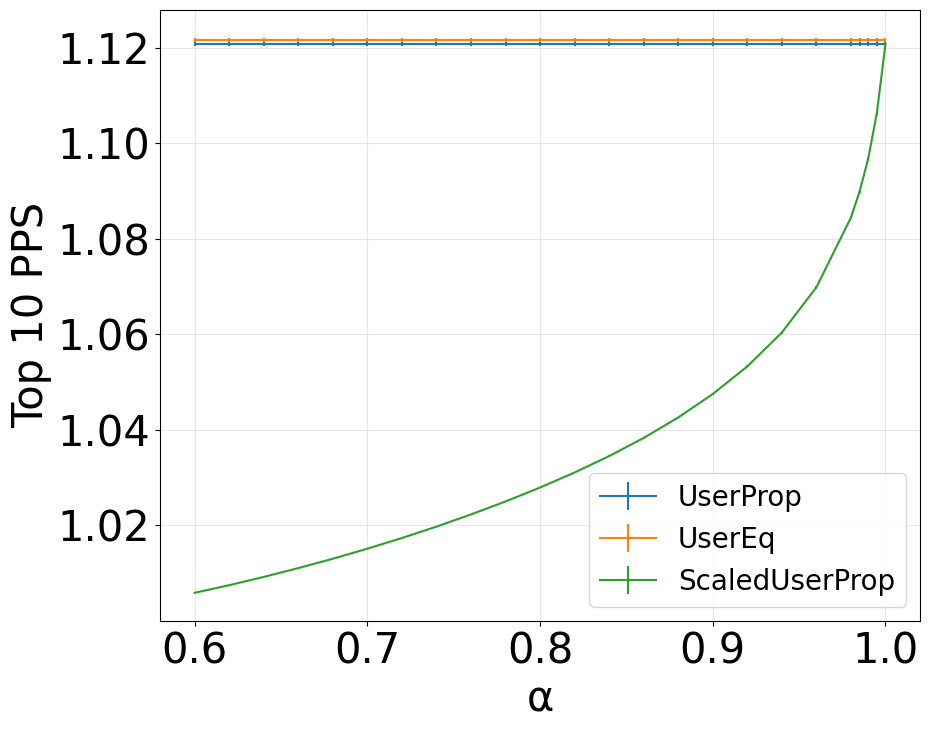
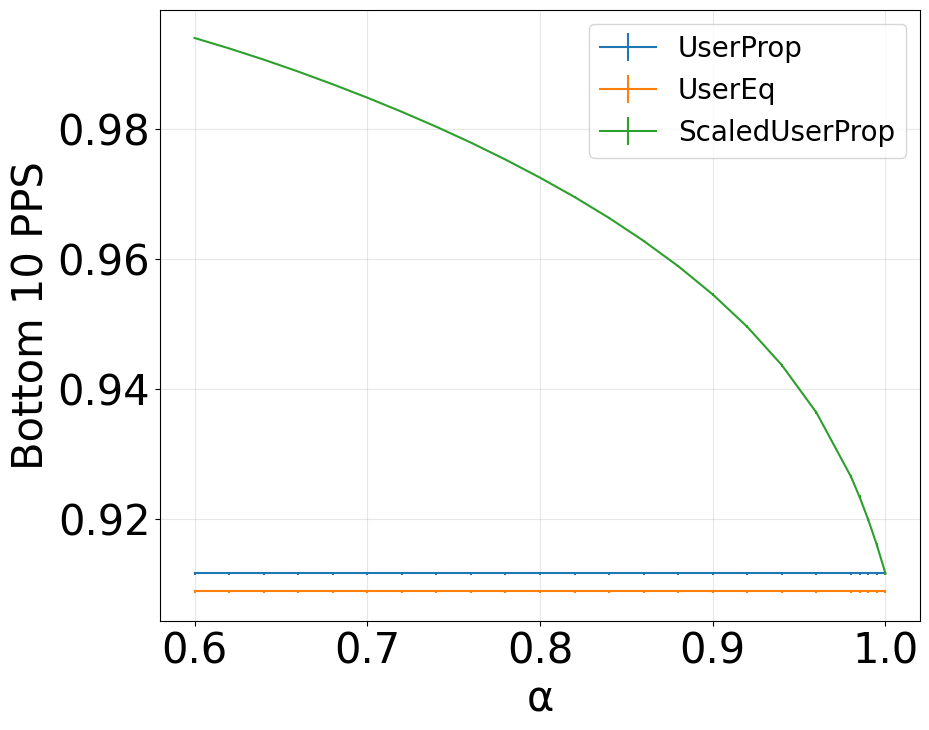
Figure 1: Overview of graphs from real and synthetic data. (a) and (b) show results for real data, while (c) and (d) show results for synthetic data. GP is short for GlobalProp.
Experimentation
The authors conducted experiments on both synthetic and real-world data to validate ScaledUserProp against GlobalProp and UserProp. The results showcased that ScaledUserProp effectively mitigates fraud while maintaining fairness, avoiding the pitfalls of disproportionate revenue allocation inherent in GlobalProp and addressing UserProp's fairness issues. The experiments with various engagement profiles in synthetic datasets confirmed ScaledUserProp's capacity to limit the maximum envy among artists, highlighting its effectiveness over alternative mechanisms.
Implications and Future Work
The proposed ScaledUserProp mechanism enhances platform transparency and fairness while reducing susceptibility to fraud. These improvements have significant implications for revenue distribution policies on subscription platforms. The insights gathered could inform improved regulatory guidelines and support the integration of more robust fraud prevention mechanisms. Future research could further explore extending this model to incorporate freemium models or examine its application contexts beyond music streaming, such as video streaming and content sharing sectors.
Conclusion
The paper effectively addresses the challenge of designing a revenue division mechanism resistant to fraudulent manipulation in subscription platforms. ScaledUserProp emerges as a fair, fraud-proof alternative to existing rules, contributing to more equitable and secure revenue distribution in the rapidly expanding digital content industry.