Papers
Topics
Authors
Recent
Search
2000 character limit reached

Uncovering the human motion pattern: Pattern Memory-based Diffusion Model for Trajectory Prediction

Published 5 Jan 2024 in cs.CV | (2401.02916v2)

Abstract: Human trajectory forecasting is a critical challenge in fields such as robotics and autonomous driving. Due to the inherent uncertainty of human actions and intentions in real-world scenarios, various unexpected occurrences may arise. To uncover latent motion patterns in human behavior, we introduce a novel memory-based method, named Motion Pattern Priors Memory Network. Our method involves constructing a memory bank derived from clustered prior knowledge of motion patterns observed in the training set trajectories. We introduce an addressing mechanism to retrieve the matched pattern and the potential target distributions for each prediction from the memory bank, which enables the identification and retrieval of natural motion patterns exhibited by agents, subsequently using the target priors memory token to guide the diffusion model to generate predictions. Extensive experiments validate the effectiveness of our approach, achieving state-of-the-art trajectory prediction accuracy. The code will be made publicly available.

Definition Search Book Streamline Icon: https://streamlinehq.com
References (21)
  1. “Towards fully autonomous driving: Systems and algorithms,” in 2011 IEEE intelligent vehicles symposium (IV). IEEE, 2011, pp. 163–168.
  2. “Social lstm: Human trajectory prediction in crowded spaces,” in CVPR, 2016, pp. 961–971.
  3. “Stgat: Modeling spatial-temporal interactions for human trajectory prediction,” in CVPR, 2019, pp. 6272–6281.
  4. “Social gan: Socially acceptable trajectories with generative adversarial networks,” in CVPR, 2018, pp. 2255–2264.
  5. “Trajectron++: Dynamically-feasible trajectory forecasting with heterogeneous data,” in ECCV. Springer, 2020, pp. 683–700.
  6. “It is not the journey but the destination: Endpoint conditioned trajectory prediction,” in ECCV. Springer, 2020, pp. 759–776.
  7. “Groupnet: Multiscale hypergraph neural networks for trajectory prediction with relational reasoning,” in CVPR, 2022, pp. 6498–6507.
  8. “Stochastic trajectory prediction via motion indeterminacy diffusion,” in CVPR, 2022, pp. 17113–17122.
  9. “Forecasting human trajectory from scene history,” NeurIPS, vol. 35, pp. 24920–24933, 2022.
  10. “Remember intentions: retrospective-memory-based trajectory prediction,” in CVPR, 2022, pp. 6488–6497.
  11. “Habit and intention in everyday life: The multiple processes by which past behavior predicts future behavior.,” Psychological bulletin, vol. 124, no. 1, pp. 54, 1998.
  12. “Ask me anything: Dynamic memory networks for natural language processing,” in ICML. PMLR, 2016, pp. 1378–1387.
  13. “Analysis of recurrent neural networks for probabilistic modeling of driver behavior,” TITS, vol. 18, no. 5, pp. 1289–1298, 2016.
  14. “Ss-lstm: A hierarchical lstm model for pedestrian trajectory prediction,” in WACV. IEEE, 2018, pp. 1186–1194.
  15. “Mantra: Memory augmented networks for multiple trajectory prediction,” in CVPR, 2020, pp. 7143–7152.
  16. “Continual multi-agent interaction behavior prediction with conditional generative memory,” RAL, vol. 6, no. 4, pp. 8410–8417, 2021.
  17. “Temporal pyramid network for pedestrian trajectory prediction with multi-supervision,” in AAAI, 2021, vol. 35, pp. 2029–2037.
  18. “Social-implicit: Rethinking trajectory prediction evaluation and the effectiveness of implicit maximum likelihood estimation,” in ECCV. Springer, 2022, pp. 463–479.
  19. “Improving data association by joint modeling of pedestrian trajectories and groupings,” in ECCV. Springer, 2010, pp. 452–465.
  20. “Crowds by example,” in Computer graphics forum. Wiley Online Library, 2007, vol. 26, pp. 655–664.
  21. “Learning social etiquette: Human trajectory understanding in crowded scenes,” in ECCV. Springer, 2016, pp. 549–565.
Citations (1)

Summary

  • The paper introduces MP²MNet, a novel framework integrating motion pattern memory with a denoising diffusion process to enhance trajectory prediction.
  • It employs K-means clustering for storing and retrieving motion priors, achieving a 7-8% improvement over previous methods using ADE and FDE metrics.
  • The approach leverages an encoder, memory bank, and Transformer-based decoder to capture realistic human motion patterns for better predictive accuracy.

Uncovering the Human Motion Pattern: Pattern Memory-based Diffusion Model for Trajectory Prediction

Introduction

The paper "Uncovering the human motion pattern: Pattern Memory-based Diffusion Model for Trajectory Prediction" introduces a novel method for human trajectory forecasting leveraging motion pattern priors within a diffusion model framework. The approach, named Motion Pattern Priors Memory Network (MP2^2MNet), addresses the challenges of unpredictable human behavior in trajectory prediction, relevant to areas such as robotics and autonomous driving. By constructing a memory bank derived from clustered prior knowledge of motion patterns, MP2^2MNet enhances the prediction accuracy by guiding diffusion models with a systematic exploration of uncertainties inherent in human trajectories.

Method: MP2^2MNet

Network Architecture

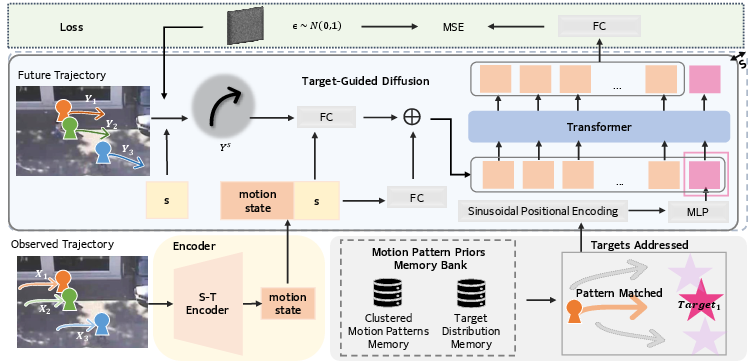
The MP2^2MNet is composed of three main components: an encoder, a motion pattern priors memory bank, and a Transformer-based decoder. The encoder captures the motion state representation from observed data, while the memory bank stores and retrieves motion pattern priors. The decoder, leveraging a denoising diffusion probabilistic model (DDPM), utilizes these priors for predicting future trajectories.

Encoder: Based on Trajectron++, the encoder extracts information from the agent's historical trajectory data, creating a motion state embedding used in further processing.

Motion Pattern Priors Memory Bank: This component clusters training trajectories into distinct motion patterns using K-means and records these along with their respective uncertainties and target distributions. During inference, the memory bank is queried to provide motion pattern matches against observed trajectories, generating a target priors memory token for the decoder.

Decoder: The Transformer-based decoder models the reverse diffusion process. It is conditioned on motion state embeddings, target priors, and time embeddings, enabling the generation of diverse and feasible trajectory predictions by transitioning from stochastic noise to determinate futures. Figure 1

Figure 1: The overview of our proposed MP2MNet method. It contains an encoder, the motion pattern priors memory bank, and a Transformer-based decoder. The encoder captures information to obtain the motion state representation. S denotes the total diffusion step and s denotes the sths^{th} step.

Motion Pattern Priors Memory Bank

At the core of MP2^2MNet is its motion pattern priors memory bank. Using K-means clustering, trajectories are grouped into KK distributions. The memory bank stores trajectory mean and uncertainty for each cluster and target distribution priors. This mechanism serves as a guide during prediction, effectively aligning the inference with realistic motion patterns.

Trajectory Addressing: Given a trajectory, the model uses negative log-likelihood to identify the best matching motion pattern stored in the memory. This selected pattern assists the diffusion model in refining trajectory predictions by providing necessary trajectory trends and uncertainties.

Target-Guided Diffusion Model

The prediction task translates into a reverse diffusion process where a Gaussian noise-infused trajectory gradually resolves into a specific prediction. This process is framed as a parameterized Markov chain, beginning at YSN(0,I)Y^S \sim \mathcal{N}(0, I) and iterating backwards to a clear trajectory. Using predefined loss functions based on KL divergence, the model optimizes the likelihood of accurate predictions throughout its training.

Experimental Results

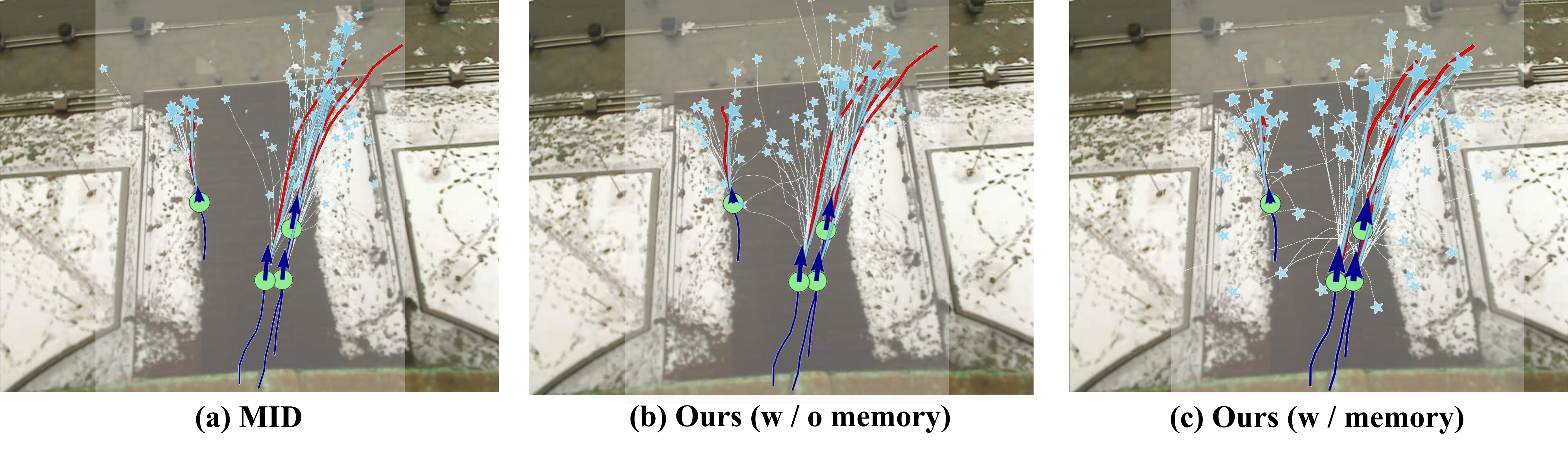
Extensive experiments confirm the superior performance of MP2^2MNet across standard datasets, notably ETH/UCY and the Stanford Drone Dataset. Using metrics like Average Displacement Error (ADE) and Final Displacement Error (FDE), the method outperformed existing approaches significantly, achieving a 7-8% improvement over the previous state-of-the-art in common scenes. Figure 2

Figure 2: Visualization comparison on the ETH/UCY datasets. We compare the best-of-20 predictions generated by our approach with those from two baseline methods: the previous MID method and our method without motion pattern priors memory.

Conclusion

MP2^2MNet presents a robust methodology for addressing the inherent uncertainties in human motion prediction. The innovative use of motion pattern priors within a memory-enhanced diffusion model not only refines prediction accuracy but also underscores the utility of integrating historical data patterns in predictive modeling. Future enhancements may explore alternative clustering strategies or extend the current framework to more complex, multi-agent environments, further expanding the applicability of such systems in dynamic real-world settings.

Paper to Video (Beta)

No one has generated a video about this paper yet.

Whiteboard

No one has generated a whiteboard explanation for this paper yet.

Open Problems

We haven't generated a list of open problems mentioned in this paper yet.

Collections

Sign up for free to add this paper to one or more collections.