Energy Momentum Localization in Quantum Gravity
Abstract: We introduce quantum spatio-temporal dynamics (QSD) as modeled by the Nexus Paradigm (NP) of quantum gravity to resolve the problem of energy-momentum localization in a gravitational field. Currently, the gravitational field as described using the language of geometry modeled under General Relativity (GR) fails to provide a generally accepted definition of energy-momentum. Attempts at resolving this problem using geometric methods have resulted in various energy-momentum complexes whose physical meaning remain dubious since the resulting complexes are non-tensorial under a general coordinate transformation. In QSD, the tangential manifold is the affine connection field in which energy-momentum localization is readily defined. We also discover that the positive mass condition is a natural consequence of quantization and that dark energy is a Higgs like field with negative energy density everywhere. Finally, energy-momentum localization in quantum gravity shows that a free falling object will experience larger vacuum fluctuations (uncertainties in location) in strong gravity than in weak gravity and that the amplitudes of these oscillations define the energy of the free falling object.
Paper Prompts
Sign up for free to create and run prompts on this paper using GPT-5.
Top Community Prompts
Explain it Like I'm 14
Overview
This paper proposes a new way to think about gravity called Quantum Spatio-Temporal Dynamics (QSD), built on something the author calls the Nexus Paradigm (NP). The main goal is to solve a long-standing puzzle in physics: how to clearly define and locate the energy and momentum in a gravitational field. In standard general relativity (GR), gravity is described using geometry (curved space-time), but GR does not give a simple, universally accepted formula for “where” the energy of the gravitational field is. This paper argues that by treating space-time with quantum ideas, we can make energy-momentum localization simpler and more natural, and also connect gravity to dark matter and dark energy.
The Big Questions
- How can we define the energy and momentum of the gravitational field in a clear, coordinate-independent way?
- Can a quantum approach to gravity naturally explain dark matter and dark energy?
- What does quantizing space-time (treating it like a wave-like, discrete system) tell us about how objects move and how gravity behaves?
How the Paper Approaches the Problem
To make these ideas easier, think of space-time as a flexible fabric and objects as marbles rolling along it:
- In GR, the fabric is curved by mass and energy. However, measuring “energy in the fabric” has been hard because the usual tools depend on how you label points (coordinates), and that changes the result.
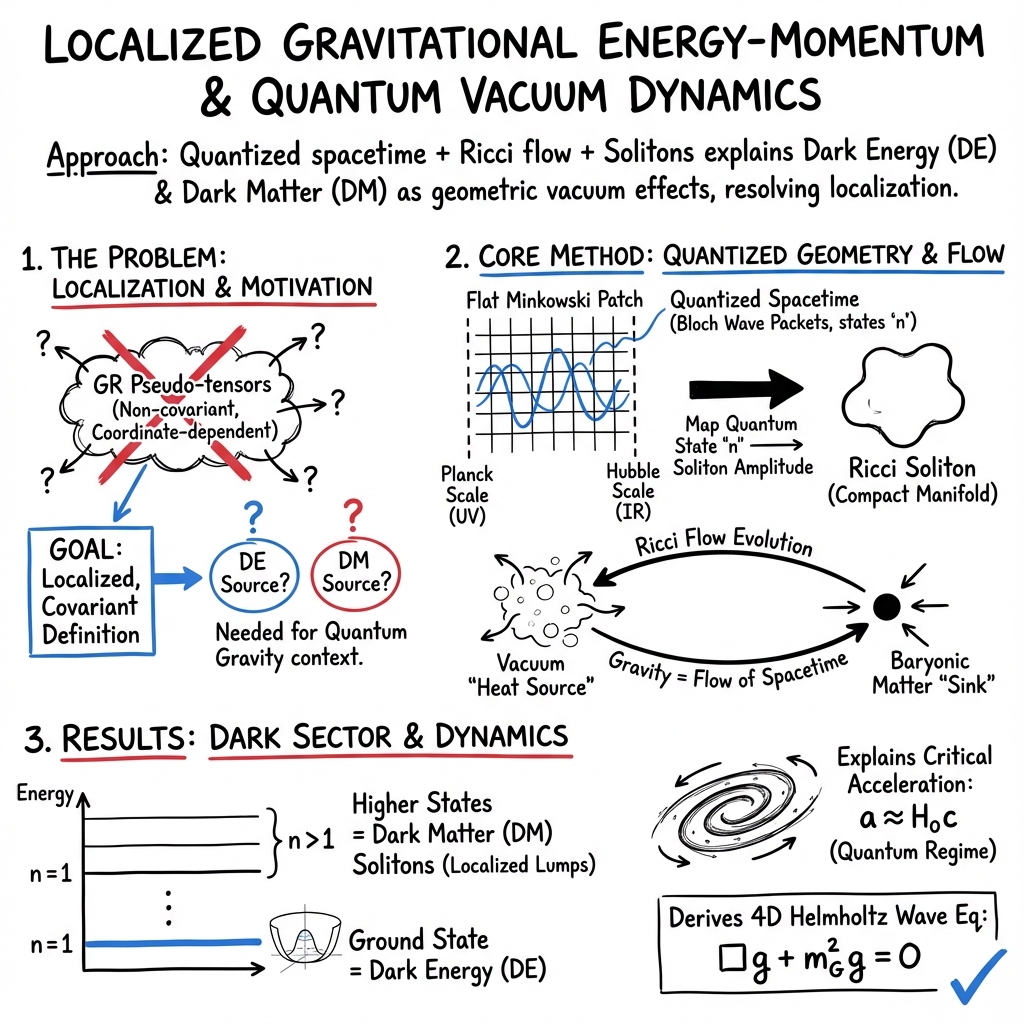
- In QSD, the author treats the fabric itself as made of tiny wave packets—like small vibrating patches or “notes” that make up space-time. These patches follow special mathematical rules (using “Clifford algebra” and “Dirac gamma matrices,” which you can think of as structured building blocks that encode directions and size).
- The idea of “Ricci flow” is used as an analogy. Ricci flow is like heat spreading evenly to smooth out bumps in a surface. Applied to space-time, it means curvature (how much the fabric bends) can be smoothed and tracked over time. This helps build a wave-based version of gravity.
- The author introduces “Ricci solitons,” which are stable, self-contained lumps of curvature/energy in space-time. These are like localized ripple-bubbles in the fabric that keep their shape. The paper argues:
- Some Ricci solitons behave like dark matter (DM): localized, persistent lumps that affect motion but don’t shine.
- The ground (lowest-energy) state of the gravitational field behaves like dark energy (DE): a Higgs-like field that has negative energy density everywhere, gently pushing space apart.
- Space-time is “quantized” with limits set by the smallest meaningful scale (Planck length) and the largest meaningful distance (Hubble radius). That creates a huge but finite set of allowed “notes” or states for space-time.
- The author connects these ideas to observed galaxy behavior. A particular acceleration scale naturally appears: (speed of light times the Hubble constant). This is close to what is used in MOND (Modified Newtonian Dynamics), which has been successful at describing galaxy rotation speeds.
- In this framework, the “connection field” (which describes how paths bend) is where energy-momentum is localized. This is more like tracking the energy in how the fabric guides motion, rather than only in the fabric’s shape.
Methods Explained Simply
- Ricci flow: Imagine ironing out wrinkles in a sheet. Ricci flow is the “ironing rule” that tells how the wrinkles (curvature) spread and smooth over time.
- Quantized space-time: Instead of thinking of space-time as perfectly smooth, think of it as made of many tiny vibrating tiles. Each tile can vibrate at certain allowed frequencies (states), like notes on a piano. You can add these notes together (Fourier methods) to get complex vibrations—this makes the fabric of space-time.
- Ricci solitons: These are like stable, traveling wave lumps in the sheet. They keep their shape even when they move or collide, much like solitons in water waves.
- Wave equation for gravity: The author derives a simple wave equation (a 4D Helmholtz equation) that says the gravitational field behaves like a set of harmonic oscillators. Think of a guitar string: its vibration energy depends most on how big the oscillation is (amplitude), not just on its pitch (frequency).
- Heat-flow analogy: Matter acts like a “heat sink,” and vacuum energy acts like a “heat source.” Space-time “flows” from source to sink, carrying along matter. So gravity looks like space-time flowing and guiding objects.
Main Findings and Why They Matter
Here are the key points, presented in a short, readable list to improve clarity:
- Energy-momentum localization becomes natural if you treat space-time as a quantum wave field and use the “connection field” to track energy. This avoids coordinate-dependent problems found in older methods.
- Dark matter can be seen as Ricci solitons: localized lumps of vacuum energy that curve space-time, affecting orbits and rotation speeds without emitting light.
- Dark energy behaves like a Higgs-like field in its ground state, with negative energy density everywhere, pushing space to expand. The paper claims this approach gives a value of the cosmological constant close to observations and addresses the “cosmological constant problem” by saying only the ground state contributes significantly.
- There is a natural “critical acceleration” scale . When acceleration is below this scale, gravity behaves differently (non-Newtonian), which matches patterns seen in galaxy rotation curves and leads to relations similar to the Baryonic Tully–Fisher relation ().
- At very high energies (very small scales), gravity becomes “asymptotically free,” meaning interactions weaken—helping avoid infinities in calculations.
- Gravitational waves carry the ground-state momentum and have a minimum energy/frequency scale tied to the Hubble constant. The energy of these waves depends strongly on amplitude.
- Stronger gravity leads to larger vacuum fluctuations: a free-falling object has more uncertainty in its exact position in strong fields than in weak fields. The amplitude of these oscillations defines the object’s energy.
- A “positive mass condition” emerges naturally from quantizing space-time: even with different vibrational modes, the framework forces mass to be positive, matching known theorems.
Implications and Potential Impact
If this approach holds up under further testing, it could:
- Offer a clearer, more consistent way to measure and track the energy of the gravitational field.
- Provide a unified picture that naturally includes dark matter and dark energy as features of the quantum gravitational field, rather than as separate mysteries.
- Explain galaxy rotation curves and other cosmic observations without needing to add ad hoc fixes, by introducing a fundamental acceleration scale and wave-based gravity dynamics.
- Suggest new ways to think about black holes, gravitational waves, and information in gravity (for example, how information might be conserved and how quantum states could reduce in strong gravity).
- Guide future simulations and experiments, such as studying “random walks” (step-by-step movements) in discretized space-time using Quantum Monte Carlo methods.
In short, the paper proposes a fresh, wave-based, quantum description of space-time that aims to fix a hard problem in GR and tie gravity to dark matter, dark energy, and observed galactic behavior. It is a theoretical proposal, so more work and testing are needed, but it outlines a path that could make gravity and cosmology fit together in a simpler, more complete way.
Glossary
- AdS (Anti–de Sitter) topology: A spacetime geometry with constant negative curvature (negative cosmological constant). "Evidently, the Ricci soliton arising from Eq.(20) has an anti-De Sitter topology and to differentiate it from a Ricci soliton of De Sitter topology we label its quantum state as ñ."
- Affine connection field: The geometric structure (connection) defining parallel transport, here treated as the field where momentum–energy is localized. "In QSD, the tangential manifold is the affine connection field in which energy-momentum localization is readily defined."
- Asymptotic freedom: The phenomenon where interactions weaken at high energies or short distances. "This aspect also reveals asymptotic freedom in quantum gravity since for high values of n, gravity (world line curvature) vanishes asymptotically."
- Baryonic matter: Ordinary matter composed of protons, neutrons, and electrons. "baryonic matter transforming into a Bose-Einstein condensate (BEC) at low gravitational quantum states."
- Baryonic Tully–Fisher relation: Empirical relation linking a galaxy’s baryonic mass to its rotation speed. "This is the Baryonic Tully - Fisher relation."
- Bloch energy eigenstate functions: Periodic eigenfunctions used to represent quantized states in a lattice-like structure. "Q(nk) = sinc (kx)eikx are Bloch energy eigenstate functions in which the four wave vectors assume the following quantized values"
- Bose–Einstein condensate (BEC): A state of matter where bosons occupy the same quantum state, exhibiting macroscopic quantum phenomena. "baryonic matter transforming into a Bose-Einstein condensate (BEC) at low gravitational quantum states."
- Bravais four lattice: A regular, periodic lattice structure generalized to four dimensions. "The Bloch functions in each eigenstate of space-time generate an infinite Bravais four lattice."
- Clifford algebra: An algebra generated by a vector space with a quadratic form, used here to encode spacetime structure. "The above conditions generate a Clifford Algebra which implies that the coefficients (A, B, C, D) must be matrices, specifically the Dirac gamma matrices."
- Clifford space Cl1,3(R)c: The Clifford algebra of 1 time and 3 space dimensions (complexified), serving as the space of quantized displacement vectors. "Thus the displacement vectors Ax" = ay" reside in Clifford space Cl1,3 (R)c"
- Cosmological constant: A constant term in Einstein’s equations associated with vacuum energy density. "In GR with the cosmological constant A, the compact Einstein manifold assumes the form"
- Covariant canonical quantization: A quantization approach that maintains covariance while constructing canonical (Hamiltonian/Lagrangian) formulations. "We proceed to find the complete covariant canonical quantization of Eq.(21)."
- Covariant derivatives: Derivatives that respect the manifold’s connection, ensuring tensorial transformation properties. "The covariant derivatives of the quantum theory describe the affine connection field in which the ground state graviton is the messenger particle with the smallest possible mass-energy in nature."
- Dark Energy (DE): A pervasive energy component driving cosmic acceleration; here identified with the ground state of the gravitational field. "DE is the ground state of the gravitational field and therefore from Eq.(46) must behave like the Higgs field but with negative potential energy minima everywhere."
- Dark Matter (DM): Non-luminous matter inferred from gravitational effects; here modeled as Ricci solitons (localized vacuum energy). "Thus DM is a Ricci soliton and should exhibit the following soliton characteristics"
- De Sitter topology: A spacetime with constant positive curvature (positive cosmological constant). "The above equation describes a Ricci soliton of De Sitter topology and is divergenceless."
- Dirac gamma matrices: Matrices generating the Clifford algebra associated with spacetime, satisfying anticommutation relations linked to the metric. "The above conditions generate a Clifford Algebra which implies that the coefficients (A, B, C, D) must be matrices, specifically the Dirac gamma matrices."
- Einstein tensor: A divergence-free tensor Gμν built from the metric and its derivatives, appearing in Einstein’s field equations. "where Guy = Ruy - ERguy is the Einstein tensor, c the speed of light and TH the Hubble radius."
- Energy–momentum complex: Non-tensorial constructions proposed to represent energy–momentum in gravitational fields. "A brief survey of the literature shows notable attempts using super-energy tensors [6-8], quasi local expressions [9-12] and energy momentum complexes of Einstein [13-14], Papapetrou [15], Møller [16], Bergman-Thompson [17] Landau- Lifshitz [18] and Weinberg[19]."
- Equivalence principle: The principle stating the equivalence of gravitational and inertial mass (local indistinguishability of gravity and acceleration). "From a physical perspective, the equivalence principle makes no distinction between gravitational mass and inertial mass."
- Event horizon: The boundary beyond which events cannot affect an outside observer in a black hole spacetime. "implying that in the Nexus Paradigm the event horizon is half the size predicted in GR."
- Geodesic: The path that extremizes proper time or distance in curved spacetime; the “straightest” possible path. "Along the geodesic, the total energy of the gravitational field or the Hamiltonian of Eq.(39) is reduced to"
- Gravitational radius: The characteristic radius rg = GM/c2 associated with a mass in general relativity. "Here rg is the gravitational radius."
- Graviton: The (hypothetical) quantum carrier of gravitational interaction; here with a ground state playing a special role. "the ground state graviton is the messenger particle with the smallest possible mass-energy in nature."
- Hamilton’s Ricci Flow: A geometric flow evolving a metric by its Ricci curvature, smoothing curvature over “time.” "This statistical view which is analogous to thermal diffusion provides an intuitive glimpse in which Hamilton's Ricci Flow dt 9 pv = Aguv [21] plays an important role in the formulation of quantum gravity."
- Helmholtz equation (4D): A differential equation of the form (∇2 + k2)ψ = 0 extended to four dimensions. "Eq.(41) is a 4D Helmholtz equation in which the source of gravitational waves is the n = +1 quantum state or ground state of space-time."
- Higgs-like field: A field with a symmetry-breaking potential similar to the Higgs mechanism. "We also discover that the positive mass condition is a natural consequence of quantization and that dark energy is a Higgs like field with negative energy density everywhere."
- Hubble radius: The characteristic scale c/H0 associated with cosmic expansion. "where Guy = Ruy - ERguy is the Einstein tensor, c the speed of light and TH the Hubble radius."
- Klein–Gordon equation: The relativistic wave equation for scalar fields. "The above equation describes quantum harmonic oscillations of the metric with positive energy levels En = ñ2hHo which from Eq.(10) we find Emax = 10120. Emin . Thus the gravitational field can be described as a system of nested harmonic oscillators in the form of Ricci solitons. More importantly, Eq.(42) helps to define the equation of continuity for the Klein-Gordon equation expressed in Eq.(41) as follows:"
- Laplacian: A differential operator (divergence of gradient) central to diffusion and wave equations. "The left side is a form of a laplacian that averages the paths taken by a test particle in a gravitational field of quantum state n."
- Mexican hat potential: A symmetry-breaking potential with a ring of minima. "The potential assumes a Mexican hat morphology under the Wick rotation g -> ig"
- Minkowski metric: The flat spacetime metric of special relativity. "These matrices are square roots of the Minkowski metric"
- Minkowski space: Four-dimensional flat spacetime used in special relativity and QFT. "we begin the quantization process by considering a large but finite patch of Minkowski space equipped with a non- degenerate symmetric bilinear form on the tangent space."
- Nexus Paradigm (NP): The specific quantum gravity framework proposed by the paper. "We introduce quantum spatio-temporal dynamics (QSD) as modeled by the Nexus Paradigm (NP) of quantum gravity"
- Positive mass condition/theorem: The requirement/result that total mass–energy is non-negative in physically reasonable spacetimes. "This resonates well with the positive mass theorems [28-29]."
- Pseudo-tensor: A non-covariant object used to try to represent gravitational energy–momentum, dependent on coordinates. "Einstein failed to find a symmetric tensor that would properly localize the energy-momentum of the gravitational field but instead introduced a non-covariant pseudo-tensor."
- Quasi local expressions: Constructions aiming to define gravitational energy in finite regions (as opposed to strictly local or global). "A brief survey of the literature shows notable attempts using super-energy tensors [6-8], quasi local expressions [9-12] and energy momentum complexes"
- Quantum spatio-temporal dynamics (QSD): The paper’s proposed quantum gravity model describing quantized spacetime dynamics. "We introduce quantum spatio-temporal dynamics (QSD) as modeled by the Nexus Paradigm (NP) of quantum gravity to resolve the problem of energy- momentum localization in a gravitational field."
- Ricci curvature tensor: A contraction of the Riemann tensor encoding how volumes change under geodesic flow. "Moreover the Ricci curvature tensor in GR is the average of the possible paths a test particle can take in a gravitational field."
- Ricci flat: A condition (Ricci tensor zero) characterizing vacuum solutions without cosmological constant. "for Eq.(14) to become Ricci flat in this state"
- Ricci soliton: A self-similar solution to the Ricci flow, often modeling localized curvature/energy configurations. "The above equation describes a Ricci soliton of De Sitter topology and is divergenceless."
- Schwarzschild metric: The spherically symmetric vacuum solution of Einstein’s equations around a non-rotating mass. "If we compare the quantized metric of Eq.(18) with the Schwarzschild metric we notice that"
- Schwarzschild radius: The radius of the event horizon for a non-rotating black hole, rs = 2GM/c2. "Here r's is the Schwarzschild radius."
- Tangential manifold: The bundle of tangent spaces treated as the arena for the affine connection/quantum dynamics. "In QSD, the tangential manifold is the affine connection field in which energy-momentum localization is readily defined."
- Wick rotation: The analytic continuation t → iτ used to relate Lorentzian and Euclidean formulations. "The potential assumes a Mexican hat morphology under the Wick rotation g -> ig"
Collections
Sign up for free to add this paper to one or more collections.