- The paper establishes a measure-theoretic connection between zeros of slow divergence integrals and the emergence of canard-induced limit cycles.
- It employs explicit density transformation formulas to model entry-exit dynamics in tunnel and funnel regimes of planar slow-fast systems.
- Numerical simulations validate the analytic predictions, offering insights into periodic orbit cyclicity and uncertainty propagation.
Ergodicity and Measure-Theoretic Analysis in Planar Slow-Fast Systems
Introduction and Problem Setting
This paper presents a rigorous investigation of the ergodic properties of slow relation (entry-exit) functions arising in planar slow-fast dynamical systems, focusing on the interplay between invariant probability measures, zeros of slow divergence integrals, and the global dynamics near critical manifolds with turning points. The authors frame their analysis within the context of C∞ planar systems exhibiting parabola-like critical curves composed of normally attracting, repelling, and contact (turning) branches, as is typical in singular perturbation problems such as the van der Pol, Liénard, and generalized systems.
A central object of study is the slow relation function S, which connects points along the attracting and repelling branches such that the slow divergence integral between paired points vanishes, directly tying the invariant measure structure to canard orbit behavior (Figure 1).
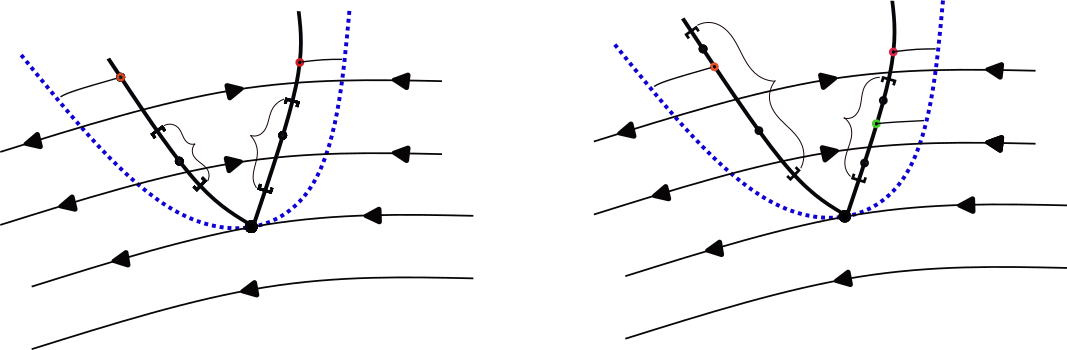 *Figure 1: Entry section σ−, exit section σ+, and definition of the slow relation function S0:L→T. *
This approach establishes a novel connection between measure-theoretic ergodic properties of S and the existence, cyclicity, and distribution of canard-induced limit cycles, providing explicit formulas for exit densities and advancing the understanding of uncertainty propagation in singularly perturbed vector fields.
Slow Relation Functions and Ergodic Structures
The slow relation (entry-exit) function S is constructed via branches of the critical manifold near a nilpotent contact point, formalizing the correspondence between entry and exit locations along transverse sections σ−,σ+ for canard trajectories. Under precise regularity and nondegeneracy assumptions on the singularity structure and slow vector field, the zeros of the slow divergence integral serve as organizing centers for the fixed points of S.
The authors systematically relate the ergodic properties of S to the bifurcation landscape of the underlying slow-fast flow:
- Unique Ergodicity: If the slow divergence integral I~ has no zeros, S admits only the Dirac measure at the contact point as an invariant measure (Theorem 1). This situation corresponds dynamically to the absence of canard cycles (limit periodic sets), with all mass accumulating at the singularity.
- Multiple Ergodic Measures: The presence of k simple zeros in I~ yields k+1 extremal invariant measures—Dirac deltas at the corresponding points—revealing the emergence of k+1 canard cycles, each organizing a distinct ergodic class (Theorem 1).
The measure-theoretic landscape is thus in bijection with the solution set of the slow divergence equation, encoding the possible periodic orbit configurations.
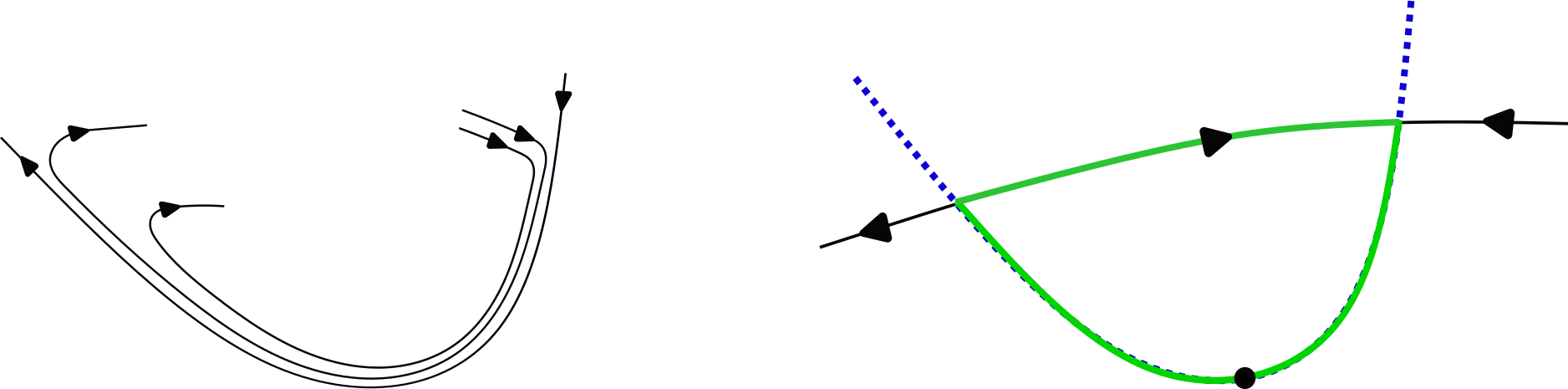
Figure 2: (a) Canard orbits illustrating the passage near the contact (turning) point. (b) Canard cycle Γ (green), which forms the skeleton for limit cycles created via singular perturbation.
Entry-Exit Distributions: Densities and Weak Convergence
A primary technical contribution is the quantification of how densities of initial conditions (entry measures) on σ− are transformed into exit measures on σ+ through the slow relation map in the weak limit ϵ→0. Depending on the global bifurcation geometry, two regimes are distinguished:
- Tunnel Case: When the interval of accessible divergence values satisfies −I~−(sc−)≤I~+(sc+), all entry densities push-forward via S0 to smooth exit densities; weak convergence of measures is shown (Theorem 4).
- Funnel/Buffer Case: If −I~−(sc−)>I~+(sc+), the dynamic splits into tunnel and funnel regions with a buffer point; the exit measure converges weakly to a mixture of the pushforward of the original entry measure under S0 for the tunnel and a Dirac mass at the image of the buffer for the funnel (Theorem 4, formula (39)).
Explicit density transformation formulas are given in terms of the derivatives of the slow divergence integrals and the inverse of S0, e.g.,
Dex(s+)=−Den(S0−1(s+))I~−′(S0−1(s+))I~+′(s+)1T(s+)
for absolutely continuous entry measures.
The analysis is applicable to high-multiplicity (degenerate) turning points and generalized singularities, subsuming classical models such as Liénard systems, where explicit integral representations are available.
Implications for Canard Cyclicity and Limit Cycles
The correspondence between ergodic measures and zeros of the slow divergence integral is leveraged to provide upper bounds on the cyclicity of canard cycles for both generic (slow-fast Hopf/turning) and degenerate (nongeneric) configurations. For instance, the cyclicity for generic turning points is at most the multiplicity of the fixed point plus one. The existence of k ergodic probability measures signals the creation of k+1 canard-induced periodic orbits, which are shown to be hyperbolic and Hausdorff-close to the corresponding singular orbits (Theorem 2, Theorem 3).
Numerical Validation and Visualization
Extensive numerical simulations support the theoretical predictions, demonstrating the convergence of exit histograms to analytic exit densities as ϵ→0 in both van der Pol systems and higher-multiplicity degenerate examples.
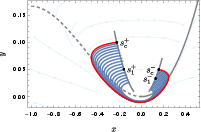
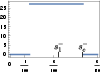
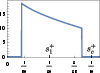
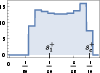
Figure 3: Numerical simulation for the tunnel case −I~−(sc−)<I~+(sc+) with ϵ=1001; right panels compare the analytic density predictions to histograms built from orbits, revealing strong weak convergence.
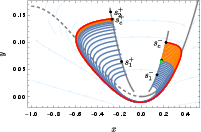
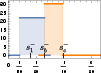


Figure 4: Numerical simulation for the funnel case −I~−(sc−)>I~+(sc+) with ϵ=1001; the exit distribution from tunnel regions is spread, whereas funnel region orbits concentrate sharply at sc+, visualizing the measure-theoretic mixture.
The figures demonstrate not only the efficacy of the measure push-forward formulas but also the structural transition in exit distributions as the critical geometry varies.
Theoretical and Practical Implications
The work provides a toolkit for quantifying the distribution and robustness of canard-induced oscillations and their sensitivity to initial conditions in multiscale systems. This is immediately relevant for models in neuroscience, chemical kinetics, and electronics, where slow passage through a Hopf bifurcation (or degenerate analogs) controls global dynamics.
From a theoretical perspective, the explicit connection between ergodic invariant measures and slow-fast bifurcation geometry opens avenues for applying advanced ergodic theory to singular perturbation problems, including random and noisy extensions.
Future directions include the extension to random dynamical systems, higher-dimensional slow-fast flows, and the integration with stochastic homogenization and uncertainty quantification frameworks.
Conclusion
This paper proposes a rigorous and comprehensive framework linking the ergodic properties of slow relation functions to the canard and limit cycle structure of planar slow-fast systems. The results deliver precise measure-theoretic characterizations of initial-to-exit uncertainty propagation, clarify the role of the slow divergence integral as a bifurcation invariant, and provide effective computational methods for density evolution in singular perturbation contexts. The interplay between invariant measure structure and system geometry is made explicit, yielding both theoretical insight and practical analytic tools.