Papers
Topics
Authors
Recent
Search
2000 character limit reached

Shorts vs. Regular Videos on YouTube: A Comparative Analysis of User Engagement and Content Creation Trends

Published 1 Mar 2024 in cs.SI | (2403.00454v1)

Abstract: YouTube introduced the Shorts video format in 2021, allowing users to upload short videos that are prominently displayed on its website and app. Despite having such a large visual footprint, there are no studies to date that have looked at the impact Shorts introduction had on the production and consumption of content on YouTube. This paper presents the first comparative analysis of YouTube Shorts versus regular videos with respect to user engagement (i.e., views, likes, and comments), content creation frequency and video categories. We collected a dataset containing information about 70k channels that posted at least one Short, and we analyzed the metadata of all the videos (9.9M Shorts and 6.9M regular videos) they uploaded between January 2021 and December 2022, spanning a two-year period including the introduction of Shorts. Our longitudinal analysis shows that content creators consistently increased the frequency of Shorts production over this period, especially for newly-created channels, which surpassed that of regular videos. We also observe that Shorts target mostly entertainment categories, while regular videos cover a wide variety of categories. In general, Shorts attract more views and likes per view than regular videos, but attract less comments per view. However, Shorts do not outperform regular videos in the education and political categories as much as they do in other categories. Our study contributes to understanding social media dynamics, to quantifying the spread of short-form content, and to motivating future research on its impact on society.

Definition Search Book Streamline Icon: https://streamlinehq.com
References (42)
  1. Researching YouTube. Convergence 24, 1 (Feb. 2018), 3–15. https://doi.org/10.1177/1354856517737222
  2. Xiang Bi and Cunchen Tang. 2020. Research on the Motives Affecting the Behavior of Short Video’s Creators. IEEE Access 8 (2020), 188415–188428. https://doi.org/10.1109/ACCESS.2020.3028392
  3. Maximilian Boeker and Aleksandra Urman. 2022. An empirical investigation of personalization factors on tiktok. In Proceedings of the ACM Web Conference 2022. 2298–2309.
  4. Characterizing and modelling popularity of user-generated videos. In Performance Evaluation.
  5. Joshua Braun. 2023. Journalism, Media Research, and Mastodon: Notes on the Future. Digital Journalism (2023), 1–8.
  6. Analyzing the Video Popularity Characteristics of Large-Scale User Generated Content Systems. In IEEE/ACM Transactions on Networking.
  7. Short-Form Videos Degrade Our Capacity to Retain Intentions: Effect of Context Switching On Prospective Memory. In Proceedings of the 2023 CHI Conference on Human Factors in Computing Systems (CHI ’23). Association for Computing Machinery, New York, NY, USA, 1–15. https://doi.org/10.1145/3544548.3580778
  8. Brian Dean. 2023. TikTok User Statistics. https://backlinko.com/tiktok-users.
  9. Tugrulcan Elmas. 2023. The Impact of Data Persistence Bias on Social Media Studies. In Proceedings of the 15th ACM Web Science Conference 2023. 196–207.
  10. A Dataset of State-Censored Tweets.. In ICWSM. 1009–1015.
  11. Misleading repurposing on twitter. In Proceedings of the International AAAI Conference on Web and Social Media, Vol. 17. 209–220.
  12. How constraints affect content: The case of Twitter’s switch from 140 to 280 characters. In Proceedings of the International AAAI Conference on Web and Social Media, Vol. 12.
  13. James Hale. 2021. YouTube Shorts Launches $100 Million Fund To Pay Creators Of Top Videos. https://www.tubefilter.com/2021/05/11/youtube-shorts-100-million-creator-fund/.
  14. YouTube Help. 2021. New Features and Updates for Shorts Viewers & Creators. https://support.google.com/youtube/thread/139221507.
  15. Analyzing disinformation and crowd manipulation tactics on YouTube. In 2018 IEEE/ACM International Conference on Advances in Social Networks Analysis and Mining (ASONAM). IEEE, 1092–1095.
  16. Measuring Misinformation in Video Search Platforms: An Audit Study on YouTube. In Proceedings of the ACM on Human-Computer Interaction.
  17. Trick and please. A mixed-method study on user assumptions about the TikTok algorithm. In Proceedings of the 13th ACM Web Science Conference 2021. 84–92.
  18. Resolving content moderation dilemmas between free speech and harmful misinformation. Proceedings of the National Academy of Sciences 120, 7 (2023), e2210666120.
  19. The algorithmic crystal: Conceptualizing the self through algorithmic personalization on TikTok. Proceedings of the ACM on Human-computer Interaction 6, CSCW2 (2022), 1–22.
  20. Whose Advantage? Measuring Attention Dynamics across YouTube and Twitter on Controversial Topics. 16 (2022), 573–583. https://doi.org/10.1609/icwsm.v16i1.19316
  21. ” Learn the Facts About COVID-19”: Analyzing the Use of Warning Labels on TikTok Videos. In Proceedings of the International AAAI Conference on Web and Social Media, Vol. 17. 554–565.
  22. Have you been properly notified? automatic compliance analysis of privacy policy text with GDPR article 13. In Proceedings of the Web Conference 2021. 2154–2164.
  23. Dancing to the partisan beat: A first analysis of political communication on TikTok. In Proceedings of the 12th ACM Conference on Web Science. 257–266.
  24. Information operations in turkey: Manufacturing resilience with free twitter accounts. In Proceedings of the International AAAI Conference on Web and Social Media, Vol. 17. 638–649.
  25. “It Is Just a Flu”: Assessing the Effect of Watch History on YouTube’s Pseudoscientific Video Recommendations. 16 (2022), 723–734. https://ojs.aaai.org/index.php/ICWSM/article/view/19329
  26. Orestis Papakyriakopoulos and Ellen Goodman. 2022. The impact of Twitter labels on misinformation spread and user engagement: Lessons from Trump’s election tweets. In Proceedings of the ACM web conference 2022. 2541–2551.
  27. Manoel Horta Ribeiro and Robert West. 2021. YouNiverse: Large-Scale Channel and Video Metadata from English-Speaking YouTube. In ICWSM. 1016–1024.
  28. Ellen Simpson and Bryan Semaan. 2021. For You, or For” You”? Everyday LGBTQ+ Encounters with TikTok. Proceedings of the ACM on human-computer interaction 4, CSCW3 (2021), 1–34.
  29. Matt G. Southern. 2022. YouTube Shorts Hits 30 Billion Views Per Day. https://www.searchenginejournal.com/youtube-shorts-hits-30-billion-views-per-day/447785/.
  30. Viewing personalized video clips recommended by TikTok activates default mode network and ventral tegmental area. NeuroImage 237 (2021), 118136.
  31. Todd Sherman. 2021. Bringing YouTube Shorts to the U.S. https://blog.youtube/news-and-events/youtube-shorts-united-states/.
  32. Victor Potrel. 2022. Five Insights Into The Popularity Of Short-Form Video Content. https://www.forbes.com/sites/forbescommunicationscouncil/2022/09/06/five-insights-into-the-popularity-of-short-form-video-content/.
  33. Kexin Wang and Sebastian Scherr. 2022. Dance the Night Away: How Automatic TikTok Use Creates Pre-Sleep Cognitive Arousal and Daytime Fatigue. Mobile Media & Communication 10, 2 (May 2022), 316–336. https://doi.org/10.1177/20501579211056116
  34. The YouTube Social Network. https://ojs.aaai.org/index.php/ICWSM/article/view/14243. 6, 1 (2012), 354–361. Number: 1.
  35. Siqi Wu and Paul Resnick. 2021. Cross-Partisan Discussions on YouTube: Conservatives Talk to Liberals but Liberals Don’t Talk to Conservatives. In Proceedings of the Fifteenth International AAAI Conference on Web and Social Media, ICWSM 2021, held virtually, June 7-10, 2021, Ceren Budak, Meeyoung Cha, Daniele Quercia, and Lexing Xie (Eds.). AAAI Press, 808–819. https://ojs.aaai.org/index.php/ICWSM/article/view/18105
  36. YouTube Developers. 2022. YouTube Data API — Google for Developers. https://developers.google.com/youtube/v3/.
  37. YouTube Help. 2023a. Create Shorts. https://support.google.com/youtube/topic/10343432.
  38. YouTube Help. 2023b. Upload Videos. https://support.google.com/youtube/topic/16547.
  39. YouTube Research. 2022a. Program Terms & Conditions. https://research.youtube/policies/terms/.
  40. YouTube Research. 2022b. YouTube Researcher Program. https://research.youtube/.
  41. Jing Zeng and Crystal Abidin. 2021. ‘# OkBoomer, time to meet the Zoomers’: Studying the memefication of intergenerational politics on TikTok. Information, Communication & Society 24, 16 (2021), 2459–2481.
  42. Driving Factors and Moderating Effects Behind Citizen Engagement With Mobile Short-Form Videos. IEEE Access 10 (2022), 40999–41009. https://doi.org/10.1109/ACCESS.2022.3167687
Citations (3)

Summary

  • The paper finds that YouTube Shorts rapidly generate higher views and likes per video compared to regular videos.
  • The paper employs a robust, large-scale longitudinal analysis using metadata from over 70,000 channels to uncover evolving content production dynamics.
  • The paper highlights that while Shorts foster viral attention, they show lower active engagement, preserving distinct niches for regular videos.

Comparative Dynamics of YouTube Shorts and Regular Videos

Data Collection and Methodology

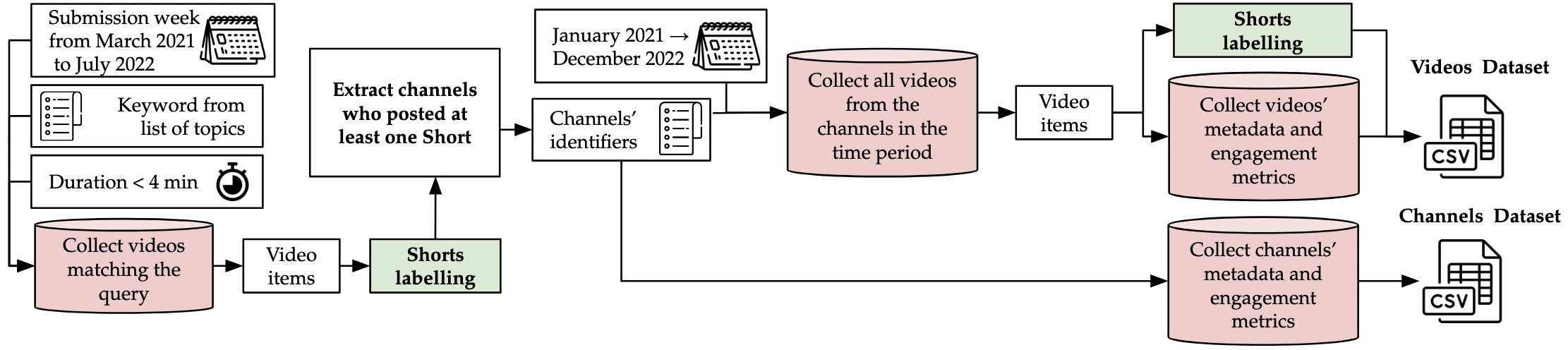
The study employs a large-scale dataset comprising metadata from over 70,000 YouTube channels that uploaded at least one Short, covering a corpus of 9.9 million Shorts and 6.9 million regular videos (RVs) from January 2021 to December 2022. Data was obtained using the YouTube Data API with extensive crawling protocols, enabling longitudinal analysis across the critical period bracketing Shorts' worldwide introduction.

The data collection strategy is methodologically robust relative to platform limitations, with methodological nuances (such as using TikTok keywords for initial seeding) and explicit acknowledgment of possible keyword-induced bias. All extracted videos were carefully classified using a multi-step protocol to distinguish Shorts from RVs, followed by comprehensive retrieval of video- and channel-level features, including category, engagement metrics, and temporal properties. Figure 1

Figure 1: Data collection process summary.

Evolution of Content Production Dynamics

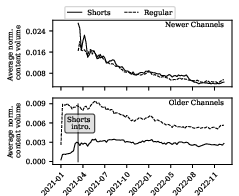
Temporal analysis reveals a sustained increase in Shorts uploads post-introduction, contrasted with stable absolute RV volumes but a clear decrease in per-channel RV posting frequency. Notably, newer channels (post-March 2021) disproportionately adopted Shorts, often to the exclusion of RVs, whereas established channels exhibited a more gradual transition, with many entering mixed-mode production but trending toward Shorts dominance over time.

The relative growth in Shorts is not fully offset by a contraction in RVs, resulting in a clear migration of content creation effort toward the short-form paradigm. Aggregate weekly content volume analysis, normalized at the channel level, shows a plateau in Shorts creation among older channels and a declining contribution from RVs, with newer channels accounting for an initial surge in Shorts volume followed by attrition. Figure 2

Figure 3: Evolution of normalized weekly content volume indicating the temporal redistribution of content creation effort toward Shorts.

Thematic Content Shifts and Categorical Preferences

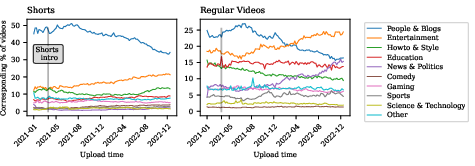
Analysis of category assignments uncovers pronounced distinctions in how Shorts and RVs are utilized. Shorts are heavily concentrated in "lightweight" categories such as People & Blogs, Entertainment, and Comedy, with the Entertainment category gaining share over time. RVs, by contrast, display considerably greater thematic diversity, with substantive representation in categories such as Education, News & Politics, and Science & Technology.

The temporal evolution of category shares demonstrates that while Shorts cement their dominance in entertainment-centric spaces, the relative homogeneity of Shorts themes stands in contrast to the heterogeneity of RV content pools, with RVs showing persistent diversity and certain non-entertainment categories (e.g., News & Politics, Education) remaining RV-centric through the observation window. Figure 4

Figure 5: Evolution of the percentage of categories attributed to Shorts and RVs, emphasizing distinct thematic preferences.

Engagement Metrics: Scale and Structure

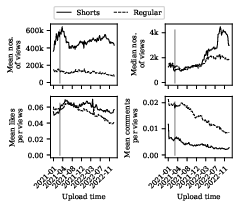
Video-level metrics indicate Shorts generate, on average, higher view and like counts per video compared to RVs. By the end of 2022, Shorts accumulated approximately six times the number of views per video, with both mean and median views indicating monotonically increasing trends for Shorts during the observation period. However, the distribution of engagement is highly skewed; the top 1% of Shorts and RVs account for over 60% of respective cumulative views, underscoring extreme virality and the consistent power-law structure of attention allocation.

Likes per view are systematically higher for Shorts, with the gap with RVs widening over time. However, comments per view remain higher for RVs, although this differential is diminishing—indicative of the comparatively passive engagement style inherent to the Shorts consumption interface (e.g., swiping vs. targeted selection). Figure 6

Figure 7: Evolution of engagement metrics, highlighting Shorts' expansion in views and likes per view, and the relative lag in comments per view.

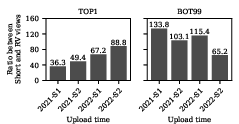
Additional granularity is provided via channel-level disaggregation. For channels producing both formats, Shorts consistently outperform RVs in attracting views, with the ratio exceeding 110x for the bottom 99% of channels and 80x for the top 1% (by subscriber count). However, there is temporal heterogeneity: the Shorts/RV view ratio increases for highly popular channels while showing a downward trend for others, potentially reflecting algorithmic or consumption-model refinements. Figure 8

Figure 2: Evolution of average ratio between Shorts' and RVs' views per channel, stratified by channel size.

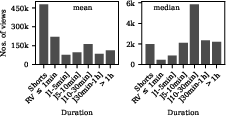
Duration analysis further demonstrates that while Shorts (≤ 1 minute) outperform the mean and median views of most RV duration buckets, the 10–30 minute RV segment achieves a notably high median view count, even exceeding that of Shorts, thus challenging the view that Shorts universally dominate all aspects of engagement and hinting at the persistent value of mid-form RVs among "core" YouTube viewers. Figure 9

Figure 4: Mean and median number of views for Shorts and RVs, stratified by video duration, revealing nontrivial audience retention in mid-length RVs.

Theoretical and Practical Implications

The empirical evidence suggests a paradigm shift in video production and engagement strategies following the introduction of Shorts. Short-form video catalyzes greater content output volumes and facilitates access to viral attention, particularly for channels with limited prior penetration. However, the thematic narrowing toward entertainment and lifestyle content implies that the Shorts format does not completely substitute for RVs, particularly in categories demanding depth (e.g., education, politics, art).

In terms of engagement, Shorts optimize for frictionless, passive consumption, driving up aggregate views and likes but structurally limiting active engagement such as commenting. This suggests Shorts are less suited, in current form, to fostering deliberative or educative interactions and may reinforce entertainment-forward temporal flows. Algorithmic adjustments by the platform (e.g., expanded Shorts recommendations, differing surfacing strategies) likely mediate both the production incentives and engagement outcomes observed.

These findings inform ongoing debates in social computing, HCI, and platform studies regarding content fragmentation, audience accessibility, and the socio-technical determinants of creative labor. For platform operators, the rise of Shorts provides a potent vector for driving watch-time and increasing creator onboarding, albeit with potential trade-offs in thematic diversity and engagement quality.

Limitations and Future Research Directions

Dataset construction is subject to topical and channel selection biases due to API constraints and keyword-dependent sampling. The focus on channels producing at least one Short necessarily omits the "resistor" subpopulation and precludes panoramic statements about Shorts adoption across the full YouTube ecosystem. Furthermore, engagement metrics are time-bound to a snapshot as of September 2023, which may privilege older content in aggregate comparisons.

Future research should address comparative causal inference of Shorts adoption, conduct user-centric interactional analyses (e.g., via comment text or qualitative methods), and link content-format shifts to longitudinal audience migration and monetization efficacy. A broader comparative analysis incorporating platforms such as TikTok and Instagram Reels will further contextualize YouTube Shorts in the wider short-form video ecosystem.

Conclusion

This analysis provides rigorous empirical characterization of Shorts' transformative effect on YouTube, highlighting its catalysis of increased content creation and attention allocation while uncovering persistent categorical boundaries and engagement modality discrepancies relative to RVs. Shorts have become a dominant vector for entertainment-based virality but have not supplanted the functional niche of regular videos for educational, political, and artistic purposes. Ongoing developments in platform affordances and algorithmic surfacing will determine the future equilibrium between these content forms.

Whiteboard

No one has generated a whiteboard explanation for this paper yet.

Open Problems

We haven't generated a list of open problems mentioned in this paper yet.

Collections

Sign up for free to add this paper to one or more collections.

Tweets

Sign up for free to view the 2 tweets with 8 likes about this paper.