Papers
Topics
Authors
Recent
Search
2000 character limit reached

CleanAgent: Automating Data Standardization with LLM-based Agents

Published 13 Mar 2024 in cs.LG, cs.AI, and cs.MA | (2403.08291v4)

Abstract: Data standardization is a crucial part of the data science life cycle. While tools like Pandas offer robust functionalities, their complexity and the manual effort required for customizing code to diverse column types pose significant challenges. Although LLMs like ChatGPT have shown promise in automating this process through natural language understanding and code generation, it still demands expert-level programming knowledge and continuous interaction for prompt refinement. To solve these challenges, our key idea is to propose a Python library with declarative, unified APIs for standardizing different column types, simplifying the LLM's code generation with concise API calls. We first propose Dataprep.Clean, a component of the Dataprep Python Library, significantly reduces the coding complexity by enabling the standardization of specific column types with a single line of code. Then, we introduce the CleanAgent framework integrating Dataprep.Clean and LLM-based agents to automate the data standardization process. With CleanAgent, data scientists only need to provide their requirements once, allowing for a hands-free process. To demonstrate the practical utility of CleanAgent, we developed a user-friendly web application, allowing users to interact with it using real-world datasets.

Citations (6)

Summary

  • The paper introduces CleanAgent, which integrates LLMs with Dataprep.Clean to automate complex data standardization processes.
  • It employs a declarative API for type-specific standardization, encapsulating splitting, validation, and transformation steps.
  • The framework minimizes user intervention through an autonomous workflow and interactive web GUI for natural language-based refinement.

CleanAgent: Automating Data Standardization with LLM-based Agents

The paper "CleanAgent: Automating Data Standardization with LLM-based Agents" presents a novel approach to automating data standardization utilizing the capabilities of LLMs integrated with a Python library called Dataprep.Clean. This framework, called CleanAgent, aims to simplify the data preparation process in data science workflows by reducing the complexity and manual effort required to standardize heterogeneous data formats across various column types.

Introduction

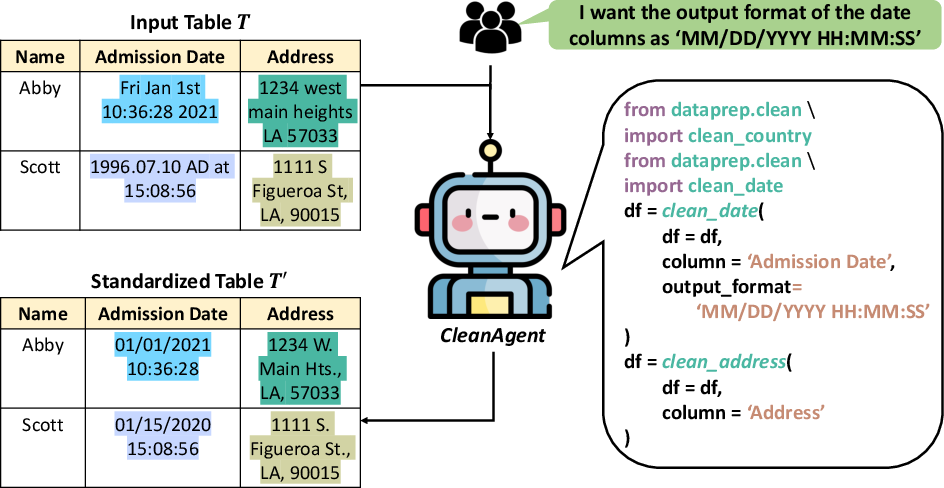
Data standardization is an essential preprocessing step in data science, facilitating efficient data integration, analysis, and decision-making. Conventional methods employing tools like Pandas often demand extensive programming efforts, particularly for complex datasets with multiple column types. The emergence of LLMs, such as ChatGPT, offers potential enhancements in automating code generation for data standardization through natural language processing. However, the requirement for expert-level programming skills and iterative prompt improvements poses limitations. Figure 1

Figure 1: An example of automatic data standardization process with CleanAgent.

Type-Specific Standardization API Design

The authors propose a declarative approach to API design in their Dataprep library, aimed at streamlining the standardization of specific column types. The planned structure is highly unified and concise:

1
clean_type(df, column_name, target_format)

This API design is motivated by three common steps in data standardization:

  1. Splitting: Extract individual components from data entries.
  2. Validation: Ensure data parts conform to expected formats.
  3. Transformation: Convert data into the desired target format.

Dataprep.Clean simplifies the task by encapsulating complex procedures into type-specific API calls, thereby enabling data scientists to perform standardization with minimal coding effort.

CleanAgent Framework

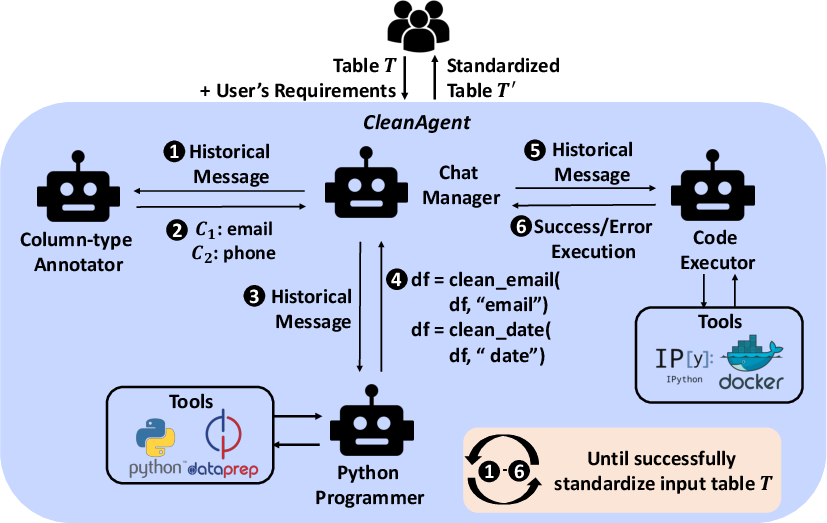
CleanAgent integrates Dataprep.Clean with LLM-based agents to enable autonomous data standardization. The agents, encompassing a Chat Manager, a Column-type Annotator, a Python Programmer, and a Code Executor, collectively execute the standardization workflow:

  • Chat Manager: Coordinates communication and retains contextual data.
  • Column-type Annotator: Leverages LLMs to classify column data types.
  • Python Programmer: Instantiates standardization code using Dataprep.Clean APIs.
  • Code Executor: Executes the generated code to produce standardized datasets.

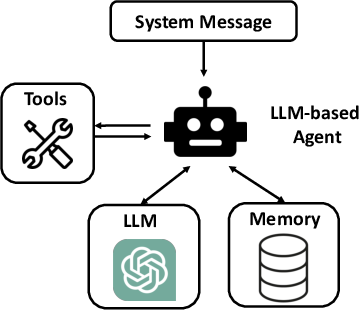
The framework minimizes user intervention to a single input of standardization requirements, automating subsequent processes. Figure 2

Figure 2: Basic Structure of LLM-based Agent.

Figure 3

Figure 3: The Workflow of CleanAgent.

Demonstration

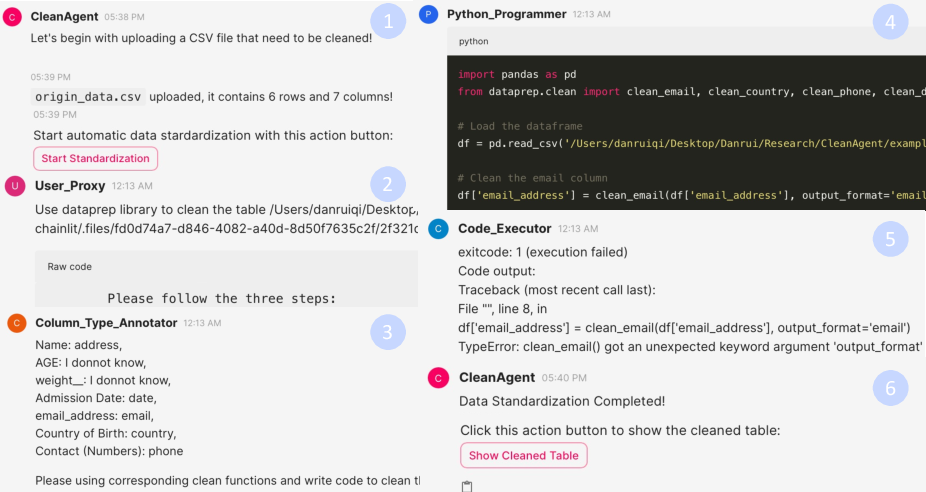
CleanAgent is implemented as a web application providing users with a GUI to interact with their datasets. Users can upload datasets and specify standardization targets; CleanAgent then proceeds to autonomously accomplish the standardization task. The web application facilitates visualization and interaction with the agents' processes, permitting users to iteratively refine outputs through natural language inputs. Figure 4

Figure 4: User interface of CleanAgent.

Conclusion

CleanAgent exemplifies the symbiotic integration of Dataprep.Clean and LLM-based agents to address data standardization challenges in data science workflows. This model highlights potential for further exploration of LLMs in automating other data science tasks. Future work may investigate expanding this framework to encompass broader aspects of data preparation, cleaning, and visualization.

Paper to Video (Beta)

No one has generated a video about this paper yet.

Whiteboard

No one has generated a whiteboard explanation for this paper yet.

Open Problems

We haven't generated a list of open problems mentioned in this paper yet.

Collections

Sign up for free to add this paper to one or more collections.

Tweets

Sign up for free to view the 3 tweets with 0 likes about this paper.