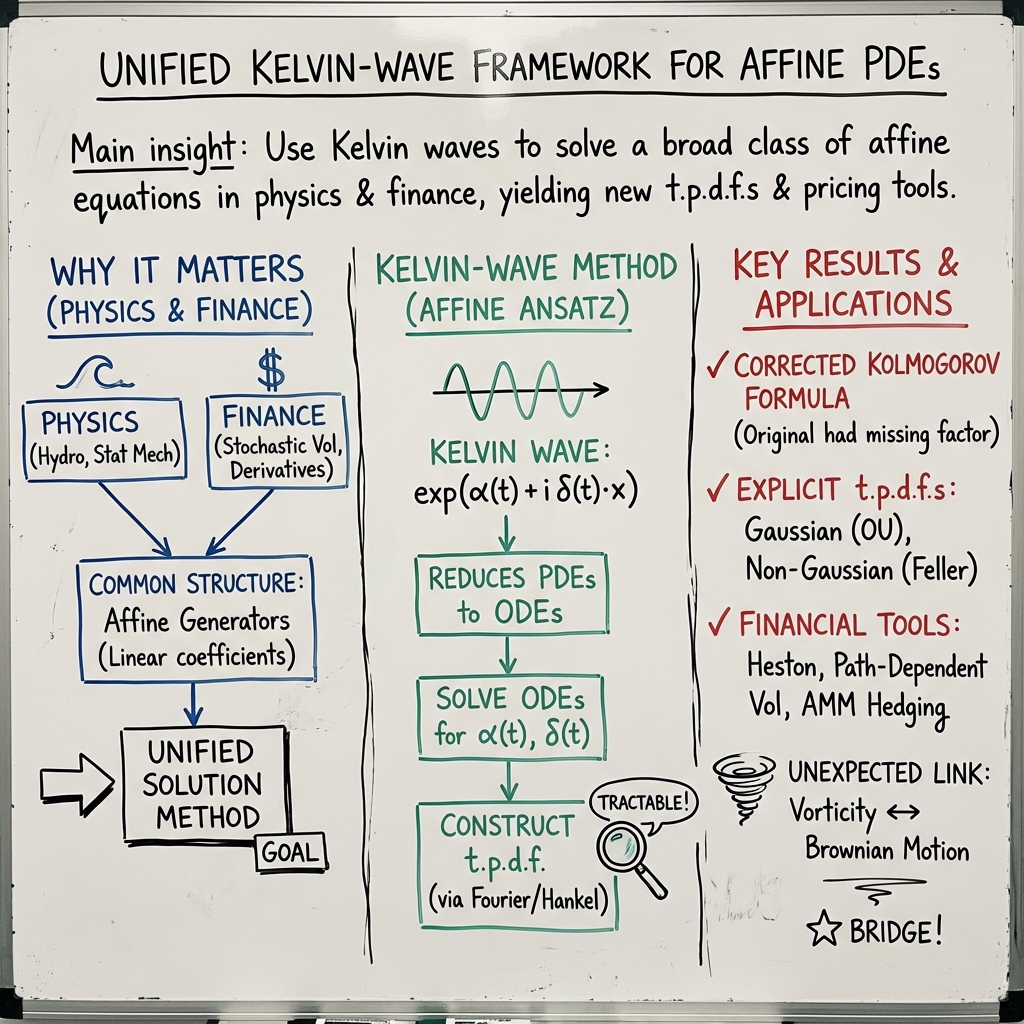
- The paper introduces a method leveraging Kelvin waves to solve classical PDEs in finance, enhancing pricing accuracy for derivatives and managing risk.
- It employs affine and pseudo-differential equations alongside fluid dynamics and stochastic processes to address hedging challenges.
- The study uncovers deep analogies between fluid mechanics and financial modeling, paving the way for advanced quantitative techniques.
Detailed Summary of "Hydrodynamics of Markets: Hidden Links Between Physics and Finance"
Introduction
The paper "Hydrodynamics of Markets: Hidden Links Between Physics and Finance" (2403.09761) explores intriguing connections between hydrodynamics, molecular physics, stochastic processes, and financial engineering. It focuses on small perturbations in fluid flows described by classical equations such as the Euler, Navier-Stokes equations, and stochastic models like the Klein-Kramers and Feller processes. This work demonstrates how Kelvin waves, originally used in fluid mechanics, can be applied to study complex financial models including the famous Black-Scholes, Heston, and Stein-Stein systems, as well as path-dependent volatility models.
Mathematical Framework
The mathematical foundation of the paper lies in the use of affine differential and pseudo-differential equations. The paper highlights generalized applications of Kolmogorov equations in describing financial systems and transitions. By utilizing Kelvin waves, the research simplifies and solves these equations, providing numerical results that are innovative in applying physics-based methods to finance. The transition probabilities, instrumental in financial modeling, are approached using the Kelvin wave methodology, offering insights into complex financial derivatives like hedging impermanent losses in cryptocurrency trading.
Main Results
The paper presents a coherent methodology for solving various classical and new problems involving Kelvin waves. It provides solutions to hydrodynamics problems of ideal and viscous fluids, path-dependent options in finance, and processes with stochastic volatility. The corrected solutions to the Kolmogorov equation elucidate dimensional inaccuracies in traditional models, opening pathways to more precise predictions of financial derivatives. The research unveils unexpected analogies between fluid vorticity equations and financial models, allowing a novel representation of flow dynamics and volatility movements.
Practical Implications
The paper's practical implications are profound for quantitative finance. The refined models for stochastic volatility and interest rates improve the predictive accuracy of pricing financial instruments. The entire framework is interdisciplinary, indicating a shift in how financial products like options, swaps, and bonds are priced and risk-managed. The novel path-dependent volatility model discussed could alter traditional risk management strategies, enabling the development of robust hedging instruments, particularly in turbulent market environments.
Theoretical Implications
Theoretically, the paper extends the application of Kelvin waves far beyond fluid mechanics. By connecting nonlinear hydrodynamic flows with degenerate and non-degenerate stochastic processes, it opens up a new field of cross-disciplinary research. The solutions not only enrich the understanding of PDEs in financial contexts but also provide powerful tools for tackling real-world problems.
Future Developments
The research indicates several promising avenues for future study, including extensions into credit derivatives pricing and advanced jump-diffusion processes. It also suggests potential developments in mean-reverting trading strategies and the exploration of high-frequency financial data through innovative mathematical constructs.
Conclusion
In conclusion, the paper establishes a comprehensive method for studying and applying Kelvin waves in finance, revealing deep interdisciplinary links and offering breakthrough solutions for complex financial modeling. The refined approach to volatility and financial derivatives holds promise for future research and practice, driving innovation at the intersection of physics and finance. These findings carry significant weight in transforming how quantitative finance approaches risk and valuation, encouraging further exploration and application of physics-inspired mathematical solutions.