Papers
Topics
Authors
Recent
Search
2000 character limit reached

AI2Apps: A Visual IDE for Building LLM-based AI Agent Applications

Published 7 Apr 2024 in cs.AI and cs.SE | (2404.04902v1)

Abstract: We introduce AI2Apps, a Visual Integrated Development Environment (Visual IDE) with full-cycle capabilities that accelerates developers to build deployable LLM-based AI agent Applications. This Visual IDE prioritizes both the Integrity of its development tools and the Visuality of its components, ensuring a smooth and efficient building experience.On one hand, AI2Apps integrates a comprehensive development toolkit ranging from a prototyping canvas and AI-assisted code editor to agent debugger, management system, and deployment tools all within a web-based graphical user interface. On the other hand, AI2Apps visualizes reusable front-end and back-end code as intuitive drag-and-drop components. Furthermore, a plugin system named AI2Apps Extension (AAE) is designed for Extensibility, showcasing how a new plugin with 20 components enables web agent to mimic human-like browsing behavior. Our case study demonstrates substantial efficiency improvements, with AI2Apps reducing token consumption and API calls when debugging a specific sophisticated multimodal agent by approximately 90% and 80%, respectively. The AI2Apps, including an online demo, open-source code, and a screencast video, is now publicly accessible.

Definition Search Book Streamline Icon: https://streamlinehq.com
References (35)
  1. AutoGPT. 2023. Autogpt. https://github.com/Significant-Gravitas/AutoGPT.
  2. Baidubce. 2023a. Appbuilder. https://cloud.baidu.com/product/AppBuilder.
  3. Baidubce. 2023b. Appbuilder-sdk. https://github.com/baidubce/app-builder.
  4. Emergent autonomous scientific research capabilities of large language models. arXiv preprint arXiv:2304.05332.
  5. Autonomous chemical research with large language models. Nature, 624(7992):570–578.
  6. Augmenting large language models with chemistry tools. In NeurIPS 2023 AI for Science Workshop.
  7. ByteDance. 2023. Coze: Next-gen ai chatbot developing platform. https://www.coze.com/.
  8. Agentverse: Facilitating multi-agent collaboration and exploring emergent behaviors in agents. arXiv preprint arXiv:2308.10848.
  9. Dataelement. 2023. Bisheng. https://github.com/dataelement/bisheng.
  10. FlowiseAI. 2023. Flowise. https://github.com/FlowiseAI/Flowise.
  11. Agentscope: A flexible yet robust multi-agent platform. arXiv preprint arXiv:2402.14034.
  12. Metagpt: Meta programming for multi-agent collaborative framework. In The Twelfth International Conference on Learning Representations.
  13. Large language models are zero-shot reasoners. Advances in neural information processing systems, 35:22199–22213.
  14. LangChain. 2023a. Langchain. https://github.com/langchain-ai/langchain.
  15. LangChain. 2023b. Langsmith. https://www.langchain.com/langsmith.
  16. LangGenius. 2023. Dify. https://github.com/langgenius/dify.
  17. Camel: Communicative agents for "mind" exploration of large language model society. In Thirty-seventh Conference on Neural Information Processing Systems.
  18. Logspace. 2023. Langflow. https://github.com/logspace-ai/langflow.
  19. Microsoft. 2023a. Autogen studio 2.0: Revolutionizing ai agents. https://autogen-studio.com/.
  20. Microsoft. 2023b. Prompt flow. https://github.com/microsoft/promptflow.
  21. Microsoft. 2023c. Prompt flow for vscode. https://marketplace.visualstudio.com/items?itemName=prompt-flow.prompt-flow.
  22. Microsoft. 2023d. Semantic kernel. https://github.com/microsoft/semantic-kernel.
  23. Microsoft. 2023e. Semantic kernel for vscode. https://learn.microsoft.com/en-us/semantic-kernel/vs-code-tools/.
  24. Microsoft. 2023f. Visual studio code - open source. https://github.com/microsoft/vscode.
  25. Yohei Nakajima. 2023. Babyagi. https://github.com/yoheinakajima/babyagi.
  26. Webgpt: Browser-assisted question-answering with human feedback. arXiv preprint arXiv:2112.09332.
  27. Openai. 2023. Explore gpts. https://chat.openai.com/gpts.
  28. Communicative agents for software development. arXiv preprint arXiv:2307.07924.
  29. Toolformer: Language models can teach themselves to use tools. Advances in Neural Information Processing Systems, 36.
  30. A survey on large language model based autonomous agents. arXiv preprint arXiv:2308.11432.
  31. Chain-of-thought prompting elicits reasoning in large language models. Advances in neural information processing systems, 35:24824–24837.
  32. Autogen: Enabling next-gen llm applications via multi-agent conversation framework. arXiv preprint arXiv:2308.08155.
  33. The rise and potential of large language model based agents: A survey. arXiv preprint arXiv:2309.07864.
  34. Openagents: An open platform for language agents in the wild. arXiv preprint arXiv:2310.10634.
  35. React: Synergizing reasoning and acting in language models. In The Eleventh International Conference on Learning Representations.
Citations (2)

Summary

  • The paper introduces AI2Apps, a visual IDE that streamlines LLM-based app development by integrating comprehensive prototyping and debugging tools.
  • It details a full-stack architecture featuring a prototyping canvas, AI-assisted code editor, specialized agent debugger, deployment tool, plugin system, and management module.
  • The study reports up to 90% reduction in token usage and 80% decrease in API calls during debugging for complex multimodal applications.

AI2Apps: A Visual IDE for Building LLM-based AI Agent Applications

Introduction

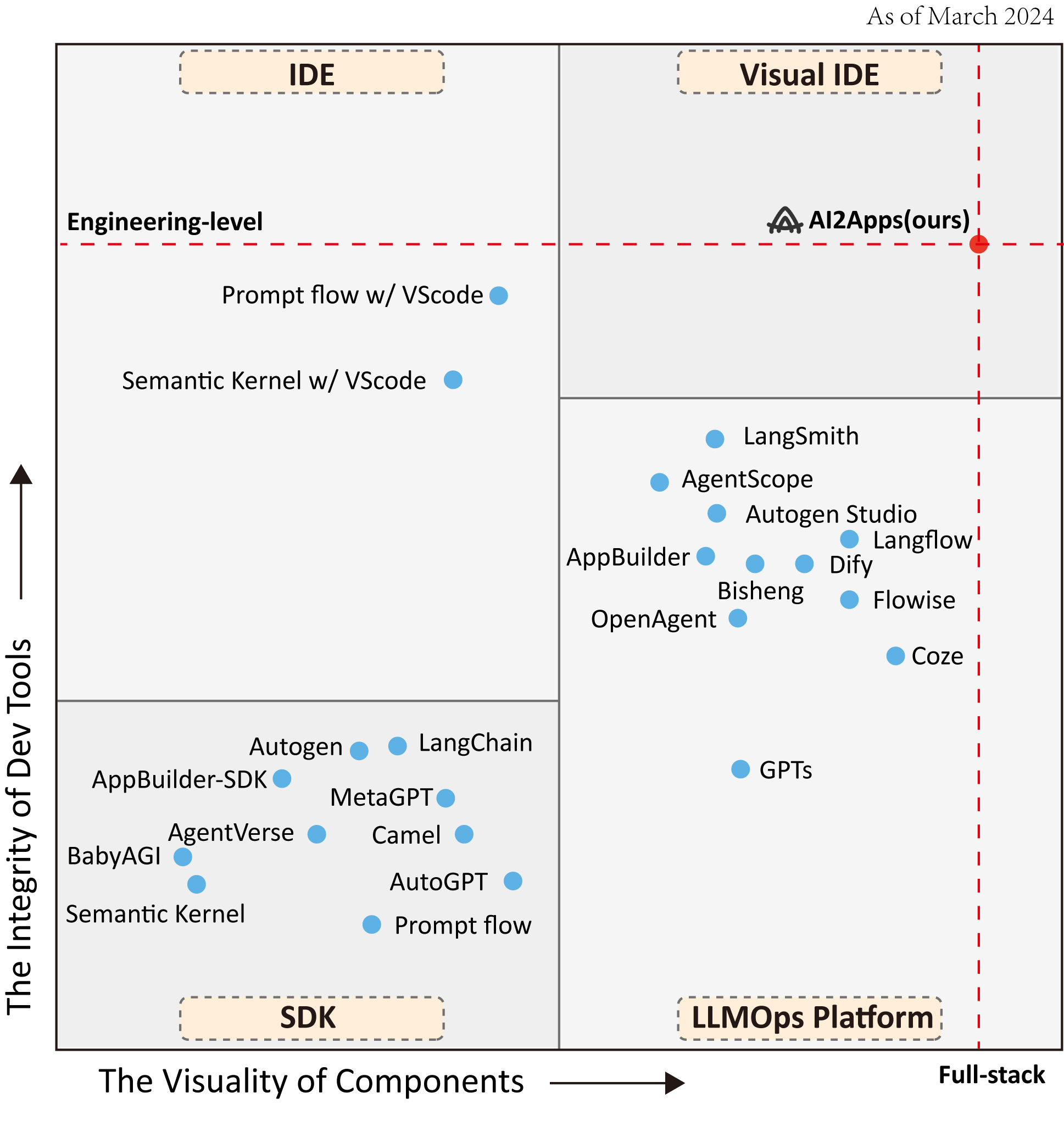
The paper "AI2Apps: A Visual IDE for Building LLM-based AI Agent Applications" presents AI2Apps as a novel development environment specifically tailored for creating applications based on LLMs. AI2Apps stands out by integrating a comprehensive suite of development tools within a web-based graphical user interface, and enhancing development efficiency through visually intuitive components. Figure 1

Figure 1: The comparison between AI2Apps and existing works on building LLM-based AI agent application is outlined, with the integrity of development tools represented on the vertical axis and the visuality of components indicated on the horizontal axis.

Architectural Overview

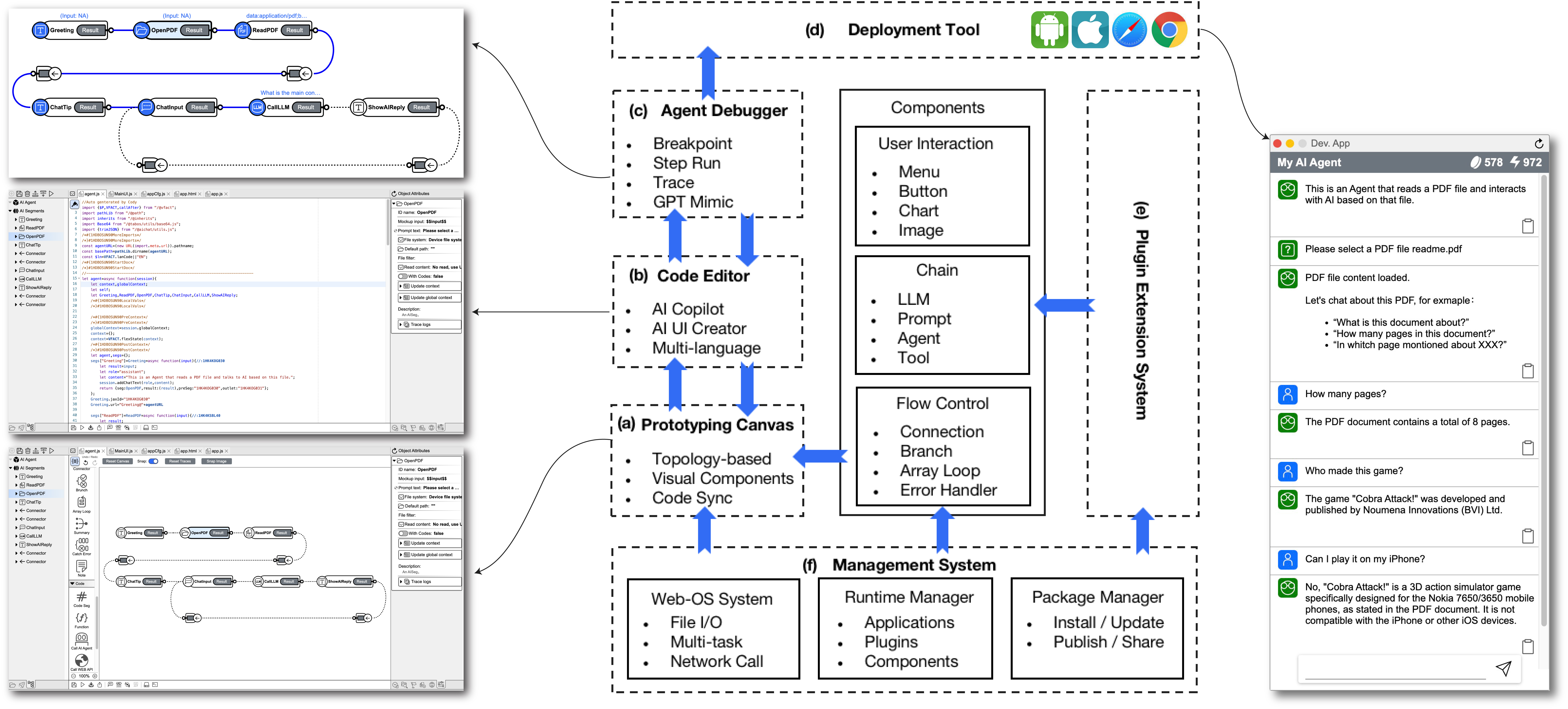
AI2Apps is described as a Visual Integrated Development Environment (IDE) with full-cycle capabilities, incorporating a range of functionalities that facilitate application development from design to deployment. The architecture of AI2Apps is segmented into several key components:

  1. Prototyping Canvas: This feature enables developers to design application logic visually by dragging and dropping components. It supports topology-based representations and visual components that simplify the development process.
  2. Code Editor: Enhanced with AI assistance, the code editor helps developers write code faster and more consistently. It supports multi-language coding and integrates tools like AI copilot for context-aware code generation.
  3. Agent Debugger: Optimized for AI agents, this debugger provides innovative tools such as topology-based debugging and simulated API returns through GPT mimic, enhancing troubleshooting and performance optimization.
  4. Deployment Tool: Allows for packaging AI agents as deployable web/mobile applications, simplifying integration with existing systems.
  5. Plugin Extension System: AI2Apps Extension (AAE) enables extensive customization through plugins, facilitating the development of complex, multi-dimensional applications.
  6. Management System: Supports operating environment management and resource scheduling, aiding in efficient application runtime operations. Figure 2

    Figure 2: Architecture of AI2Apps. The left and right sides display screenshots. (a) Prototyping Canvas utilizes built-in components for designing topology diagrams. (b) Code Editor utilizes AI assistance to continue programming the code generated in real-time by the Prototyping Canvas. (c) Agent Debugger pinpoints issues and optimizes agent performance. (d) Deployment Tool releases deployable apps. (e) Plugin Extension System introduces new components. (f) Management System supports the operating environment and resource scheduling.

Efficiency Gains

The paper highlights significant efficiency gains achieved through AI2Apps, particularly in reducing token consumption and API call frequency during debugging processes. The case study demonstrated reductions of approximately 90% in token usage and 80% in API calls for debugging a complex multimodal agent application. These results underscore the impact of AI2Apps's integrated debugging and development tools in optimizing resource usage and streamlining application development. Figure 3

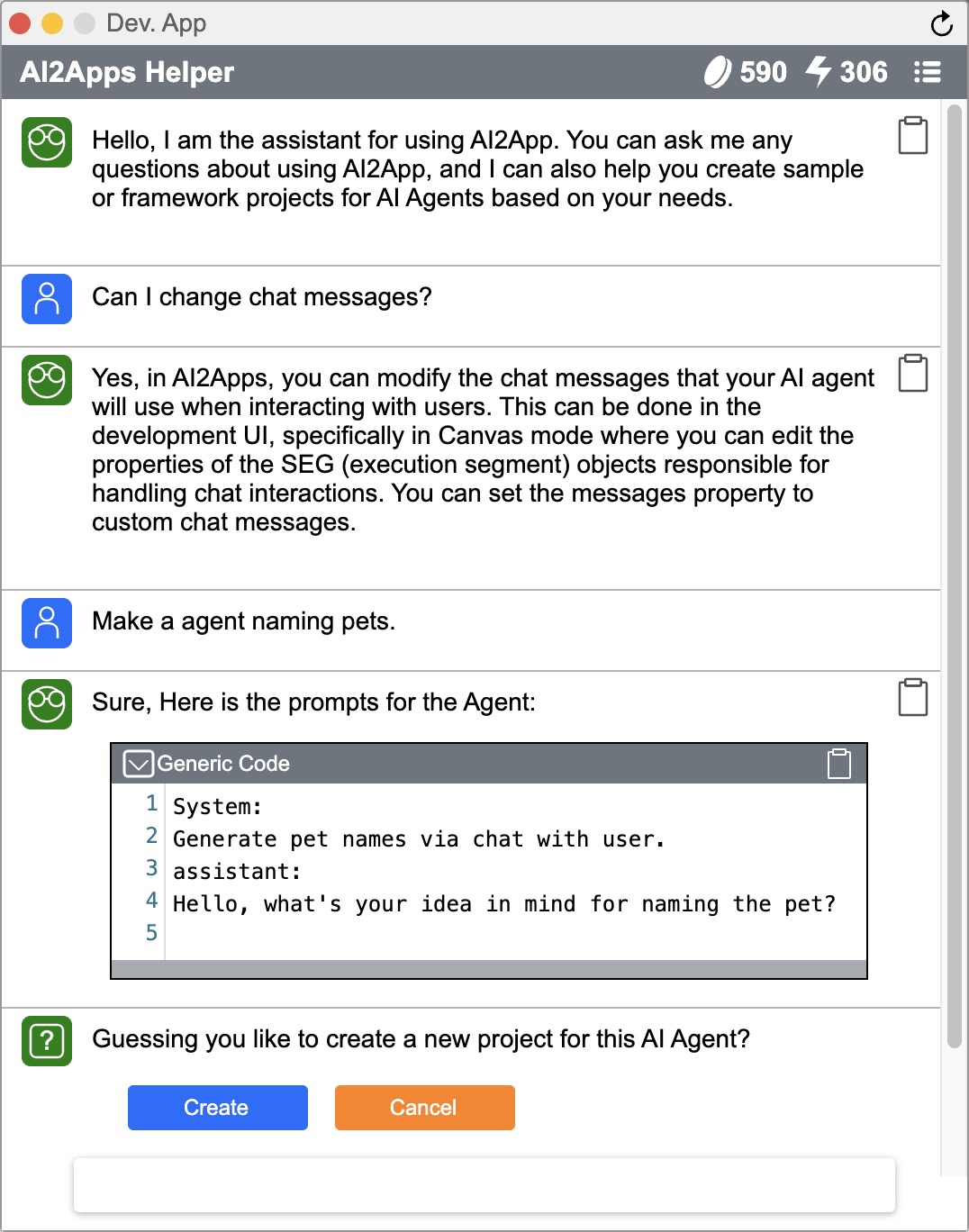
Figure 3: Screenshot of our usage assistant built by AI2Apps.

AI2Apps is benchmarked against existing LLMOps platforms, IDEs, and SDKs, evident from the comparisons in the paper. AI2Apps distinctively unifies comprehensive development tools and full-stack visuality, offering unparalleled development convenience and flexibility. As illustrated in these comparisons, AI2Apps surpasses traditional development environments by providing both engineering-level integrity and visual component manipulation, essential for efficient LLM-based application building.

Conclusion

AI2Apps represents a significant advancement in the field of AI agent application development by offering a robust Visual IDE that integrates extensive development tools and visual components. The substantial reduction in resource consumption during debugging, coupled with its extensibility and comprehensive functionality, positions AI2Apps as a prominent choice for developers. As LLM applications continue to evolve, AI2Apps's contribution to tooling and visual development is poised to facilitate further innovations and efficiency in LLM-based agent application design and deployment.

Paper to Video (Beta)

Whiteboard

No one has generated a whiteboard explanation for this paper yet.

Open Problems

We haven't generated a list of open problems mentioned in this paper yet.

Collections

Sign up for free to add this paper to one or more collections.