Papers
Topics
Authors
Recent
Search
2000 character limit reached

Enhancing Q&A with Domain-Specific Fine-Tuning and Iterative Reasoning: A Comparative Study

Published 17 Apr 2024 in cs.AI | (2404.11792v2)

Abstract: This paper investigates the impact of domain-specific model fine-tuning and of reasoning mechanisms on the performance of question-answering (Q&A) systems powered by LLMs and Retrieval-Augmented Generation (RAG). Using the FinanceBench SEC financial filings dataset, we observe that, for RAG, combining a fine-tuned embedding model with a fine-tuned LLM achieves better accuracy than generic models, with relatively greater gains attributable to fine-tuned embedding models. Additionally, employing reasoning iterations on top of RAG delivers an even bigger jump in performance, enabling the Q&A systems to get closer to human-expert quality. We discuss the implications of such findings, propose a structured technical design space capturing major technical components of Q&A AI, and provide recommendations for making high-impact technical choices for such components. We plan to follow up on this work with actionable guides for AI teams and further investigations into the impact of domain-specific augmentation in RAG and into agentic AI capabilities such as advanced planning and reasoning.

Definition Search Book Streamline Icon: https://streamlinehq.com
References (27)
  1. Iz Beltagy, Matthew E. Peters and Arman Cohan “Longformer: The Long-Document Transformer”, 2020 arXiv:2004.05150 [cs.CL]
  2. John Richard Boyd “Patterns of Conflict”, 1986 URL: http://d-n-i.net/second_level/boyd_military.htm
  3. “Language Models are Few-Shot Learners”, 2020 arXiv:2005.14165 [cs.CL]
  4. “HybridQA: A Dataset of Multi-Hop Question Answering over Tabular and Textual Data”, 2020 arXiv:2004.07347 [cs.CL]
  5. “Transformer-XL: Attentive Language Models Beyond a Fixed-Length Context”, 2019 arXiv:1901.02860 [cs.LG]
  6. “BERT: Pre-training of Deep Bidirectional Transformers for Language Understanding”, 2018 arXiv:1810.04805 [cs.CL]
  7. Robert E. Enck “The OODA Loop” In Home Health Care Management & Practice 24.3, 2012, pp. 123–124 DOI: 10.1177/1084822312439314
  8. “Retrieval-Generation Synergy Augmented Large Language Models”, 2023 arXiv:2310.05149 [cs.CL]
  9. “Prompt-Guided Retrieval Augmentation for Non-Knowledge-Intensive Tasks”, 2023 arXiv:2305.17653 [cs.CL]
  10. “Parameter-Efficient Transfer Learning for NLP”, 2019 arXiv:1902.00751 [cs.LG]
  11. “RAVEN: In-Context Learning with Retrieval-Augmented Encoder-Decoder Language Models”, 2024 arXiv:2308.07922 [cs.CL]
  12. “FinanceBench: A New Benchmark for Financial Question Answering”, 2023 arXiv:2311.11944 [cs.CL]
  13. “Active Retrieval Augmented Generation”, 2023 arXiv:2305.06983 [cs.CL]
  14. “Knowledge-Augmented Reasoning Distillation for Small Language Models in Knowledge-Intensive Tasks”, 2023 arXiv:2305.18395 [cs.CL]
  15. “UnifiedQA: Crossing Format Boundaries With a Single QA System”, 2020 arXiv:2005.00700 [cs.CL]
  16. Yann LeCun “A Path Towards Autonomous Machine Intelligence”, 2022 URL: https://openreview.net/pdf?id=BZ5a1r-kVsf
  17. “Retrieval-Augmented Generation for Knowledge-Intensive NLP Tasks”, 2021 arXiv:2005.11401 [cs.CL]
  18. “RoBERTa: A Robustly Optimized BERT Pretraining Approach”, 2019 arXiv:1907.11692 [cs.CL]
  19. “Self-Refine: Iterative Refinement with Self-Feedback”, 2023 arXiv:2303.17651 [cs.CL]
  20. “Exploring the Limits of Transfer Learning with a Unified Text-to-Text Transformer”, 2023 arXiv:1910.10683 [cs.LG]
  21. “DistilBERT, a distilled version of BERT: smaller, faster, cheaper and lighter”, 2020 arXiv:1910.01108 [cs.CL]
  22. “PlanBench: An Extensible Benchmark for Evaluating Large Language Models on Planning and Reasoning about Change”, 2022 arXiv:2206.10498 [cs.CL]
  23. “Attention Is All You Need”, 2017 arXiv:1706.03762 [cs.CL]
  24. “Self-Evaluation Guided Beam Search for Reasoning”, 2023 arXiv:2305.00633 [cs.CL]
  25. “Tree of Thoughts: Deliberate Problem Solving with Large Language Models”, 2023 arXiv:2305.10601 [cs.CL]
  26. “Retrieve Anything To Augment Large Language Models”, 2023 arXiv:2310.07554 [cs.IR]
  27. “Self-Discover: Large Language Models Self-Compose Reasoning Structures”, 2024 arXiv:2402.03620 [cs.AI]
Citations (2)

Summary

  • The paper demonstrates that fine-tuning embedding models significantly improves Q&A accuracy on domain-specific tasks.
  • The integration of iterative reasoning using the OODA loop yields a 20-25% performance gain over standard RAG configurations.
  • Experimental results on the FinanceBench SEC dataset validate the effectiveness of enhancing retrieval and generative models for expert-level accuracy.

Enhancing Q&A with Domain-Specific Fine-Tuning and Iterative Reasoning

Introduction

The paper "Enhancing Q&A with Domain-Specific Fine-Tuning and Iterative Reasoning: A Comparative Study" explores the application of domain-specific fine-tuning and iterative reasoning to question-answering (Q&A) systems powered by LLMs and retrieval-augmented generation (RAG). Leveraging the FinanceBench SEC financial filings dataset, the study demonstrates how fine-tuning embedding models coupled with LLMs significantly increases accuracy over generic models, with the greatest gains coming from fine-tuned embedding models. Additionally, the implementation of reasoning iterations on RAG further enhances performance, pushing the Q&A systems closer to human-expert quality.

Methodology

The study introduces a framework that enhances Q&A accuracy by integrating iterative reasoning mechanisms and domain-specific fine-tuning. This involves:

  1. Fine-Tuning Embedding Models: The fine-tuning process utilizes text-embedding models to more accurately index and retrieve domain-specific data. In particular, the study evaluates BAAI's bge-large-en model which outperformed its predecessors on retrieval benchmarks.
  2. Fine-Tuning Generative Models: Through fine-tuning LLMs such as GPT-3.5-turbo, the Q&A systems can synthesize answers more aligned with domain-specific logic and presentation styles.
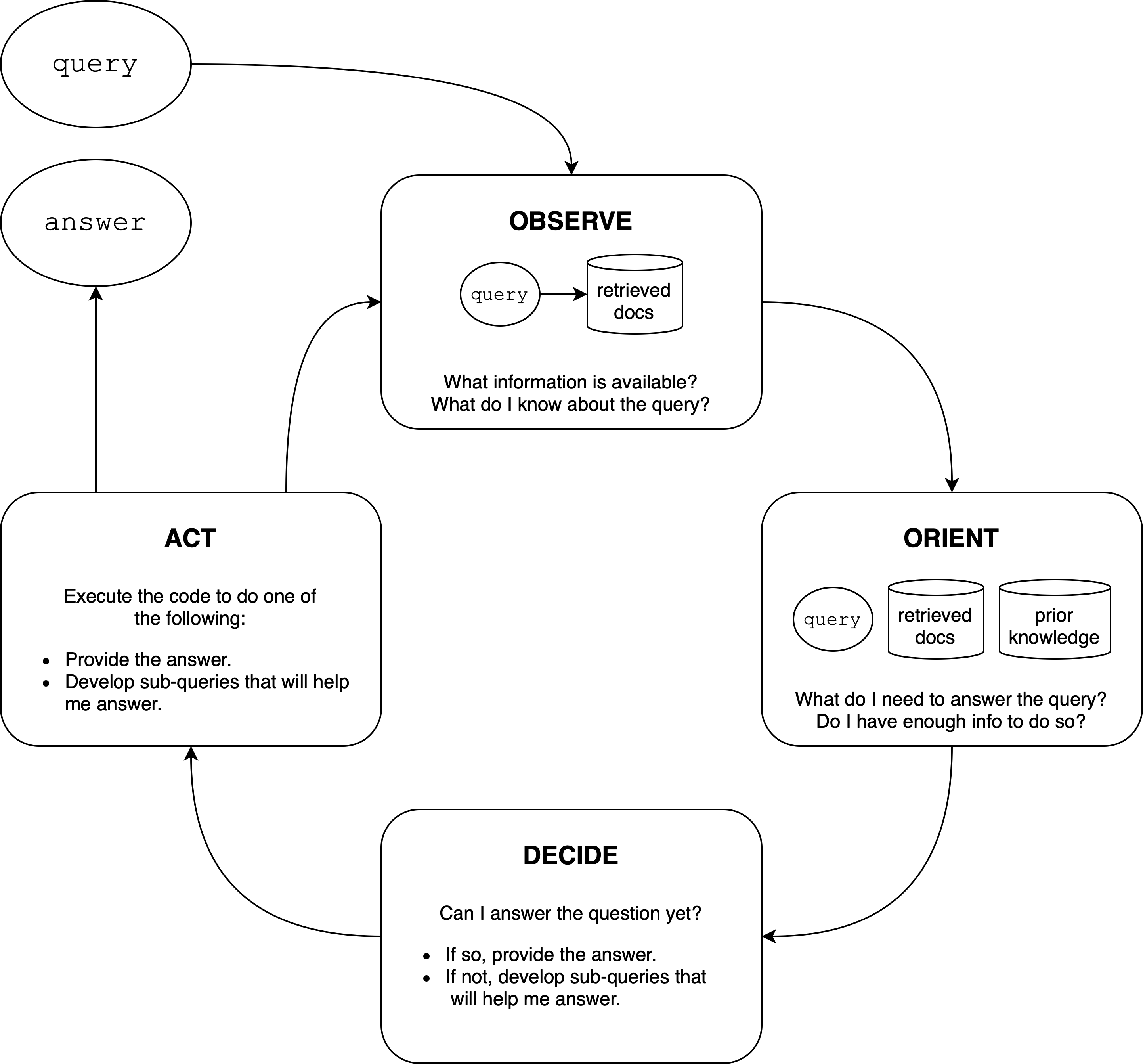
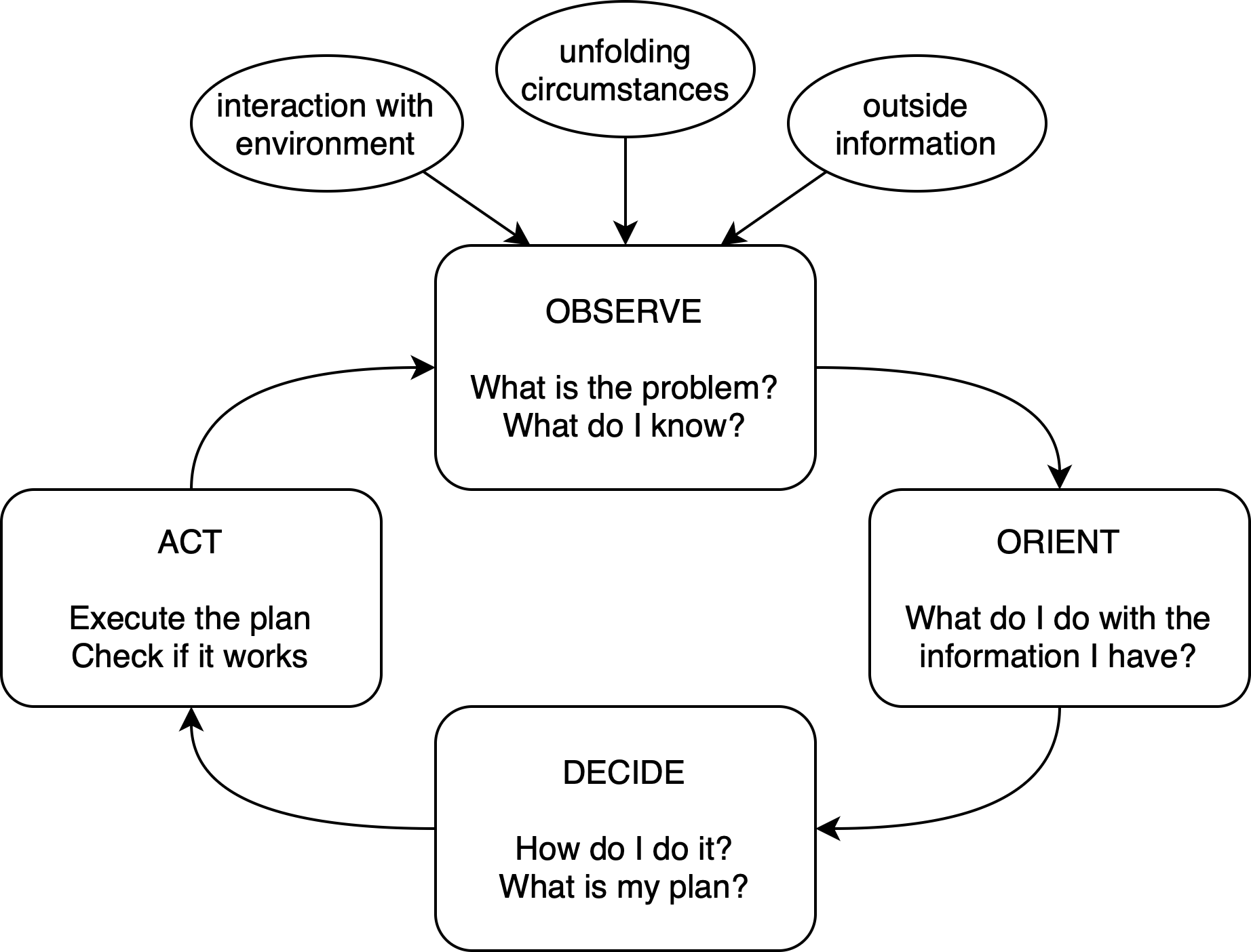
  3. Iterative Reasoning through OODA: The study integrates the Observe-Orient-Decide-Act (OODA) loop into RAG-based systems, allowing for multi-step reasoning, which is crucial for complex Q&A tasks. Figure 1

    Figure 1: A typical OODA reasoning loop.

The study employs a specific implementation of OODA to improve the consistency and reliability of the answers provided by the system. Figure 2

Figure 2: A specific implementation of OODA applied to question-answering with RAG.

Experimental Setup

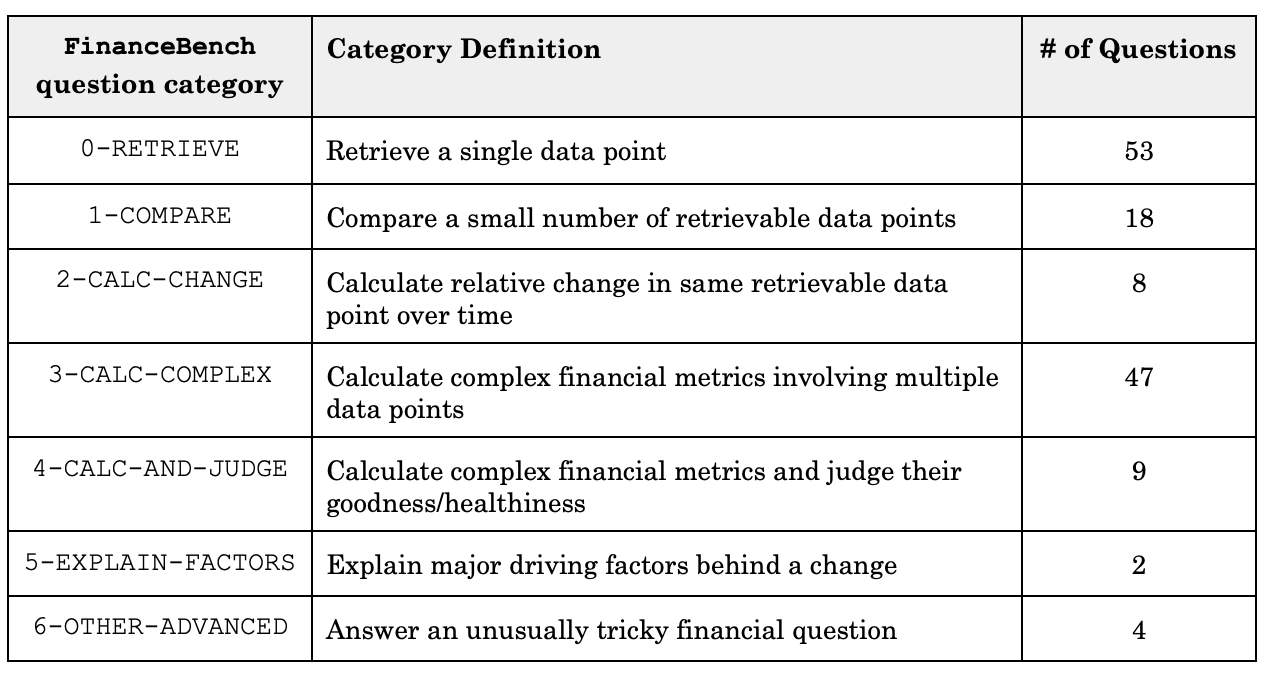
The experiments utilize the FinanceBench dataset derived from SEC filings, comprised of 150 question-answer pairs with expert answers. Fine-tuning procedures involve selecting question-context pairs to train models, ensuring domain-relevancy and enhancing effectiveness. Evaluations are performed using automated retrieval quality and answer correctness metrics, both automated and human-judged. Figure 3

Figure 3: Question difficulty categorizations for FinanceBench.

Results and Analysis

The experimental results signify notable advancements:

  1. Improvements through Fine-Tuning:
    • The integration of fine-tuned retrievers notably increases accuracy, offering an efficient way to enhance Q&A systems without extensive retraining of LLMs.
    • Fine-tuning generative models provides an additional accuracy boost, although less pronounced than that from retrievers.
  2. Advantages of Iterative Reasoning:
    • Integrating OODA loops results in substantial performance benefits, outperforming fully fine-tuned RAG configurations by 20-25 percentage points.
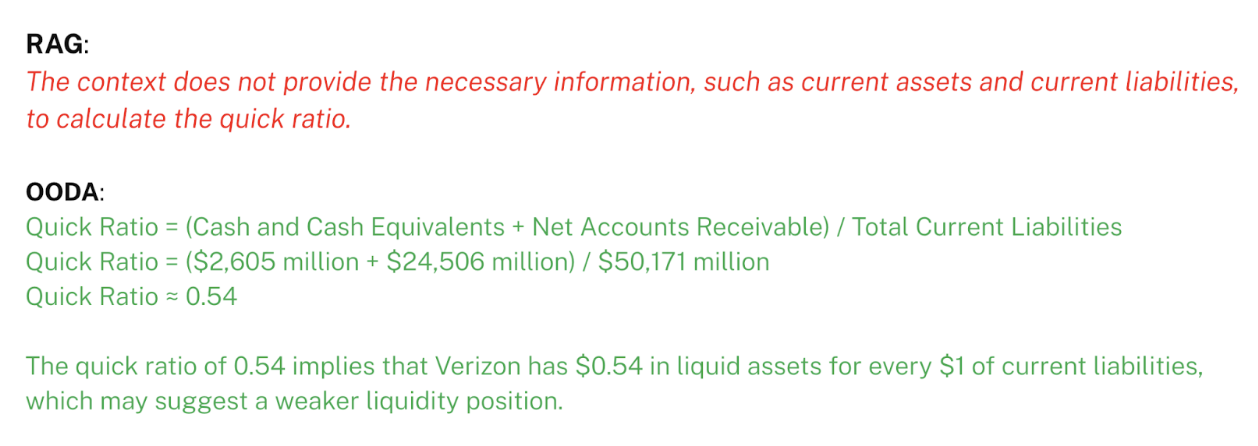
    • This suggests substantial iterative reasoning capabilities, even generalized, can significantly benefit domain-specific applications. Figure 4

      Figure 4: Comparison of pure-RAG and OODA-enabled answers to a FinanceBench question.

Implications

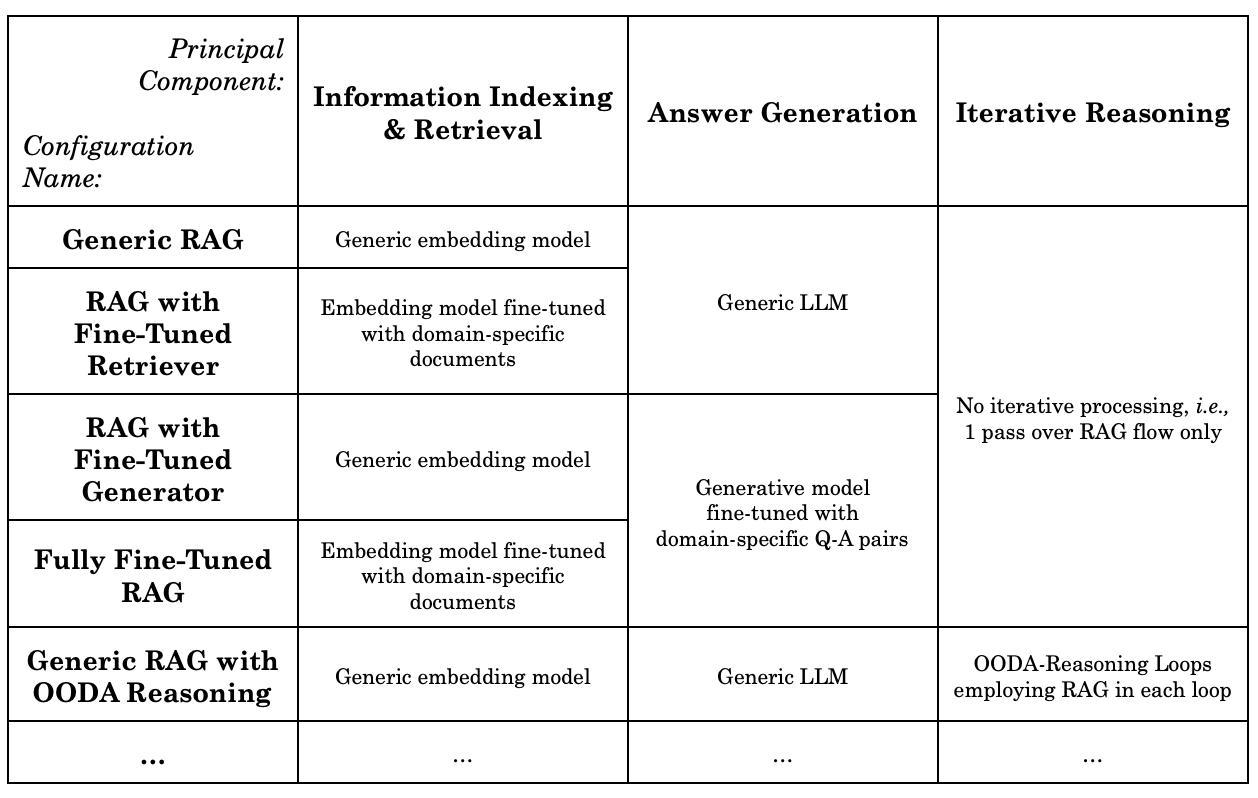
The findings underscore the significant impact these techniques can have on advancing domain-specific Q&A systems. Prioritizing the fine-tuning of embedding models is recommended due to its efficiency and effectiveness. Additionally, incorporating iterative reasoning methods like OODA can provide substantial improvements in accuracy and context consistency. Figure 5

Figure 5: A structured technical design space capturing high-impact components within question-answering systems.

Conclusion

The study identifies key areas for enhancing Q&A systems through domain-specific fine-tuning and iterative reasoning, yielding marked improvements in accuracy for domain-specific tasks. Future directions include exploring custom augmenters for RAG, practical guidelines for AI teams, and advanced planning and reasoning mechanisms. Building on this foundation will support the development of robust, high-accuracy AI systems tailored to industry needs.

Paper to Video (Beta)

Whiteboard

No one has generated a whiteboard explanation for this paper yet.

Open Problems

We haven't generated a list of open problems mentioned in this paper yet.

Collections

Sign up for free to add this paper to one or more collections.

Tweets

Sign up for free to view the 6 tweets with 134 likes about this paper.