- The paper introduces a novel autoencoder framework that uses a composite loss function to preserve the topology of dynamic systems in the latent space.
- It employs a three-dimensional latent space and tests the method on synthetic Lorenz system data, demonstrating accurate reconstruction of unstable periodic orbits.
- The study shows significant potential for applying these techniques in real-world dynamic analysis, thereby enhancing machine learning models for chaotic system modeling.
Reconstructing Attractors with Autoencoders
Introduction
The paper "Reconstructing Attractors with Autoencoders" (2404.16855) explores using autoencoders to reconstruct attractors from dynamic systems data, specifically focusing on preserving the topology of the underlying phase space. The authors apply their methodology to the Lorenz atmospheric convection problem, serving as a classic test case for such dynamical systems.
Autoencoder Architecture and Methodology
Autoencoders are neural networks designed for dimensionality reduction. The network in question comprises two components: the encoder and the decoder. The encoder maps the high-dimensional input data into a reduced latent space, while the decoder reconstructs the data from this compressed representation. The critical aspect of this paper is the training of the autoencoder to ensure the reconstructed latent space flow retains the topological characteristics of the original dynamic system.
The authors propose a novel loss function that includes two components: the mean squared error and a term penalizing the deviation between successive frame reconstructions, ensuring non-linear transformation smoothness. This composite loss function enables the autoencoder to learn a representation in the latent space that is topologically equivalent to the original space.
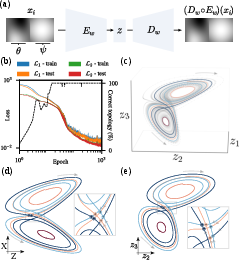
Figure 1: (a) The autoencoder. Input data is encoded to and decoded from the latent space. (b) Evolution of both terms of our loss function, measured in the train and test datasets, left axis. Mean values over 20 trained networks, with their standard error are shown. Evolution of the percentage of autoencoders with correct topology in the latent space as a function of the training epoch is shown in black dashed line, right axis. (c) Reconstructed flow in the latent space of an autoencoder. Five Lorenz unstable orbits and their linking numbers in phase space (d) and latent space (e). Dot color indicates which orbit is above at the crossing point.
Implementation and Numerical Experiments
Numerical experiments utilizing synthetic data from the Lorenz system demonstrate the efficacy of the proposed method. The system, defined by specific initial conditions and parameters, provided temporal series data used to generate pixelated frames, subsequently serving as autoencoder training inputs. The network architecture encompasses a three-dimensional latent space, with intermediate layers progressively reducing the dimensionality of the input data. Training proceeded with multiple networks, iterating over epochs to optimize the novel loss function.
Results indicated that the method consistently produced latent space reconstructions preserving the original system's topological features. Key metrics include the correct reconstruction of unstable periodic orbits, evidenced by their relative rotation rates and linking numbers.
Implications and Future Directions
This framework offers significant potential for reconstructing topologically faithful representations of dynamic systems captured through extensive datasets. By ensuring topological fidelity, the research enhances confidence in the applicability of machine learning models for real-world dynamic analysis, particularly where full system dynamics are not directly observable.
The implications of this study extend to numerous domains, including physics and environmental modeling, where understanding complex and chaotic systems is crucial. Future work could explore the integration of these principles within broader applications, including real-time data processing and multi-modal systems.
Conclusion
The research presented in "Reconstructing Attractors with Autoencoders" provides a substantial contribution to the field of dynamic systems modeling. By demonstrating that autoencoders, when trained with an appropriate loss function, can yield topologically equivalent latent space flows, the paper advances the utility of neural networks in accurately capturing complex dynamics. This achievement opens up new possibilities for further exploration in the interplay between AI and dynamic systems.