Deep thermalization in Gaussian continuous-variable quantum systems
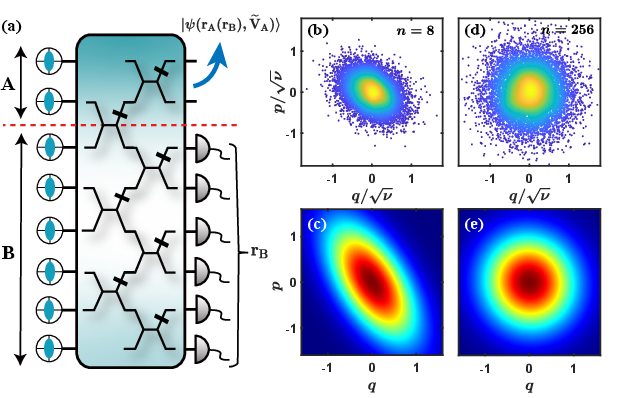
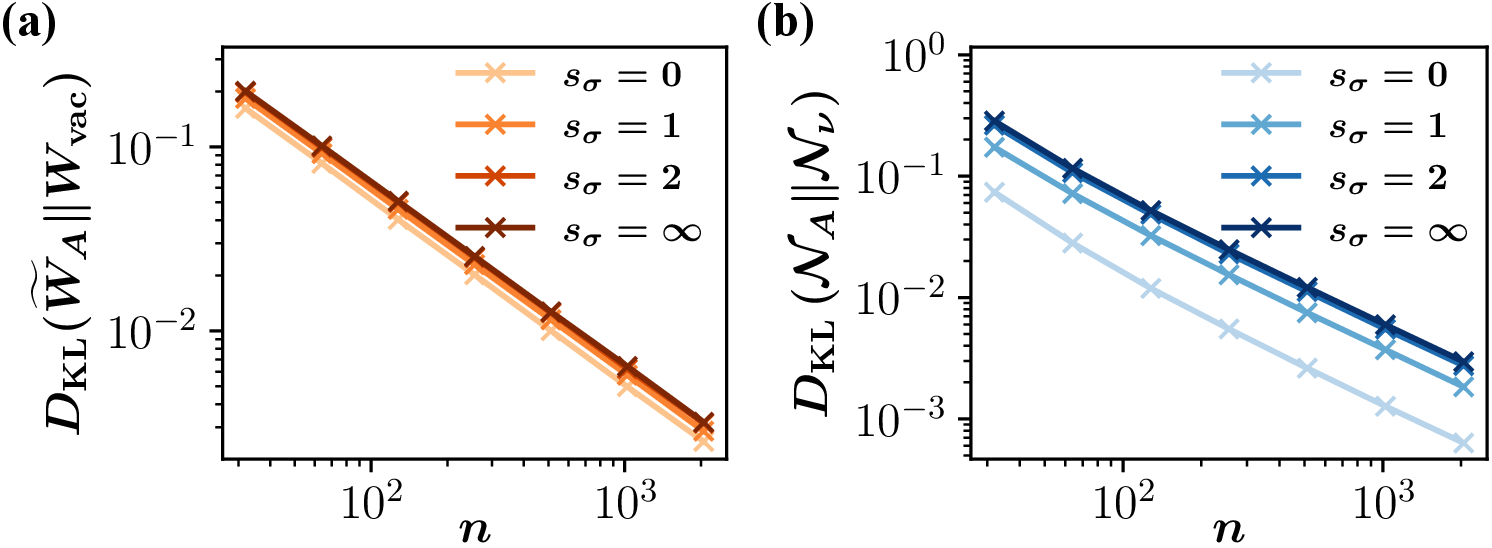
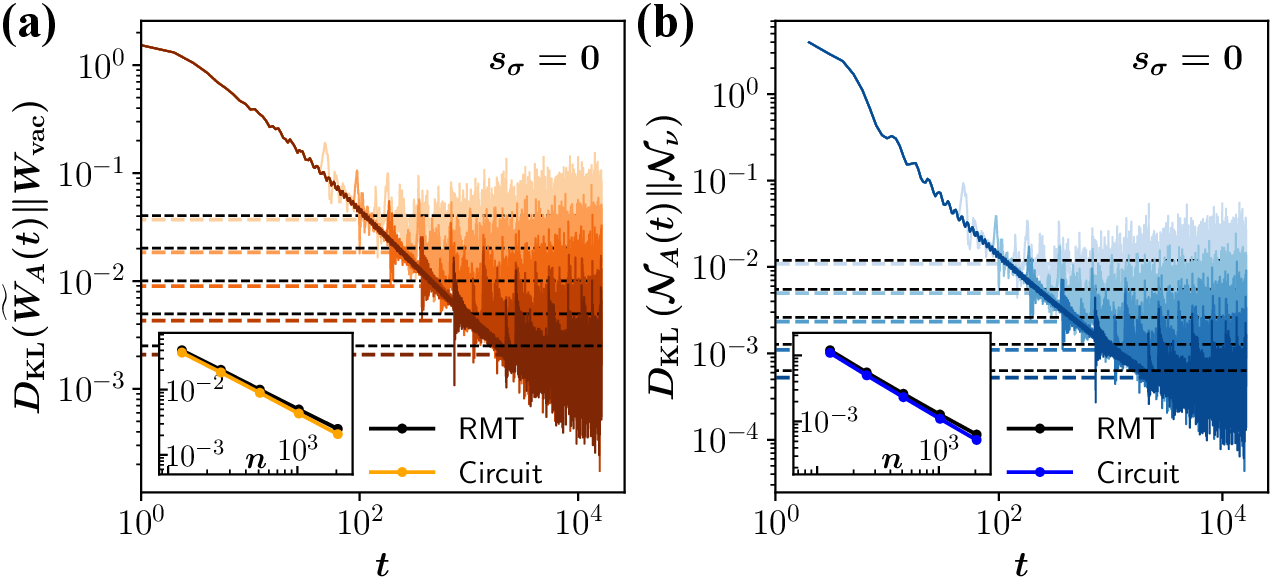
Abstract: We uncover emergent universality arising in the equilibration dynamics of multimode continuous-variable systems. Specifically, we study the ensemble of pure states supported on a small subsystem of a few modes, generated by Gaussian measurements on the remaining modes of a globally pure bosonic Gaussian state. We find that beginning from highly entangled, complex global states, such as random Gaussian states and product squeezed states coupled via a deep array of linear optical elements, the induced ensemble attains a universal form, independent of the choice of measurement basis: it is composed of unsqueezed coherent states whose displacements are distributed normally and isotropically, with variance depending on only the particle-number density of the system. We further show that the emergence of such a universal form is consistent with a generalized maximum entropy principle, which endows the limiting ensemble, which we call the "Gaussian Scrooge distribution", with a special quantum information-theoretic property of having minimal accessible information. Our results represent a conceptual generalization of the recently introduced notion of "deep thermalization" in discrete-variable quantum many-body systems -- a novel form of equilibration going beyond thermalization of local observables -- to the realm of continuous-variable quantum systems. Moreover, it demonstrates how quantum information-theoretic perspectives can unveil new physical phenomena and principles in quantum dynamics and statistical mechanics.
- Marcos Rigol, Vanja Dunjko, and Maxim Olshanii, “Thermalization and its mechanism for generic isolated quantum systems,” Nature 452, 854–858 (2008).
- Rahul Nandkishore and David A. Huse, “Many-body localization and thermalization in quantum statistical mechanics,” Annual Review of Condensed Matter Physics 6, 15–38 (2015).
- Dmitry A. Abanin, Ehud Altman, Immanuel Bloch, and Maksym Serbyn, “Colloquium: Many-body localization, thermalization, and entanglement,” Rev. Mod. Phys. 91, 021001 (2019).
- E. T. Jaynes, “Information theory and statistical mechanics,” Phys. Rev. 106, 620–630 (1957).
- Joonhee Choi, Adam L Shaw, Ivaylo S Madjarov, Xin Xie, Ran Finkelstein, Jacob P Covey, Jordan S Cotler, Daniel K Mark, Hsin-Yuan Huang, Anant Kale, Hannes Pichler, Fernando Brandao, Soonwon Choi, and Manuel Endres, “Preparing random states and benchmarking with many-body quantum chaos,” Nature 613, 468–473 (2023).
- Jordan S. Cotler, Daniel K. Mark, Hsin-Yuan Huang, Felipe Hernández, Joonhee Choi, Adam L. Shaw, Manuel Endres, and Soonwon Choi, “Emergent quantum state designs from individual many-body wave functions,” PRX Quantum 4, 010311 (2023).
- Wen Wei Ho and Soonwon Choi, “Exact emergent quantum state designs from quantum chaotic dynamics,” Phys. Rev. Lett. 128, 060601 (2022).
- Matteo Ippoliti and Wen Wei Ho, “Dynamical purification and the emergence of quantum state designs from the projected ensemble,” PRX Quantum 4, 030322 (2023).
- Matteo Ippoliti and Wen Wei Ho, “Solvable model of deep thermalization with distinct design times,” Quantum 6, 886 (2022).
- Pieter W. Claeys and Austen Lamacraft, “Emergent quantum state designs and biunitarity in dual-unitary circuit dynamics,” Quantum 6, 738 (2022).
- Harshank Shrotriya and Wen Wei Ho, “Nonlocality of deep thermalization,” arXiv preprint arXiv:2305.08437 (2023).
- Maxime Lucas, Lorenzo Piroli, Jacopo De Nardis, and Andrea De Luca, “Generalized deep thermalization for free fermions,” Phys. Rev. A 107, 032215 (2023).
- Tanmay Bhore, Jean-Yves Desaules, and Zlatko Papić, “Deep thermalization in constrained quantum systems,” Phys. Rev. B 108, 104317 (2023).
- Amos Chan and Andrea De Luca, “Projected state ensemble of a generic model of many-body quantum chaos,” arXiv preprint arXiv:2402.16939 (2024).
- Naga Dileep Varikuti and Soumik Bandyopadhyay, “Unraveling the emergence of quantum state designs in systems with symmetry,” arXiv preprint arXiv:2402.08949 (2024).
- Christopher Vairogs and Bin Yan, “Extracting randomness from quantum ‘magic’,” arXiv preprint arXiv:2402.10181 (2024).
- Daniel K Mark, Federica Surace, Andreas Elben, Adam L Shaw, Joonhee Choi, Gil Refael, Manuel Endres, and Soonwon Choi, “A maximum entropy principle in deep thermalization and in hilbert-space ergodicity,” arXiv preprint arXiv:2403.11970 (2024).
- Adam L Shaw, Daniel K Mark, Joonhee Choi, Ran Refael, Finkelstein, Pascal Scholl, Soonwon Choi, and Manuel Endres, “Universal fluctuations and noise learning from hilbert-space ergodicity,” arXiv preprint arXiv:2403.11971 (2024).
- Joseph T. Iosue, Kunal Sharma, Michael J. Gullans, and Victor V. Albert, “Continuous-variable quantum state designs: Theory and applications,” Phys. Rev. X 14, 011013 (2024).
- Richard Jozsa, Daniel Robb, and William K. Wootters, “Lower bound for accessible information in quantum mechanics,” Phys. Rev. A 49, 668–677 (1994).
- Michael A. Nielsen and Isaac L. Chuang, Quantum Computation and Quantum Information: 10th Anniversary Edition (Cambridge University Press, 2010).
- See Supplemental material online for details of statements and proofs presented in the main text.
- Christian Weedbrook, Stefano Pirandola, Raúl García-Patrón, Nicolas J Cerf, Timothy C Ralph, Jeffrey H Shapiro, and Seth Lloyd, “Gaussian quantum information,” Reviews of Modern Physics 84, 621 (2012).
- A Serafini, O C O Dahlsten, D Gross, and M B Plenio, “Canonical and micro-canonical typical entanglement of continuous variable systems,” Journal of Physics A: Mathematical and Theoretical 40, 9551 (2007).
- Motohisa Fukuda and Robert Koenig, “Typical entanglement for Gaussian states,” Journal of Mathematical Physics 60, 112203 (2019).
- Joseph T. Iosue, Adam Ehrenberg, Dominik Hangleiter, Abhinav Deshpande, and Alexey V. Gorshkov, “Page curves and typical entanglement in linear optics,” Quantum 7, 1017 (2023).
- Don Weingarten, “Asymptotic behavior of group integrals in the limit of infinite rank,” Journal of Mathematical Physics 19, 999–1001 (1978).
- Benoît Collins, “Moments and cumulants of polynomial random variables on unitarygroups, the itzykson-zuber integral, and free probability,” International Mathematics Research Notices 2003, 953–982 (2003).
- A. P. Lund, A. Laing, S. Rahimi-Keshari, T. Rudolph, J. L. O’Brien, and T. C. Ralph, “Boson sampling from a gaussian state,” Phys. Rev. Lett. 113, 100502 (2014).
- Craig S. Hamilton, Regina Kruse, Linda Sansoni, Sonja Barkhofen, Christine Silberhorn, and Igor Jex, “Gaussian boson sampling,” Phys. Rev. Lett. 119, 170501 (2017).
- Regina Kruse, Craig S. Hamilton, Linda Sansoni, Sonja Barkhofen, Christine Silberhorn, and Igor Jex, “Detailed study of gaussian boson sampling,” Phys. Rev. A 100, 032326 (2019).
- Daniel Grier, Daniel J Brod, Juan Miguel Arrazola, Marcos Benicio de Andrade Alonso, and Nicolás Quesada, “The complexity of bipartite gaussian boson sampling,” Quantum 6, 863 (2022).
- Abhinav Deshpande, Arthur Mehta, Trevor Vincent, Nicolás Quesada, Marcel Hinsche, Marios Ioannou, Lars Madsen, Jonathan Lavoie, Haoyu Qi, Jens Eisert, Dominik Hangleiter, Bill Fefferman, and Ish Dhand, “Quantum computational advantage via high-dimensional gaussian boson sampling,” Science Advances 8, eabi7894 (2022).
- J. Preskill, “Caltech lecture notes for ph219/cs219, quantum information, chapter 10. quantum information theory,” (2024).
- Alexander S. Holevo, “Gaussian maximizers for quantum gaussian observables and ensembles,” IEEE Transactions on Information Theory 66, 5634–5641 (2020).
- Alexander S Holevo, “Accessible information of a general quantum gaussian ensemble,” Journal of Mathematical Physics 62 (2021).
- Sheldon Goldstein, Joel L Lebowitz, Roderich Tumulka, and Nino Zanghì, “On the distribution of the wave function for systems in thermal equilibrium,” Journal of statistical physics 125, 1193–1221 (2006).
- Peter Reimann, “Typicality of pure states randomly sampled according to the gaussian adjusted projected measure,” Journal of Statistical Physics 132, 921–935 (2008).
Paper Prompts
Sign up for free to create and run prompts on this paper using GPT-5.
Top Community Prompts
Collections
Sign up for free to add this paper to one or more collections.