Isospectral oscillators as a resource for quantum information processing
Abstract: We address quantum systems isospectral to the harmonic oscillator, as those found within the framework of supersymmetric quantum mechanics, as potential resources for continuous variable quantum information. These deformed oscillator potentials share the equally spaced energy levels of the shifted harmonic oscillator but differ significantly in that they are non-harmonic. Consequently, their ground states and thermal equilibrium states are no longer Gaussian and exhibit non-classical properties. We quantify their non-Gaussianity and evaluate their non-classicality using various measures, including quadrature squeezing, photon number squeezing, Wigner function negativity, and quadrature coherence scale. Additionally, we employ quantum estimation theory to identify optimal measurement strategies and establish ultimate precision bounds for inferring the deformation parameter. Our findings prove that quantum systems isospectral to the harmonic oscillator may represent promising platforms for quantum information with continuous variables. In turn, non-Gaussian and non-classical stationary states may be obtained and these features persist at non-zero temperature.
Paper Prompts
Sign up for free to create and run prompts on this paper using GPT-5.
Top Community Prompts
Explain it Like I'm 14
A simple guide to “Isospectral oscillators as a resource for quantum information processing”
1) What is this paper about?
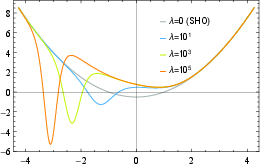
The paper explores a special kind of quantum system that behaves like the usual “harmonic oscillator” (think of a perfect spring or a smooth bowl) in terms of its energy levels, but looks different in shape. These are called isospectral oscillators: “iso” means “same,” and “spectral” refers to energy levels. Even though these systems share the same energy steps as the normal oscillator, their shapes are deformed. Because of that, the states they produce are not simple bell-curve shapes (not “Gaussian”) and show stronger “quantum” behavior (non-classical effects). The authors study how useful these unusual systems could be for quantum information tasks that use continuous quantities like position and momentum (continuous variables).
2) What questions are the researchers asking?
They ask:
- Can these isospectral oscillators naturally create quantum states that are both non-Gaussian and non-classical (the kinds of states that help with advanced quantum computing and communication)?
- How strong are these properties, and do they survive when the system is at a non-zero temperature (i.e., not perfectly cold)?
- If we treat the “deformation” of the oscillator as a hidden knob, what is the best way to measure it, and how precisely can we estimate it?
3) How did they study this? (Methods in everyday words)
First, think of a normal harmonic oscillator as a perfect bowl with balls rolling inside. Now imagine gently reshaping the bowl so it’s a bit lopsided or has a dip—yet somehow the allowed “heights” (energy levels) for the balls remain exactly the same. That reshaping is built using a mathematical tool called supersymmetric quantum mechanics (SUSY). It lets you generate new “bowls” (potentials) that keep the same energy steps but change the shapes of the states.
They looked at two kinds of states:
- Ground states (the lowest-energy states)
- Thermal (equilibrium) states at non-zero temperature (a mix of energy levels due to heat)
To check how “useful” these states are for quantum information, they measured:
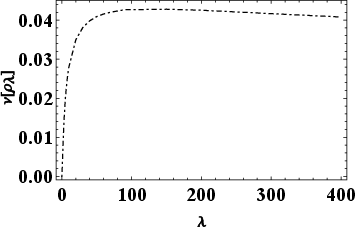
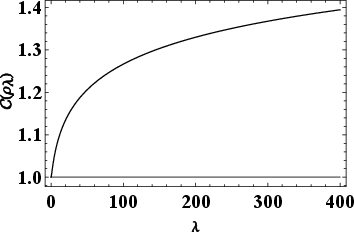
- Non-Gaussianity: How different the state is from a perfect bell curve. They used a standard information measure (relative entropy) to compare the real state to a Gaussian with the same average and spread.
- Non-classicality: They used several indicators:
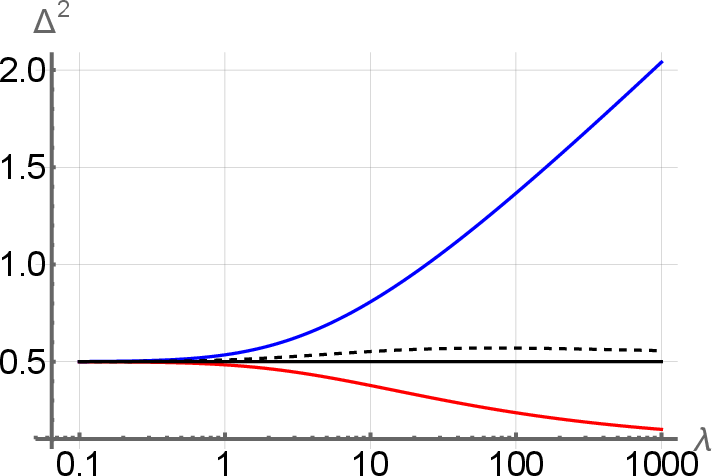
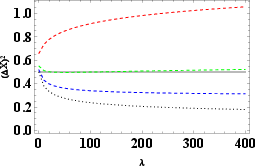
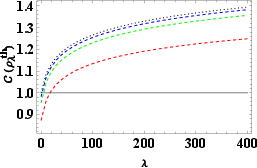
- Quadrature squeezing: Less noise than usual in position or momentum (good for precision).
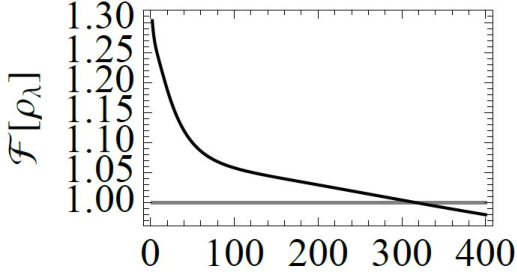
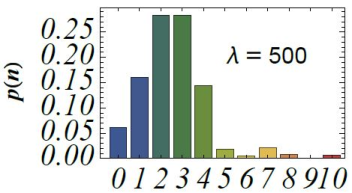
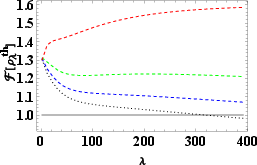
- Photon number squeezing (Fano factor): If it’s less than 1, the photon counts fluctuate less than random—this is a quantum sign.
- Wigner function negativity: A special “map” of the state has negative regions—this cannot happen classically.
- Quadrature coherence scale (QCS): Tells how large and delicate the state’s quantum coherence is.
They also used quantum estimation theory to answer: “What measurement gives the most precise estimate of the deformation parameter?” The key tool here is the quantum Fisher information (QFI), which sets the ultimate limit on measurement precision.
4) What did they find, and why does it matter?
Here are the main results:
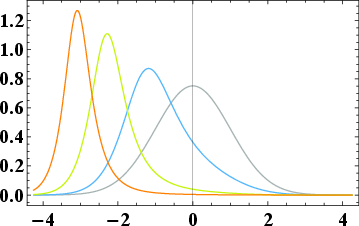
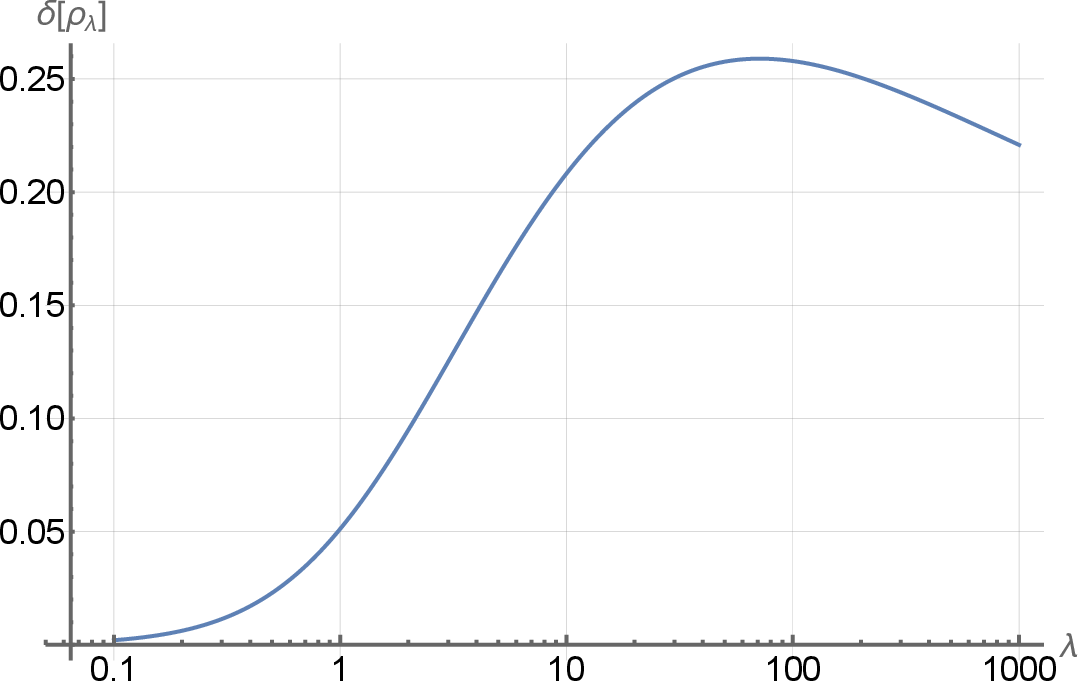
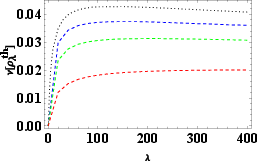
- Non-Gaussian states for free: The ground states of these deformed oscillators are non-Gaussian for basically all positive deformations. You don’t need complicated non-linear tricks to make them—this is built in.
- Strong quantum features:
- Ground states show squeezing in position (reduced noise), which is a clear non-classical signature.
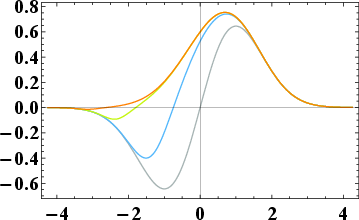
- The Wigner function has negative regions, another strong sign of “quantumness.”
- Photon number squeezing (Fano factor < 1) appears when the deformation is large enough.
- Temperature helps some parts, hurts others:
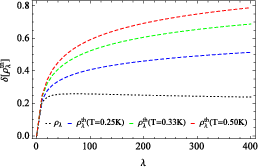
- Non-Gaussianity persists at non-zero temperature and can even increase with temperature (the states stay usefully non-Gaussian).
- Some non-classical features (like squeezing and Wigner negativity) weaken as temperature rises, but they survive up to a point. So there’s a practical temperature range where useful quantum effects remain.
- Easy and optimal measurement:
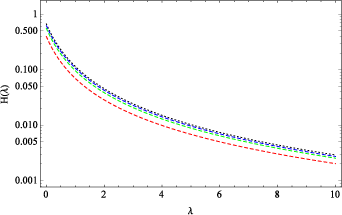
- To estimate the deformation parameter, simply measuring position is already optimal. That means it gives you the best possible precision allowed by quantum mechanics (it saturates the quantum limit given by the QFI).
- Precision slowly worsens as the deformation grows, and gently decreases as temperature increases, but the strategy stays optimal and informative.
Why this matters: Non-Gaussian, non-classical states are crucial resources for continuous-variable quantum technologies (like certain forms of quantum computing, communication, and sensing). They’re usually hard and expensive to make. This work shows a physics-based way to get them “natively” from the shape of the system itself, potentially making experiments simpler.
5) What’s the bigger picture?
This study suggests a promising new platform for quantum technologies:
- Isospectral oscillators naturally produce the “right kind” of quantum states (non-Gaussian and non-classical).
- These properties survive at realistic (non-zero) temperatures, which is important for experiments.
- Calibrating and characterizing the system is straightforward: just measure position to optimally learn the deformation parameter.
- This could lower the cost and complexity of generating advanced quantum resources, helping with tasks like quantum computation, quantum communication, and precision measurements.
In short, by cleverly reshaping a familiar quantum system (without changing its energy ladder), we can tap into richer quantum behavior that’s useful, robust, and easier to access in the lab.
Knowledge Gaps
Knowledge gaps, limitations, and open questions
The following points identify what remains missing, uncertain, or unexplored in the paper, highlighting concrete directions for future research:
- Physical implementation: No proposed experimental platforms or control schemes to realize SUSY-generated isospectral potentials and to tune the deformation parameter λ (e.g., trapped ions with engineered optical potentials, cold atoms in optical lattices, circuit QED/optomechanics). Specify feasible parameter ranges, calibration procedures, and how to imprint the required anharmonic terms.
- Unit consistency and physical scales: The paper sets yet reports temperatures in Kelvin. Clarify the mapping between the dimensionless model and physical units (specifically, how relates to ), and provide a recipe to translate reported λ and values to experimentally relevant scales.
- Negative λ regime and boundary behavior: The analysis effectively focuses on λ above the square-integrability threshold. Systematically study the regime near the lower bound (here ) and for negative λ, including potential singularities, spectral/normalizability issues, and how non-Gaussianity/non-classicality behave close to the boundary.
- Analytical understanding of non-Gaussianity maxima: The QRE-based non-Gaussianity of the ground state peaks near and then decreases without an explanation. Derive analytic or asymptotic expressions for and (e.g., via semiclassical or perturbative expansions of the wavefunction) to explain the origin/position of this maximum and its relation to potential deformations.
- Optimal quadrature and squeezing angle: Squeezing is reported only for canonical and . Optimize over rotated quadratures to find the maximum squeezing and determine whether angle-dependent squeezing persists across λ and , including analytic conditions for minimum variance.
- Robustness to noise and imperfections: Non-classicality and non-Gaussianity are evaluated at thermal equilibrium but not under realistic noise channels (loss, dephasing, phase diffusion, detector inefficiency). Quantify robustness (e.g., critical loss threshold for Wigner negativity) and the decoherence timescales compared to preparation/measurement times.
- Measurement practicality for QCRB saturation: Position measurements are claimed optimal (i.e., ) but no practical scheme is detailed. Specify how to implement and calibrate homodyne/position measurements in candidate platforms, model finite efficiency and resolution, and assess finite-sample performance and estimator bias/variance relative to the QCRB.
- Multiparameter estimation and identifiability: Only local single-parameter estimation of λ is considered. Study joint estimation of (and possibly other Hamiltonian parameters), the trade-offs between parameters (SLD compatibility), and global identifiability when QFI tends to zero at large λ.
- Probe-state optimization for metrology: Only stationary (ground/thermal) states are used as probes. Investigate whether preparing tailored non-stationary probes (e.g., coherent/squeezed states of the isospectral oscillator, driven dynamics, time-dependent protocols) can enhance the QFI for λ and mitigate the decay of precision at large λ.
- Operational resource advantage: The paper motivates CV tasks but does not quantify operational gains. Test these states in concrete protocols (e.g., teleportation fidelity, continuous-variable QKD key rates, boson sampling/non-Gaussian gate injection) and benchmark against standard non-Gaussian sources (photon addition/subtraction, Kerr).
- Resource-theoretic characterization: Beyond QRE non-Gaussianity and Wigner negativity, connect to resource theories (e.g., non-Gaussian monotones, nonclassical depth, entanglement potential) to determine whether the generated states are useful monotones under Gaussian operations and quantify convertibility/distillation.
- Multimode generalization and entanglement: The study is single-mode. Extend to coupled isospectral oscillators and analyze entanglement generation, cluster-state preparation, and scalability. Determine how λ affects entangling rates and Gaussian/non-Gaussian correlations.
- Thermal state preparation realism: Thermal states are assumed Gibbs with energies independent of λ, but eigenfunctions differ with λ. Clarify physical equilibration mechanisms that produce for the deformed potential, including bath coupling models and whether detailed balance holds with the λ-dependent eigenbasis.
- Wigner negativity measurement overhead: Estimation of Wigner negativity is stated numerically; provide experimentally feasible tomography schemes (e.g., balanced homodyne, pattern functions) and analyze sampling complexity, errors, and thresholds for certifying negativity in the λ-dependent states.
- QCS definition and derivation consistency: The QCS is introduced via commutators, but later a simplified formula is used (e.g., for pure states, and for thermal states). Derive these expressions rigorously from the original definition, confirm units/scaling, and assess sensitivity to off-diagonal covariances.
- Closed-form moments and covariance: Expectation values and variances are computed numerically. Seek closed-form expressions (or controlled approximations) for , , and mixed moments in terms of λ to enable analytic control of squeezing, non-Gaussianity, and QCS.
- Potential shape–state property mapping: Establish explicit mappings between the anharmonic terms induced by λ (e.g., effective linear/cubic contributions near the origin) and measurable state properties (squeezing, photon statistics). Provide inversion strategies to infer potential parameters from state diagnostics.
- Large-λ limits and experimental constraints: For large λ the potentials become very narrow/deeply localized. Assess experimental constraints (trap stability, anharmonicity-induced heating, state preparation fidelity) and the practical limits before the QFI and non-classical advantages become unusable.
- Comparative performance vs. conventional sources: Benchmark non-Gaussianity, Wigner negativity, and metrological precision of isospectral states against standard non-Gaussian state engineering (photon addition/subtraction, cat/GKP states) to identify regimes where SUSY isospectral oscillators offer tangible advantages.
- Dynamical preparation protocols: The paper assumes stationary states; design and analyze realistic state preparation protocols (adiabatic ramps in λ, quenches, reservoir engineering) including diabatic errors, preparation time, and fidelity.
- Fault tolerance and error correction relevance: Explore whether these non-Gaussian/non-classical stationary states can be leveraged for CV fault-tolerant encodings (e.g., GKP) or as ancilla resources for non-Gaussian gate implementation; quantify noise thresholds and gate fidelities.
- Extension to coherent states of isospectral oscillators: The conclusion mentions this as future work; explicitly construct these states, derive their properties (Gaussianity, squeezing, negativity), and assess whether they provide superior operational resources compared to ground/thermal states.
- Experimental validation roadmap: Provide a concrete validation plan (platform choice, parameter targets, measurement sequences, and expected signatures) to test the predicted non-Gaussian/non-classical features and the metrological performance of λ estimation.
Collections
Sign up for free to add this paper to one or more collections.