- The paper presents analytic ground-state solutions for the double-Morse potential, revealing tunable non-Gaussian and nonclassical behavior with varying α.
- It quantifies state properties using measures like Bures nonlinearity, Wigner negativity, and entanglement potential, demonstrating monotonic scaling with potential parameters.
- The study establishes optimal quantum metrology protocols via quantum Fisher information, showcasing enhanced parameter estimation and practical implications for quantum sensing.
Nonclassical State Generation and Quantum Metrology in the Double-Morse Potential
Introduction and Motivation
This paper rigorously analyzes the quantum properties of the double-Morse (DM) potential, focusing on its utility for generating nonclassical states and enhancing quantum metrology. The DM potential, constructed by superposing two Morse wells, offers tunable anharmonicity and bistability via the control parameter α (width/asymmetry). Exploiting analytic tractability, the authors derive ground-state solutions, compute measures quantifying nonlinearity, non-Gaussianity, nonclassicality, entanglement generation, and parameter estimation performance, systematically mapping how these properties respond to variations in α. The investigation demonstrates that the DM potential’s ground state provides an experimentally relevant single-mode non-Gaussian resource, with implications for continuous-variable quantum information and quantum-enhanced sensing.
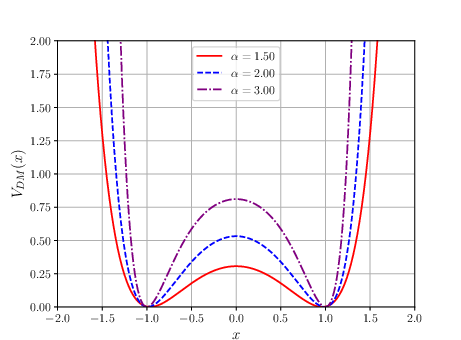
Figure 1: Double Morse potential profiles for various values of α.
Analytical Ground State and Potential Landscape
The DM potential is expressed as VDM(x)=D(Acosh(αx)−1)2 with A=2e−αx0 defining well separation. For A<1, the system exhibits a symmetric double-well; increasing α deepens the barrier and widens the minima separation. The analytically derived ground-state wavefunction, ψ0(x) in terms of modified Bessel functions, allows evaluation of all relevant expectation values and statistical descriptors. The ground-state probability density ∣ψ0(x)∣2 sharpens with increasing α, indicating enhanced localization at the minima and pronounced suppression in the inter-well region.
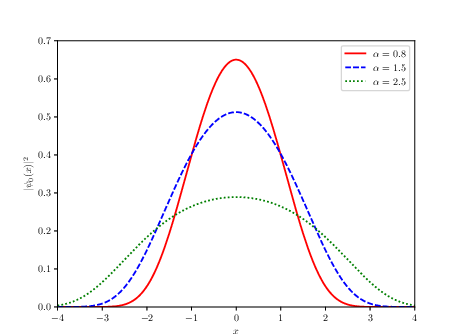
Figure 2: Ground-state probability density ∣ψ0(x)∣2 becomes narrower and more localized at the well minima as α increases.
Quantification of Non-Gaussianity and Nonclassicality
The paper employs both the Bures-based ground-state nonlinearity measure and quantum relative entropy-based non-Gaussianity, capitalizing on covariance-matrix analytics. It is observed that ηNG grows monotonically with α (Figure 3), with larger well separations x0 yielding higher non-Gaussianity. For sufficiently large α, ηNG exhibits insensitivity to x0, signifying universal behavior in the strongly anharmonic regime.
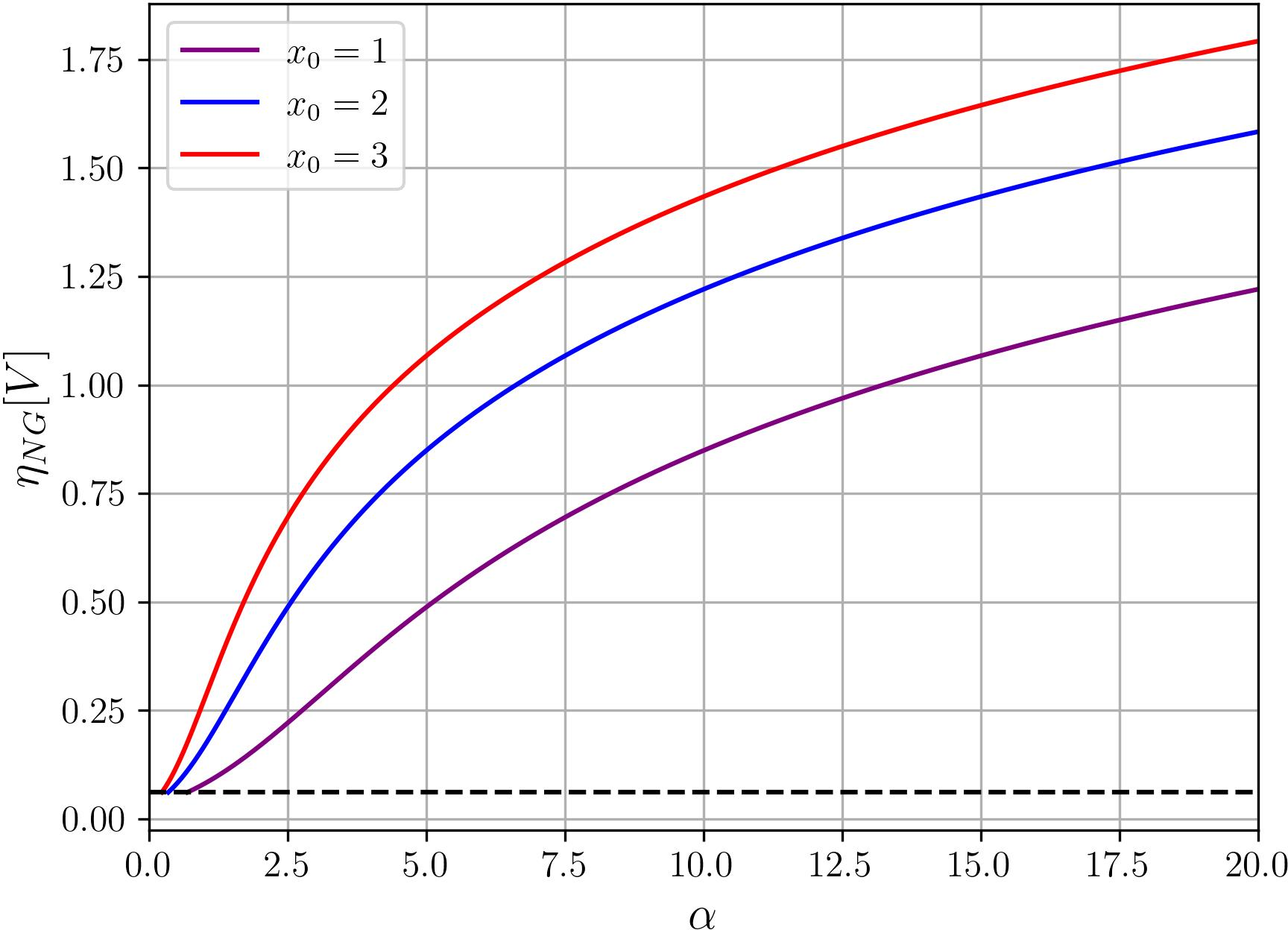
Figure 3: Non-Gaussianity measure ηNG increases monotonically with α for all tested x0, converging for large width.
Nonclassicality is assessed via the negativity of the ground-state Wigner function, W0(x,p), for which a closed-form analytic expression in terms of imaginary-order Bessel functions is provided. The Wigner distribution reveals strong negative regions—quantum interference fringes—near the central barrier and along the p direction, directly indicating nonclassical behavior per Hudson's theorem.
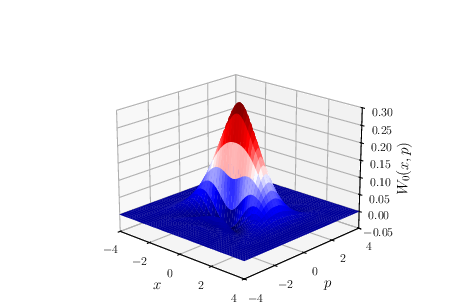
Figure 4: Ground-state Wigner distribution W0(x,p) for α=5 and x0=1, exhibiting regions of negativity.
The integrated nonclassicality measure, ηNC, likewise increases monotonically with α. All curves for different well separations originate from a minimal baseline (Gaussian-like at small α) and grow significantly with stronger double-well character.
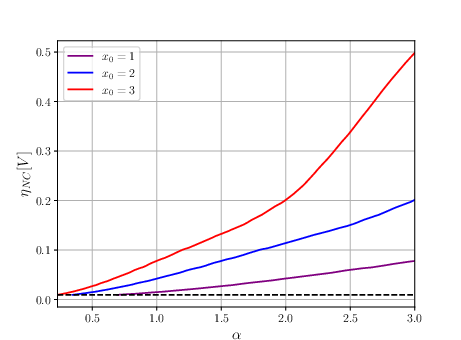
Figure 5: Nonclassicality measure ηNC as a function of α, monotonically increasing for all x0.
A parametric sweep of ηNC versus ηNG shows a universal monotonic and superlinear co-variation, regardless of x0. This operational dependence enables robust quantification of nonclassical resources from ground-state statistics alone.
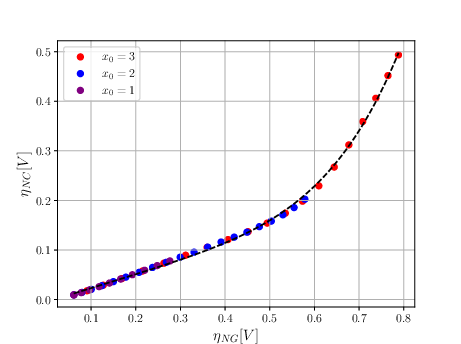
Figure 6: Correlation between non-Gaussianity ηNG and nonclassicality ηNC for various x0, fit with a composite power law.
Entanglement Generation via Linear Optics
Entanglement potential (EP) is used to operationally benchmark single-mode nonclassicality: interference of the DM ground state with vacuum at a 50:50 beam splitter produces bipartite output entanglement, quantified by von Neumann entropy. As the control parameter α increases, EP(ρ) rises monotonically and saturates, with higher x0 consistently increasing the entanglement for all α.
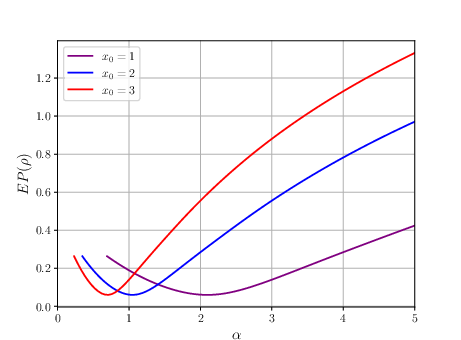
Figure 7: Entanglement potential EP(ρ) generated by beam splitter versus α; higher x0 boosts entanglement output.
Estimation protocols targeting the DM width/asymmetry α are cast in the framework of quantum estimation theory (QET). The authors derive a compact analytical formula for the quantum Fisher information (QFI) of the DM ground state using the closed-form solution for ψ0(x). The QFI is shown to decrease monotonically with α for all tested values of x0, reflecting reduced sensitivity in the deep double-well regime. Direct position measurements on the ground state are proven to be optimal, achieving the quantum Cramér–Rao bound for estimator precision in α.
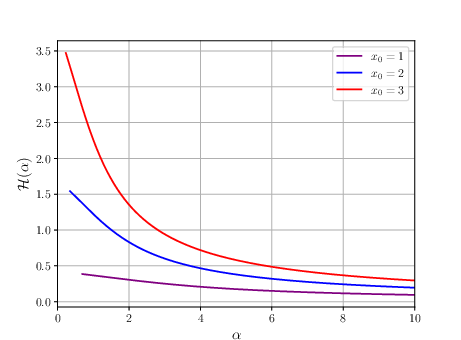
Figure 8: Fisher information of ψ0(x) as a function of α for multiple x0; information content reduces as wells deepen.
Implications and Prospects
This study establishes the double-Morse potential as a structurally tunable, analytically tractable platform for continuous-variable nonclassical state engineering. The ability to transition between Gaussian and strongly non-Gaussian regimes by manipulating α enables fine control over quantum features required in quantum information processing, quantum simulation, and precision metrology. The systematic monotonic enhancements in non-Gaussianity, nonclassicality, and output entanglement position the DM oscillator as a versatile resource for quantum technologies.
Operational implementation would benefit from experimental studies of decoherence effects and structural imperfections, investigating the resilience of Wigner negativity and output entanglement under realistic conditions. Extensions to mixed-state scenarios and verification of entanglement generation by linear optics will broaden applicability. Quantum estimation strategies leveraging shallow-well sensitivity could yield improved protocols for parameter sensing in chemical and condensed matter contexts.
Conclusion
The paper demonstrates that the double-Morse potential is a controllable generator of non-Gaussian, nonclassical single-mode quantum states, with monotonic scaling of operational resource measures with the width parameter α. Analytic tractability enables closed-form assessments of state properties and metrological bounds. The DM oscillator’s capacity for entanglement generation and parameter estimation advocates its adoption in experimental quantum technology platforms and supports further exploration of complex, tunable nonlinear potentials for quantum information science.