Evaluating the World Model Implicit in a Generative Model
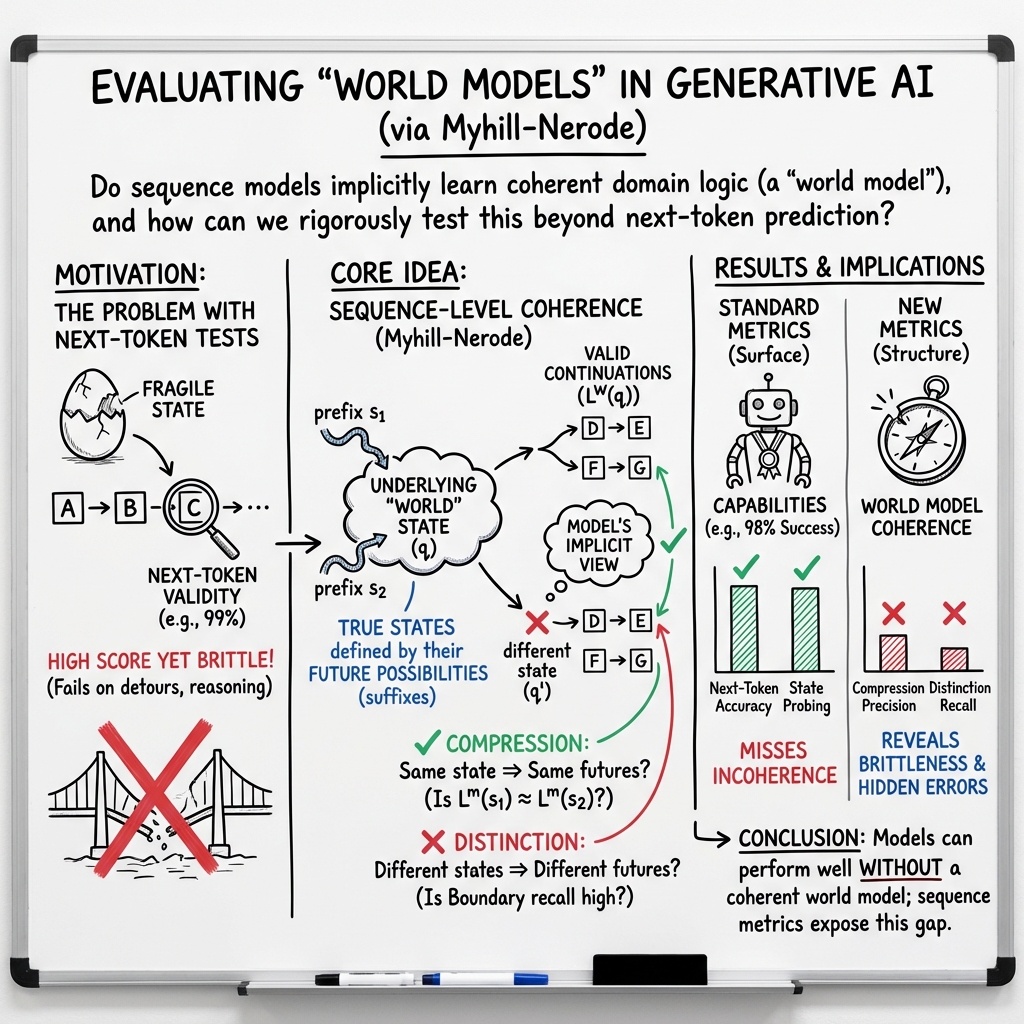
Abstract: Recent work suggests that LLMs may implicitly learn world models. How should we assess this possibility? We formalize this question for the case where the underlying reality is governed by a deterministic finite automaton. This includes problems as diverse as simple logical reasoning, geographic navigation, game-playing, and chemistry. We propose new evaluation metrics for world model recovery inspired by the classic Myhill-Nerode theorem from language theory. We illustrate their utility in three domains: game playing, logic puzzles, and navigation. In all domains, the generative models we consider do well on existing diagnostics for assessing world models, but our evaluation metrics reveal their world models to be far less coherent than they appear. Such incoherence creates fragility: using a generative model to solve related but subtly different tasks can lead to failures. Building generative models that meaningfully capture the underlying logic of the domains they model would be immensely valuable; our results suggest new ways to assess how close a given model is to that goal.
Paper Prompts
Sign up for free to create and run prompts on this paper using GPT-5.
Top Community Prompts
Explain it Like I'm 14
Explaining “Evaluating the World Model Implicit in a Generative Model”
Overview
This paper studies whether LLMs (like chatbots) secretly learn “world models” — internal maps of how a situation works — just from reading lots of text or sequences. The authors focus on worlds that can be described by clear rules and a finite number of situations (like board games, city maps, and logic puzzles). They create new tests to check if these models truly understand the structure of the world, or if they just look good on simple checks.
Key Questions
The paper asks:
- Do generative models really learn the rules of the world they’re trained on (like the rules of a game or the layout of a city)?
- How can we measure whether a model’s internal “world model” is correct?
- Why do common tests (like “predict the next move/token”) sometimes say a model is great when its understanding is actually shaky?
Methods and Approach
Think of a “world model” like a machine that knows:
- The current situation (called a “state”).
- Which actions are allowed from that situation.
- How each action changes the situation.
The authors model these worlds using a Deterministic Finite Automaton (DFA):
- A DFA is like a simple game engine: it has a fixed set of states and rules for moving from one state to another when you apply an action (or read the next token).
- Examples: A city map (states are intersections; actions are turns), a board game (states are board positions; actions are legal moves), or a logic puzzle (states are all possible valid arrangements so far; actions are new statements).
They explain why checking only the “next token” can be misleading:
- In many worlds, two different states can look the same if you only take one step. You only discover the difference after several steps.
- Example: A variation of Connect-4. Early in the game, almost any move is legal, so a model that always guesses randomly looks great on “next move” accuracy even though it understands nothing. But later moves reveal if the model really understands the board.
To fix this, they use ideas from a classic math result called the Myhill-Nerode theorem:
- Interior: Actions that keep two states looking the same (they don’t reveal differences).
- Boundary: The shortest sequence of actions that finally shows the states are different.
From this, they propose two metrics:
- Sequence compression: If two different action histories lead to the same state, does the model treat them the same going forward? In other words, does it “compress” different paths to the same understanding?
- Sequence distinction: If two histories lead to different states, does the model correctly notice the difference and allow different future actions?
They test models in three areas:
- Navigation in New York City: train transformers to predict turn-by-turn directions between intersections.
- Othello: train models to predict moves from game transcripts.
- Logic puzzles: ask big LLMs to reason about seating arrangements with clues.
Main Findings and Why They Matter
Here are the key results, explained in everyday terms:
- Navigation looks good on the surface but breaks underneath:
- Models trained on New York City directions can predict legal next turns almost perfectly and often find shortest paths.
- But the new metrics reveal that their internal maps are incoherent. When the authors reconstruct the “map” inside the models from the model’s own outputs, the maps include impossible streets and weird overpasses that don’t exist.
- When they inject detours (like a closed road), the models often fail to re-route. The model trained on random walks is more robust, but the ones trained mainly on shortest paths are fragile. This shows their “world models” aren’t truly solid.
- Othello shows the same pattern:
- Both models look good on simple checks, but the one trained on real championship games struggles with compression and distinction. The model trained on synthetic (random) games performs much better on the new metrics, meaning it learns the game’s structure more coherently.
- Logic puzzles: smart answers without stable understanding:
- Big LLMs can solve fully specified seating puzzles very well.
- But they often fail when asked to treat different clue paths that lead to the same situation as equivalent (low compression precision), and they miss many sequences that should reveal differences between states (low distinction recall).
- This means a model can deliver correct answers in some cases without really having a reliable internal grasp of the rules.
Overall lesson:
- Common tests (like “is your next move legal?” or “can a probe decode the current state?”) can say the model is great even when its underlying world model is inconsistent. The new metrics catch these deeper problems.
Implications and Impact
Why this matters:
- If we want models that truly understand the worlds they operate in — cities, games, science problems — we need to measure real understanding, not just whether they guess the next token right.
- Better evaluation helps us build models that are less fragile, more trustworthy, and more generalizable. For example:
- Navigation that can handle detours calmly.
- Game-playing that understands rules regardless of opening styles.
- Scientific modeling (like in chemistry or genetics) that relies on consistent internal logic.
- The paper’s approach gives researchers clearer tools to check whether a model’s “world model” is truly coherent.
- While the paper focuses on simple, rule-based worlds (DFAs), the core ideas — “do you compress same states?” and “do you distinguish different states?” — could be extended to richer, messier real-world settings in future work.
Knowledge Gaps
Below is a concise list of the paper’s unresolved knowledge gaps, limitations, and open questions that future work could address:
- Assumption of DFA world models: The framework only handles deterministic finite automata; it does not cover stochastic, nondeterministic, partially observable, or continuous-state environments (e.g., POMDPs, MDPs, hybrid symbolic–numeric systems).
- Ground-truth access requirement: The metrics rely on query access to the true automaton (states and transition validity). Many real domains lack a known or tractable world model. How to evaluate without ground-truth DFA access?
- Automaton discovery: The paper does not provide methods to infer or learn the underlying DFA (or a minimal DFA) from sequences. How can one jointly learn or approximate state partitions and transitions?
- Computational scalability: Exact computation or approximation of Myhill–Nerode boundaries and interiors may be intractable for large alphabets or state spaces. What are efficient algorithms, sampling strategies, or bounds for scalable evaluation?
- Sample complexity: The paper does not quantify how many sequences, state pairs, and boundary samples are needed to estimate precision/recall within desired confidence intervals; no finite-sample guarantees are provided.
- Sensitivity to acceptance threshold ε: The evaluation depends on a probability threshold defining “accepted” continuations. How should ε be selected or calibrated across models and decoding settings, and what is the sensitivity of conclusions to ε?
- Decoding dependence: Results primarily use greedy decoding. How do compression/distinction scores change under different decoding policies (temperature, top-k, nucleus sampling, beam search)?
- Approximate next-token correctness: While exact next-token prediction implies recovery, the paper does not provide theoretical bounds relating near-perfect next-token accuracy to language-level recovery (e.g., via distances between accepted languages).
- Boundary length and interior size characterization: The framework highlights boundary/interior but does not provide metrics for boundary-length distributions or interior size profiles across domains, which could diagnose where next-token testing is fragile.
- Metric validity for continuous outputs: The proposed metrics assume discrete token alphabets. How can the approach be generalized to free-form natural language generations or continuous actions?
- Evaluation without minimal DFA: The theory references minimal DFAs, but practical world models may not be minimal. How do metrics behave when the underlying DFA is non-minimal or when the minimal automaton is unknown?
- Precision for LLM distinction: For logic puzzles, distinction precision was not computed due to cost. What scalable approximations enable precision estimation for LLMs while preserving reliability?
- Training interventions: The paper proposes evaluation metrics but does not explore training methods to improve compression/distinction (e.g., structural regularizers, contrastive losses, automaton-aware objectives, curriculum design).
- Relating data diversity to recovery: Random-walk training improved distinction/compression compared to shortest-path training, but the causal mechanisms are not analyzed. What properties of data distributions most promote world-model recovery?
- Robustness to distribution shift: The evaluation avoids overlapping origin–destination pairs across splits, but does not examine out-of-distribution states, unseen intersections, or topology changes (e.g., new roads, closures).
- Map reconstruction assumptions: The reconstruction fixes the vertex set to the true intersections and constrains degree/orientation. How would reconstruction perform when the node set is unknown, with noisy GPS paths, or in cities with irregular street layouts?
- Reconstruction fidelity metrics: Visual inspection reveals incoherence, but there is no formal quantitative measure of reconstructed graph quality (e.g., edge-orientation error, planarity violations, flyover counts, path stretch).
- Real-world trajectory realism: Taxi routes are approximated via shortest/noisy-shortest paths or random walks—not actual driven trajectories. How do results change with real turn-level traces (including traffic, turn restrictions, and driver behavior)?
- Detour design and guarantees: The detour procedure ensures a valid path exists but details are limited; the impact of different detour policies, frequencies, and adversarial perturbations on performance is not characterized theoretically.
- Linking metrics to downstream failure: While detour robustness correlates with distinction/compression, the paper does not propose formal predictive models linking metric scores to task performance under perturbations.
- State probe limitations: Probes recover current state in many cases despite incoherent world models. What are the conditions under which probing overestimates world-model fidelity, and can probe-based methods be refined to detect incoherence?
- Generalization to other domains: Extensions to protein design, chemistry, and genomics are suggested but not demonstrated. How to adapt metrics when tokens/states are domain-specific and rules are partially known or probabilistic?
- Handling nondeterminism and noise: Many domains have nondeterministic transitions or noisy observations. How can Myhill–Nerode-inspired evaluations be adapted to stochastic languages and probabilistic automata?
- Error localization: The metrics provide aggregate scores but do not localize where compression/distinction errors occur (e.g., specific neighborhoods, board regions, or logical constraints). Can one develop tools to diagnose and correct specific error modes?
- Interpretability and mechanism: The paper does not connect compression/distinction failures to internal model mechanisms (e.g., attention patterns, representation geometry). Can mechanistic interpretability reveal why states fail to compress or distinguish?
- Scaling laws: Only two transformer sizes were trained from scratch on navigation. Do larger models, longer training, or pretraining on diverse corpora improve world-model recovery predictably, and what are the scaling laws for compression/distinction?
- Formal guarantees for evaluation procedures: Beyond definitions, the paper lacks formal guarantees (e.g., consistency of boundary estimators, robustness to model miscalibration). Can we provide theoretical properties for the proposed metrics?
Practical Applications
Immediate Applications
The paper introduces practical, model-agnostic metrics (sequence compression and sequence distinction) and test procedures to evaluate whether a generative model has a coherent “world model” of a domain representable as a deterministic finite automaton (DFA). Below are immediate, deployable use cases across sectors that leverage these metrics, the provided benchmark and software, and the detour-fragility methodology.
Software, ML, and Product Engineering
- World-model audit in model evaluation pipelines
- Use the compression/distinction metrics as a pre-deployment gate for models used in structured domains (e.g., planners, protocol handlers, UI flow agents).
- Potential tools/products/workflows: CI/CD “world-model check” suite; model cards including boundary precision/recall; test harnesses that generate Myhill–Nerode boundary cases.
- Assumptions/dependencies: Access to a rule engine/simulator or DFA for the target domain; model APIs exposing token probabilities or controllable sampling thresholds; computational budget for boundary estimation.
- Interpretability and debugging via model-implied graph reconstruction
- Apply the reconstruction method to visualize implicit graphs learned by models (as in Manhattan maps) to spot inconsistent structure (e.g., impossible edges, cycles, or missing transitions).
- Potential tools/products/workflows: “World-model viewer” for engineering and safety teams; diffing reconstructed graphs across versions to detect regression.
- Assumptions/dependencies: Known vertex set or canonical state abstraction; constraints that bound reconstruction combinatorics; sufficient sampling coverage of generated sequences.
- Robustness testing through detour-stress tests
- Adopt the detour-fragility test (random and adversarial “detours”) for any model controlling sequential decisions under constraints, catching failure modes masked by high next-token validity.
- Potential tools/products/workflows: Red-team robustness scripts for planning agents; test coverage targets that include boundary-reaching perturbations.
- Assumptions/dependencies: Ability to enforce valid perturbations; a simulator that guarantees a reachable goal remains; reproducible decoding.
- Data augmentation for better world-model fidelity
- Incorporate diverse traversal data (e.g., random walks rather than only shortest paths) to improve the distinction metric and downstream robustness.
- Potential tools/products/workflows: Training data generators that emphasize diverse, boundary-probing trajectories; curriculum schedules mixing shortest paths and random walks.
- Assumptions/dependencies: Access to domain graph/simulator; careful balancing to avoid degrading other performance metrics.
- Safer agentic workflows
- Gate agent actions in structured workflows (RPA, API orchestration, LLM agents) with boundary-aware validators to prevent incoherent transitions.
- Potential tools/products/workflows: DFA-based guards or “coherence filters” in agent frameworks; fallback planning policies when boundary inconsistencies are detected.
- Assumptions/dependencies: DFA or approximate automaton for the workflow; acceptance thresholds tuned to model API precision.
Mapping, Logistics, and Navigation
- Pre-deployment evaluation of routing models
- Evaluate learned route planners with compression/distinction metrics to identify incoherence that standard next-token and probing tests miss.
- Potential tools/products/workflows: Navigation QA suite that includes detour robustness and boundary recall/precision; procurement criteria for third-party routing models.
- Assumptions/dependencies: Access to the real road network as a DFA-like graph; APIs that output token probabilities for turns/directions.
- Route reliability under disruptions
- Incorporate detour-stress testing for fleet, delivery, and mobility platforms to ensure plans remain valid under closures or dynamic constraints.
- Potential tools/products/workflows: “Detour resilience” score in SLAs; continuous monitoring on live telemetry to detect rising boundary errors.
- Assumptions/dependencies: Accurate, up-to-date maps; mechanism to simulate or ingest real-time detours; safety oversight.
Games and Interactive Systems
- Game AI evaluation beyond next-move validity
- Use sequence compression to ensure distinct openings that converge to the same board position are treated equivalently; use distinction to detect fused states.
- Potential tools/products/workflows: Tournament eligibility checks for AI; model selection favoring coherent world models for coaching/analysis tools.
- Assumptions/dependencies: Enumerated game DFAs or high-fidelity simulators; compute sufficient to sample boundaries.
Education and Assessment
- Logic tutoring and curriculum design
- Diagnose where LLMs violate compression (treating equivalent partial information as different) to design targeted exercises; use distinction failures to craft “teachable moments.”
- Potential tools/products/workflows: EdTech analytics dashboards flagging student/LLM inconsistencies relative to the DFA; auto-generated practice problems that hit boundary cases.
- Assumptions/dependencies: Formalized puzzle domains as DFAs; controlled prompting to elicit step-by-step reasoning; evaluation harness integrated with LLM APIs.
Healthcare and Life Sciences
- Sanity checks for sequence-based scientific modeling
- Audit LLMs used in chemistry/protein/DNA tasks where protocols or reaction grammars can be DFA-approximated, ensuring models respect process constraints.
- Potential tools/products/workflows: “Protocol coherence” checks in automated lab planning; boundary-aware proposal filters for reaction steps.
- Assumptions/dependencies: High-quality, domain-specific DFAs or grammars; domain simulators to compute acceptance sets; human oversight in safety-critical contexts.
Finance, Compliance, and Enterprise Workflows
- Policy/compliance rule adherence
- Validate that LLM-driven workflows obey procedural constraints (KYC/AML checks, approval gates) by auditing compression/distinction on the organization’s process DFA.
- Potential tools/products/workflows: Compliance audit trail including boundary metrics; automated pre-execution checks for agent actions in ERP/CRM.
- Assumptions/dependencies: Accurate formalization of policies as state machines; governance for updates when policies change.
Policy and Governance
- Risk management and procurement standards
- Include world-model coherence metrics in AI assurance frameworks for safety-critical or high-stakes domains.
- Potential tools/products/workflows: NIST/ISO-aligned guidance recommending boundary-based evaluations; disclosure of detour robustness in safety cases.
- Assumptions/dependencies: Sector-specific DFAs/simulators; standardized reporting formats; independent evaluation capacity.
Long-Term Applications
Extending the paper’s DFA-based framework, metrics, and insights to broader, more stochastic, and partially observed settings could enable certification, training innovations, and safer deployments across many industries.
Cross-Cutting ML Advancements
- Certification of learned world models beyond DFAs
- Generalize compression/distinction metrics to stochastic automata, POMDPs, and hybrid systems; develop formal “world-model coherence” certifications.
- Potential tools/products/workflows: Third-party certification services; formal verification toolchains integrating boundary metrics with model checking.
- Assumptions/dependencies: Theoretical extensions to non-deterministic/stochastic settings; scalable algorithms for boundary estimation; standardized test corpora.
- Training objectives aligned with world-model recovery
- Create loss functions or regularizers that directly optimize sequence compression and distinction, reducing reliance on proxy next-token performance.
- Potential tools/products/workflows: World-model-aware pretraining; curriculum learning that schedules interior vs. boundary exposures; architecture modules that enforce state consistency.
- Assumptions/dependencies: Differentiable surrogates for boundary metrics; stable optimization; evaluation frameworks to prevent mode collapse.
- World-model distillation to interpretable automata
- Extract compact automata that approximate a model’s behavior for safety, interpretability, and governance.
- Potential tools/products/workflows: “Automaton distillers” producing human-auditable controllers; change detection via automaton diffs between model versions.
- Assumptions/dependencies: Reliable black-box-to-automata extraction; guarantees on fidelity and error bounds; handling of very large state spaces.
Robotics, Autonomy, and CPS
- Safety cases for autonomous systems
- Use generalized world-model metrics for certifying planners in autonomous vehicles, drones, and industrial robots operating under dynamic constraints.
- Potential tools/products/workflows: Regulatory submissions including boundary robustness; runtime monitors that halt plans when compression fails.
- Assumptions/dependencies: High-fidelity simulators/digital twins; real-time estimation of world-model coherence; integration with existing safety standards (e.g., ISO 26262).
- Robust re-planning under uncertainty
- Build agents that detect when they are near a boundary and proactively seek information or switch to conservative policies.
- Potential tools/products/workflows: Boundary-aware exploration strategies; uncertainty-aware controllers that degrade gracefully during detours/disruptions.
- Assumptions/dependencies: Calibrated uncertainty estimates; sensor fusion; compute for online evaluation.
Mapping, Supply Chain, and Energy
- Dynamic network operations under disruptions
- Apply detour-robustness concepts to power grid reconfiguration, supply chain routing, and telecom network recovery after failures.
- Potential tools/products/workflows: Control room dashboards showing “coherence margins”; simulators that generate adversarial boundary scenarios for drills.
- Assumptions/dependencies: Accurate digital twins; regulatory permissions to test; cross-system integration.
Healthcare and Science
- Protocol-true lab automation and clinical decision support
- Ensure agentic systems strictly adhere to experimental/clinical pathway constraints, with boundary-aware alerts when proposed steps violate protocol logic.
- Potential tools/products/workflows: Protocol validators embedded in lab robots; CDSS modules that flag logic inconsistencies in recommendations.
- Assumptions/dependencies: Machine-readable protocols; validated simulators; rigorous clinical oversight and audit trails.
- Scientific discovery with grounded world models
- Build LLM-driven discovery pipelines that can prove adherence to mechanistic constraints (e.g., reaction pathways) using coherence metrics.
- Potential tools/products/workflows: Discovery platforms that reject incoherent hypotheses; factorized models that separately learn structure and dynamics.
- Assumptions/dependencies: High-quality symbolic knowledge bases; multi-modal integration (text + structured data).
Education and Assessment
- Formal methods–based tutoring at scale
- Tutors that diagnose reasoning errors as compression/distinction failures, offering targeted feedback on equivalence and discriminative evidence.
- Potential tools/products/workflows: Adaptive assessment engines that generate minimal distinguishing counterexamples for students.
- Assumptions/dependencies: Rich, domain-formalized curricula; measurement models linking DFA metrics to learning outcomes.
Finance and Governance
- Process integrity in autonomous enterprise agents
- Certify that autonomous financial or operations agents comply with internal control “worlds,” even under rare sequences of events (boundary regions).
- Potential tools/products/workflows: Real-time control monitors; internal audit tools that reconstruct agent-implied process automata.
- Assumptions/dependencies: Formalized internal control DFAs; privacy-preserving evaluation; model governance maturity.
- Regulatory frameworks for “world-model audits”
- Mandate coherence reporting for AI systems in high-stakes use, akin to stress tests in banking.
- Potential tools/products/workflows: Sector-specific audit protocols; public incident reporting tied to boundary failures.
- Assumptions/dependencies: Consensus standards; auditor expertise; incentives/compliance mechanisms.
Notes on Assumptions and Dependencies (Global)
- DFA suitability: The immediate metrics assume the domain can be approximated as a DFA or that a rule-based simulator exists; long-term work extends beyond DFAs.
- Access to ground truth oracles: Computing boundaries requires membership tests (accept/reject) from a DFA/simulator; where unavailable, proxy or learned oracles are needed.
- API capabilities: Many applications need token-level probabilities or logprobs to define acceptance at a threshold ε; some providers limit access.
- Computational cost: Boundary estimation and reconstruction can be expensive for large state spaces; sampling and approximation strategies are necessary.
- Data coverage: Accurate assessment relies on sampling sequences that reach boundary regions; biased datasets (e.g., only optimal paths) can hide failures.
- Safety and oversight: In safety-critical contexts, human-in-the-loop review and regulatory alignment remain essential despite improved metrics.
These applications leverage the paper’s central insight: next-token validity and simple probes can dramatically overstate a model’s grasp of underlying structure. Compression and distinction metrics, reconstruction, and detour-stress testing provide actionable ways to close this gap across research and deployment.
Glossary
- Adversarial detours: A stress-test setup where each chosen action is replaced by the model’s worst valid alternative to force difficult re-routing. Example: "for ``adversarial detours'', it is replaced with the model's lowest ranked valid token."
- Boundary precision: The fraction of model-identified minimal distinguishing suffixes that truly distinguish two states in the ground-truth DFA. Example: "and the boundary precision is defined as"
- Boundary recall: The fraction of ground-truth minimal distinguishing suffixes that the model correctly identifies as distinguishing. Example: "The boundary recall of generative model m(·) with respect to a DFA W is defined as"
- Chain-of-thought reasoning: A prompting technique that elicits intermediate reasoning steps from an LLM before the final answer. Example: "We perform greedy decoding and encourage each model to perform chain-of-thought reasoning"
- Current-state probe: A diagnostic that trains a simple classifier on internal representations to recover the current underlying state. Example: "Meanwhile, the current-state probe trains a probe \citep{hewitt2019designing} from a transformer's representation to predict the current intersection implied by the directions so far."
- Deterministic finite automaton (DFA): A finite-state machine with deterministic transitions that recognizes a regular language. Example: "We formalize this question for the case where the underlying reality is governed by a deterministic finite automaton."
- End-of-sequence token: A special marker that denotes the termination of a generated sequence. Example: "and concludes with a special end-of-sequence token."
- Extended transition function: The function that applies the DFA’s single-step transition repeatedly over a sequence to yield a resulting state. Example: "An extended transition function takes a state and a sequence, and it inductively applies δ to each token of the sequence."
- Generative model: A model that defines a probability distribution over the next token conditioned on the observed prefix. Example: "A generative model m(·) \colon Σ* → Δ(Σ) is a probability distribution over next-tokens given an input sequence."
- Graph reconstruction: Inferring an underlying graph (e.g., a map) from sequences generated by a model. Example: "we use graph reconstruction techniques to recover each model's implicit street map of New York City."
- Greedy decoding: A decoding strategy that selects the highest-probability next token at each step without lookahead. Example: "and use greedy decoding to generate a set of directions."
- Linear probe: A linear classifier/regressor trained on model representations to assess whether specific information is linearly decodable. Example: "We train a linear probe on a transformer's last layer representation and evaluate on held-out data."
- Model-agnostic: An evaluation approach that uses only input-output behavior, not internals of the model. Example: "By contrast, our evaluation metrics are model-agnostic: they're based only on sequences."
- Myhill-Nerode boundary: The set of shortest distinguishing suffixes that are accepted from one state but not another. Example: "The Myhill-Nerode boundary is the set of minimal suffixes accepted by a DFA at q1 but not q2:"
- Myhill-Nerode interior: The set of suffixes that are accepted from both of two states and hence do not distinguish them. Example: "Given a DFA W, the Myhill-Nerode interior for the pair q1, q2 ∈ F is the set of sequences accepted when starting at both states:"
- Myhill-Nerode theorem: A foundational result characterizing regular languages via distinguishability of states by suffixes. Example: "The Myhill-Nerode theorem states that the sets of sequences accepted by a minimal DFA starting at two distinct states are distinct"
- Next-token prediction: The core language modeling task of predicting the next symbol given a prefix. Example: "Next-token prediction, however, is a limited evaluation metric."
- Next-token test: An evaluation that checks whether the model’s top-1 next token is legal/valid under the true world model. Example: "The next-token test assesses whether a model, when conditioned on each subsequence in the test set, predicts a legal turn for its top-1 predicted next-token."
- Random walks: Traversals where each next step is sampled randomly rather than chosen to optimize a path. Example: "Finally, random walks samples random traversals rather than approximating shortest paths."
- Sequence compression: The requirement that different prefixes leading to the same state admit the same set of continuations. Example: "To evaluate sequence compression, we sample equal state pairs q1 = q2."
- Sequence distinction: The requirement that prefixes leading to different states have distinguishable sets of continuations. Example: "To evaluate sequence distinction, we sample distinct state pairs, i.e. q1 ≠ q2."
- Transformer: An attention-based neural architecture for sequence modeling and generation. Example: "We train two types of transformers from scratch using next-token prediction for each dataset"
- World model: An internal representation of the environment’s latent states and transition dynamics that supports generalization across tasks. Example: "Recent work suggests that LLMs may implicitly learn world models."
Collections
Sign up for free to add this paper to one or more collections.