- The paper presents an SLM optimization protocol that precisely aligns optical tweezers on single trapped 174Yb+ ions, achieving a near-diffraction-limited waist.
- It employs in situ fluorescence feedback and phase correction routines using Zernike analysis to mitigate aberrations and enhance fluorescence by a factor of 4.4.
- The study demonstrates multiplexed tweezer operation for individual ion addressing, offering scalable quantum control for advanced ion-trap experiments.
Alignment and Optimization of Optical Tweezers on Trapped Ions
Introduction
This paper addresses the precise alignment and optimization of optical tweezers onto single trapped ions, specifically 174Yb+ in an RF-Paul trap, and establishes an experimental protocol for in situ characterization of the tweezer properties. The integration of tightly-focused optical tweezers with ion-trap platforms is motivated by the prospect of scalable quantum simulation and enhanced quantum control, particularly for locally manipulating ion confinement and for individual addressing in multi-ion crystals. This work demonstrates the achievement of a near-diffraction-limited tweezer waist, quantifies coherent and incoherent effects from optical forces, evaluates aberration-mitigation routines, and validates multiplexed tweezer generation via spatial light modulators (SLMs).
Experimental System Overview
The experimental system comprises a linear Paul trap confining 174Yb+ ions, with Doppler cooling on the 369 nm 2S1/2→2P1/2 transition, and a 935 nm repumping beam providing the optical tweezer. Fluorescence is imaged onto a CCD via a high numerical aperture system. The 935 nm laser is phase-modulated by a reflective SLM, magnified, and focused onto the ion with a 2-inch doublet system. The full optical path is modeled to yield a theoretical minimal waist of 2.5(2)μm.
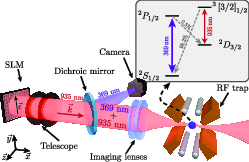
Figure 1: Overview of the RF Paul trap setup, including SLM, tweezer telescope, and imaging optics used for in situ alignment and characterization.
In Situ Tweezer Characterization and SLM-Based Aberration Correction
The ion serves as a localized probe for the tweezer intensity by mapping ion fluorescence as a function of position within the tweezer focus. The SLM phase is partitioned into zones (reference and probe), and an iterative phase optimization routine maximizes the fluorescence by compensating for system aberrations. The protocol is inspired by adaptive methods developed for neutral-atom tweezer platforms but is adapted and validated for ions, accounting for their distinct localization and susceptibility to stray fields.
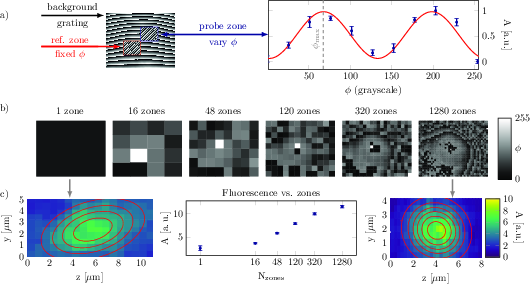
Figure 2: (a) Zonal mapping and phase optimization schema; (b-c) convergence of fluorescence and evolution of beam profile from elliptical to near-circular as aberration correction is refined.
After full optimization (1280 SLM zones), the waist is reduced from w1=6.1(4)μm (uncompensated) to w1=2.9(2)μm and w2=2.3(2)μm, achieving a fluorescence enhancement by a factor of 4.4(0.9) and a nearly circular profile. This matches the theoretical diffraction limit imposed by the optical system. The gain in fluorescence saturates for >1000 zones, indicating the primary aberrations are compensated by low-order corrections.
Quantum Effects in Tweezer-Ion Coupling
The fluorescence of the ion in the tweezer is strongly modulated by coherent population trapping (CPT) phenomena, yielding pronounced non-monotonic features in fluorescence versus tweezer power and detuning. Theoretical modeling requires a 10-level system including Zeeman structure and CPT dark states to reproduce the observed features. The centrally-localized Rabi frequency is found to reach Ωtw=2π×390(70) MHz, with the background Rabi frequency suppressed by a factor of $19(3)$.
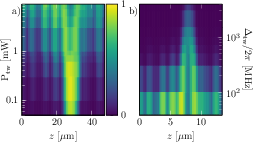
Figure 3: Dependence of fluorescence signal on position, tweezer power, and detuning, indicating the substantial influence of coherent population trapping on spectroscopy.
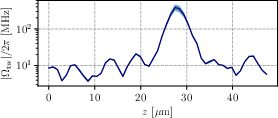
Figure 4: Axial profile of the tweezer Rabi frequency extracted through detailed fitting to experimental fluorescence data, validating spatial localization and background suppression.
This CPT-driven reduction in fluorescence complicates in situ metrology and necessitates cautious selection of probe parameters during SLM optimization.
Optical Forces, Radiation Pressure, and Mapping Artifacts
At reduced axial confinement (ωz<2π×60 kHz), the Doppler beam exerts sufficient radiation pressure to displace the equilibrium ion position within the trap, distorting the apparent tweezer map and shifting the extracted focus by up to 1.8(3)μm. At nominal trapping, this effect is negligible; however, at weaker confinement, it must be quantitatively modeled and mitigated to avoid systematic error in tweezer alignment.
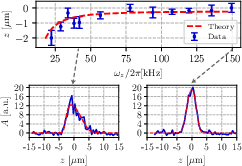
Figure 5: Radiation pressure effects—the displacement of the extracted beam center as a function of axial trap frequency, and associated fluorescence maps for different strengths of axial confinement.
Multiplexed Tweezer Generation and Individual Ion Addressing
The protocol generalizes to multi-tweezer operation by partitioning the SLM with a checkerboard pattern, enabling independent focusing on selected ions in a multi-ion chain. As demonstrated, selective repumping leads to site-resolved fluorescence from targeted ions. Lateral misalignment and optimal waist are characterized for both tweezers, supporting scalability of the method.
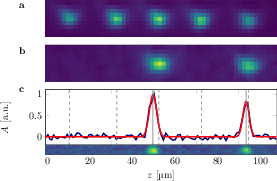
Figure 6: Demonstration of dual tweezers addressing individual ions in a chain; selective fluorescence and mapping confirm individual control and spatial resolution.
Phase Pattern Engineering and Aberration Analysis
The total phase imprinted by the SLM comprises the system flatness correction, a diffractive pattern, and the experimentally-acquired aberration correction. Decomposition of the correction into Zernike polynomials reveals that the dominant aberrations are defocus, astigmatism (second order), and third-order terms such as trefoil and coma, consistent with optical misalignments and lens imperfections. The approach can be further refined by direct optimization of a minimal set of Zernike modes.
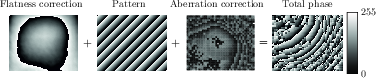
Figure 7: Composite phase contributions included in the SLM pattern (flatness, steerable diffraction, zone-specific aberration correction).
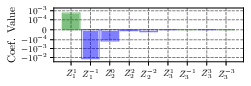
Figure 8: Zernike polynomial expansion coefficients extracted from the experimental correction phase, enabling identification of key aberration types.
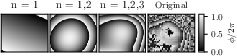
Figure 9: Visualization of the wavefront aberration pattern resolved into first, second, and third Zernike orders.
Theoretical and Practical Implications
The work demonstrates a robust, scalable protocol for aligning and optimizing optical tweezers on ions to the diffraction limit using in situ feedback and phase-pattern engineering via SLMs. The results validate the transfer of mature neutral-tweezer techniques into the trapped-ion domain with quantitative assessment of aberration compensation and quantum-state effects. The ability to scale the number of tweezers supports integration with proposals for tailored quantum simulations and direct engineering of spin-phonon couplings [Espinoza et al., Phys. Rev. A 104, 013302 (2021)].
The SLM-based aberration correction and multi-tweezer approach is particularly relevant for large-scale quantum information processing, where the need for parallelism, precise local control, and programmability are critical. Further, alignment routines can serve as pre-calibration steps prior to switching to far-detuned, high-power tweezers for significant modification of trap confinement—key to implementing quantum gates via local phonon mode engineering or for exploring optically-induced disorder.
The paper discusses practical limitations: while the current power at 935 nm is insufficient for strong confinement modification, the method is compatible with high-power infrared systems. Active stabilization of tweezer pointing can further suppress slow drifts to the sub-micron scale, enhancing operational stability in long-duration protocols.
Conclusion
This work provides a detailed experimental and theoretical analysis of optical tweezer alignment on single and multiple trapped ions using SLM-based phase engineering and in situ feedback. The achieved waist matches the theoretical diffraction limit, with quantitative suppression of background Rabi driving and identification of dominant aberrations. These experimental protocols and characterization techniques establish a foundation for advanced manipulation in trapped-ion quantum computing and simulation, particularly where tailored local control and reprogrammable optical potentials are required. Potential future directions include high-stability operation with actively-stabilized pointing, integrating stronger IR tweezers, and real-time adaptive correction of non-stationary aberrations during dynamical experiments.
Reference: "Alignment and Optimisation of Optical Tweezers on Trapped Ions" (2406.06721).