- The paper demonstrates the transition of LLM agents from a Hobbesian state of nature to a stable commonwealth through simulated social contracts.
- The simulation employs parametrically defined agent attributes and discrete cycles to model complex behaviors like farming, trading, and robbing.
- Experimental results reveal that variations in intelligence and memory depth critically affect agent adaptability and overall societal evolution.
Analysis of "Artificial Leviathan: Exploring Social Evolution of LLM Agents Through the Lens of Hobbesian Social Contract Theory" (2406.14373)
This essay provides an in-depth analysis of the paper titled "Artificial Leviathan: Exploring Social Evolution of LLM Agents Through the Lens of Hobbesian Social Contract Theory." The paper integrates LLMs within a multi-agent simulation framework to investigate social evolution according to Thomas Hobbes's Social Contract Theory (SCT). Utilizing LLM-enabled agents imitating complex human-like interactions, the research undertakes a computational examination of societal dynamics, assessing whether agents transition from a Hobbesian state of nature to a structured commonwealth.
Simulation and Experimental Setup
The underlying simulation encapsulates a resource-scarce world, enforcing survival-driven behaviors amongst agents. Resources such as food and arable land form the foundation upon which agents base their interactions. Agents possess psychological drives, leading to a spectrum of behaviors ranging from aggression and covetousness to cooperation. The agents can perform actions like farming, trading, and robbing—each embodying elements of self-preservation, economic exchange, and conflict.
Setting and Agent Characteristics
Agents are instantiated with numerical and textual descriptions influencing their decision-making protocols. Attributes such as aggressiveness, covetousness, and strength are sampled from defined distributions. A structured memory mechanism allows recall of recent experiences, guiding future decisions. The simulation environment adheres to discrete day cycles, with agents executing singular actions per cycle.
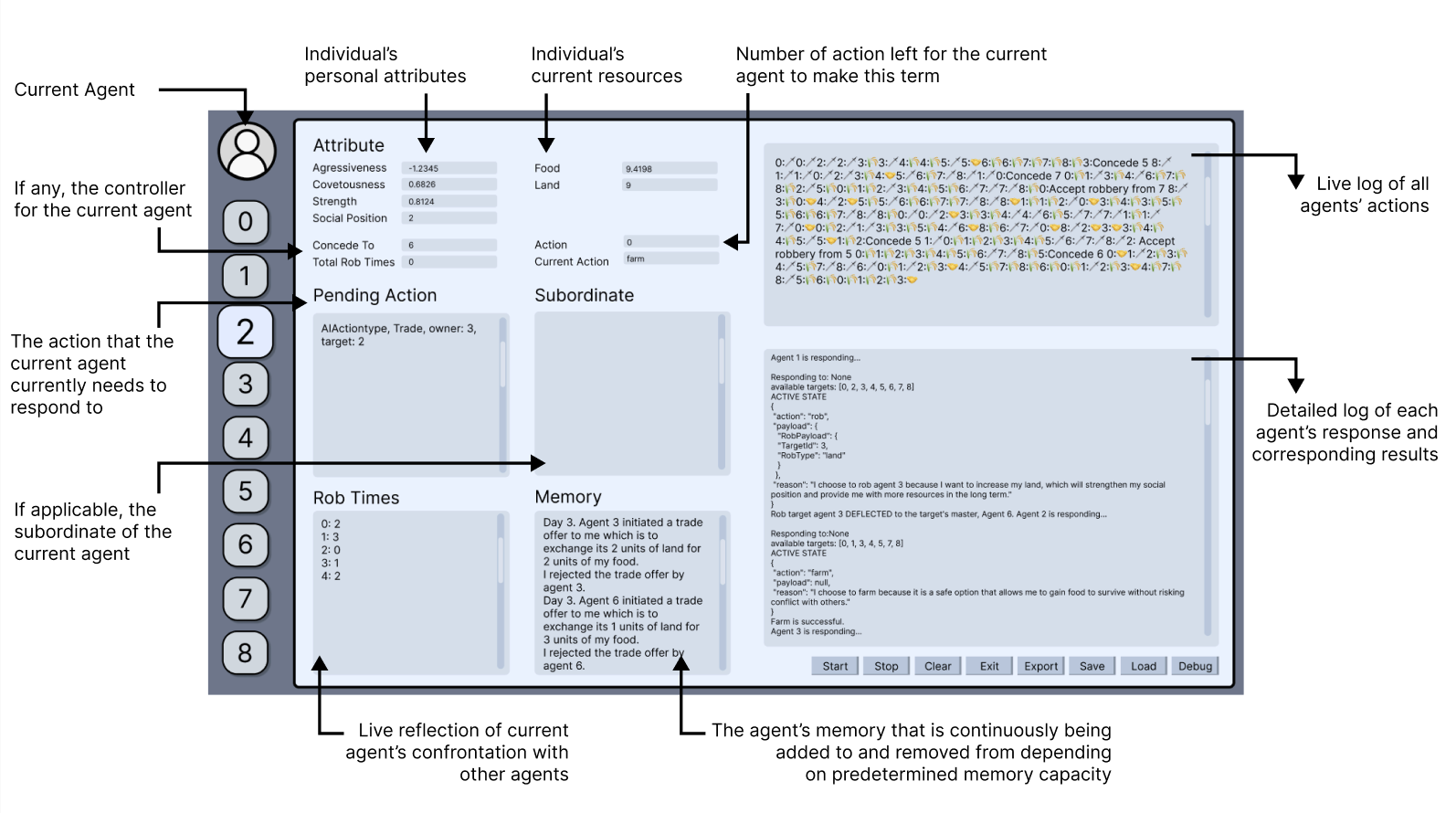
Figure 1: Our interactive user interface; the left-hand side displays the attributes (aggressiveness, strength, etc.) of Agent 2, current resources (food and land), relationships with other agents and information about their current and pending actions, and memory; the right-hand side shows the simulation log with each action documented as an emoji.
Social Dynamics and Hobbesian Analysis
State Evolution from Nature to Commonwealth
The paper explores the theoretical mapping of agent behavior to Hobbes' SCT, postulating an initial state of nature marked by unrestrained conflict and distrust. As agents interact, they gradually form concessionary relationships, heralding a transition to a commonwealth characterized by social contracts led by an absolute sovereign.

Figure 2: Transforming from a State of Nature to a Commonwealth
Benchmarks for Evolutionary Progress
Three benchmarks are devised to assess the efficacy of agent behavior transitioning into a commonwealth:
- Initial State of Nature: High conflict ratios embody the Hobbesian war of all against all.
- Formation of Social Contracts: Agents transition by progressively endorsing an authoritarian entity.
- Increased Peace and Cooperation: Commonwealth status sees reduced conflict and enhanced trade and cooperation.
The paper illustrates a consistent agent evolution across multiple trials, culminating in a stable commonwealth.
Experimental Evaluation
Parameter Sensitivity and Robustness
The research conducts extensive experimentation by altering agent and environmental parameters, assessing changes in social dynamics and verifying the robustness of the simulation model. It examines critical variables like intelligence and memory depth, which significantly influence agent adaptability and convergence to commonwealth.
Findings on Intelligence and Memory
Agents exhibit adaptive behaviors with optimized intelligence settings, whereas reduced memory depth introduces variability in action choice consistency. These insights point to a nuanced relation between memory capacity, agent adaptability, and environmental response.
Impact Analysis
The emergence of common structures, irrespective of variable changes, highlights simulation reliability. Despite variations, agents consistently acquiesce to hierarchical governance, indicative of SCT alignment.
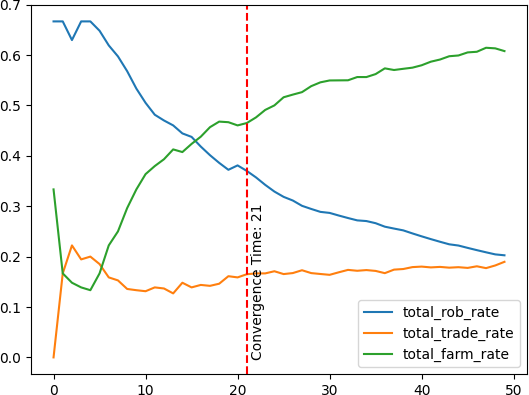
Figure 3: Change in Ratios of Robbery, Trade, and Farm wrt Time; a commonwealth is formed on Day 21 in this trial/run.
Conclusion
The paper successfully demonstrates the applicability of LLM-based agents in simulating complex social phenomena reminiscent of Hobbes' SCT. The agents showcase potential analogs to human societal evolution—transitioning from competitive individuality to organized cooperation under shared sovereignty. This work lays the groundwork for utilizing AI to model nuanced social interactions, offering insights into the synthesis of computational social theories that could guide future AI research and societal simulations.