Papers
Topics
Authors
Recent
Search
2000 character limit reached

AgentSociety: Large-Scale Simulation of LLM-Driven Generative Agents Advances Understanding of Human Behaviors and Society

Published 12 Feb 2025 in cs.SI and cs.AI | (2502.08691v1)

Abstract: Understanding human behavior and society is a central focus in social sciences, with the rise of generative social science marking a significant paradigmatic shift. By leveraging bottom-up simulations, it replaces costly and logistically challenging traditional experiments with scalable, replicable, and systematic computational approaches for studying complex social dynamics. Recent advances in LLMs have further transformed this research paradigm, enabling the creation of human-like generative social agents and realistic simulacra of society. In this paper, we propose AgentSociety, a large-scale social simulator that integrates LLM-driven agents, a realistic societal environment, and a powerful large-scale simulation engine. Based on the proposed simulator, we generate social lives for over 10k agents, simulating their 5 million interactions both among agents and between agents and their environment. Furthermore, we explore the potential of AgentSociety as a testbed for computational social experiments, focusing on four key social issues: polarization, the spread of inflammatory messages, the effects of universal basic income policies, and the impact of external shocks such as hurricanes. These four issues serve as valuable cases for assessing AgentSociety's support for typical research methods -- such as surveys, interviews, and interventions -- as well as for investigating the patterns, causes, and underlying mechanisms of social issues. The alignment between AgentSociety's outcomes and real-world experimental results not only demonstrates its ability to capture human behaviors and their underlying mechanisms, but also underscores its potential as an important platform for social scientists and policymakers.
Summary

  • The paper introduces AgentSociety, which integrates LLM-driven agents with emotional, need-based, and cognitive processes to simulate human behavior.
  • It employs a scalable simulation engine using Ray and asyncio to accurately model urban, social, and economic environments.
  • Experiments demonstrate applications in reducing polarization, evaluating UBI effects, and mitigating misinformation spread.

AgentSociety: Large-Scale Simulation of LLM-Driven Generative Agents

The paper presents "AgentSociety," a comprehensive simulator integrating LLM-driven generative agents within a realistic societal framework. This work spearheads the simulation of human behaviors and societal dynamics, opening new avenues for empirical social science experiments. The following sections detail its core components, including agent designs, societal environment, and simulation architecture.

LLM-Driven Social Generative Agents

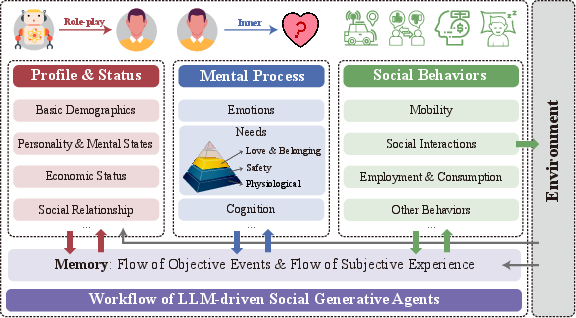
The simulator's core lies in LLM-driven agents with tailored psychological designs. These agents possess three-tiered mental processes: emotions, needs, and cognition.

  • Emotions and Needs: Emotions represent transient responses, while needs represent enduring motivational goals. Needs follow Maslow's hierarchy, dynamically adjusting according to agent experiences and objectives.
  • Cognition: Advanced processes guide decision-making, allowing agents to adapt their actions to dynamic environments, supporting realistic social interactions. Figure 1

    Figure 1: Overview of LLM-driven social generative agents.

Societal Environment

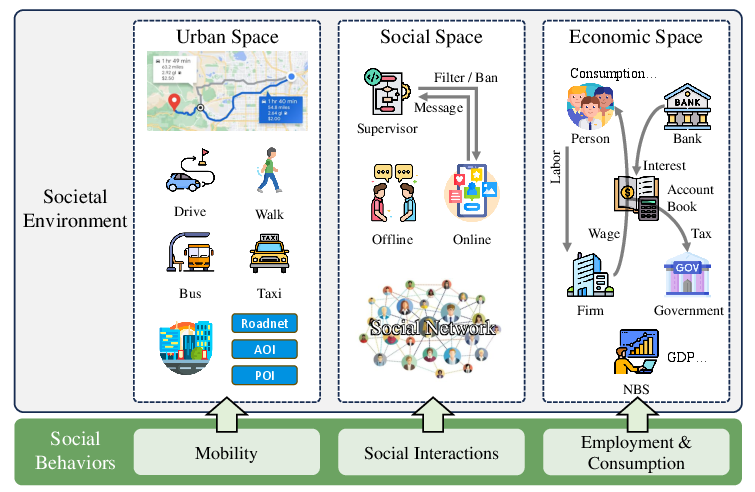
The realistic societal environment comprises three integral spaces:

  • Urban Space: Modeled with road networks and Points of Interest (POIs), supporting mobility through agent navigation via driving, walking, public transit, and taxis.
  • Social Space: Mimics online and offline social interactions, managing agent connections and social behaviors.
  • Economic Space: Simulates key macroeconomic behaviors and interactions, like production, consumption, and work dynamics. Figure 2

    Figure 2: Overview of the societal environment.

Simulation Engine Architecture

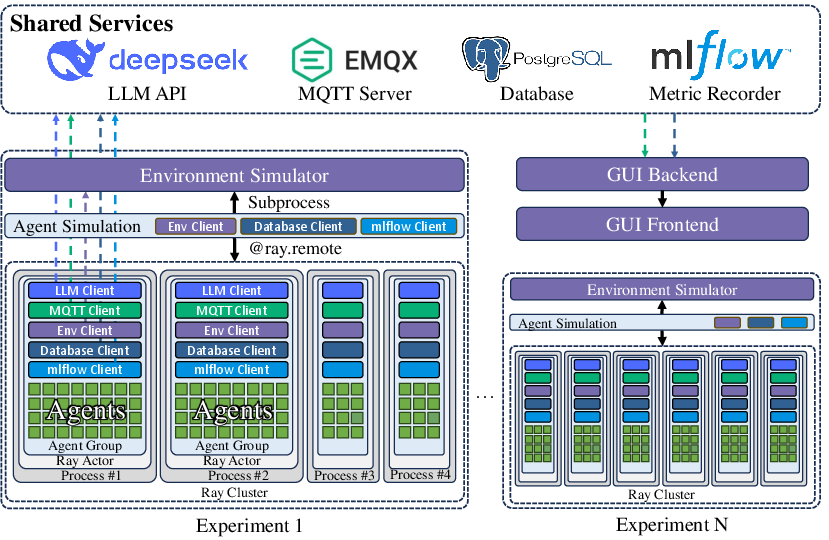
The simulation engine supports large-scale, asynchronous, distributed execution. Key features include:

  • Distributed Execution: Utilizes Ray and asyncio for parallel processing, effectively managing computational loads and ensuring scalable agent interactions.
  • MQTT Messaging System: Enables efficient, high-throughput communication between agents, surpassing traditional methods in lower latency and higher concurrency capabilities. Figure 3

    Figure 3: System architecture of the large-scale social simulation engine.

Social Experiments and Application

AgentSociety enables versatile social experiments:

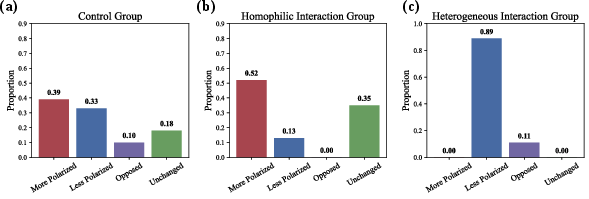
  • Polarization Study: Examines opinion changes on gun control issues, highlighting the emergence of polarization under different interaction settings. Findings suggest heterogenous exposure can mitigate polarization. Figure 4

    Figure 4: Opinion changes on the political issue of Gun Control across three experimental setups.

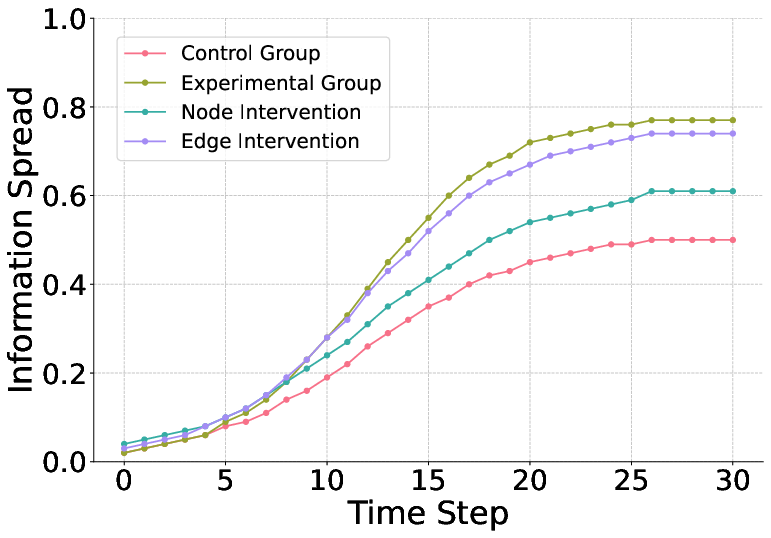
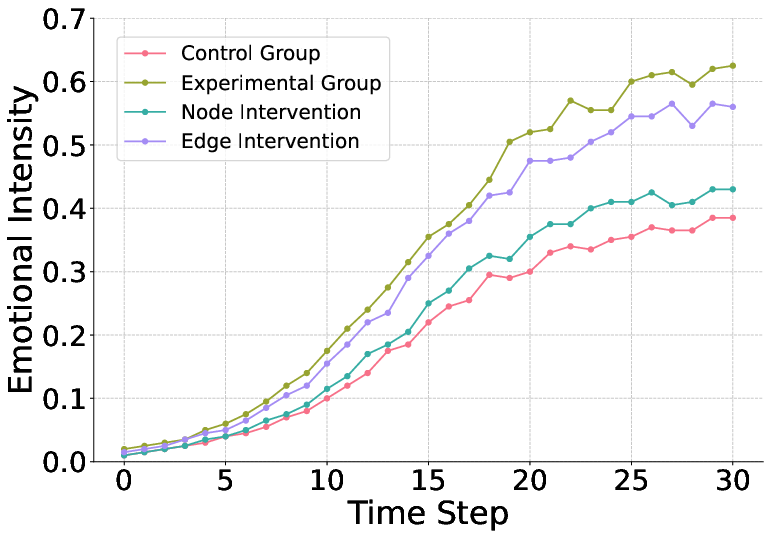
  • Inflammatory Message Spread: Investigates spread dynamics and intervention strategies, using the example of the "chained woman incident." The simulator evaluates node and edge interventions, demonstrating the effectiveness of node intervention in reducing spread and emotional impact. Figure 5

Figure 5

Figure 5: Information Spread over Time.

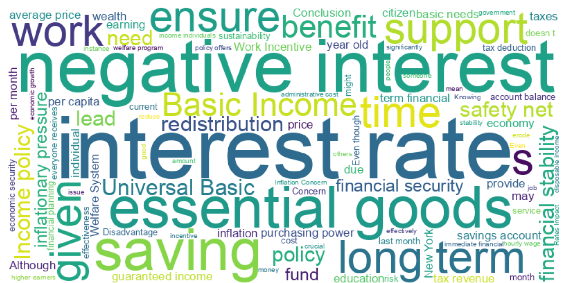
  • Universal Basic Income (UBI): Analyzes economic and social impacts of a \$1,000 monthly UBI, simulating real-world policy outcomes observed in Texas. UBI increased consumption and reduced depression, paralleling real experiment results. Figure 6

    Figure 6: Agent opinions on UBI policy.

Conclusion

AgentSociety offers transformative tools for computational social science, shifting traditional methods to dynamic simulation paradigms utilizing LLM-based agents. Its ability to simulate and experiment with societal interventions holds vast potential for policy evaluation, risk mitigation, and future societal planning. This work positions AgentSociety as a pivotal platform for exploring human-AI societal evolution.

Paper to Video (Beta)

Whiteboard

No one has generated a whiteboard explanation for this paper yet.

Open Problems

We haven't generated a list of open problems mentioned in this paper yet.

Collections

Sign up for free to add this paper to one or more collections.

Tweets

Sign up for free to view the 3 tweets with 2 likes about this paper.