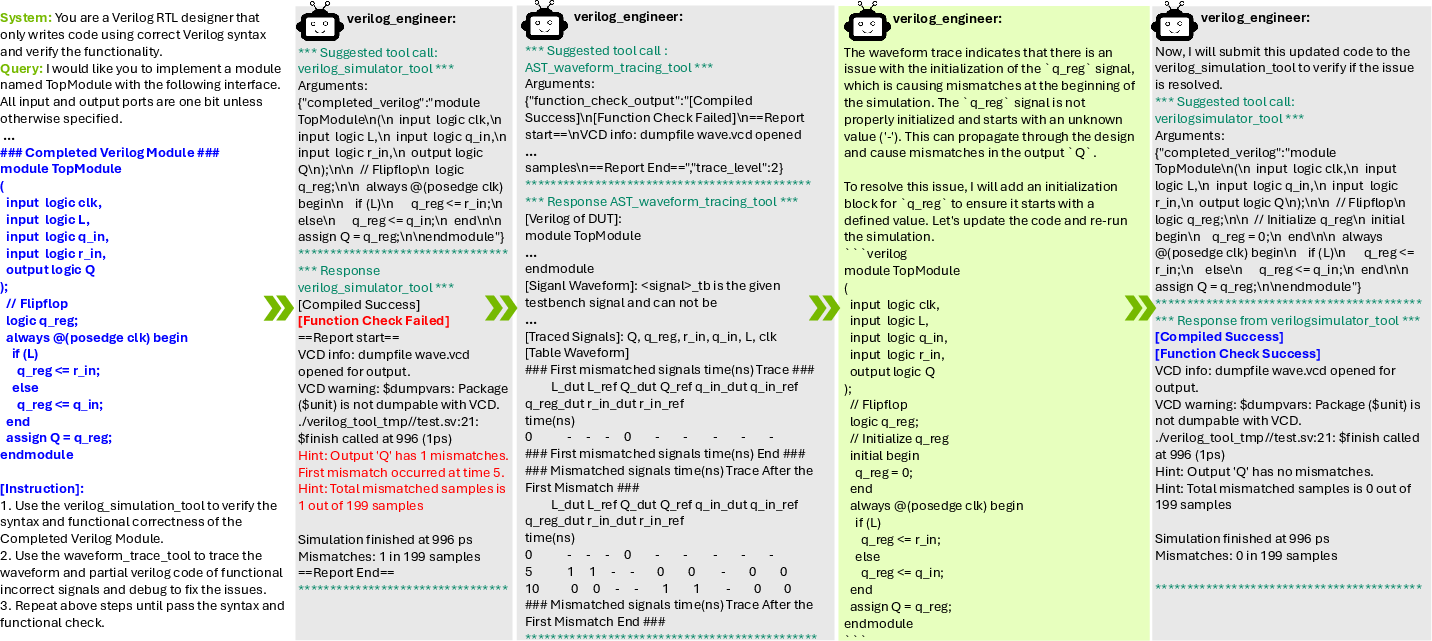
- The paper presents an autonomous AI system that uses a task-driven circuit relation graph to generate and debug Verilog code.
- It employs a multi-agent framework with distinct code and debug agents, leveraging AST-based waveform tracing for functional verification.
- Experimental results show a 94.2% accuracy in code generation on the VerilogEval-Human v2 benchmark, outperforming previous methods by 33.9%.
The paper introduces "VerilogCoder", an architecture consisting of autonomous AI agents for generating and debugging Verilog code using a task-driven circuit relation graph (TCRG) and an abstract syntax tree (AST)-based waveform tracing tool. This approach aims to improve the correctness of Verilog code, both syntactically and functionally, surpassing existing state-of-the-art techniques.
Introduction
The complexity of modern integrated circuit (IC) design necessitates sophisticated methods for automated hardware description languages (HDL) processing. Verilog, as a prominent HDL, requires robust tools to minimize the designer's overhead associated with iterative coding and debugging. VerilogCoder deploys LLMs in conjunction with AI agents to automate these tasks, providing a scalable solution that addresses both syntax and functionality concerns.
VerilogCoder Architecture
VerilogCoder's architecture encompasses several modules: task planning, multi-agent reasoning, and debugging. A novel TCRG is employed to aid in task planning, while a comprehensive Verilog toolkit supports the multi-agent strategy. This toolkit includes syntax checkers and a novel AST-based waveform tracing tool.
Task Planning
The task planning phase leverages a TCRG to structure sub-tasks, incorporating detailed signal and transition information. The TCRG-based task planner constructs high-quality plans that incorporate essential circuitry details, which are often omitted by conventional LLM planning strategies.
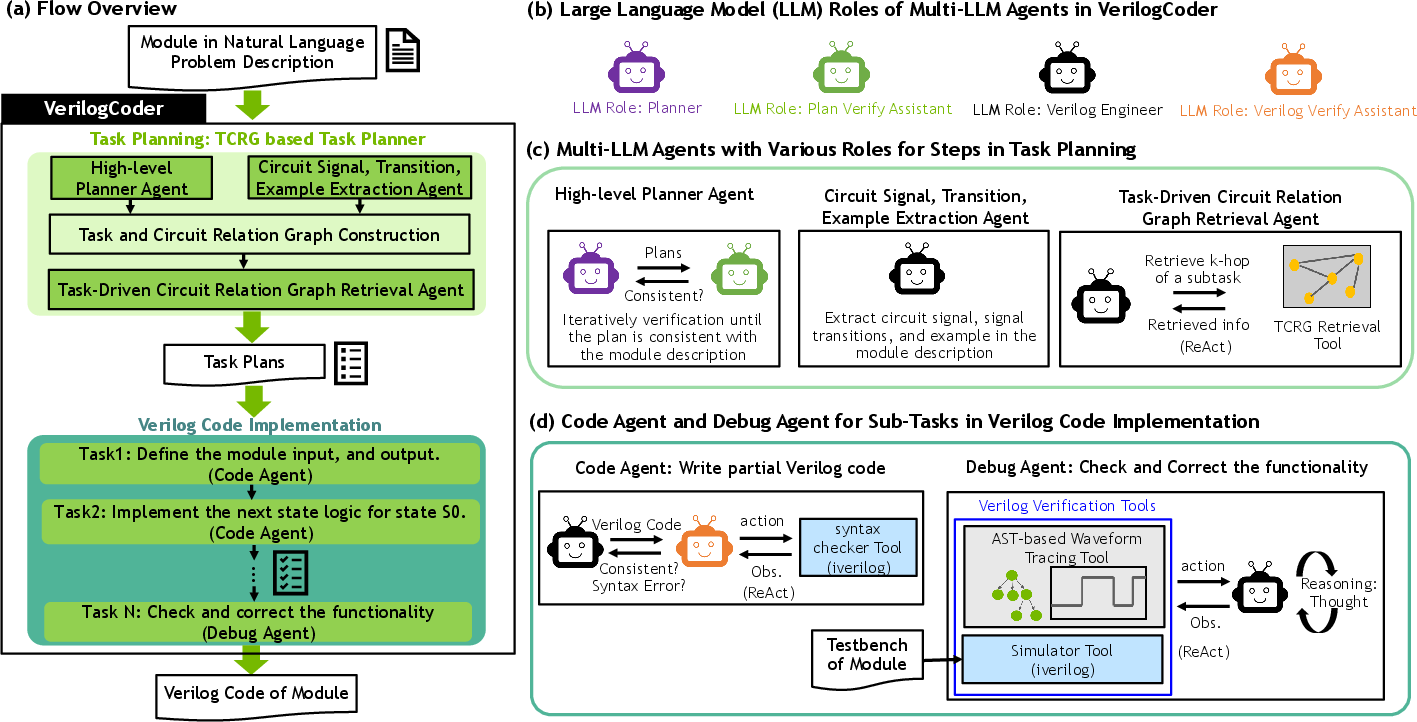
Figure 1: Flow overview of VerilogCoder illustrating the comprehensive plan generation for Verilog code completion.
Verilog Code Implementation with Multi-AI Agents
Verilog code implementation is driven by task plans generated from the TCRG. The multi-agent framework operates in a synchronized manner, with distinct agents handling code syntax verification and functional debugging.
Experimental Results
VerilogCoder achieves a 94.2% accuracy in generating syntactically and functionally correct Verilog code on the VerilogEval-Human v2 benchmark, outperforming previous methods by 33.9%. The AST-based tool significantly contributed to this performance, particularly in tasks requiring intricate waveform analysis.
Implications and Future Work
The introduction of VerilogCoder provides a framework that significantly enhances the efficiency of Verilog code generation in IC design processes. Future work can enhance the system's PPA (Power, Performance, Area) metrics through improved LLM training and memory management for continuous learning from previous coding experiences.
In summary, VerilogCoder represents a substantial advancement in autonomous HDL processing, facilitated by advanced task planning and debugging capabilities, demonstrating notable improvements over existing methods.