- The paper demonstrates that stout smearing alters the scaling behavior of taste breaking, challenging traditional Symanzik predictions.
- The study uses quenched Wilson gauge configurations to compute eigenvalue spectra across various smearing steps and lattice spacings.
- The analysis shows staggered fermions achieve O(a²) scaling with smearing for non-topological modes, while minimally doubled actions remain at O(a) scaling.
Eigenvalue-Based Taste Breaking of Staggered, Karsten-Wilczek, and Borici-Creutz Fermions: Scaling and Smearing Effects in the Schwinger Model
Introduction and Objectives
This study systematically analyzes taste symmetry breaking for staggered, Karsten-Wilczek (KW), and Borici-Creutz (BC) fermions within the two-dimensional Schwinger model, leveraging the minimal doubling nature that these discretizations share in 2D. The central focus is on the scaling of taste-breaking effects, as quantified by eigenvalue splittings of the continuum Dirac operator represented by these lattice actions. A particularly novel feature is the comparative evaluation of taste symmetry violations among these formulations under various levels of stout smearing, across a continuum of lattice spacings and in the presence of nontrivial gauge topology.
Methodology
Configurations are generated in the quenched Schwinger model using the Wilson gauge action and augmented update algorithms facilitating ergodic sampling across gauge field topological sectors (q∈Z). For each configuration, the Dirac operator matrices for staggered, KW, and BC discretizations are constructed at three smearing levels: none, one, and three steps of stout smearing (with ρ=0.25). The lowest 16 eigenvalues on the positive imaginary axis are computed for each Dirac operator and assigned to distinct taste pairs, referenced against the topological charge of the configuration.
Taste breaking is then quantified as the splitting, δ, within each near-degenerate eigenvalue pair. Distinctions are made between splittings associated with would-be zero modes (wbz, topological) and splittings associated with non-topological modes (ntm). Scaling analyses are performed over lattice spacings spanning an order of magnitude at fixed physical volume, in addition to finite volume investigations.
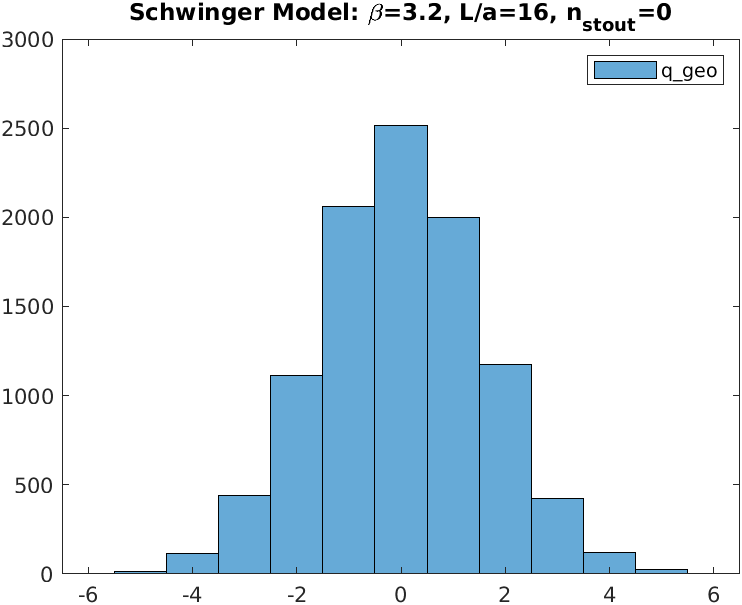
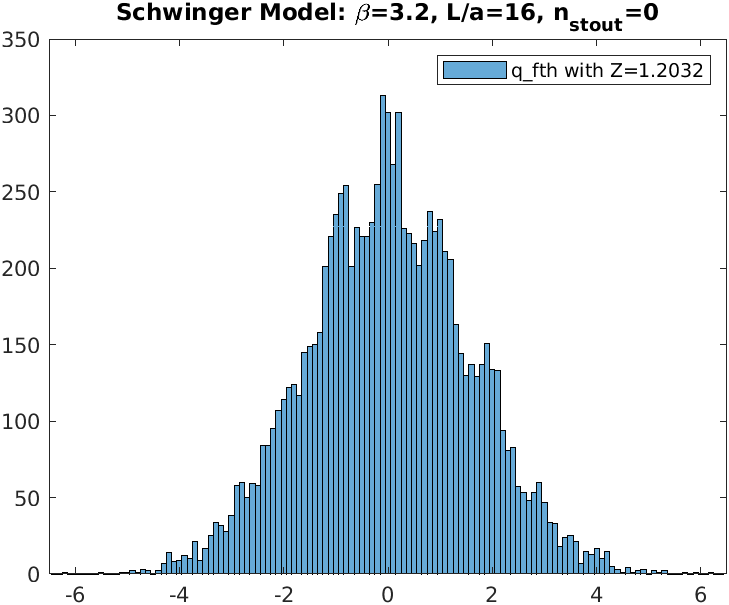
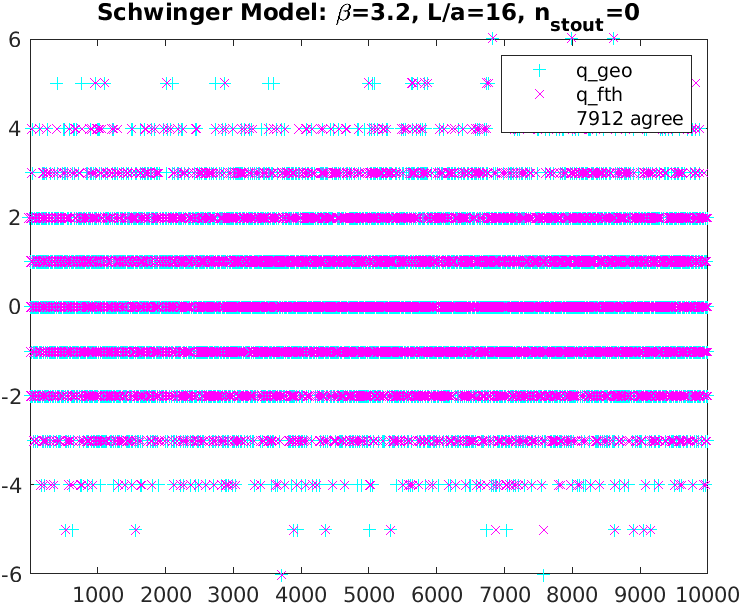
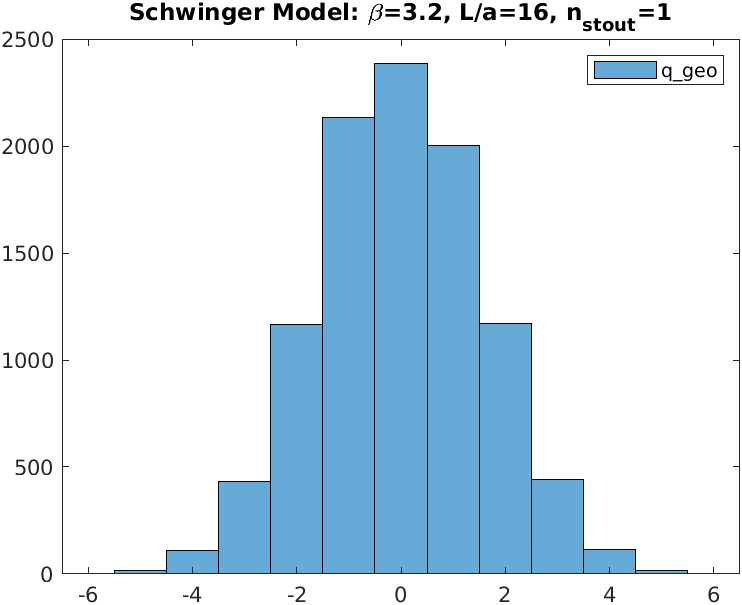
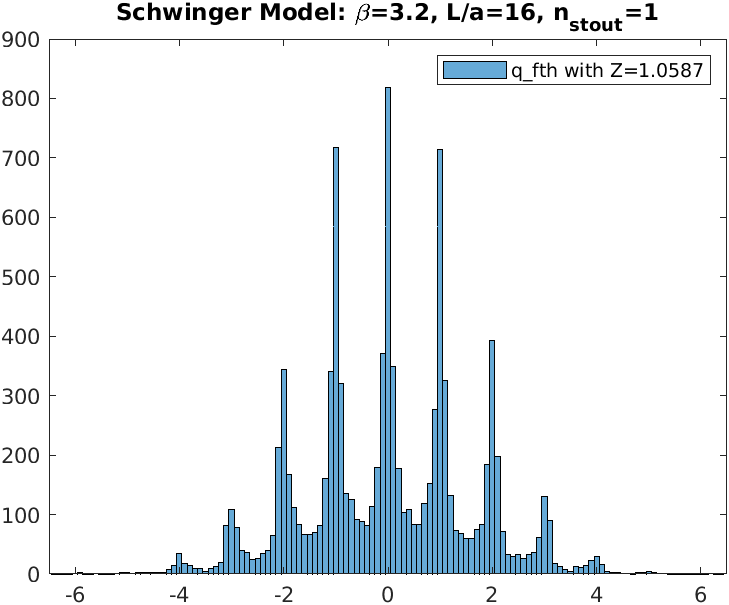
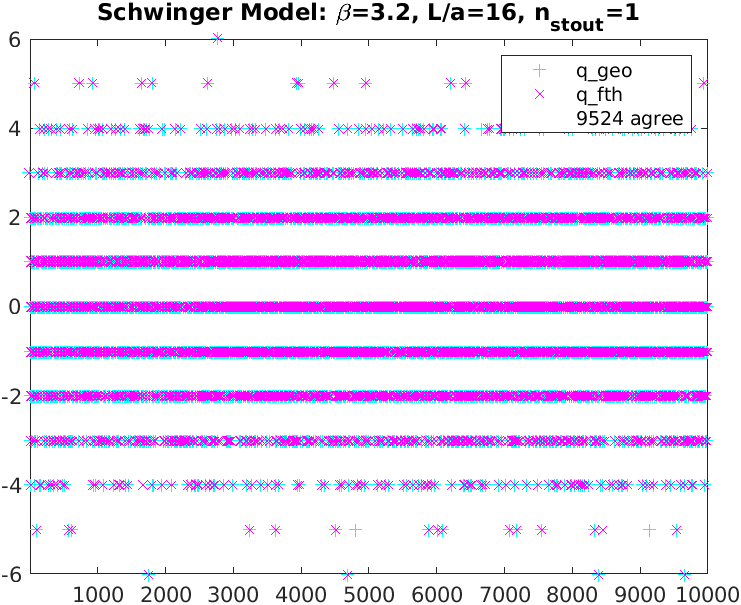
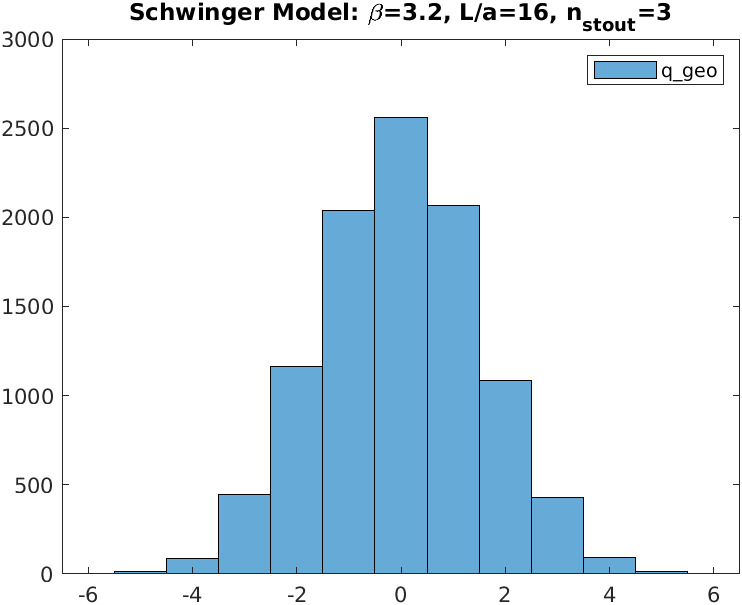
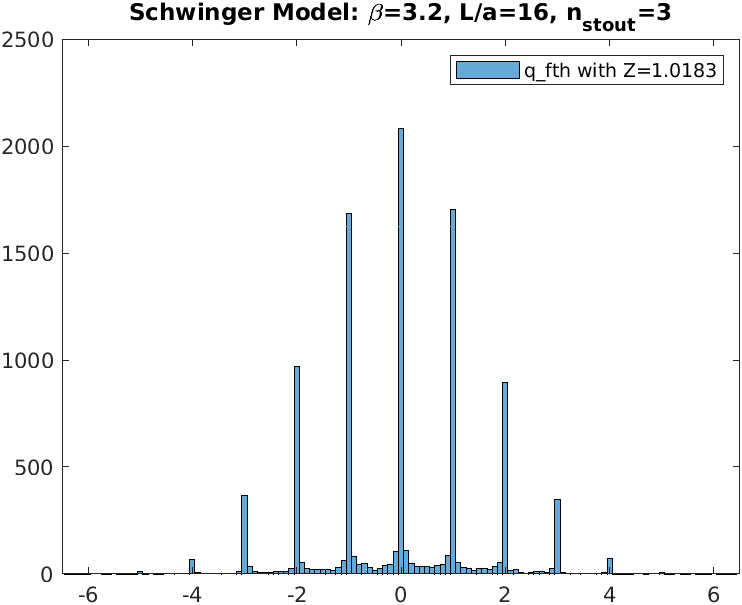
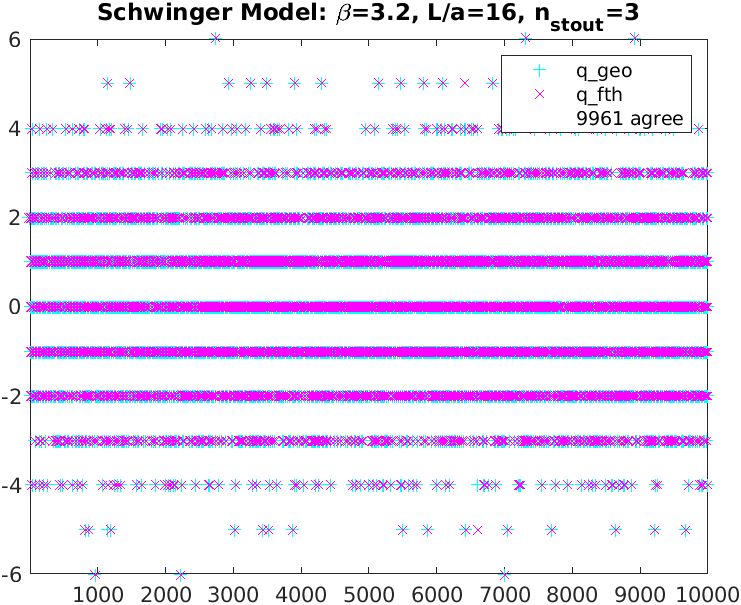
Figure 1: Histograms for the assignment of integer and non-integer topological charge at different smearing levels, demonstrating effective coverage of topological sectors under the simulation protocol.
Numerical Results: Smearing, Lattice Spacing, and Volume Dependence
Taste Splittings on Typical Configurations
Across the central ensemble, the magnitude and hierarchy of taste splittings depend strongly on the underlying topological charge and the Dirac operator chosen. For non-topological modes, the staggered action consistently exhibits the smallest splittings, followed by KW and then BC. For would-be zero modes, this hierarchy is inverted, with KW fermions possessing the least taste breaking for these modes.
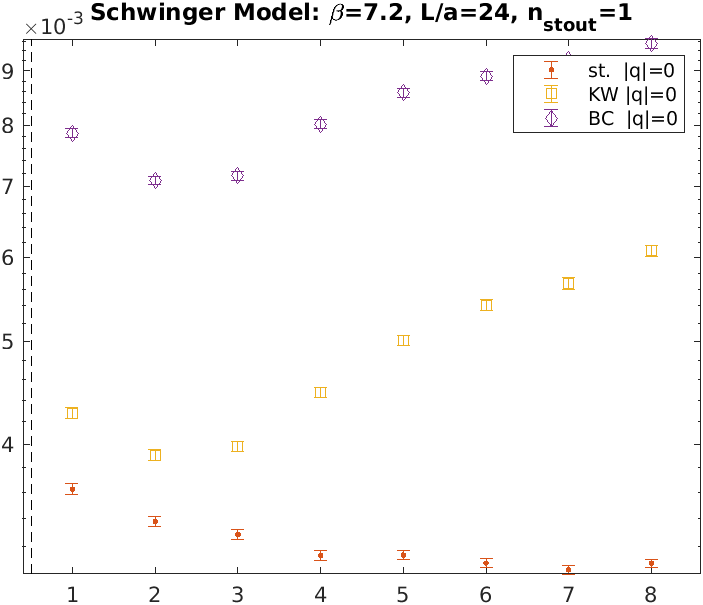
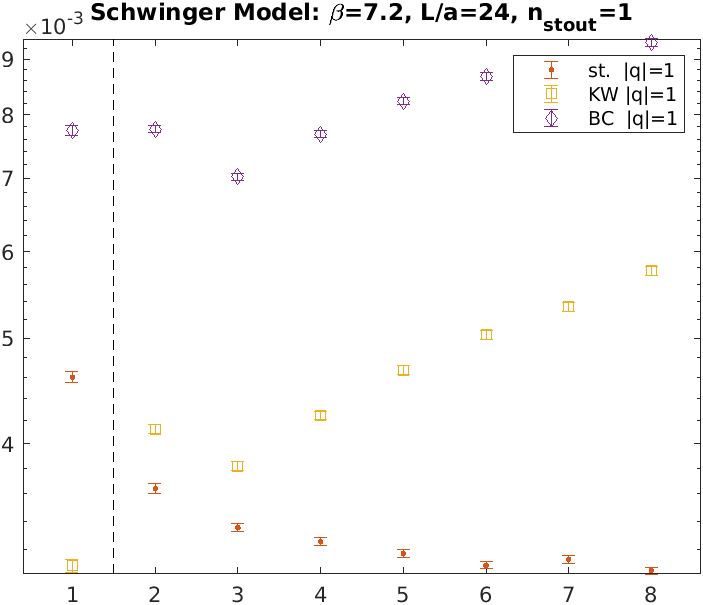
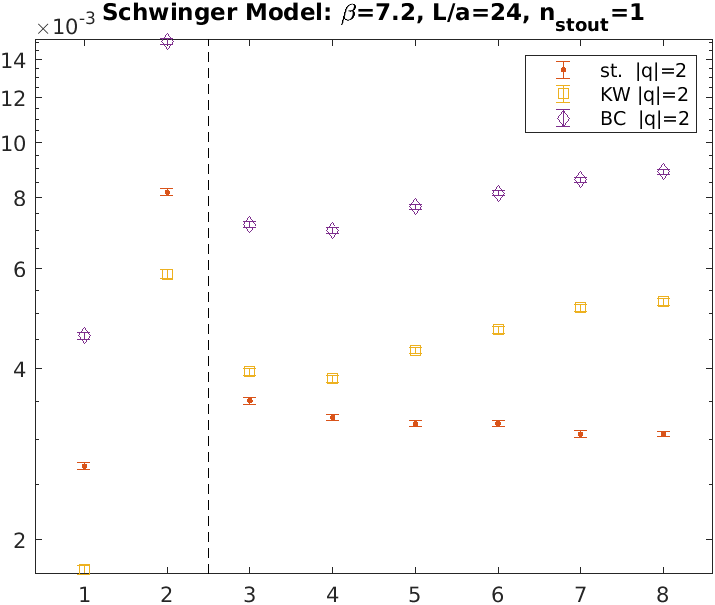
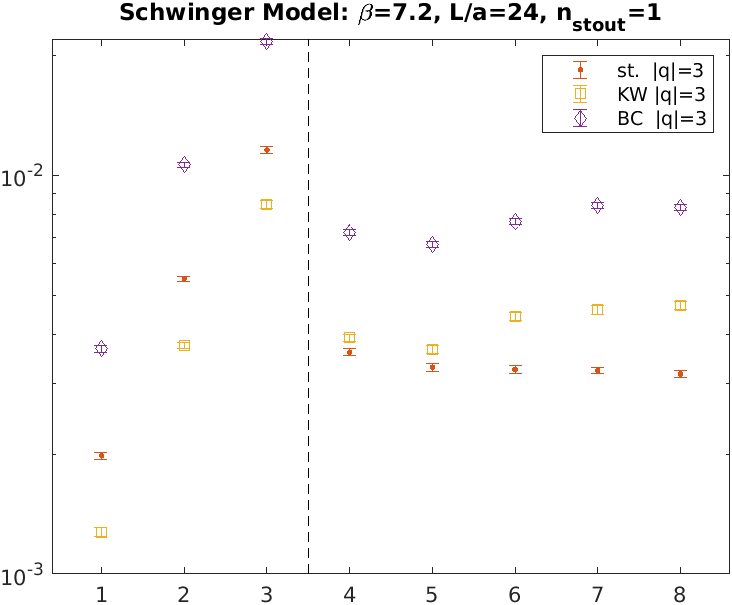
Figure 2: Taste-splittings for staggered, KW, and BC fermions on the central ensemble (β=7.2,L/a=24,nstout=1), separated by ∣q∣=0,1,2,3.
Lattice Spacing Scaling and Smearing Effects
The scaling of taste splittings with the lattice spacing a is observed to be contingent on both the type of mode (wbz vs. ntm) and the presence or absence of link smearing:
- Without smearing, splittings for all formulations scale as δ∝a for both wbz and ntm in the accessible a range, contrary to the usual O(a2) expectation for improved staggered actions.
- With one or more smearing steps, the scaling for wbz transitions to δ∝a2 for all formulations, in accordance with Symanzik effective theory predictions. For ntm splittings, only the staggered formulation achieves O(a2) with smearing, whereas KW and BC maintain δ∝a behavior even under smearing.
Large logarithmic corrections to scaling are present with smearing, complicating the unambiguous extraction of the power law behavior at accessible lattice spacings.
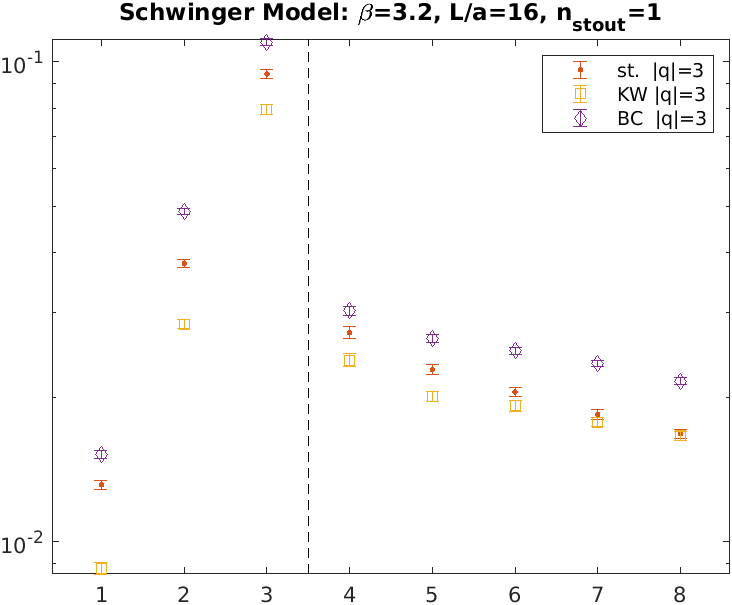
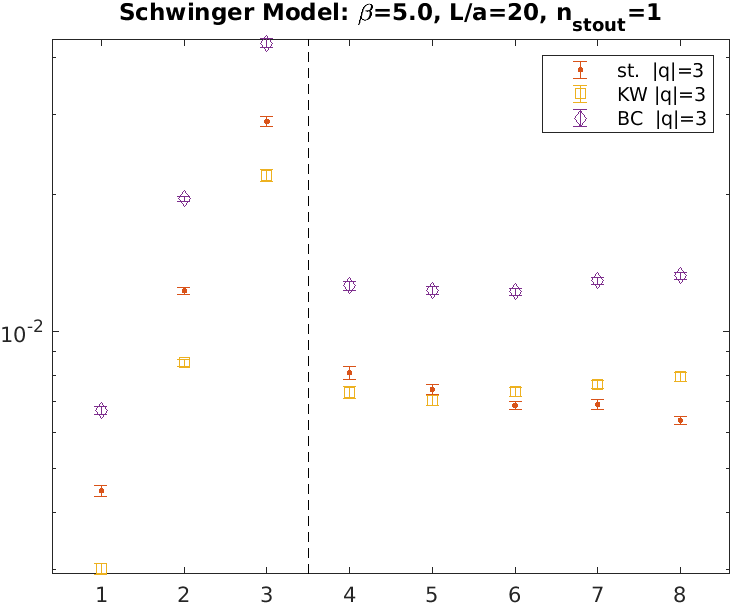
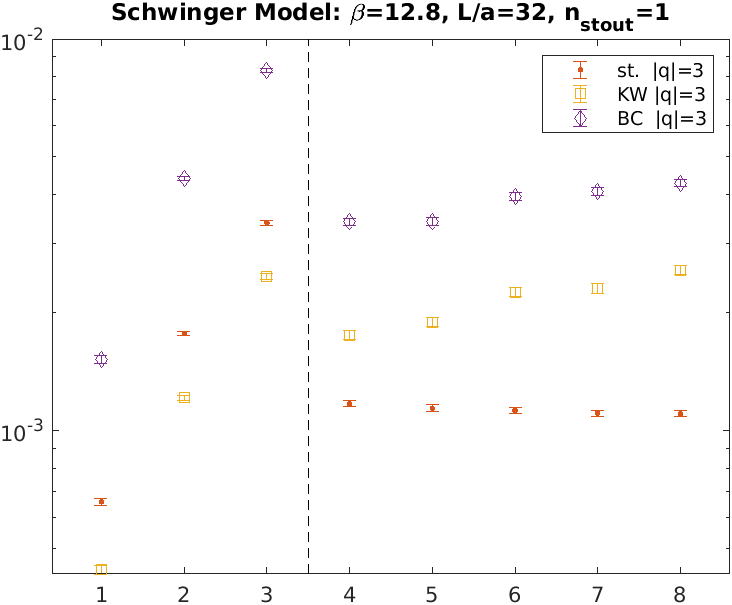
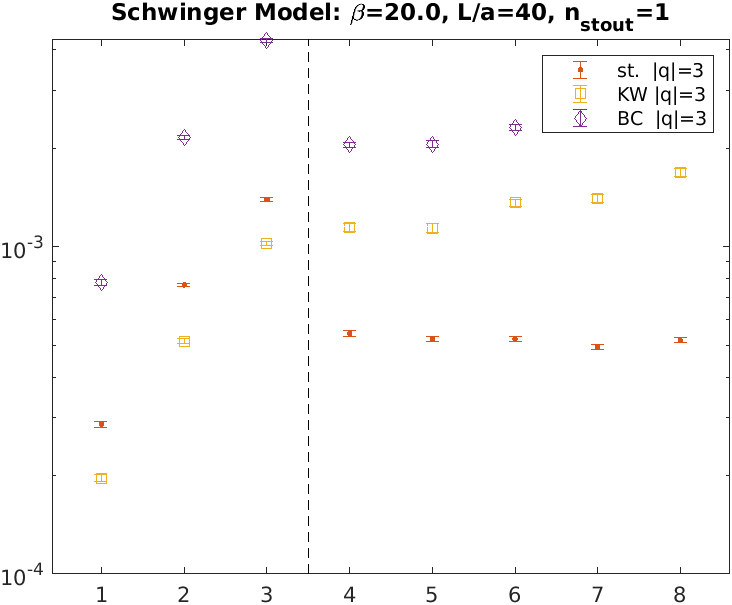
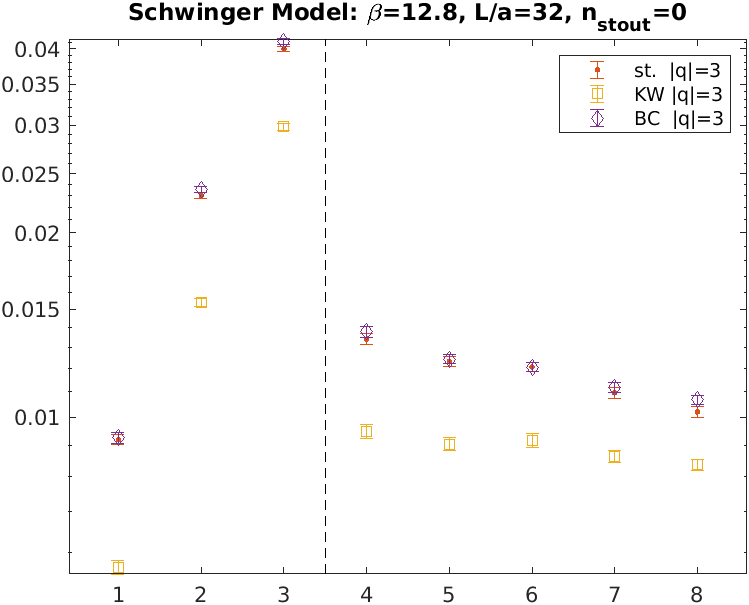
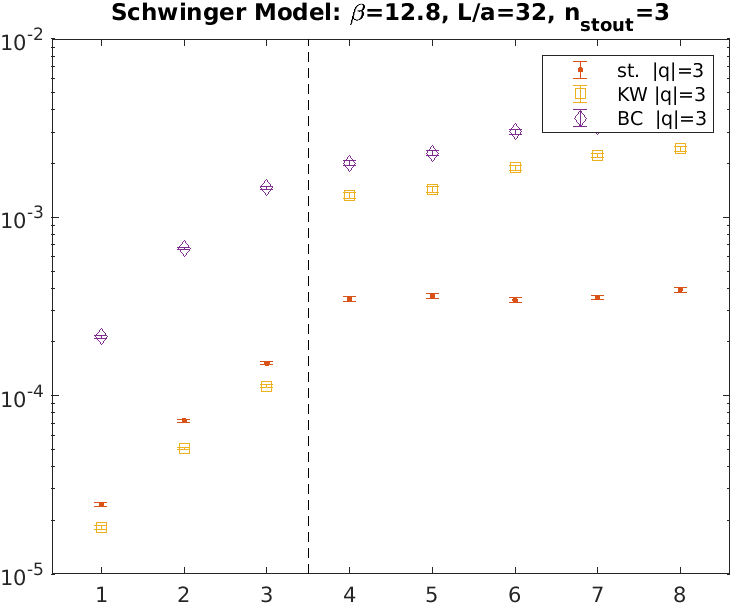
Figure 3: Lattice spacing (a) dependence of taste splittings for ∣q∣=3, illustrating scaling trends and the effect of smearing.
Finite Volume Effects
Volume dependence studies confirm that the qualitative hierarchy of taste splittings is robust to variations in box size at fixed lattice spacing. Both the mode-type dependence of the winner (KW for wbz, staggered for ntm) and the magnitude differences persist, demonstrating that the phenomena are not finite volume artifacts.
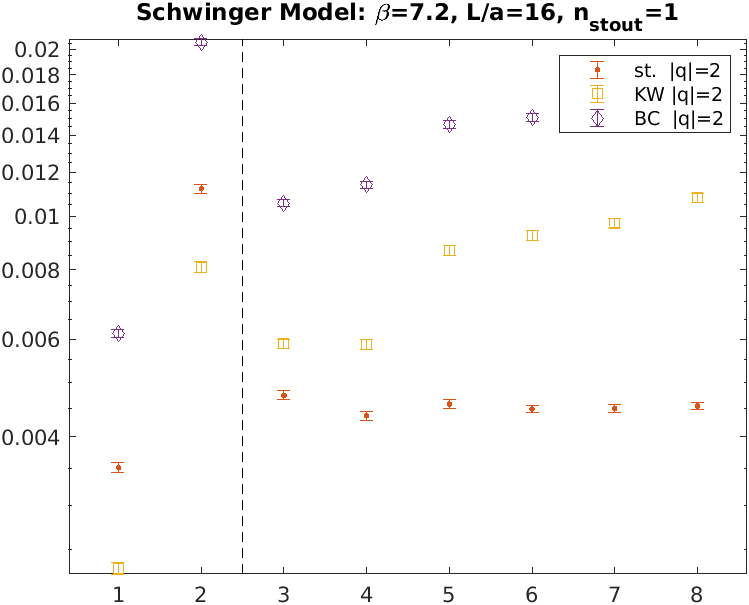
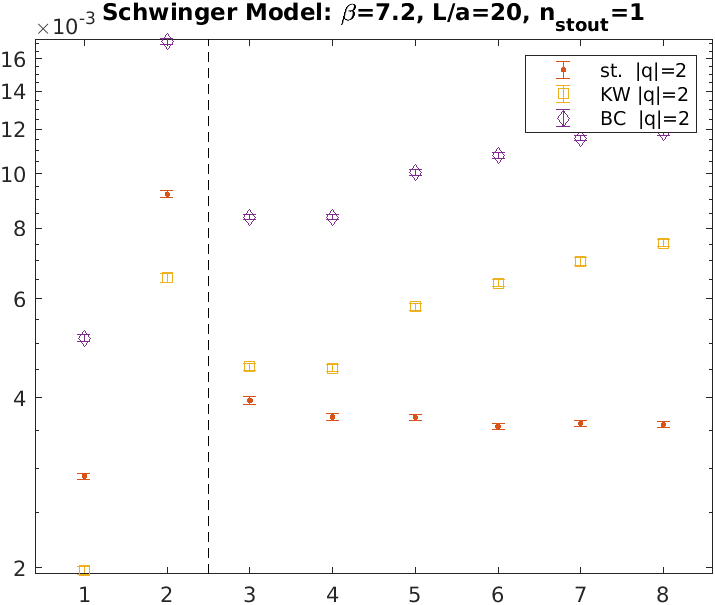
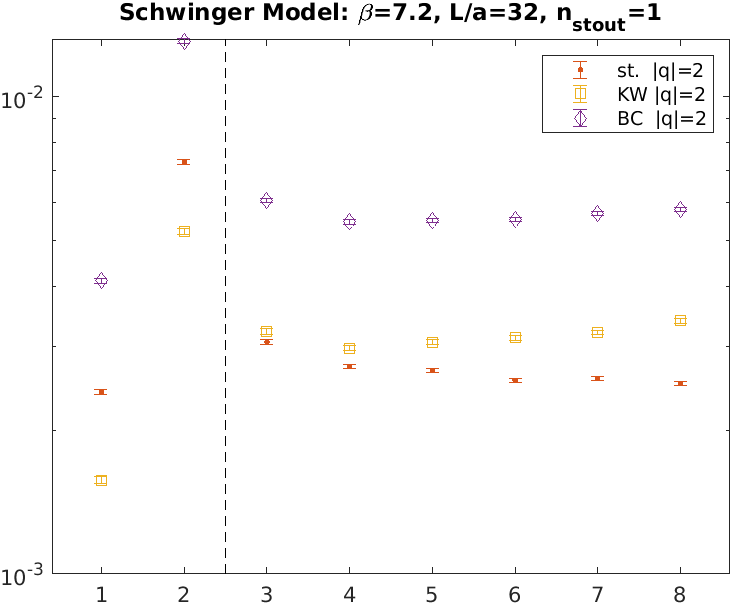
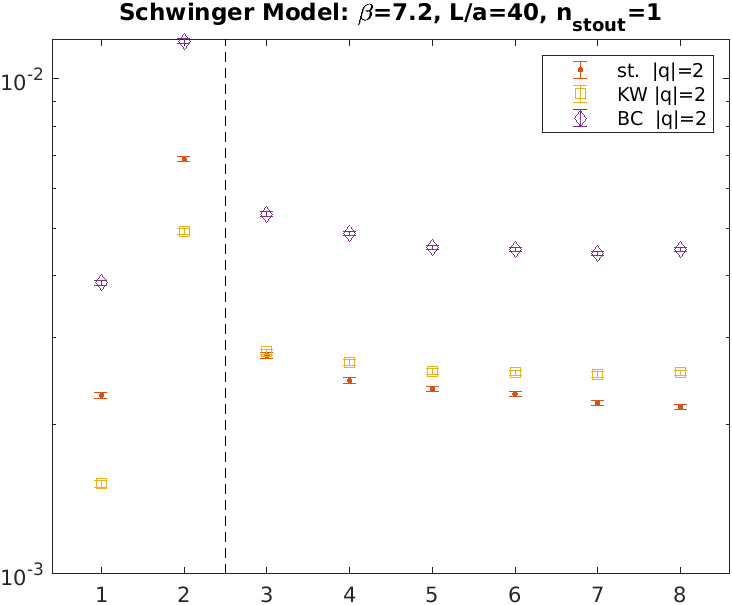
Figure 4: Volume dependence in taste splitting for ∣q∣=2, confirming stability of splitting hierarchies against box size variations.
Symanzik Scaling Analysis
A comprehensive scaling analysis distinguishes between would-be zero mode (wbz) and non-topological mode (ntm) splittings, individually tracking their approach to the continuum as a function of a for every formulation and smearing level.
- Unsmoothed actions (nstout=0): Both staggered and minimally doubled (KW/BC) formulations display δ∝a scaling for both wbz and ntm splittings.
- Smeared actions (nstout≥1): Smeared staggered fermions achieve δ∝a2 for both wbz and ntm splittings; KW/BC reach O(a2) only for wbz, remaining at O(a) for ntm.
- Logarithmic corrections: Substantial log-enhanced deviations from the naïve scaling laws observed in all cases, but most pronounced with increasing smearing.
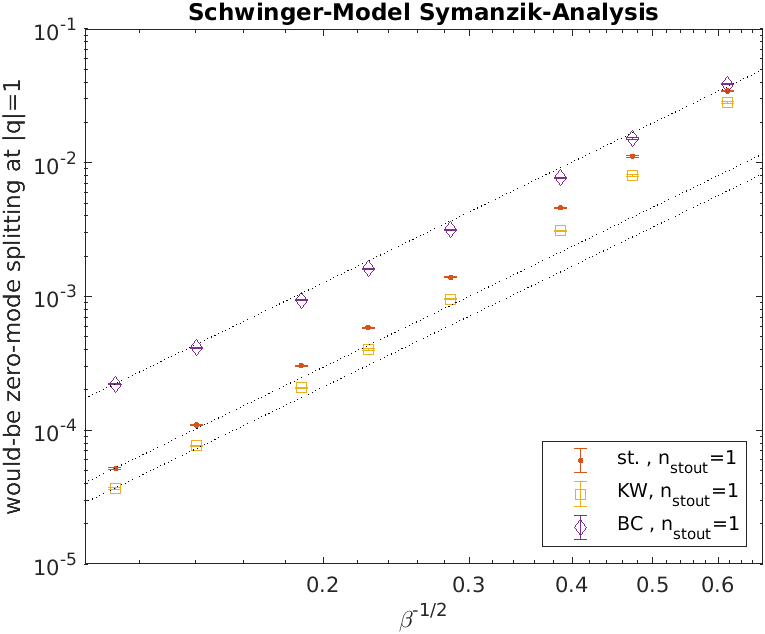
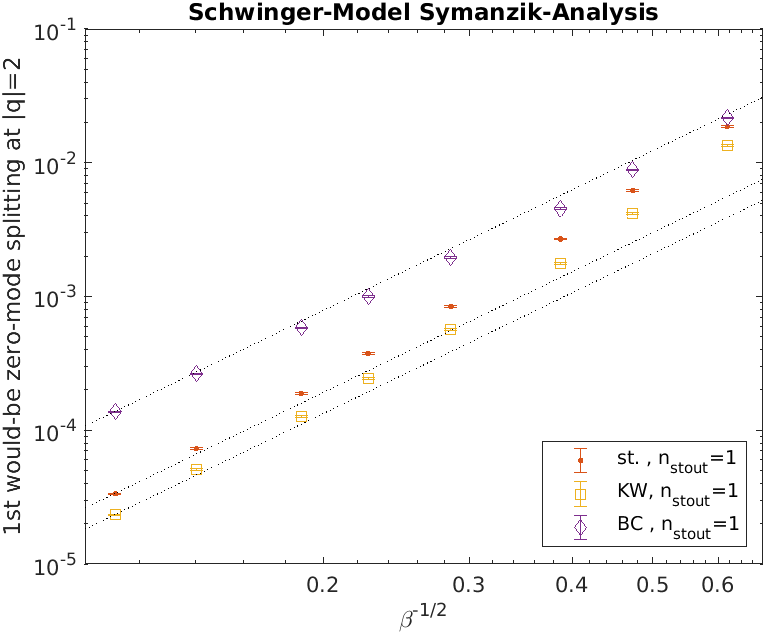
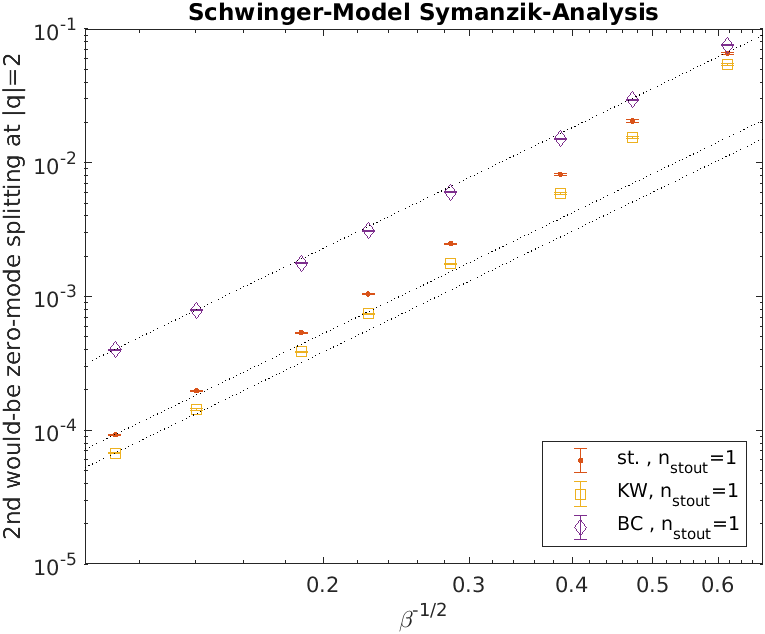
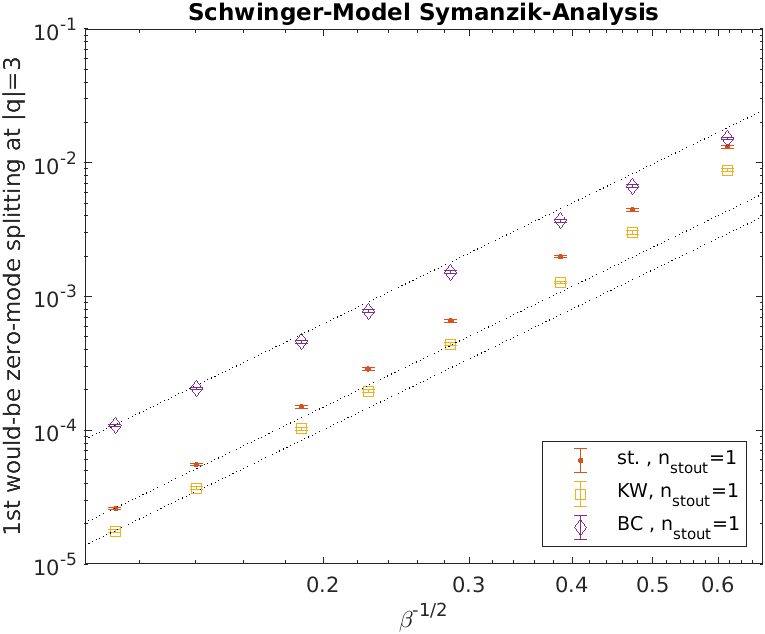
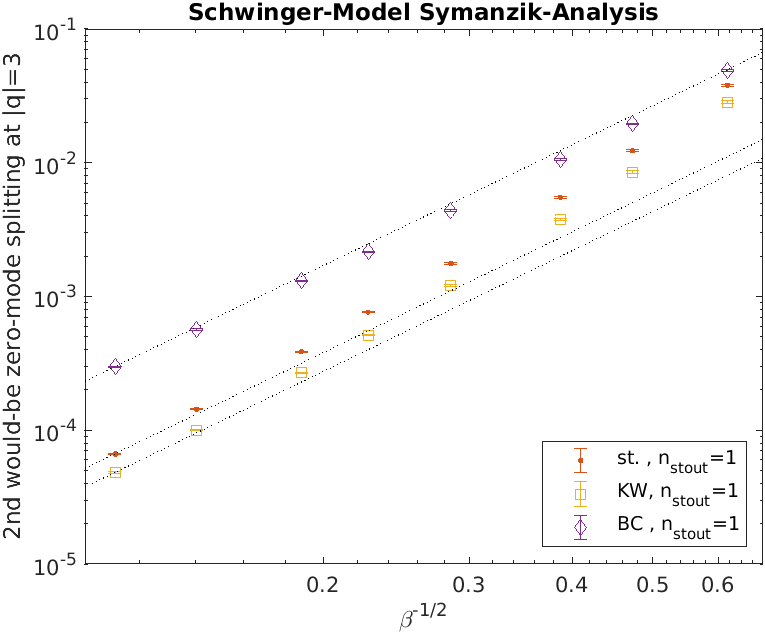
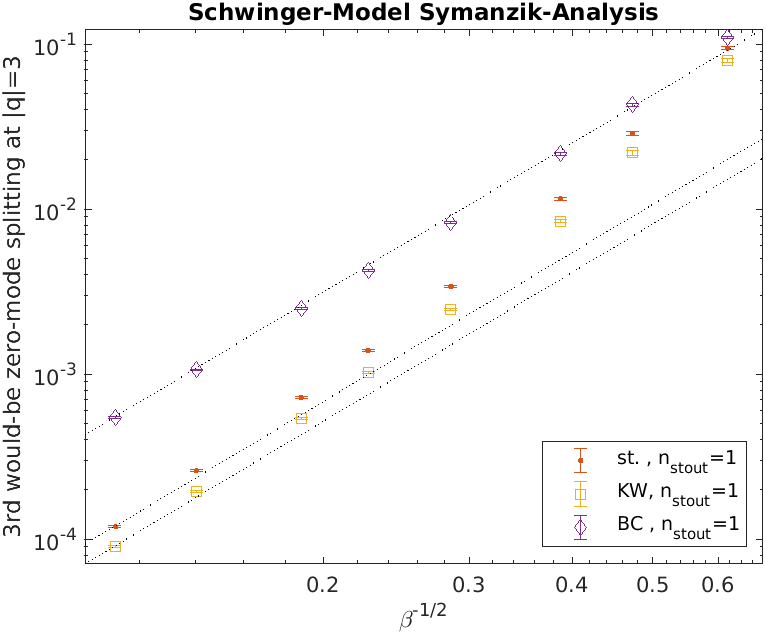
Figure 5: Symanzik scaling for would-be zero mode splittings (nstout=1): log-log plots demonstrate achieving the expected O(a2) scaling only with smearing applied.
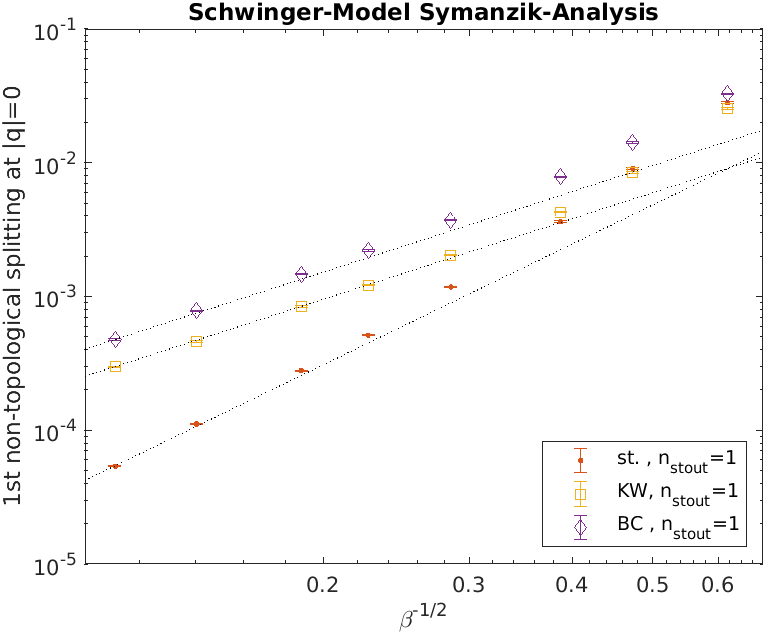
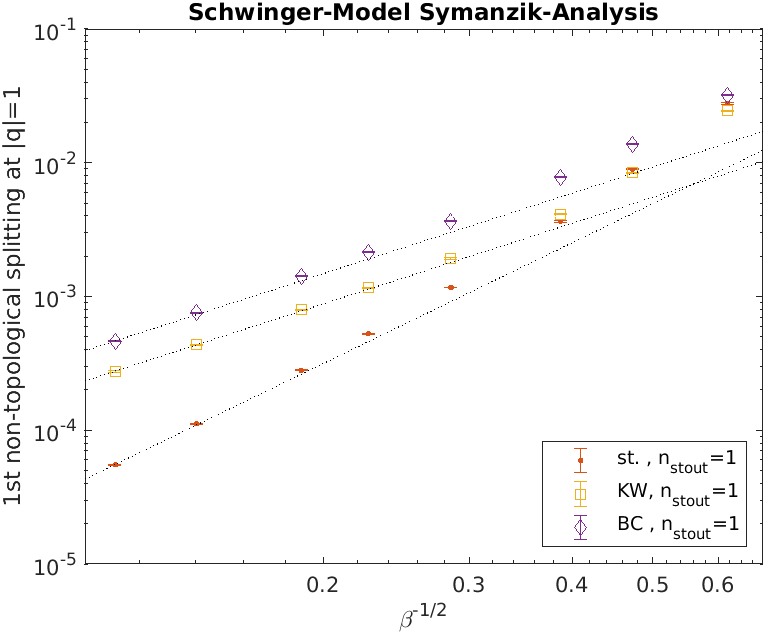
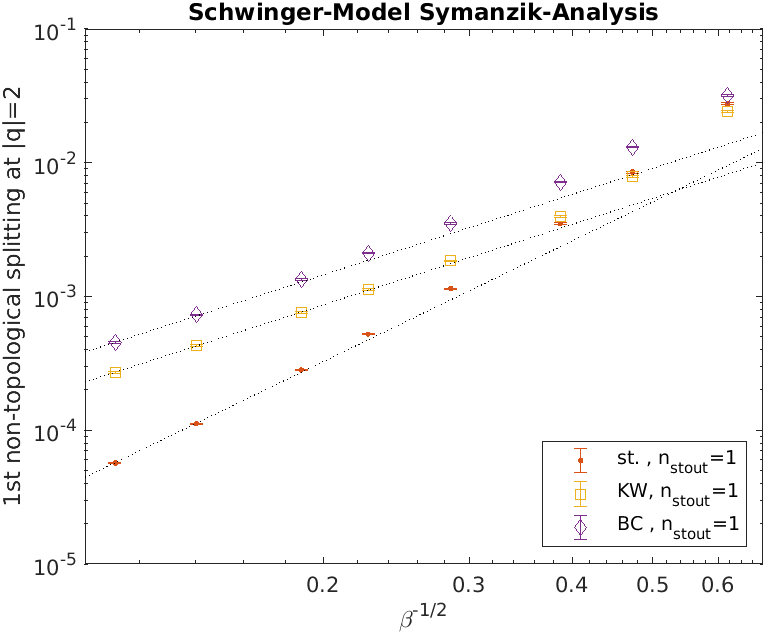
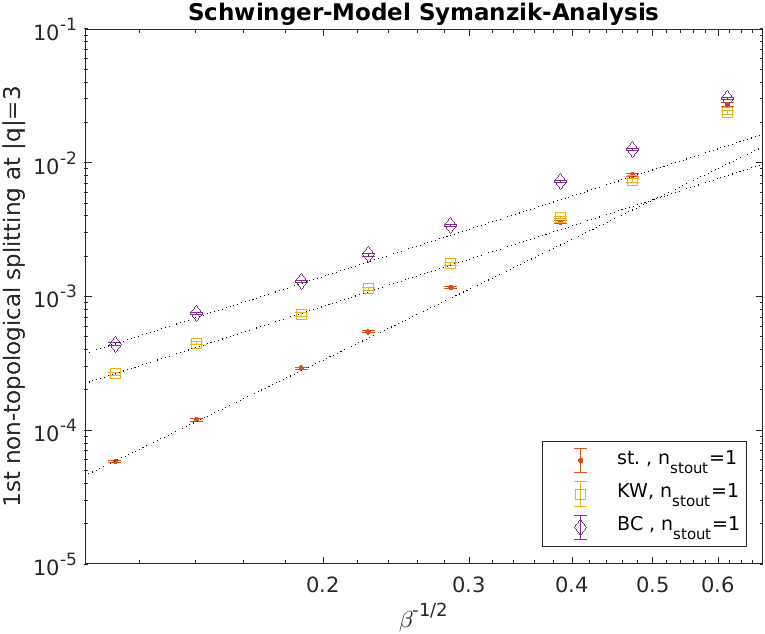
Figure 6: Symanzik scaling for non-topological mode splittings (nstout=1): staggered fermions approach O(a2) scaling, while minimally doubled actions plateau at O(a).
These results are summarized in Table 1 of the original text and highlight a contradictory observation: smearing alters the apparent universality class of the taste violations for the staggered action, a result at odds with standard Symanzik expectations.
Implications and Outlook
Theoretical Impact
The findings challenge established interpretations of universality for lattice fermion actions under smearing. That a local modification like smearing modifies the leading scaling power is in apparent contradiction to the standard scenario, which asserts that smearing should not affect the universality class, only subleading artifacts. This points to subtle and insufficiently understood interplay between smearing, chiral symmetry breaking, and topological structure in finite-a lattice Dirac spectra. The presence of large logarithmic corrections further complicates rigorous scaling analysis.
Practical Consequences
For lattice simulations requiring vanishing taste breaking—particularly for studies involving topological observables or near-zero Dirac modes—these results inform the choice of discretization and smearing prescription. The strong sensitivity of scaling behavior and splitting magnitude to both action and smearing underlines the need for careful benchmarking of any staggered or minimally doubled fermion-based approach, especially in near-continuum or high-precision regimes.
Future Research Directions
- Systematic inclusion and tuning of marginal counterterms for minimally doubled fermions in 2D, to discern whether their scaling can be modified analogously to smearing-induced effects in staggered formulations.
- Extension to hadronic spectrum-based measures of taste splitting, potentially clarifying connections between spectral and spectroscopic taste violations and their asymptotic scaling.
- Detailed studies of the interplay between topology, smearing flow time, and higher-order corrections in Symanzik expansion, including exploration of the form and origin of the observed logarithmic scaling corrections.
- Comparative studies in higher dimensions (e.g., 4D QCD), where the taste structure and symmetry breaking patterns are richer.
Conclusion
This work provides a comparative and detailed numerical analysis of taste breaking in staggered, Karsten-Wilczek, and Borici-Creutz fermions within the Schwinger model, showing that both the scaling exponent and hierarchy of taste splittings crucially depend on link smearing, the action chosen, and the topological structure of the gauge background. The dependence of scaling exponents for taste breaking on smearing level—contrary to Symanzik theory—constitutes a significant theoretical puzzle. The results highlight the necessity of careful study of smearing and topological effects in any precision lattice calculation involving taste-doubled or minimally doubled fermion actions.
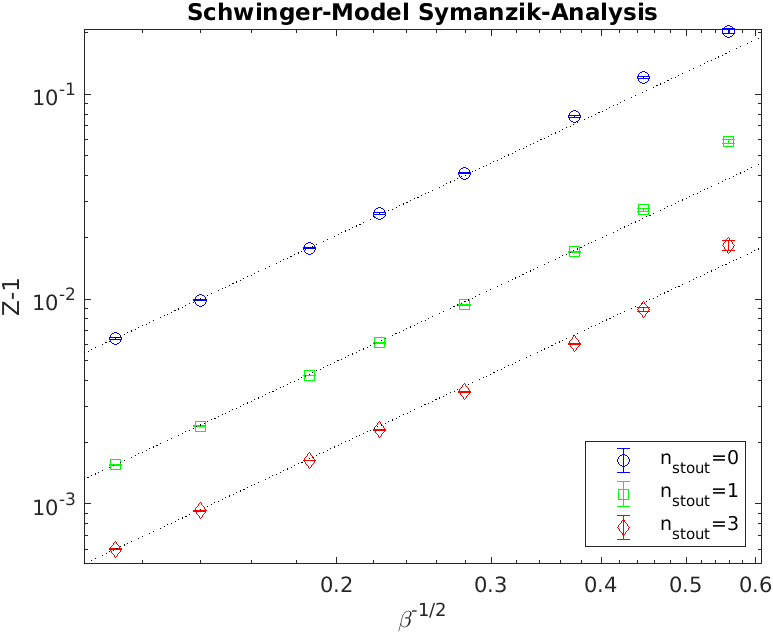
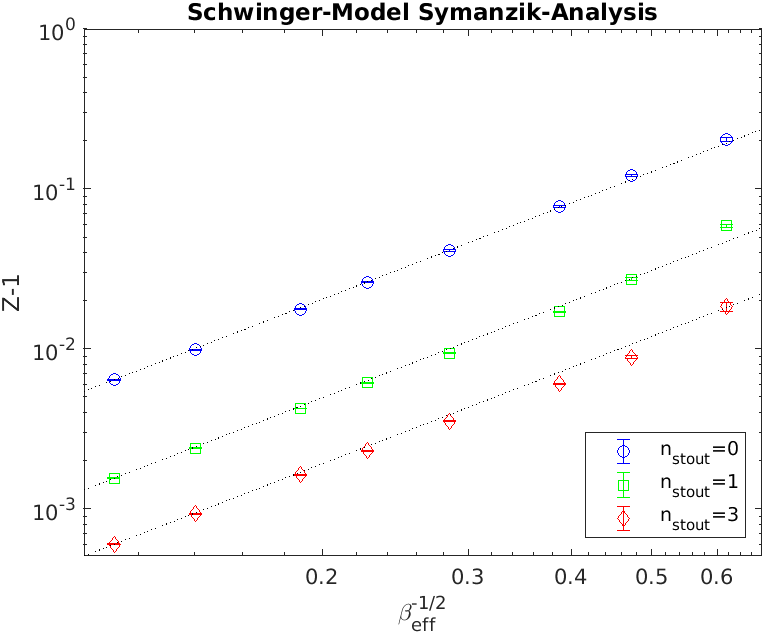
Figure 7: Symanzik scaling of the topological charge renormalization factor Z, validating standard O(a2) behavior for gluonic quantities and further highlighting the fermionic origin of the anomalous scaling seen in taste-breaking observables.