- The paper demonstrates that weighted human brain connectomes exhibit multiscale self-similarity with invariant statistical properties across varying resolutions.
- It employs a weighted geometric soft configuration model integrated with hyperbolic embeddings to accurately replicate the distributions of weights and strengths.
- By confirming the weak ties hypothesis, the study highlights that low-weight connections are key for effective intermodular integration in brain networks.
Multiscale Self-Similarity of the Weighted Human Brain Connectome
The study titled "The multiscale self-similarity of the weighted human brain connectome" (2410.06739) provides a comprehensive analysis of how anatomical connectivity in the human brain exhibits self-similar features across various scales. The paper leverages empirical data to investigate the hierarchical organization of weights in brain connectomes and postulates a unified model to describe these phenomena.
Overview of Findings
The research demonstrates that the weighted human brain connectome exhibits multiscale self-similarity, characterized by consistent statistical properties of weak and strong ties across different observation resolutions. This self-similar behavior is captured by applying a renormalization of the weighted structure on hyperbolic embeddings of the connectomes. Importantly, this obviates the need for separate generative models at each scale, suggesting a unified connectivity rule governing the brain’s network integration.
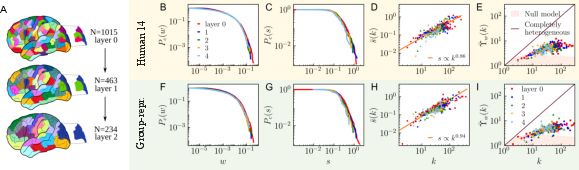
Figure 1: Self-similarity of weighted human brain connectomes across scales.
Evidence for Self-Similarity
Two independent datasets, comprised of 84 weighted connectomes from healthy human subjects, were analyzed to validate the findings. The University of Lausanne dataset and Human Connectome Project dataset provided high-resolution data of neural connectivity networks reconstructed from imaging data. The study found that various statistical metrics, such as complementary cumulative distributions of weights and strengths, are nearly invariant across layers with varying anatomical detail.
This invariance supports the notion of self-similarity, where the network's organizational rules do not depend on the specific scale at which the connectome is observed (Figure 1). The analysis also underscores the statistical consistency between the individual and group-representative connectomes.
Weak Ties Hypothesis
An essential aspect of the study is the validation of the weak ties hypothesis within the brain connectomes. Through detailed analysis, the paper shows that weak links—often perceived as negligible—are crucial for multiscale module integration, aligning with the concept of weak ties facilitating efficient information transfer in complex networks.
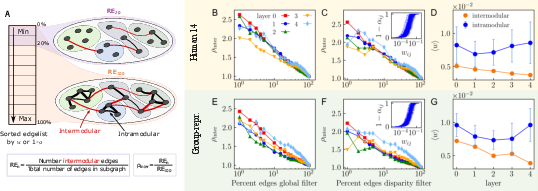
Figure 2: Weak-ties spectrum demonstrating the exponential decay of intermodular connections as edge weight filters vary.
The weak ties hypothesis was confirmed by observing that low-weight connections tend to bridge intermodular gaps more prevalently than strong ties, highlighting their importance in maintaining the topological integrity of network modules across scales (Figure 2).
The Geometric Model
The weighted geometric soft configuration model, WS1, provides a robust framework for capturing the observed scaling laws and weight distributions in brain connectomes. This model couples both topology and weights to a latent hyperbolic space, where similarity coordinates and popularity metrics guide the likelihood of connection formation and weight assignment.
This model was able to replicate the real-world distribution of weights and strengths accurately and demonstrated that a single set of distance-dependent rules suffices to describe both weak and strong ties across all scales examined.
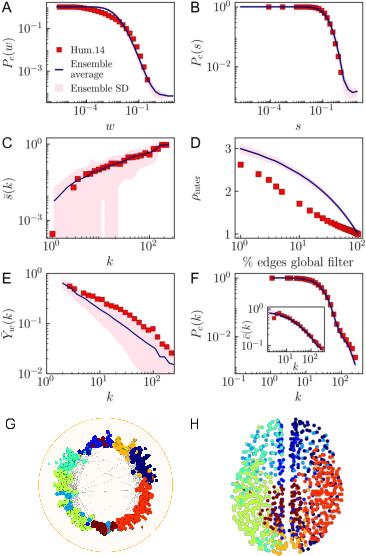
Figure 3: Geometric renormalization of weighted connectomes depicting the preservation of network properties across scales.
Implications and Future Directions
The multiscale self-similarity highlighted in this research suggests that evolutionary processes may sculpt the network architecture of human brains to optimize for criticality—possibly granting robustness and efficient integration of functional processes. This idea supports the hypothesis that criticality provides a robust framework absent of scale-specific adjustments.
Future investigations might explore the presence of resolution thresholds where this symmetry might be disrupted, or how these properties change in neurological disorders. These insights could extend beyond neuroscience, suggesting that self-similar weighted structures may be a prevalent organizational principle in various complex networks.
Conclusion
This study articulates a compelling case for the multiscale self-similarity in weighted human brain connectomes, underpinning a novel understanding of brain architecture. By utilizing a geometric framework, the research not only explains current observations but also sets the groundwork for examining how such symmetries might manifest across other complex systems.