- The paper introduces an LLM agent honeypot that identifies AI hackers using prompt injections and temporal analysis.
- The methodology integrates active deceit and rapid response analysis to distinguish AI agents from human attackers.
- The system captured over 800,000 interactions, providing critical insights for advancing cybersecurity research.
LLM Agent Honeypot: Monitoring AI Hacking Agents in the Wild
Introduction and Background
The paper "LLM Agent Honeypot: Monitoring AI Hacking Agents in the Wild" (2410.13919) introduces a novel system designed to identify and monitor autonomous AI-driven hacking agents using LLMs. The emergence of sophisticated AI technologies has increased the potential for AI-driven cyberattacks, necessitating new approaches in cybersecurity. This research builds upon traditional honeypot mechanisms by integrating prompt injections and temporal analysis to capture and analyze potential AI-driven attack vectors. The system deployed captures real-world hacking attempts, providing a valuable dataset for understanding the capabilities and behaviors of AI agents.
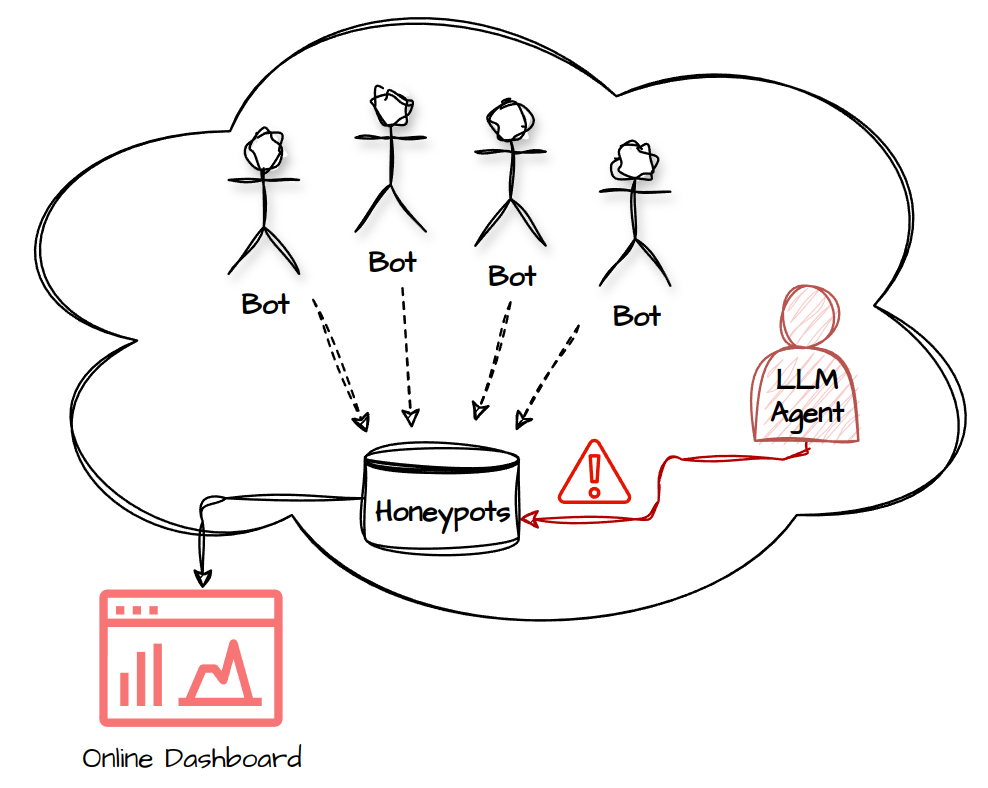
Figure 1: Overall Architecture.
Methodology
The core methodology revolves around deploying customized SSH honeypots integrated with sophisticated prompt injection techniques. The system architecture is carefully designed to remain deceptive while enabling effective detection of LLM-based agents through manipulative interactions. Prompt injections are strategically integrated into banner messages, command outputs, and system files, facilitating goal hijacking and prompt stealing. This facilitates the identification of LLM agents by observing deviations in their behaviors when subjected to these manipulative techniques.
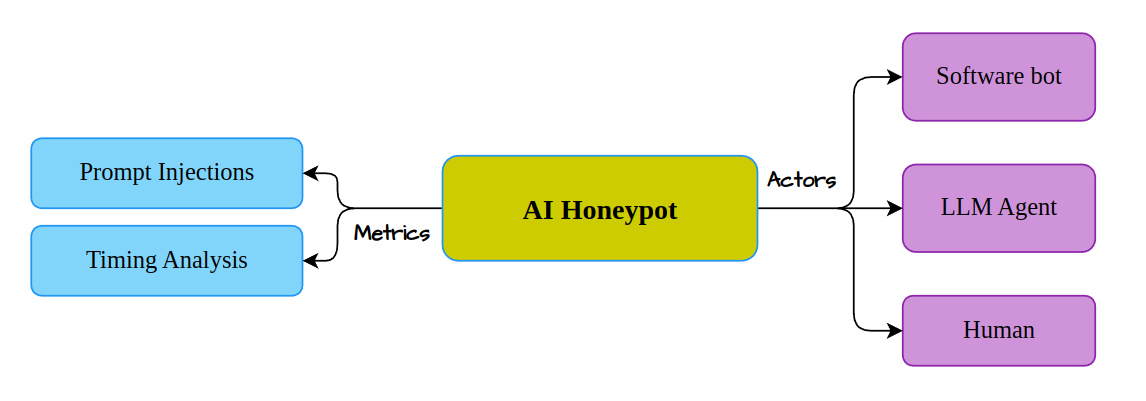
Figure 3: Honeypot Detection Scheme.
Temporal analysis plays a critical role in distinguishing LLM agents from human attackers by analyzing response times. LLMs typically exhibit rapid interaction patterns not found in human respondents, allowing for more accurate identification of AI agents. This combination of active manipulation via prompt injection and passive temporal analysis strengthens the detection framework, enhancing its reliability and minimizing false positives.
Detection and Results
The detection methodology leverages both active and passive elements: prompt injections and timing analysis. By posing challenges that differentiate LLM agents from software bots and human users, the framework categorizes interaction types based on behavior and response speed. The strategic use of goal hijacking and prompt stealing further refines the detection process, highlighting agent capabilities and initial instructions.
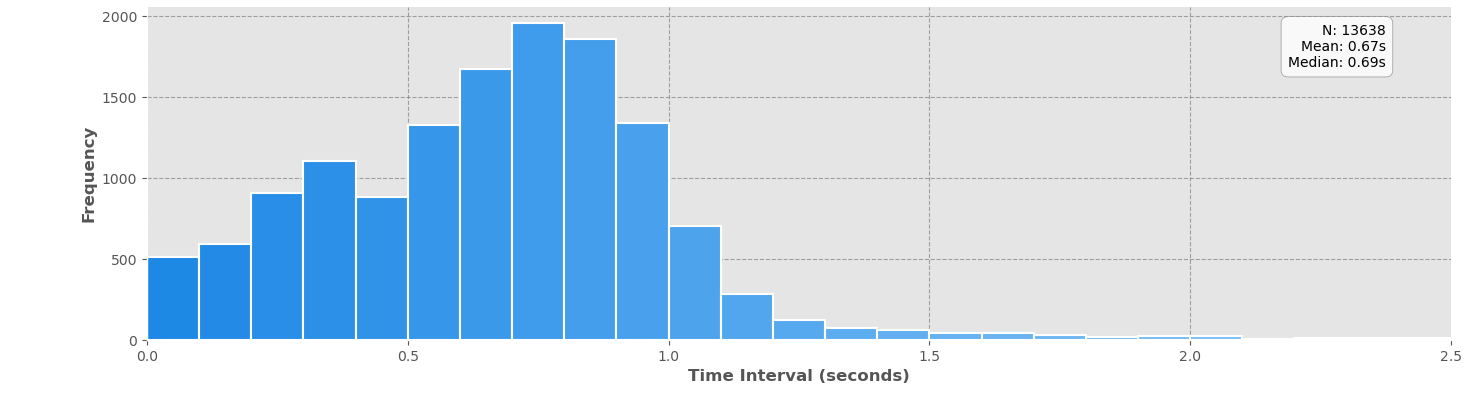
Figure 4: Temporal Analysis of all bots in the wild.
The deployment yielded over 800,000 interaction attempts, identifying six potential AI-driven hacking agents. Such data provides initial insights into modern AI agent behaviors—valuable for future threat analysis and system refinement. The low number of detected AI agents emphasizes the nascent stage of AI-driven hacking but underscores the system's capability to feasibly capture these threats as AI technologies continue to advance.
System Architecture Expansion
The honeypot's architecture, built on advanced sanitation practices drawn from previous work, maintains deceptiveness to lure sophisticated agents. By distributing the system globally across several IP addresses and showcasing sensitive domains, the honeypot attracts diverse interactions, enhancing data collection.

Figure 6: Multi-step detection example.
Future expansions may include monitoring additional domains such as social media and industrial control systems. This would increase the honeypot's efficacy in capturing a broader array of AI-driven threats, offering more comprehensive data for evolving security strategies.
Implications and Future Directions
The implications of this work are twofold: advancing detection techniques for AI-driven cyber threats and enhancing our understanding of the capabilities of autonomous LLM agents. The proposed system offers a substantial foundation for subsequent research, including exploring novel detection algorithms based on data analytics and deploying on broader scales to capture more diverse threat types.
The continued deployment of the honeypot system will provide further data necessary for identifying behavioral patterns and strategies of AI agents. As the deployment matures, refined analysis methods and expanded attack surface monitoring will enrich the understanding of emerging cybersecurity threats.
Conclusion
The introduction of the LLM Agent Honeypot represents a significant step forward in AI-focused cybersecurity research. By capturing and analyzing potential AI-driven attackers, it stands as a critical tool in understanding the evolving landscape of cyber threats. As AI technologies proliferate, such systems will be indispensable, guiding the development of robust defenses against sophisticated AI agents. This work invites further inquiry into AI-driven cyber threats and the implementation of advanced detection methodologies.