OpenCity: A Scalable Platform to Simulate Urban Activities with Massive LLM Agents
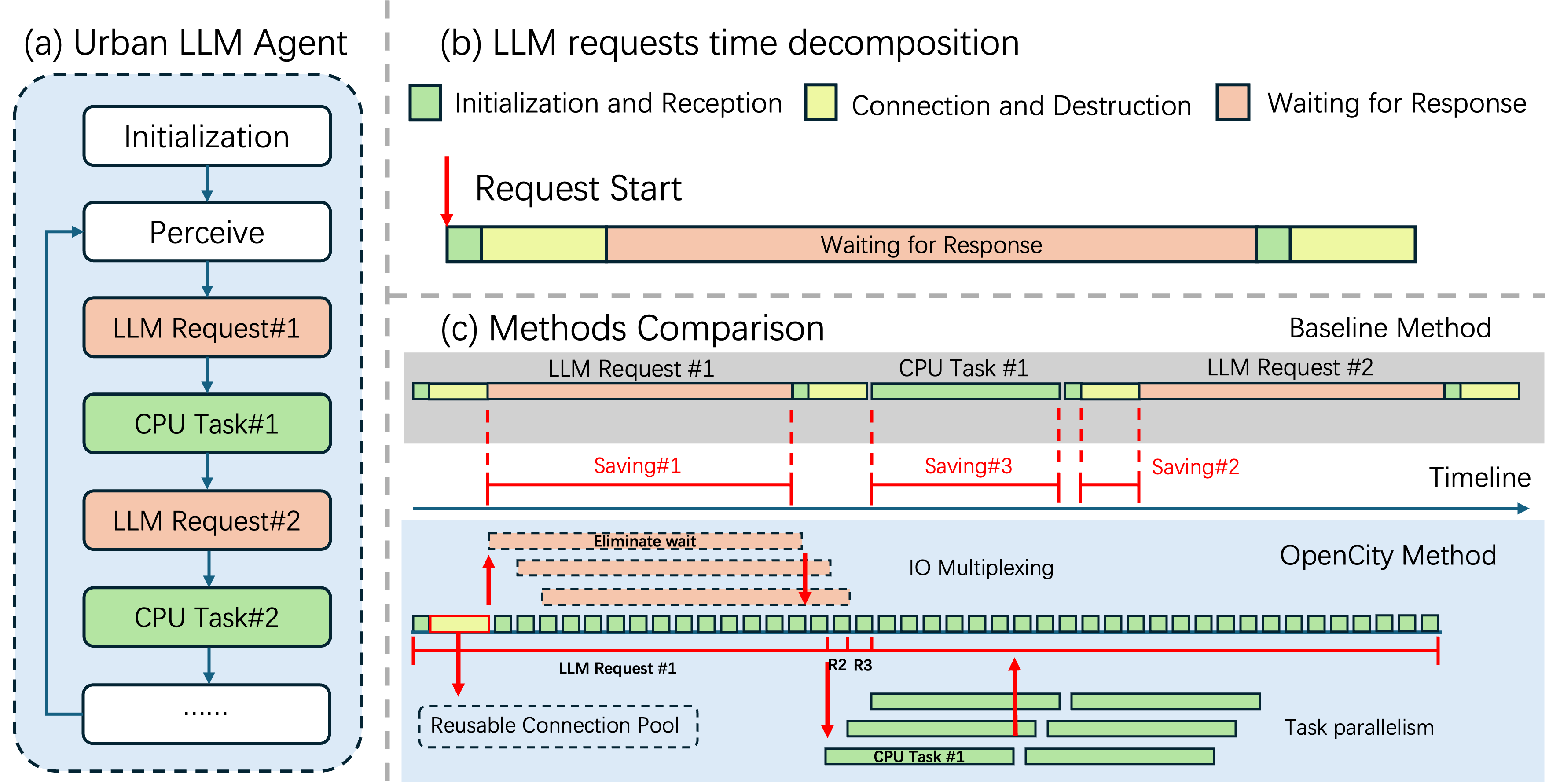
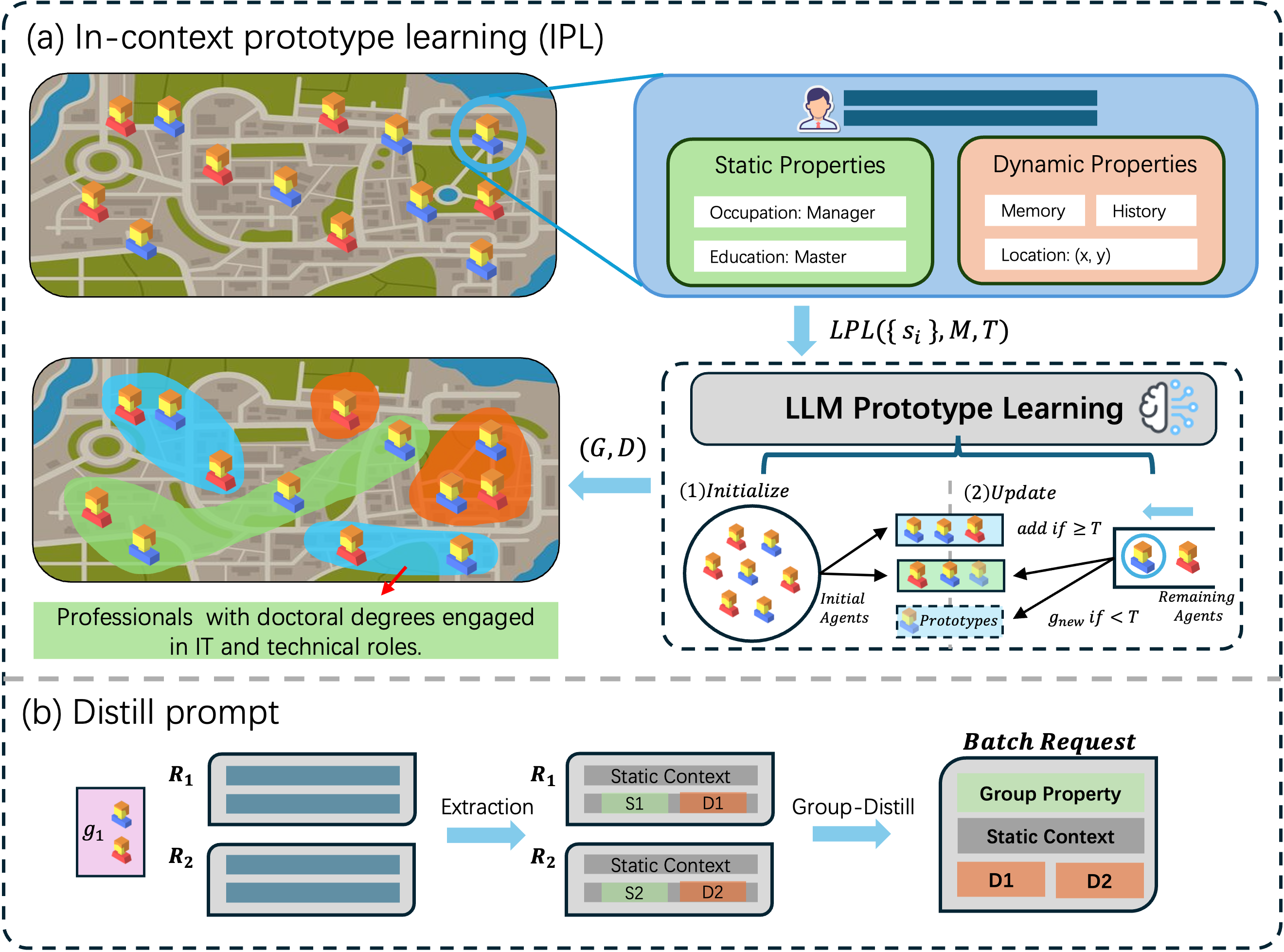
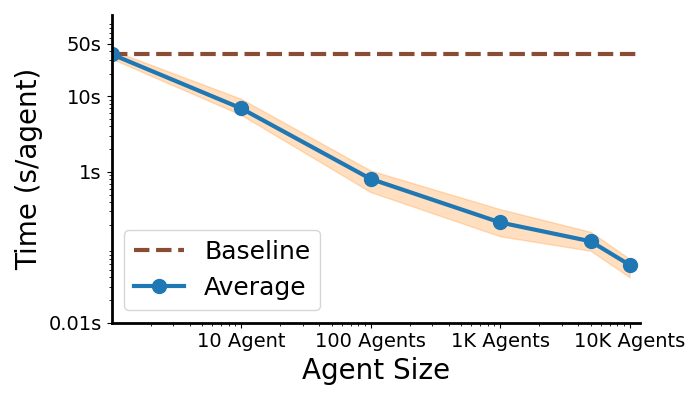
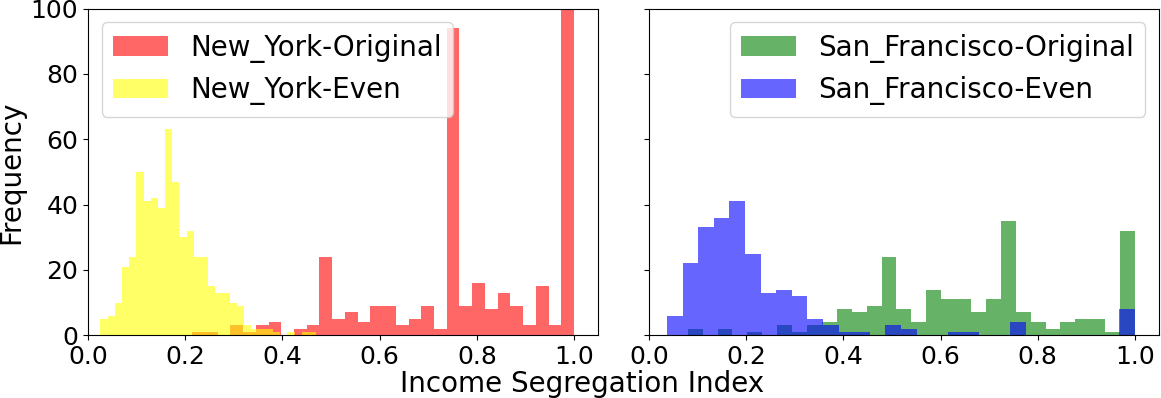
Abstract: Agent-based models (ABMs) have long been employed to explore how individual behaviors aggregate into complex societal phenomena in urban space. Unlike black-box predictive models, ABMs excel at explaining the micro-macro linkages that drive such emergent behaviors. The recent rise of LLMs has led to the development of LLM agents capable of simulating urban activities with unprecedented realism. However, the extreme high computational cost of LLMs presents significant challenges for scaling up the simulations of LLM agents. To address this problem, we propose OpenCity, a scalable simulation platform optimized for both system and prompt efficiencies. Specifically, we propose a LLM request scheduler to reduce communication overhead by parallelizing requests through IO multiplexing. Besides, we deisgn a "group-and-distill" prompt optimization strategy minimizes redundancy by clustering agents with similar static attributes. Through experiments on six global cities, OpenCity achieves a 600-fold acceleration in simulation time per agent, a 70% reduction in LLM requests, and a 50% reduction in token usage. These improvements enable the simulation of 10,000 agents' daily activities in 1 hour on commodity hardware. Besides, the substantial speedup of OpenCity allows us to establish a urban simulation benchmark for LLM agents for the first time, comparing simulated urban activities with real-world data in 6 major cities around the globe. We believe our OpenCity platform provides a critical infrastructure to harness the power of LLMs for interdisciplinary studies in urban space, fostering the collective efforts of broader research communities. Code repo is available at https://anonymous.4open.science/r/Anonymous-OpenCity-42BD.
- Thomas C Schelling. Micromotives and macrobehavior. WW Norton & Company, 2006.
- Emergence of urban growth patterns from human mobility behavior. Nature Computational Science, 1(12):791–800, 2021.
- Strategic covid-19 vaccine distribution can simultaneously elevate social utility and equity. Nature Human Behaviour, 6(11):1503–1514, 2022.
- Generative agents: Interactive simulacra of human behavior. In Proceedings of the 36th annual acm symposium on user interface software and technology, pages 1–22, 2023.
- Urban generative intelligence (ugi): A foundational platform for agents in embodied city environment. arXiv preprint arXiv:2312.11813, 2023.
- Beyond imitation: Generating human mobility from context-aware reasoning with large language models. arXiv preprint arXiv:2402.09836, 2024.
- Chain-of-thought prompting elicits reasoning in large language models. Advances in neural information processing systems, 35:24824–24837, 2022.
- Perceive, reflect, and plan: Designing llm agent for goal-directed city navigation without instructions. arXiv preprint arXiv:2408.04168, 2024.
- On the limits of agency in agent-based models. arXiv preprint arXiv:2409.10568, 2024.
- Francesc Bruguera i Moriscot. Benchmarking input/output multiplexing facilities of the linux kernel. 2019.
- Computer networks: a systems approach. Morgan Kaufmann, 2007.
- Batch prompting: Efficient inference with large language model apis. arXiv preprint arXiv:2301.08721, 2023.
- Understanding individual human mobility patterns. nature, 453(7196):779–782, 2008.
- The timegeo modeling framework for urban mobility without travel surveys. Proceedings of the National Academy of Sciences, 113(37):E5370–E5378, 2016.
- Mobility patterns are associated with experienced income segregation in large us cities. Nature communications, 12(1):4633, 2021.
- Modelling the scaling properties of human mobility. Nature physics, 6(10):818–823, 2010.
- The dimensions of residential segregation. Social forces, 67(2):281–315, 1988.
- Significant Gravitas. Autogpt. https://github.com/Significant-Gravitas/AutoGPT, 2023. Accessed: 2024-09-01.
- A survey on large language model based autonomous agents. Frontiers of Computer Science, 18(6):186345, 2024.
- The rise and potential of large language model based agents: A survey. arXiv preprint arXiv:2309.07864, 2023.
- Communicative agents for software development. arXiv preprint arXiv:2307.07924, 6, 2023.
- Swe-agent: Agent-computer interfaces enable automated software engineering. arXiv preprint arXiv:2405.15793, 2024.
- Metagpt: Meta programming for multi-agent collaborative framework. arXiv preprint arXiv:2308.00352, 2023.
- S3: Social-network simulation system with large language model-empowered agents. arXiv preprint arXiv:2307.14984, 2023.
- Recagent: A novel simulation paradigm for recommender systems. arXiv preprint arXiv:2306.02552, 2023.
- Towards efficient generative large language model serving: A survey from algorithms to systems. arXiv preprint arXiv:2312.15234, 2023.
- Flashattention: Fast and memory-efficient exact attention with io-awareness. Advances in Neural Information Processing Systems, 35:16344–16359, 2022.
- Awq: Activation-aware weight quantization for on-device llm compression and acceleration. Proceedings of Machine Learning and Systems, 6:87–100, 2024.
- Efficient memory management for large language model serving with pagedattention. In Proceedings of the 29th Symposium on Operating Systems Principles, pages 611–626, 2023.
- Efficiently programming large language models using sglang. arXiv preprint arXiv:2312.07104, 2023.
- Defint: A default-interventionist framework for efficient reasoning with hybrid large language models. arXiv preprint arXiv:2402.02563, 2024.
- Automating customer service using langchain: Building custom open-source gpt chatbot for organizations. arXiv preprint arXiv:2310.05421, 2023.
- Auto-gpt for online decision making: Benchmarks and additional opinions. arXiv preprint arXiv:2306.02224, 2023.
Paper Prompts
Sign up for free to create and run prompts on this paper using GPT-5.
Top Community Prompts
Collections
Sign up for free to add this paper to one or more collections.