- The paper demonstrates that AI adoption in research increases individual impact, as evidenced by higher citation rates, while contracting the breadth of scientific exploration.
- It identifies accelerated AI integration across natural sciences using a fine-tuned BERT model, achieving high reliability (Fleiss’ Kappa ≥ 0.93).
- The study highlights a paradox where enhanced career trajectories coincide with a narrowing focus on data-rich, popular research topics.
Introduction
The paper "Artificial Intelligence Tools Expand Scientists' Impact but Contract Science's Focus" (2412.07727) investigates the implications of AI adoption in scientific research. The authors analyze extensive data from the OpenAlex dataset, comprising 41.3 million research papers across multiple natural science disciplines, such as biology, medicine, chemistry, geology, materials science, and physics, from 1980 to 2025. The study utilizes a pre-trained LLM fine-tuned for identifying AI-augmented research and achieves an F1-score of 0.875. The results reflect an accelerated adoption of AI by scientists, leading to individual professional benefits but a concurrent narrowing of scientific focus.
AI's Role in Science:
AI has proven transformative across various fields, enhancing productivity and discovery rates. The paper highlights AI's expansive role, drawing on examples such as AlphaFold's success in predicting protein structures and AI's contribution to improving fusion reaction designs and advancing matrix multiplication techniques in deep learning. AI tools like ChatGPT are rapidly integrating into scientific methodology, automating traditional tasks and potentially reshaping the publication landscape.
Increasing AI Adoption and Impact
The paper identifies AI's growing prevalence in research, recognized through a sophisticated BERT-based identification model. This analysis spans three distinct AI eras—Machine Learning (ML), Deep Learning (DL), and Generative AI (GAI).
Performance and Accuracy:
The adoption rates of AI-augmented papers and researchers across these eras exhibit substantial growth:
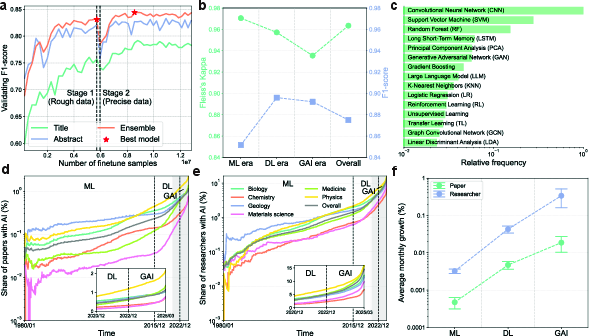
Figure 1: Increasing prevalence of AI adoption in science.
The accuracy of the identification model has been validated by expert consensus, showing high reliability (Fleiss’ Kappa ≥0.93).
AI's Individual Benefits:
AI augmentation fosters significant academic attention, evidenced by increased citation rates. AI researchers outperform their counterparts, publishing and receiving citations at exponentially greater rates, accelerating career transitions to established researchers.
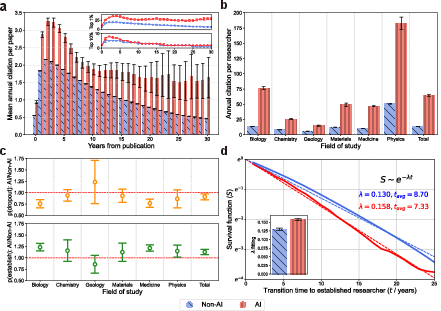
Figure 2: AI enlarges paper impact and enhances researcher careers.
Contraction of Scientific Focus
Despite individual benefits, AI tools prompt a contraction in the collective breadth of scientific inquiry.
Knowledge Extent Measures:
AI-driven research exhibits reduced "knowledge extent," focusing on narrower subject areas and existing popular topics more than non-AI counterparts.
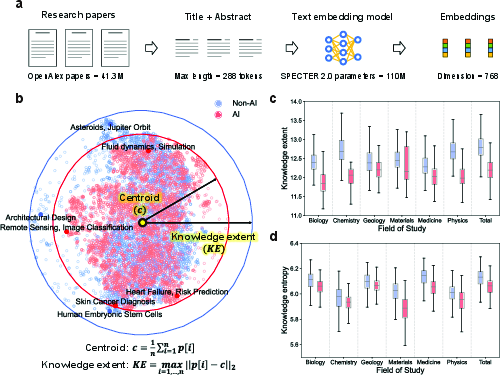
Figure 3: AI adoption is associated with a contraction in knowledge extent within and across scientific fields.
Engagement and Diversity:
AI papers contribute less to follow-on engagement, consolidating recognition among fewer top papers. This concentration is indicative of reduced innovation diversity in the scientific process.
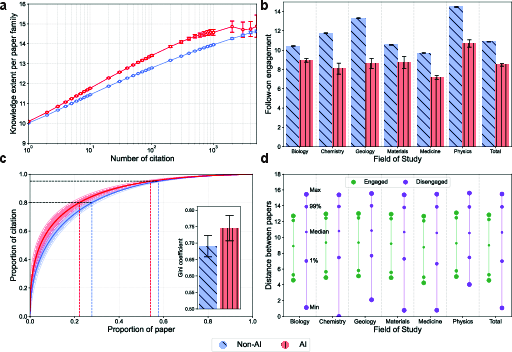
Figure 4: Reduced follow-on engagement and more overlapping works in AI research.
Discussion
The findings present an intriguing paradox: while AI aids individual researchers by enhancing visibility and career development, it potentially stifles the collective scope of scientific exploration. AI encourages a focus on data-rich domains, potentially overlooking foundational questions less amenable to AI methodologies. Generative AI's rapid evolution further impacts this trajectory, demanding critical evaluation of scientific priorities.
Conclusion
Artificial Intelligence is reshaping the scientific landscape, offering individual advantages while simultaneously contracting the breadth of inquiries pursued. This study calls attention to necessary policy considerations to leverage AI effectively, ensuring its evolution fosters broad scientific discovery without limiting scope to popular, data-abundant areas alone. Future AI systems must expand beyond cognitive tasks to enable exploration into novel scientific domains, sustaining long-term innovation across disciplines.