- The paper rigorously establishes a non-perturbative, microscopic Floquet–Keldysh framework that captures all observed subharmonic gap structures in DC current-biased Josephson junctions.
- Non-perturbative numerical and analytic results reveal both odd and even gap structures emerging at moderate-to-high transparencies, resolving inconsistencies with previous theories.
- The study demonstrates that correlated tunneling processes and time-domain interference under DC bias produce robust SGS signatures, offering insights for quantum device design.
Microscopic Foundation of Subharmonic Gap Structure in DC Current-Biased Josephson Junctions
Introduction
The paper "Origin of Subharmonic Gap Structure of DC Current-Biased Josephson Junctions" (2412.09862) establishes a comprehensive microscopic framework for describing DC current-biased Josephson junctions at arbitrary junction transparencies. Addressing inconsistencies present in previous phenomenological and perturbative theories, this work rigorously identifies the mechanisms generating subharmonic gap structure (SGS) observed in the current-voltage characteristics (IVC) under experimentally realistic current bias conditions. The analysis supersedes previous models limited to low-transparency (Werthamer theory) or voltage bias conditions, providing both non-perturbative numerical results and analytic insights from time-domain and generalized multiple Andreev reflection (MAR) perspectives.
Existing Theoretical Limitations
Prior theoretical attempts have modeled SGS in Josephson junctions predominantly within two paradigms:
- Phenomenological RCSJ models: These empirical models, prioritizing circuit simplicity, miss SGS features entirely under current bias, failing to account for the interplay between supercurrent pulses and nonequilibrium dynamics in the superconducting state.
- Werthamer theory: Microscopic but perturbative and confined to the tunnel (low transparency, T≪1) limit, this approach only predicts odd subharmonics at e⟨V⟩=2Δ/(2n−1). This prediction diverges from experimental findings where SGS appears at all integer subharmonics e⟨V⟩=2Δ/n.
The universal observation of both odd and even SGS in molecular, atomic, and high-transparency junctions necessitated a more general theory, especially one accounting for high transparency and true current bias environments. Previous MAR and multiparticle tunneling theories, essential for understanding SGS under voltage bias, lose applicability in the current-bias regime due to the emergence of a self-consistent, dynamical AC voltage response.
The theoretical foundation of this work is a non-perturbative Floquet–Keldysh Green’s function approach, capturing single-channel junctions between s-wave superconducting reservoirs. The formalism self-consistently relates the time-dependent superconducting phase ϕ(t) and AC voltage V(t) generated in response to a DC current bias. Crucially, the periodicity of ϕ(t) and thus H(t) justifies the Floquet treatment, allowing all harmonics to be systematically included.
Non-equilibrium steady states are defined by ϕ(t+T0)=ϕ(t)+2π, with the periodic voltage V(t) of period T0=π/(e⟨V⟩). The essence of the SGS and hysteresis phenomena is contained in the multidimensional structure arising from the convolution of Floquet, Nambu, and Keldysh spaces.
The fundamental object is the DC component of the current, extracted via matrix inversion—not perturbative summation—of the full non-equilibrium Green’s function expansion. This procedure circumvents divergence and non-analyticity issues present in earlier approaches.
Numerical and Analytical Results
Non-perturbative numerical solutions yield current-voltage curves and differential conductances exhibiting both odd and emergent even SGS as junction transparency increases. The hysteretic nature of the IVC at large transparencies is captured, supporting the presence of multiple voltage solutions to fixed current bias.
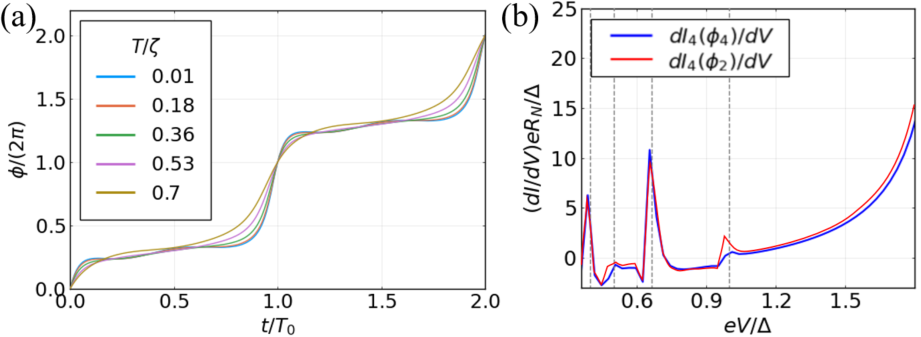
Figure 1: (a) The numerically calculated nonperturbative phase ϕ(t) for a DC bias displays discrete phase steps, while (b) the normalized differential conductance shows even subharmonic peaks at O(T4).
These results directly mirror experimental observations, where transparent junctions display all integer subharmonic gap structures, in contradiction to the traditional low-transparency predictions.
Microscopic Origin of Even SGS: Beyond Werthamer Theory
A central outcome is the microscopically grounded explanation for the origin of even SGS, which the Werthamer theory inherently misses. Two complementary frameworks are elaborated:
Time-Domain Interference and Charge-Transfer Pathways
Supercurrent under DC bias results in a self-organized train of sharp, periodic non-equilibrium voltage pulses. The time-domain analysis uncovers that:
- Odd SGS (Werthamer limit) are due to constructive interference in pair current carried by single quasiparticle tunneling, with the resonance condition set by phase accumulations following each pulse.
- Even SGS arise at next-to-leading order (O(T4)): processes where supercurrent is carried by correlated tunneling of pairs of quasiparticles. Interference effects, and cancellation of certain dynamical phases, modify the resonance condition so that even denominators become accessible.
Frequency-Domain: Generalized Multiple Andreev Reflection
A systematic expansion in the tunnel coupling reveals that, while under DC voltage bias only processes with single-valued energy exchange contribute (conventional MAR and MPT), under DC current bias the voltage is itself AC, and the spectrum of excitation energies spans all odd harmonics of Ω=e⟨V⟩.
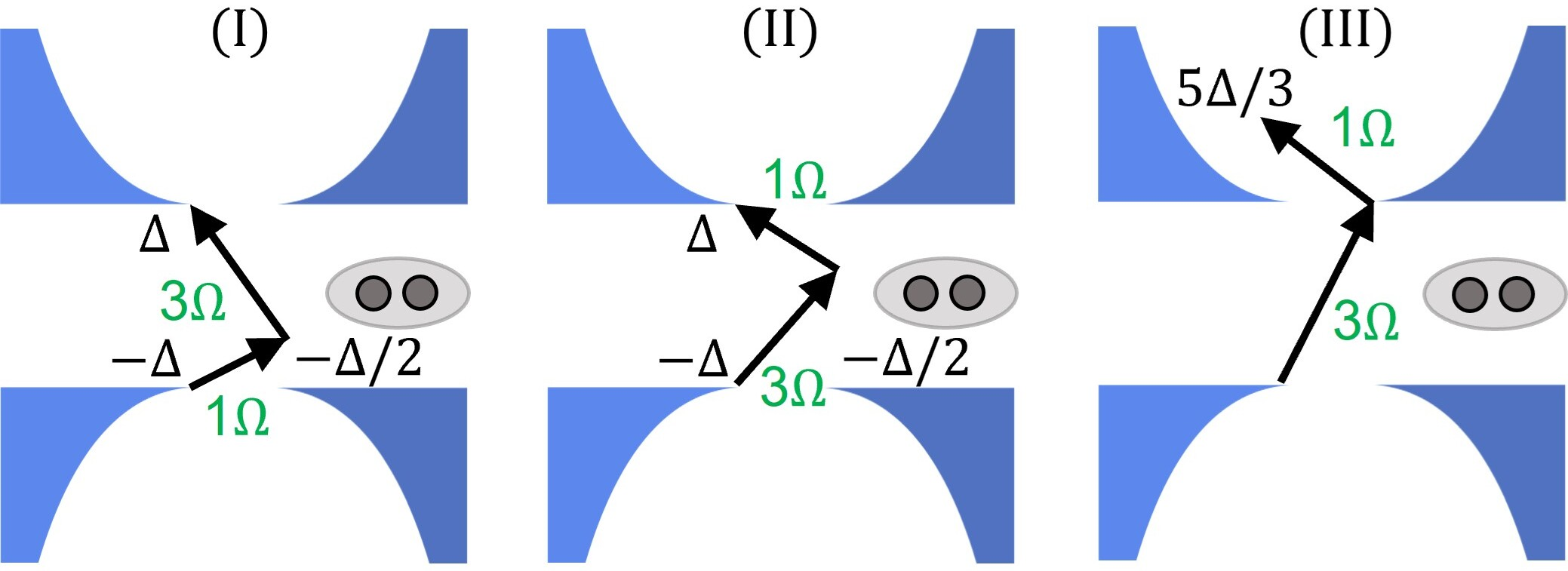
Figure 2: Schematic representation of resonant type-(ii) processes at O(T4), illustrating how combinations of different energy exchanges via the voltage harmonics generate both even and odd subharmonic resonances in the DC current.
At this order, all subharmonics appear through multi-path tunneling sequences where intermediate steps exchange different amounts of energy. These type-(ii) MAR processes enable, in the current-biased regime, the unification of all observed subharmonic structures at much lower order than required under DC voltage bias.
Strong Quantitative Signatures
Numerical calculations expose that as transparency increases, the SGS peaks broaden due to the renormalization of the superconducting density of states at the gap edges. Importantly, even subharmonic conductance peaks become pronounced only at moderate to high transparencies.
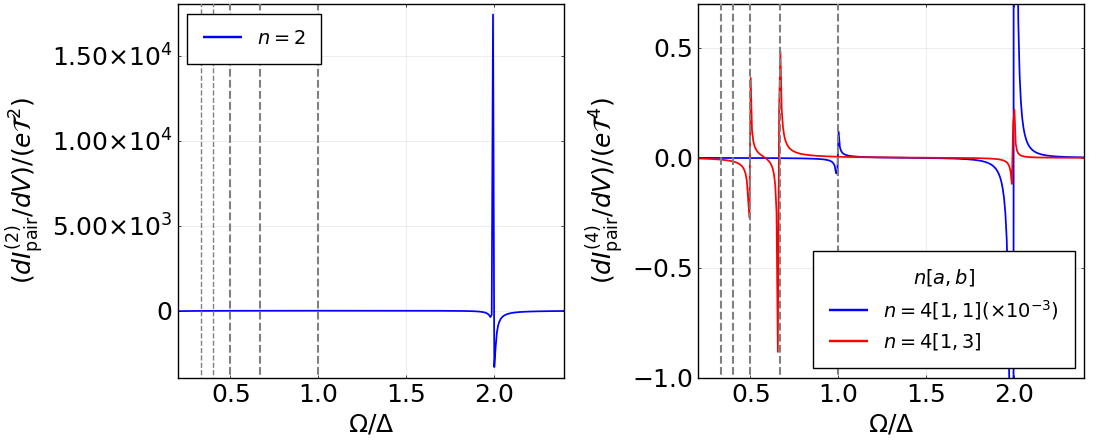
Figure 3: The normalized differential conductance, showing the emergence and evolution of even subharmonics as the junction transparency is increased.
Implications and Future Directions
This framework establishes that the SGS spectrum under DC current bias is a robust signature of microscopic electronic processes involving higher-order tunneling and AC-driven resonant coupling. The theory demonstrates that the necessary condition for the full SGS series is the participation of processes with an even number of intermediate quasiparticles, captured at O(T4) and beyond.
Practically, this provides a direct route to interpreting SGS experiments across the full range of transparencies, furnishing predictive tools for the design and interpretation of superconducting quantum devices and molecular junctions. Theoretically, the work clarifies the limitations of perturbative (tunnel) and phenomenological approaches—highlighting the need for non-perturbative Floquet–Keldysh methods in describing nonequilibrium phenomena in superconducting electronics.
Extensions to multi-channel interfaces, topological superconductors, and quantum dot junctions would further broaden applications in quantum information processing and mesoscopic superconductivity. The utility of the unified microscopic formalism in analyzing the interplay of phase, voltage, and correlation effects in complex superconducting circuits is thus clear.
Conclusion
A microscopic, non-perturbative theory for DC current-biased Josephson junctions with arbitrary transparency has been established. By constructing the full nonequilibrium Green’s function in the Floquet–Keldysh framework, the work provides the first theoretical demonstration of all observed SGS, elucidating their microscopic origin and resonance conditions from both time- and frequency-domain perspectives. These results resolve the discrepancies between prior theory and experiment and lay the foundation for future studies of strongly non-equilibrium superconducting systems.