The Impact of Socio-Economic Challenges and Technological Progress on Economic Inequality: An Estimation with the Perelman Model and Ricci Flow Methods
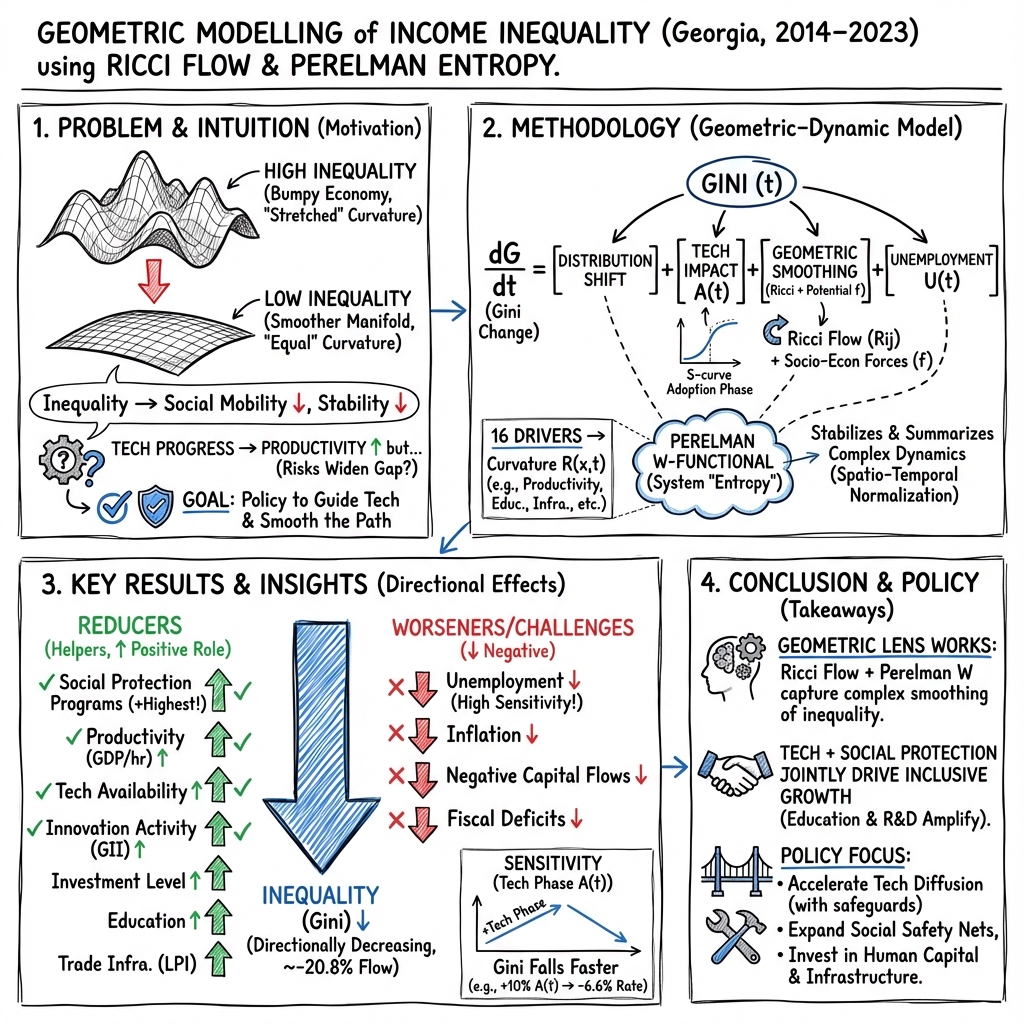
Abstract: The article examines the impact of 16 key parameters of the Georgian economy on economic inequality, using the Perelman model and Ricci flow mathematical methods. The study aims to conduct a deep analysis of the impact of socio-economic challenges and technological progress on the dynamics of the Gini coefficient. The article examines the following parameters: income distribution, productivity (GDP per hour), unemployment rate, investment rate, inflation rate, migration (net negative), education level, social mobility, trade infrastructure, capital flows, innovative activities, access to healthcare, fiscal policy (budget deficit), international trade (turnover relative to GDP), social protection programs, and technological access. The results of the study confirm that technological innovations and social protection programs have a positive impact on reducing inequality. Productivity growth, improving the quality of education, and strengthening R&D investments increase the possibility of inclusive development. Sensitivity analysis shows that social mobility and infrastructure are important factors that affect economic stability. The accuracy of the model is confirmed by high R2 values (80-90%) and the statistical reliability of the Z-statistic (<0.05). The study uses Ricci flow methods, which allow for a geometric analysis of the transformation of economic parameters in time and space. Recommendations include the strategic introduction of technological progress, the expansion of social protection programs, improving the quality of education, and encouraging international trade, which will contribute to economic sustainability and reduce inequality. The article highlights multifaceted approaches that combine technological innovation and responses to socio-economic challenges to ensure sustainable and inclusive economic development.
Paper Prompts
Sign up for free to create and run prompts on this paper using GPT-5.
Top Community Prompts
Explain it Like I'm 14
Overview
This paper looks at why some people in Georgia (a country in Eastern Europe) earn much more money than others, and how new technologies and social policies can change that. The author uses a special kind of math, originally created to study the shape of curved surfaces, to model how inequality changes over time.
Key Questions
The paper asks simple but important questions:
- What makes income inequality go up or down in Georgia?
- Do technology, education, and social programs help reduce inequality?
- Which factors matter most for keeping the economy stable and fair?
Methods Explained Simply
The study uses two main ideas:
- Gini coefficient: This is a number between 0 and 1 that shows how unequal income is in a country. 0 means everyone has the same income; 1 means one person has everything. In Georgia, the Gini is about 0.36, meaning inequality is real but not extreme.
- Ricci flow and Perelman’s model: These are advanced math tools from geometry. Think of the economy like a bumpy landscape. High hills represent groups with very high income, and deep valleys represent low-income groups. “Ricci flow” is like a smoothing process that shows how this landscape might change over time. Perelman’s “entropy” idea measures how messy or uneven the landscape is. The author uses these tools as a metaphor and a model to track how 16 different economic factors push the landscape toward more fairness (smoother) or more inequality (bumpier).
To make it practical, the author:
- Collected data on 16 factors, like unemployment, education, innovation, trade, healthcare, and social protection.
- Built a model to see how changes in these factors affect the Gini coefficient over time and across regions.
- Ran statistical tests (like checking R² and significance) to make sure the model fits the data well and the results are not just random.
What the Study Found
Here are the main results in simple terms:
- Technology and innovation tend to reduce inequality when people have access to them and when the country invests in research and development (R&D).
- Social protection programs (like cash support, pensions, and help for the poor) strongly reduce inequality.
- Productivity growth (producing more value per hour), better education, and more R&D support “inclusive development,” meaning more people benefit from growth.
- Lower unemployment and lower inflation help make income more equal.
- Social mobility (how easily people can move from lower to higher income groups) and better infrastructure are key for long-term stability.
- International trade and investment can help, but their benefits are limited if the local systems (like education, healthcare, and institutions) are weak.
The model’s accuracy was strong: it explained about 80–90% of the changes observed (high R²), and statistical tests suggested the findings are reliable (results unlikely due to chance).
Why This Matters
These findings say that inequality is not just about luck or individual effort. It is shaped by big systems—technology access, schools, jobs, healthcare, and smart government policies. If Georgia improves these systems, more people can share in economic success.
Implications and Impact
Based on the results, the paper recommends:
- Encourage technological progress, but make sure people can access it and learn the skills to use it.
- Expand social protection programs to help those left behind.
- Improve the quality of education to prepare people for modern jobs.
- Support R&D and innovation so the economy grows in ways that include more people.
- Strengthen infrastructure and social mobility so opportunities are not limited by where you live or your background.
- Use international trade wisely, alongside strong local institutions.
If Georgia follows these steps, it can build a fairer economy where growth benefits more families, not just a few. The math tools used here help leaders see how different policies shape the “economic landscape” and guide smarter decisions for an inclusive future.
Practical Applications
Immediate Applications
Below is a curated set of practical applications that can be deployed now, leveraging the paper’s empirical findings, coefficients, and workflow prototypes (Excel-based regression; 16-parameter Ricci model; sensitivity analyses). Each item notes sectors, potential tools/products/workflows, and key assumptions or dependencies.
- Inequality-focused policy dashboards and scenario planning
- Sector: Public policy; finance; labor; social services
- Tools/workflows: A lightweight “Gini Dynamics” dashboard (Excel or Python) using the paper’s 16-parameter Ricci model and coefficients to simulate dG/dt under policy levers (e.g., social protection budgets, R&D incentives, unemployment programs, education spending, trade and logistics upgrades).
- Assumptions/dependencies: Recent and reliable national statistics; model calibration to local parameters; stakeholder capacity to interpret geometric-model outputs.
- Targeted expansion of social protection programs
- Sector: Social services; public policy; finance
- Tools/workflows: Portfolio rebalancing toward benefits with demonstrated inequality reduction (the paper’s highest positive effect); workflows for eligibility expansion, benefit adequacy reviews, and retraining stipends.
- Assumptions/dependencies: Fiscal space; effective targeting; administrative capacity and data on coverage gaps.
- “Inclusive technology adoption” checklists for firms
- Sector: Software; manufacturing; AI/automation; HR
- Tools/products: Pre-deployment impact checklists using A(t) to assess short-run distributional effects; pairing automation with upskilling budgets and wage ladders; internal workforce analytics tracking inequality-related KPIs (training hours, wage progression, job transitions).
- Assumptions/dependencies: Management buy-in; access to workforce data; alignment with sectoral regulations.
- R&D incentive design aligned with inequality reduction
- Sector: Innovation policy; universities; tech industry
- Tools/workflows: Grant scoring rubrics weighted by coefficients linked to Gini reduction (β < 0 in the model); priority calls for education-tech, SME productivity tools, and health access tech; performance contracts tied to inclusion metrics.
- Assumptions/dependencies: Transparent selection processes; monitoring systems; legal frameworks for performance-based grants.
- Education quality and upskilling programs
- Sector: Education; workforce development
- Tools/workflows: Micro-credential pathways and vocational curricula targeting skills complementary to automation; placement pipelines to high-productivity sectors (per positive Ricci flow for productivity, education, innovation).
- Assumptions/dependencies: Training providers’ capacity; employer partnerships; equitable access (rural/low-income).
- Logistics and trade infrastructure quick wins
- Sector: Trade; transport; customs; supply chain
- Tools/workflows: LPI-focused operational improvements (customs digitization, port scheduling, corridor maintenance); SME export facilitation; link to international trade programs due to positive effects on stabilization.
- Assumptions/dependencies: Interagency coordination; donor support; maintenance budgets; compliance reforms.
- Health access micro-projects and telemedicine pilots
- Sector: Healthcare; digital health
- Tools/products: Rural telehealth hubs; mobile clinics; appointment scheduling platforms; targeted subsidies for underserved groups, given modest but positive impact on inequality.
- Assumptions/dependencies: Connectivity; staffing; reimbursement mechanisms; data privacy compliance.
- Migration and diaspora engagement initiatives
- Sector: Labor; foreign affairs; innovation ecosystems
- Tools/workflows: Return programs for skilled migrants; diaspora mentorship networks; fast-track innovation visas; SME co-investment schemes to offset negative net migration and strengthen innovation.
- Assumptions/dependencies: Attractive incentives; streamlined processes; local absorptive capacity for skills.
- Impact investing and FDI term sheets with inclusion clauses
- Sector: Finance; development banking; corporate investment
- Tools/products: Portfolio scoring using model outputs (expected ΔGini per unit of capital); FDI agreements with local training, supply-chain integration, and wage standards; reporting templates aligned with the paper’s coefficients.
- Assumptions/dependencies: Investor willingness; enforceable covenants; local supplier readiness.
- Regional inequality heat-mapping for budget allocation
- Sector: Municipal planning; GIS; social services
- Tools/workflows: Geospatial proxies for “economic curvature” (hotspots) using the 16-parameter set; budget targeting toward high-curvature zones (low mobility, poor infrastructure) with bundled interventions.
- Assumptions/dependencies: Subnational data availability; GIS capacity; cross-agency funding coordination.
- Academic replication and teaching modules
- Sector: Academia; computational social science
- Tools/workflows: Course modules on Ricci flows in socioeconomics; replication notebooks (Excel/Python) using national datasets; student-led sensitivity analyses to local conditions; methods seminars on Perelman’s W-functional in applied modeling.
- Assumptions/dependencies: Data access; faculty expertise; ethics approvals for data use.
Long-Term Applications
The following require further validation, scaling, cross-country calibration, and/or technical development. They build on the paper’s geometric-method innovations (Ricci flow, W-functional) and empirical patterns.
- National real-time “inequality digital twin” based on Ricci flows
- Sector: Public policy; central analytics units; cloud/data infrastructure
- Tools/products: Streaming pipelines (tax, labor, healthcare, education, trade); geospatial Ricci-flow engine to simulate dG/dt under policy shocks; cloud-based dashboards for ministries.
- Assumptions/dependencies: High-frequency, high-quality data; secure cloud; sustained funding; interdisciplinary teams.
- Standardized certification for “Inclusive Tech Deployment”
- Sector: AI/automation; standards bodies; HR
- Tools/products: ISO-like standard leveraging A(t), workforce mobility metrics, and wage ladders; third-party audits; public registries.
- Assumptions/dependencies: Consensus among industry and regulators; testability and auditability; enforcement.
- Central bank and treasury policy rules with inequality targets
- Sector: Macroeconomic policy; monetary/fiscal authorities
- Tools/workflows: Policy reaction functions that incorporate inequality curvature terms (e.g., inflation-unemployment-inequality trilemma constraints); scenario stress tests.
- Assumptions/dependencies: Robust causal evidence; political mandate; model interpretability.
- Open-source Ricci-flow econometrics library for socioeconomics
- Sector: Academia; data science; economic modeling
- Tools/products: Python/R packages implementing the 16-parameter Ricci model, Perelman’s W-functional, calibration routines; documentation and benchmark datasets for cross-country studies.
- Assumptions/dependencies: Community maintainers; reproducible pipelines; broad adoption and peer review.
- AI-enabled labor market optimizer for mobility and upskilling
- Sector: Education-tech; HR-tech; public employment services
- Tools/products: Recommendation systems mapping skill gaps to training paths; subsidies and wage progression models that maximize mobility (positive coefficients); employer-matching engines.
- Assumptions/dependencies: Comprehensive skills and vacancy data; privacy and fairness safeguards; budgetary support.
- Dynamic social protection personalization
- Sector: Social services; fintech/insurtech
- Tools/workflows: Real-time benefit tuning using predictive models and curvature signals (e.g., shocks in unemployment or capital flows); integrated claims and case management.
- Assumptions/dependencies: Legal frameworks for dynamic benefits; data integration; beneficiary safeguards.
- Geospatial “curvature smoothing” in infrastructure planning
- Sector: Transport; energy; urban planning
- Tools/workflows: Network optimization that reduces economic curvature hotspots (poor logistics, low mobility); prioritization of nodes/edges with highest inequality gradients.
- Assumptions/dependencies: Engineering feasibility; environmental and social impact assessments; financing.
- International development program optimization
- Sector: Multilateral agencies; donors; NGOs
- Tools/workflows: Portfolio models allocating grants/loans to interventions with strongest expected ΔGini (social protection, education quality, innovation systems, logistics); cross-country calibration.
- Assumptions/dependencies: Comparable metrics across countries; governance capacity; long-term monitoring.
- Health access optimization via hybrid delivery models
- Sector: Healthcare; digital health; insurance
- Tools/products: Integrated telehealth plus community care networks targeting regions with low access; pricing and coverage models sensitive to inequality gradients.
- Assumptions/dependencies: Provider networks; reimbursement policies; digital literacy and connectivity.
- Curriculum reform integrating geometric methods in economics
- Sector: Higher education; research training
- Tools/workflows: New courses on geometric flows for socio-economic modeling; capstone labs applying Ricci-flow-based inequality analyses to national datasets.
- Assumptions/dependencies: Faculty training; accreditation updates; student demand.
Cross-cutting notes on assumptions and dependencies
- External validity: The model is calibrated to Georgia; transfer to other countries or subnational contexts requires re-estimation of coefficients and sensitivity analyses.
- Data quality and timeliness: High R² (80–90%) in the paper is contingent on reliable measurement of the 16 parameters; real-time or subnational applications demand richer, cleaner data.
- Interpretability: Geometric constructs (Ricci curvature, W-functional) need stakeholder-oriented explanations to avoid misuse in policy and industry settings.
- Governance and ethics: Automation/AI applications must include fairness, labor protections, and privacy; social protection personalization requires strong safeguards.
- Capacity and resources: Most long-term applications depend on cross-agency coordination, cloud/data infrastructure, analytic talent, and sustained funding.
Glossary
- Coefficient of determination (R2): A statistical measure indicating how well a model explains the variance of the dependent variable. "R2 (coefficient of determination) determines the accuracy of forecasting the changes in parameters."
- Foreign Direct Investment (FDI): Cross-border investment where a firm or individual from one country acquires control or significant ownership in a business in another country. "Liu et al. (2023) and Haider et al. (2023) delve deeper into the impact of foreign direct investment (FDI)."
- Gini coefficient: A measure of income inequality ranging from 0 (perfect equality) to 1 (perfect inequality). "One of the main methods used to study inequality is the Gini coefficient - a measure that serves to assess the level of distribution of wealth and resources."
- Global Innovation Index: An international composite indicator developed by WIPO that benchmarks countries’ innovation performance. "Innovation activities (Global Innovation Index) (29.9)."
- Gradient flow: A mathematical evolution process driven by the gradient of a functional, used here to model dynamics of economic parameters. "It is based on the mathematical models of the Ricci and gradient stream/flow."
- Gradient of the potential function: The vector of partial derivatives indicating the direction and rate of fastest increase of a potential function. " | Vf |2 is the square of the gradient of the potential function."
- Hamilton's theorem: Foundational results in geometric analysis related to the Ricci flow on manifolds. "Hamilton's theorem and Perelman's proof of the evolution of the Ricci flow (Perelman, 2008)..."
- Linear regression: A statistical method for modeling the linear relationship between a dependent variable and one or more independent variables. "For this procedure, linear regression methods were used to determine the regression coefficient (slope) of each parameter..."
- Logistics Performance Index (LPI): A World Bank index assessing trade logistics efficiency across countries. "Trade Infrastructure (LPI index) (2.7)."
- Manifolds (three-dimensional): Mathematical spaces locally resembling Euclidean space; key objects in differential geometry and Ricci flow theory. "The Ricci flow equation, introduced by Hamilton, is one of the most important tools for studying geometric structure, especially when it comes to three-dimensional manifolds."
- Normalization and stabilization ((4TT)-n/2): A scaling factor in Perelman’s W-functional ensuring proper normalization with respect to time and dimension. "(4TT)-n/2 (normalization and stabilization) (1.01)."
- Perelman entropy formula: A functional introduced by Perelman to study the Ricci flow via entropy methods. "The Perelman entropy formula in the given model is used to combine the energy component and the gradient potential..."
- Perelman's proof: Grigori Perelman’s proof concerning the evolution of Ricci flow, central to resolving major problems in geometry. "Hamilton's theorem and Perelman's proof of the evolution of the Ricci flow (Perelman, 2008)..."
- Poincaré hypothesis: A central conjecture in topology, solved by Perelman using Ricci flow and entropy methods. "the entropy formula used is developed by Grigor Perelman to solve the Poincaré hypothesis"
- Regression coefficient (slope): The parameter in linear regression indicating the rate of change of the dependent variable with respect to an independent variable. "For this procedure, linear regression methods were used to determine the regression coefficient (slope) of each parameter..."
- Ricci curvature: A measure of curvature in differential geometry capturing volume deformation; mapped here to “economic space.” "R(x,t) is a Ricci curvature, a term that describes the 'curve of economic space'"
- Ricci flow: A geometric evolution equation that deforms the metric of a manifold, applied here as an economic modeling tool. "The study uses Ricci flow methods, which allow for a geometric analysis of the transformation of economic parameters in time and space."
- Ricci flow equation: The specific differential equation governing Ricci flow in geometric analysis. "The Ricci flow equation, introduced by Hamilton, is one of the most important tools for studying geometric structure..."
- Ricci flow surgery: Perelman’s technique of performing “surgical operations” during Ricci flow to handle singularities. "In Perelman's work, which describes the surgical operations of the Ricci flow, he significantly raises fundamental issues..."
- Sensitivity analysis: An approach to assess how variation in model inputs affects outputs, used to evaluate technological impacts on inequality. "Sensitivity analysis shows that social mobility and infrastructure are important factors that affect economic stability."
- W-functional: Perelman’s functional measuring an entropy-like quantity along Ricci flow, adapted here for economic dynamics. "The W-functional describes the so-called 'entropy-like quantity', which gives a certain measure of the dynamics of the development of the overall 'geometric characteristics' of the system."
- Z-statistic: A statistical metric used to assess significance in correlation or regression analyses. "Z statistics were calculated for each parameter, which is later used in correlation analysis in order to determine its statistical significance."
Collections
Sign up for free to add this paper to one or more collections.