- The paper presents a neuro-symbolic framework that combines transformer-guided proposal generation with an extended DSL to tackle complex ARC tasks.
- It integrates ML with combinatorial search to leverage both learning and symbolic reasoning for enhanced visual task-solving.
- It achieves a 27% performance improvement over existing methods, highlighting promising advancements for neuro-symbolic AI.
NSA: Neuro-symbolic ARC Challenge
Introduction
The paper "NSA: Neuro-symbolic ARC Challenge" (2501.04424) addresses the complexity of the Abstraction and Reasoning Corpus (ARC), a benchmark for evaluating visual reasoning capabilities that challenge both ML models and combinatorial search methods. By integrating a transformer for proposal generation with combinatorial search using a DSL, the authors introduce a neuro-symbolic approach capable of surpassing existing methods on the ARC evaluation set by 27%. This essay provides an expert-level summary and analysis, focusing on the methodology, experimental results, and potential implications for the field of neuro-symbolic AI.
Methodology
The core of the NSA framework is a hybrid approach that combines ML with symbolic reasoning, leveraging the strengths of both paradigms. The proposed method consists of three main components:
- Domain-Specific Language (DSL): The study extends the existing ARGA DSL by incorporating additional transformation primitives, thereby enhancing its representational capacity. The original ARGA DSL included basic operations such as filters and transformation primitives for manipulating input images. The extended DSL, named ARGAe, adds 15 new primitives (e.g.,
extract, duplicate, upscale_grid), enabling the system to handle a wider variety of ARC tasks.
- Transformer-Guided Proposal Generation: A transformer model is pre-trained on a synthetically generated dataset to predict promising transformation primitives, effectively narrowing the search space for the combinatorial approach. The model is further fine-tuned at test-time using additional synthetically generated training tasks, enhancing its ability to adapt to specific instances of the ARC tasks.
- Combinatorial Search: The DSL is utilized in conjunction with a combinatorial search algorithm, which employs a greedy best-first search strategy to identify the correct sequence of transformations. This search is guided by the transformer's predictions, which propose a subset of transformations deemed most promising.
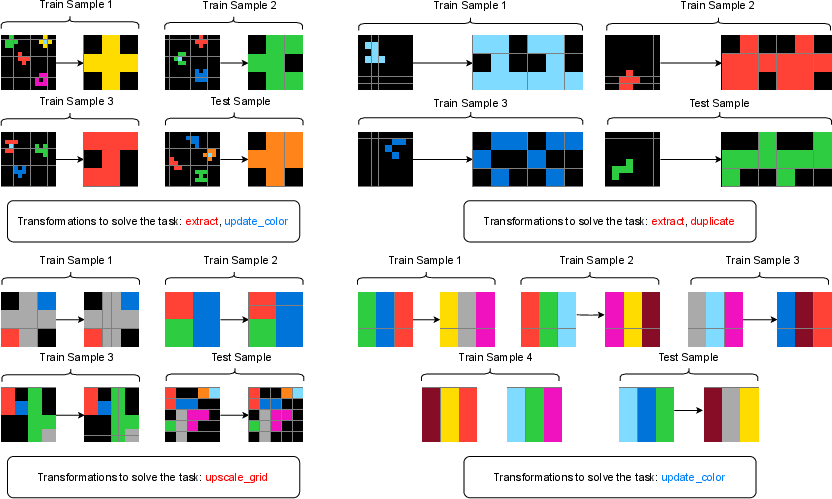
Figure 1: Input-output pairs and a test image from selected ARC tasks, illustrating transformation challenges and the capabilities of ARGA, ARGAe, and NSA.
Experimental Results
The authors conducted a comprehensive evaluation on both the train and evaluation datasets of the ARC benchmark. The results demonstrate the superiority of the NSA approach over existing methods:
- Train Set Performance: NSA solved 78 out of 400 tasks, outperforming methods like ARGA and other DSL-based approaches, which typically solve fewer tasks due to limited representational capacity and search space complexities.
- Evaluation Set Performance: On the evaluation dataset, NSA solved 75 tasks, surpassing baselines such as CodeIt and the pure DSL method Ainooson.
The comparison highlights the effectiveness of the NSA approach in retaining the DSL's expressive power while mitigating the combinatorial search's challenges through transformer-guided search space restriction.
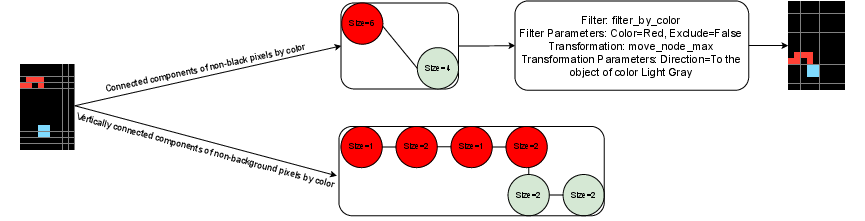
Figure 2: Two distinct abstractions of the same grid, emphasizing the choice of abstraction crucial for correct solutions.
Implications and Future Directions
The NSA framework represents a significant step towards integrating symbolic reasoning with deep learning techniques in solving complex visual tasks. Its ability to outperform both purely ML and purely symbolic methods suggests a promising direction for future research in neuro-symbolic AI. The approach also sheds light on the potential of DSLs to provide inductive biases that enable ML models to reason at appropriate abstraction levels.
Moving forward, researchers could explore scaling the representational capacity of DSLs and transformer models even further. This continued integration of ML and symbolic approaches may lead to breakthroughs in areas requiring complex reasoning, such as autonomous systems, cognitive robotics, and advanced pattern recognition.
Additionally, the study raises questions about the computational trade-offs involved in neuro-symbolic systems. Balancing the time spent on proposal generation and transformation search against the inherent complexity of tasks is a challenge that warrants further investigation.
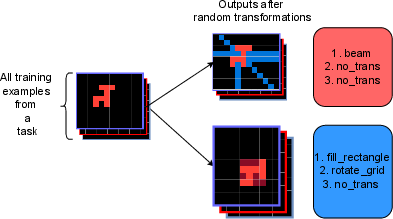
Figure 3: Hindsight relabeling example, illustrating the generation of new input-output pairs to enhance transformer training.
Conclusion
In summary, the "NSA: Neuro-symbolic ARC Challenge" paper makes substantial contributions to the field of neuro-symbolic AI by introducing a method that effectively merges ML and symbolic reasoning for solving the ARC benchmark. The proposed approach not only exceeds the performance of existing methods but also opens avenues for further research in combining these paradigms to tackle complex reasoning tasks. As the field progresses, the integration of ML and symbolic techniques will likely become increasingly pivotal in developing robust AI systems capable of sophisticated reasoning and decision-making.