- The paper introduces LO-dressed and LO-free Rydberg atomic receivers that demonstrate up to 44 dB SNR improvement and a 150-fold extension in coverage.
- It details a comprehensive noise analysis including quantum projection and thermal noise, with analytical models highlighting response and distortion characteristics.
- Simulations using the QuTiP toolkit validate the receivers’ superior sensitivity, reduced symbol error rates, and potential for integration into atomic MIMO systems.
Harnessing Rydberg Atomic Receivers: From Quantum Physics to Wireless Communications
Introduction
The concept of integrating Rydberg atomic receivers into wireless communication systems emerges as a novel application of quantum physics principles. This paper introduces two configurations of Rydberg atomic receivers: the LO-dressed receiver and the LO-free receiver. The LO-dressed variant incorporates a local oscillator (LO), whereas the LO-free version operates without it. The study elaborates on the receiver's responses to radio frequency (RF) signals, potential noise sources, and system performance, offering simulation results that characterize their wireless system functionality.
Fundamentals of Rydberg Atomic Receivers
Rydberg atoms, known for their large principal quantum numbers and high electric dipole moments, offer the capability to engage with weak RF fields, making them sensitive electric field sensors. The interaction between RF signals and Rydberg atoms alters atomic energy levels, which can be detected through electromagnetically induced transparency (EIT).
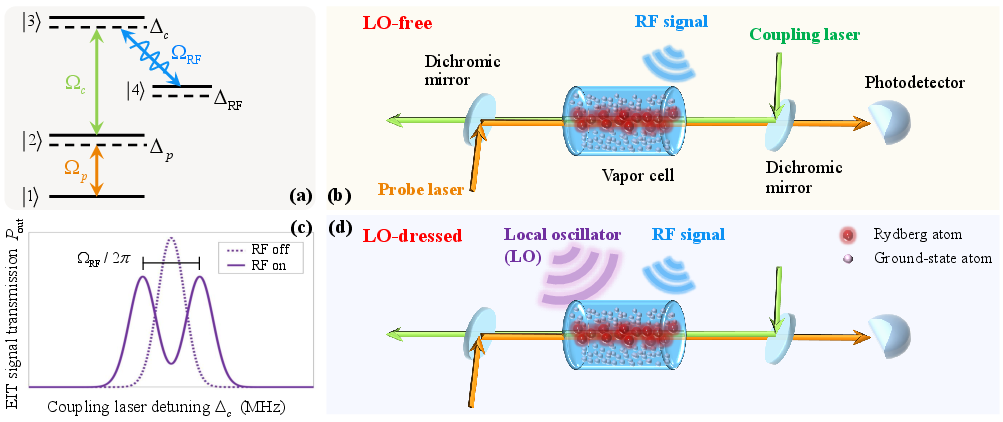
Figure 1: Illustration of the Rydberg atomic receivers and measurement principles. (a) Energy level diagram. (b) EIT and AT-splitting based measurement. (c) LO-free Rydberg atomic receiver. (d) LO-dressed Rydberg atomic receiver.
Rydberg atomic sensing has captivated researchers for decades due to its precision in measuring electric fields. Rydberg atomic receivers offer distinct advantages over traditional RF receivers, such as wavelength independence and the capability to detect signals without absorbing electromagnetic energy. LO-free receivers excel in amplitude measurement, while LO-dressed systems facilitate precise phase detection through the Rydberg atomic mixer concept.
Noise Modeling and Mathematical Representation
The potential noise sources affecting Rydberg atomic receivers include background noise, quantum projection noise (QPN), thermal noise, and observation uncertainty noise. These noise sources define the intrinsic and extrinsic factors limiting system performance.
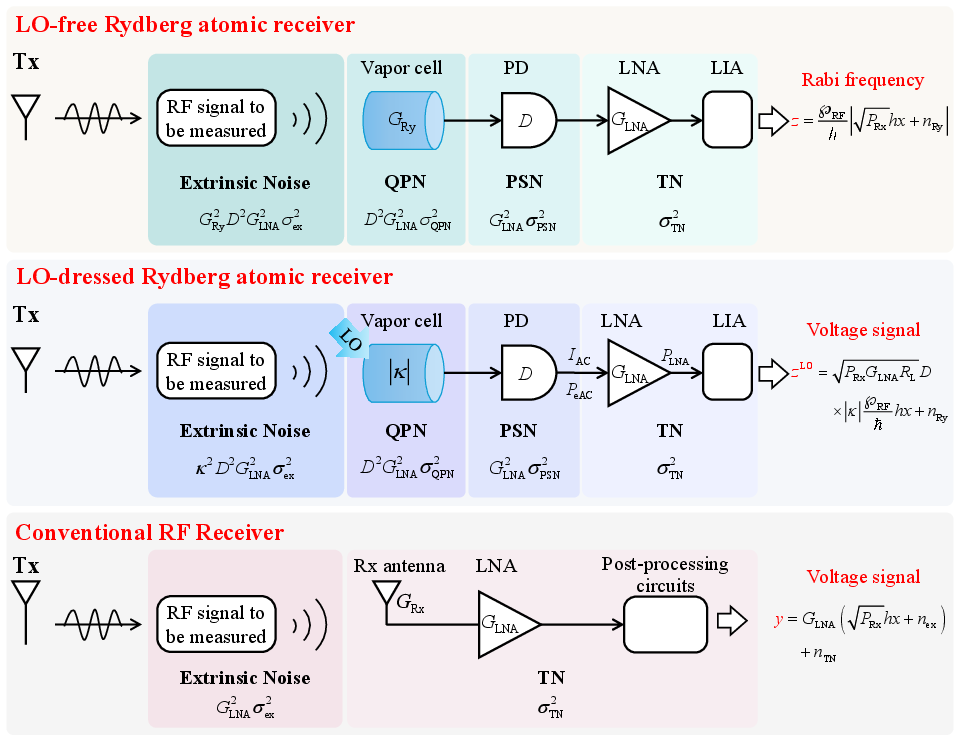
Figure 2: Noise modeling for the LO-free and the LO-dressed Rydberg atomic receivers as well as the conventional RF receiver.
The paper presents wireless models tailored for both LO-free and LO-dressed Rydberg atomic receivers, explicating the receivers' response to RF signals through analytical formulations. The signal-to-noise ratio (SNR) is derived for each configuration, providing insights into practical implementation potential within wireless systems.
Distortion Effects and Practical Implications
Rydberg atomic receivers, although offering enhanced sensitivity, operate optimally within certain ranges. Distortion may occur beyond these bounds, with LO-free systems entering distortion regions at low RF Rabi frequencies, while LO-dressed receivers exhibit non-linear behavior outside their linear dynamic range.
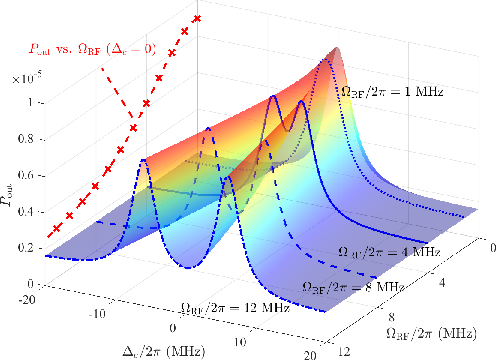
Figure 3: The probe laser transmission Pout depicting distortion in LO-free systems under weak RF Rabi frequencies.
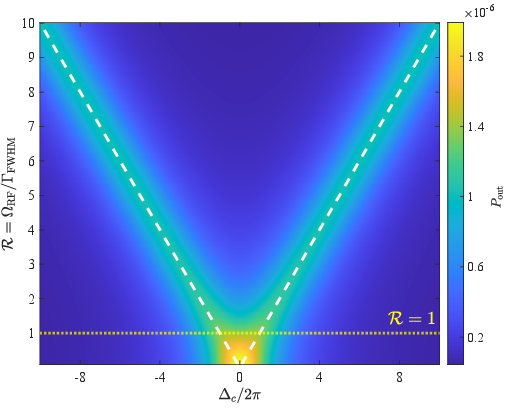
Figure 4: The probe laser transmission heatmap as a function of the coupling detuning Δc/2π and the ratio R illustrating limits for linear dynamics in LO-dressed systems.
Numerical Evaluation of Rydberg Atomic Receivers
Extensive simulations using the QuTiP toolkit yields favorable performance metrics for Rydberg atomic receivers, demonstrating SNR gains of approximately 44 dB over traditional RF receivers at low transmit power levels. Numerical results further reveal their capability to extend effective coverage ranges by a factor of 150.
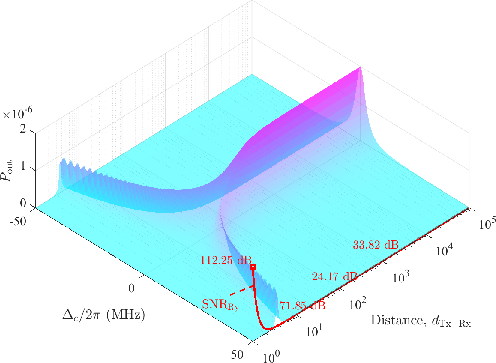
Figure 5: The probe laser transmission Pout reflecting performance gains in LO-dressed systems.
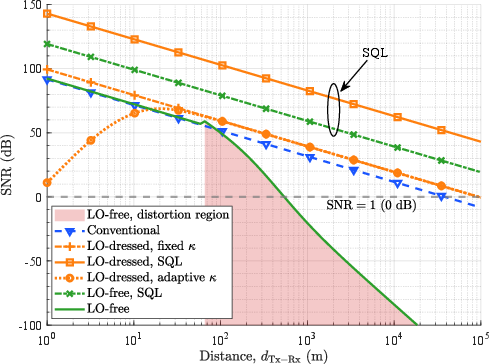
Figure 6: SNR performance versus distance dTx-Rx showcasing superior SNR in Rydberg atomic receivers.
Additionally, mutual information and symbol error rates (SER) are explored to underscore capacity improvements and reduced error rates achievable by Rydberg atomic receivers. The complementary benefits imply potential operational advantages in varying transmission scenarios requiring precision and sensitivity.
Conclusion
Rydberg atomic receivers leverage the extensive dipole moment properties of Rydberg atoms, translating this principle into practical benefits for wireless communications. While both configurations offer distinct advantages, their combined utilization maximizes system performance across diverse transmission distances and power levels. Future studies may focus on broader bandwidth applications and the realization of atomic MIMO systems, further enhancing quantum-aided wireless communication paradigms.
By synergizing quantum physics and wireless communication disciplines, Rydberg atomic receivers pave the way for significant advancements in precision measurement applications and the development of next-generation wireless communication systems.