- The paper introduces an innovative quantum radar that leverages Rydberg atoms to vastly improve signal-to-noise ratio and target velocity estimation.
- The design employs an optical readout method with ladder-type EIT to detect RF fields with high sensitivity.
- Numerical simulations reveal a 40 dB SNR boost and reduced RMSE in velocity measurement compared to conventional radar systems.
Analysis of "Rydberg Atomic RF Sensor-based Quantum Radar"
Introduction
The paper "Rydberg Atomic RF Sensor-based Quantum Radar" (2512.17421) presents a novel approach to radar technology through the integration of quantum sensing. Specifically, it investigates the use of Rydberg atom-based RF sensors in quantum radar systems, highlighting the potential advantages over traditional radar systems that utilize classical dipole antennas. The study focuses on the fundamental difference in detection principles between Rydberg atom-based and conventional radar systems, emphasizing the benefits in signal-to-noise ratio (SNR) and target velocity estimation.
Rydberg Atom-Based Quantum Sensing
Rydberg atoms offer a promising avenue for precision electric field sensing due to their significant quantum properties, such as large principal quantum numbers and strong electric dipole transitions. The core sensing mechanism employs a ladder-type electromagnetically induced transparency (EIT) system, which is modulated by external RF fields, leading to phenomena like Autler–Townes splitting. This splitting enables the detection and measurement of electric fields at a quantum level.
System Model and Design
The proposed quantum radar system replaces the conventional dipole antenna with a Rydberg atom-based sensor system (Figure 1). This system exploits the properties of Rydberg atoms to measure electric fields with higher sensitivity. The design utilizes optical readout employing laser-induced transitions in Rydberg atoms, rather than traditional circuit-based receivers. This alteration allows a level of flexibility in radar operation, which can be tuned optically rather than mechanically, an advantage in wide frequency band adaptability.
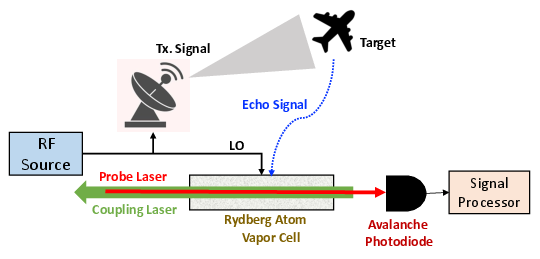
Figure 1: System model of a Rydberg atom-based radar.
Signal-to-Noise Ratio
The study provides a comprehensive analysis of the SNR achievable by the Rydberg atom-based system compared to classical radar. The authors derive expressions for the SNR in both systems, demonstrating conditions under which the quantum radar achieves superior SNR due to the low noise baseline of Rydberg sensors. The paper details how the effective area of the sensor and its quantum noise properties contribute to this improved SNR.
Velocity Estimation
The paper employs invariant function-based methods to estimate the Doppler frequency and consequently, the target's velocity. The quantum radar's superior SNR translates to lower root mean square error (RMSE) in velocity estimation compared to classical radar. The results indicate that the quantum radar not only enhances detection capabilities but also sustains its advantageous performance over a broader range of target distances.
Numerical Results
Through simulations, the authors demonstrate the Rydberg quantum radar's significant improvement in SNR by approximately 40 dB over conventional radars. This performance advantage translates into better accuracy in velocity estimations, maintaining low RMSEs even at larger target distances. These outcomes underscore the potential of quantum-enhanced radar systems to outperform traditional systems in complex detection scenarios.
Conclusion
The research provides a compelling case for the deployment of Rydberg atom-based RF sensors in radar applications. By leveraging quantum principles, the proposed system demonstrates clear advantages in signal fidelity and accuracy over conventional radar systems. Future work could explore optimization of Rydberg state transitions and further integration challenges, paving the path for practical deployments in advanced sensing applications.
In conclusion, the integration of Rydberg atomic sensors in radar technology represents a significant evolution in radar capabilities, offering insights into future advancements in both theoretical and applied realms of AI and radar engineering.