- The paper demonstrates the use of Rydberg atom sensors to demodulate FM audio signals from FRS handheld UHF radios.
- The paper employs a two-photon ladder scheme with lock-in amplification to measure the AC Stark shift induced by RF fields, ensuring precise channel detection.
- The paper evidences both single and multi-channel detection with effective channel isolation, suggesting future scalability in quantum sensor communication systems.
Rydberg Atom Reception of Handheld UHF Frequency-Modulated Two-Way Radio
Introduction
The paper explores the capabilities of Rydberg atom-based sensors in receiving real-world UHF frequency-modulated signals from consumer-grade handheld radios. Rydberg atoms are known for their large polarizabilities and transition dipole moments, making them highly sensitive electric field sensors. This study transcends previous laboratory-specific signal detections by harnessing the AC Stark shift to demodulate FM audio transmissions in a Rydberg atomic vapor. This advancement offers promising applications in practical communication systems.
FRS Radio
The Family Radio Service (FRS) provides a subset of UHF bands allocated for public use, and these bands were the focus of the signal reception study without surpassing legal output power limits. Specifically, channels within the 462.550–462.725 MHz range for 2W output and 467.5625–467.7125 MHz for 0.5W output were analyzed. Through spectrum analysis, the study confirmed the frequency modulation characteristics of these channels.
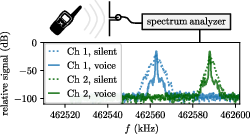
Figure 1: FRS radio channels. a) A table of center frequencies of all 22 FRS radio channels. b) Measured spectrum analyzer traces of the handheld radio transmitting on FRS channels 1 and 2, recorded with a resolution bandwidth of 300 Hz.
Measurement Scheme
Rydberg atoms, specifically 85Rb, were employed as the atomic sensors, utilizing a two-photon ladder scheme to produce electromagnetically induced transparency (EIT). The setup enabled probing of the Stark shift induced by RF fields in UHF bands, mapped to changes in the transmission of 780 nm light.
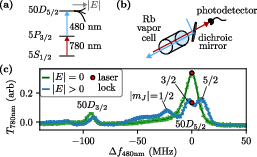
Figure 2: Measurement of the electric field strength using Rydberg atoms. a) The energy level diagram. b) The physical setup. c) The measured EIT spectrum, given by the transmission of the 780 nm light.
The detection involved inducing a localized RF field using an offset local oscillator, allowing beatnotes to be detected across multiple FRS channels via lock-in amplification. The modulation scheme effectively transcribed frequency variations to audio signals, showcasing a straightforward conversion process.
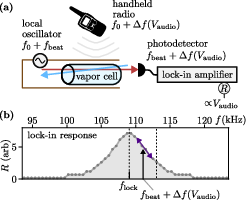
Figure 3: Demodulation scheme for receiving FM signals via AC Stark shift. a) The detection scheme. The frequency is denoted at each point along the signal chain to demonstrate the encoding of the audio signal.
Single Channel Detection
The study implemented a detailed detection scheme for FRS channel 1, demonstrating that human speech from a handheld radio can be successfully demodulated using Rydberg atom sensors. The spectral response of the atomic receiver was also characterized, showing a relatively flat response vis-a-vis traditional radio receivers, often acting as low-pass filters post-demodulation.
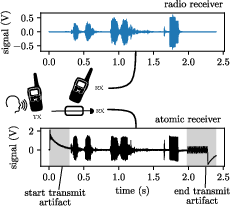
Figure 4: Simultaneous recordings of a voice speaking into a handheld two-way radio, recorded using the line out of another handheld two-way radio and the atomic receiver.
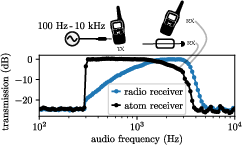
Figure 5: Spectral response of audio transmitted by a handheld two-way radio and received by either another handheld two-way radio or the atomic receiver.
Additionally, the paper provides the SNR comparison of the atomic receiver across different transmission ranges, indicating a correlation with electric field strength metrics.
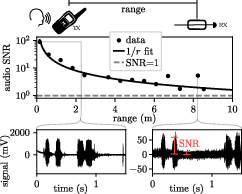
Figure 6: The signal-to-noise ratio (SNR) of the atomic receiver detecting a two-way radio transmission at varying ranges.
Multi-channel Detection
With the feasibility of detecting multiple channels simultaneously, the Rydberg sensor presents a competitive alternative to traditional receivers. This is facilitated by the independent beatnotes generated across channels when using a single local oscillator, showcased through spectrum analyzer measurements.
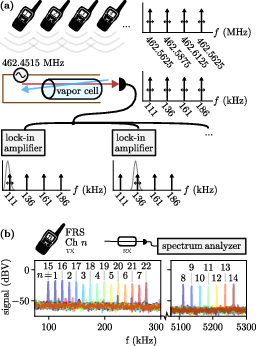
Figure 7: Measurement scheme for simultaneously receiving all 462 MHz FRS channels.
The paper successfully demonstrates this capability by independently demodulating FRS channels using multiple lock-in amplifier channels and highlighting effective channel isolation.
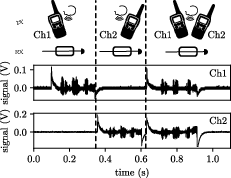
Figure 8: Simultaneous atomic reception of two FRS channels using two lock-in frequencies on the same photodetector line.
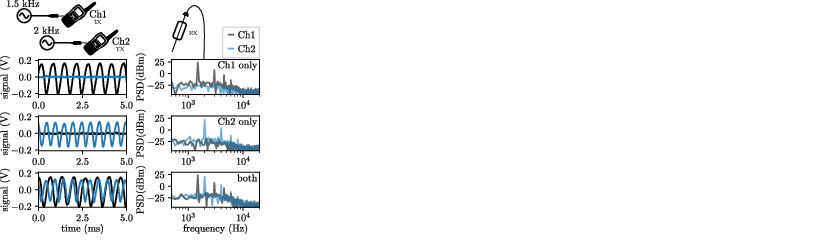
Figure 9: Measurement of channel isolation during simultaneous detection.
Conclusion
The study confirms the utility of Rydberg atom-based sensors in practical FM signal reception from consumer-radio devices, offering a robust single and multi-channel demodulation. While receiver range remains modest, enhancements in atomic sensor sensitivity, perhaps through three-photon schemes, promise future scalability without relying on local oscillators. The results pave the way for implementing quantum sensors in communication, proposing potential expansion into communication systems without field enhancement requirements.

