Multichannel, ultra-wideband Rydberg Electrometry with an Optical Frequency Comb
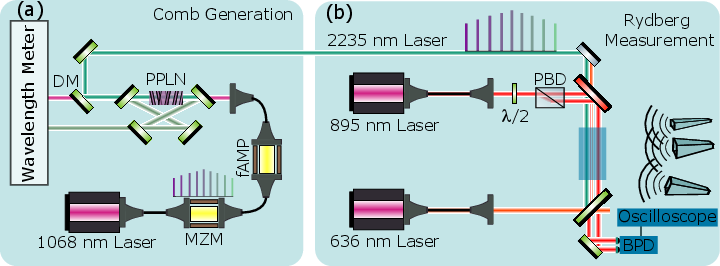
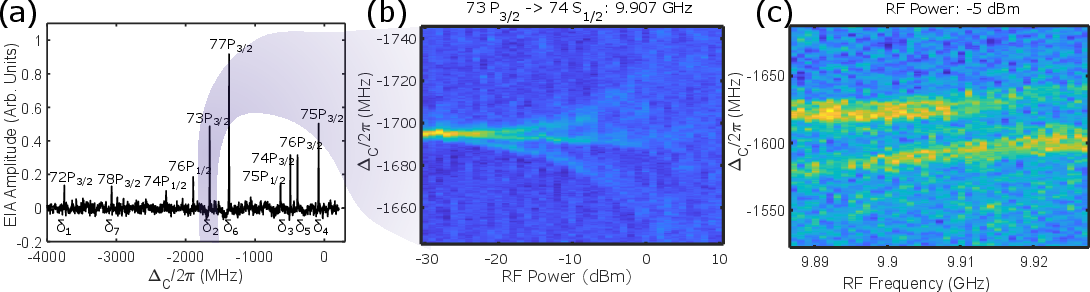
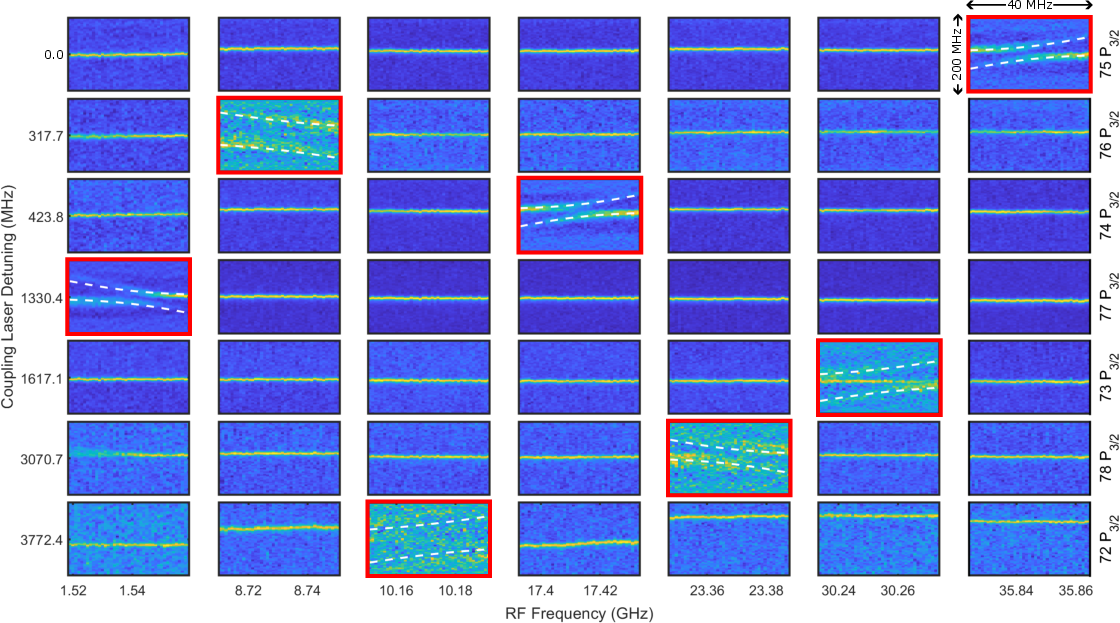
Abstract: While Rydberg atoms have shown tremendous potential to serve as accurate and sensitive detectors of microwaves and millimeter waves, their response is generally limited to a single narrow frequency band around a chosen microwave transition. As a result, their potential to serve as agile and wideband electromagnetic receivers has not been fully realized. Here we demonstrate the use of a mid-infrared, frequency agile optical frequency comb as the coupling laser for three-photon Rydberg atom electrometry. This approach allows us to simultaneously prepare as many as seven individual Rydberg states, allowing for multichannel detection across a frequency range from 1 GHz to 40 GHz. The generality and flexibility of this method for wideband multiplexing is anticipated to have transformative effects in the field of Rydberg electrometry, paving the way for advanced information coding and arbitrary signal detection.
Paper Prompts
Sign up for free to create and run prompts on this paper using GPT-5.
Top Community Prompts
Knowledge Gaps
Unresolved knowledge gaps, limitations, and open questions
Below is a concise, actionable list of what remains missing, uncertain, or unexplored based on the paper.
- Simultaneous multitone operation was not demonstrated; cross-talk and intermodulation products with multiple concurrent RF carriers across channels remain unquantified.
- Per‑channel sensitivity (e.g., noise‑equivalent field, minimum detectable field), noise floor, and dynamic range across 1–40 GHz were not measured or compared to single‑state Rydberg sensors.
- The instantaneous baseband bandwidth per channel (i.e., modulation bandwidth that can be demodulated without scanning) and how it scales with optical powers and Rabi rates is not reported.
- Channel orthogonality was inferred from non-overlapping transition frequencies; quantitative isolation metrics (e.g., dB isolation vs. detuning, out‑of‑band rejection) were not provided.
- Impact of unequal detunings from comb teeth (Table 1 shows detunings up to ~±3.7 GHz) on coupling strength, power broadening, and SNR uniformity across channels is uncharacterized.
- Maximum number of simultaneous channels achievable with this scheme (limited by per‑tooth power, optical pumping, detector dynamic range, and state crowding) is not analyzed.
- Scalability strategies (e.g., denser combs, inclusion of nP1/2 states, multiple manifolds/species) and the onset of spectral crowding and state mixing are not quantified.
- No end‑to‑end communications demonstration (e.g., OFDM/FHSS) is shown; BER/EVM performance, demodulation fidelity, and tolerance to realistic interference are unknown.
- The approach relied on scanning the coupling comb at ~30 Hz; a path to high‑speed, simultaneous, fixed‑frequency readout (without scanning) and its achievable latency is not demonstrated.
- Agility limits for FHSS (i.e., how fast the comb spacing, detunings, or tooth amplitudes can be reconfigured) are not measured; MZM/OPO retuning times and control architectures are unspecified.
- Mid‑IR comb phase coherence and relative phase noise across teeth at 2235 nm (after OPO translation) were not characterized; implications for phase‑sensitive detection are unknown.
- Long‑term frequency stability and referencing of the free‑running coupling comb (to the atomic transitions or an optical/radio reference) are not addressed; drift tolerance and auto‑locking schemes are open.
- Effect of comb relative intensity noise (RIN) and per‑tooth amplitude fluctuations on probe readout noise and inter‑channel correlations is not quantified.
- Balanced photodetector readout was used, but a full noise budget (shot noise, technical noise, laser RIN/phase noise, electronics) and proximity to the quantum limit are not reported.
- Autler–Townes field calibration uncertainties (state energies, dipole moments, polarization selection rules, RF field inhomogeneity) were not propagated to give traceable error bars.
- RF field uniformity at the cell (near‑ vs. far‑field of horns), polarization purity, and spatial inhomogeneity effects on line shapes, AT splitting, and channel isolation were not quantified.
- Vector field (polarization) sensing capability with multichannel readout and how it could disentangle different polarizations simultaneously remains unexplored.
- The impact of AC Stark shifts from off‑resonant comb teeth and dressing/probe fields on neighboring channels (cross‑saturation, light shifts, baseline drifts) is not modeled or measured.
- Multi‑level/multi‑tooth interactions with seven simultaneously driven Rydberg states are not theoretically treated; full density‑matrix simulations to predict cross‑effects are absent.
- Power broadening due to high per‑tooth power (~300 mW/teeth, 2.6×2π MHz coupling Rabi rate) and its trade‑off with sensitivity and selectivity (linewidths, channel overlap) are not analyzed.
- Atomic density/temperature, transit‑time broadening, and collisional effects on bandwidth and sensitivity were not reported; optimization across operating conditions remains open.
- Robustness to stray and static fields (cell charging, surface effects) and generalizability beyond the provided low‑impurity cell are not evaluated.
- Extension beyond 40 GHz (up to ~100 GHz as claimed) lacks experimental validation; increasing line density and closer state spacings at higher frequencies pose unresolved channel‑collision risks.
- Applicability to other species (e.g., Rb) or alternative excitation schemes (two‑photon vs. three‑photon) and the resulting trade‑offs in Doppler cancellation, SNR, and complexity are not benchmarked.
- Calibration traceability to SI units (link to RF standards), repeatability across different cells, and inter‑laboratory reproducibility are not established.
- Thermal and optical loading effects (cell heating, photodarkening, thermal lensing) from multi‑watt mid‑IR comb operation are not assessed over time.
- Practical integration questions—size, power consumption, environmental robustness, and pathways to compact packaging—are not discussed.
- Strategies for multi‑channel digital signal processing (e.g., per‑state synchronous demodulation, parallel detection electronics, real‑time spectral separation on a single probe) are not detailed.
- Limits from blackbody radiation‑induced transitions and Rydberg lifetime at chosen n on sensitivity, bandwidth, and long‑term stability are not quantified.
- Error sources in the avoided‑crossing fits (Eq. for generalized Rabi frequency), including model validity with multi‑level coupling and off‑resonant drives, are not analyzed.
Collections
Sign up for free to add this paper to one or more collections.