Arbitrary Instantaneous Bandwidth Microwave Receiver via Scalable Rydberg Vapor Cell Array with Stark Comb
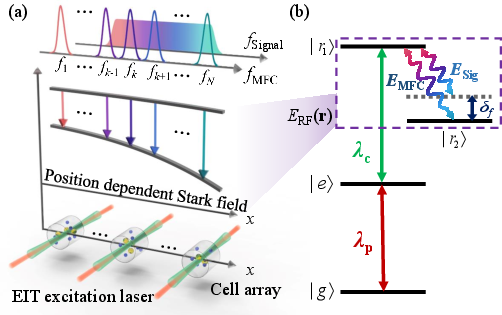
Abstract: Rydberg atoms have great potential for microwave (MW) measurements due to their high sensitivity, broad carrier bandwidth, and traceability. However, the narrow instantaneous bandwidth of the MW receiver limits its applications. Improving the instantaneous bandwidth of the receiver is an ongoing challenge. Here, we report on the achievement of an arbitrary instantaneous bandwidth MW receiver via a linear array of scalable Rydberg vapor cells with Stark comb, where the Stark comb consists of an MW frequency comb (MFC) and a position-dependent Stark field. In the presence of the Stark field, the resonance MW transition frequency between two Rydberg states is position dependent, so that we can make each MFC line act as a local oscillator (LO) field to resonantly couple one Rydberg cell. Thus, each cell receives part of a broadband MW signal within its instantaneous bandwidth using atomic heterodyne detection, achieving the measurements of the broadband MW signal simultaneously. In our proof-of-principle experiment, we demonstrate the MW receiver with 210~MHz instantaneous bandwidth using an MFC field with 21 lines. Meanwhile, we achieve an overall sensitivity of 326.6~nVcm${-1}$Hz${-1/2}$. In principle, the method allows for achieving an arbitrary instantaneous bandwidth of the receiver, provided we have enough MFC lines with enough power. Our work paves the way to design and develop a scalable MW receiver for applications in radar, communication, and spectrum monitoring.
Paper Prompts
Sign up for free to create and run prompts on this paper using GPT-5.
Top Community Prompts
Explain it Like I'm 14
Plain-English Summary of the Paper
What is this paper about?
This paper shows a new way to build a “super-listening” microwave receiver using special atoms called Rydberg atoms. The goal is to listen to a very wide chunk of microwave frequencies all at once (called “instantaneous bandwidth”), not just a tiny slice. The researchers demonstrate a method that can, in principle, be scaled to cover almost any size of bandwidth, and they prove it with an experiment that listens to 210 MHz of microwaves at the same time.
What questions were the researchers trying to answer?
They focused on two simple questions:
- How can we make an atom-based microwave receiver that listens to a much wider range of frequencies at once?
- Can we do this without losing sensitivity (the ability to pick up very weak signals)?
How does it work? (With simple explanations of the science)
Think of listening to radio stations:
- A normal radio tunes to one station at a time.
- This system sets up many “mini radios” in a line, each one tuned to a different station—so together, they can listen to a lot of stations at once.
Here are the key parts and what they mean:
- Rydberg atoms: Atoms with one electron very far from the nucleus. Because of that, they are super sensitive to microwaves—like having giant “antennae.”
- Vapor cell: A tiny glass container with gas (atoms) inside.
- Electromagnetically Induced Transparency (EIT): A laser trick that lets the atoms become see-through in a very controlled way. It also makes them great microwave sensors.
- Stark field: An electric field that shifts the atoms’ favorite “listening” frequency—like turning the tuning knob on a radio. Here, the field changes with position, so each spot in space tunes to a different frequency.
- Microwave frequency comb (MFC): A set of many microwave tones (like the evenly spaced teeth of a comb). Each “tooth” can act like a reference tone.
- Local oscillator (LO): A reference tone that you mix with the incoming signal to create a “beat note” (the difference in frequency). This is called heterodyne detection and makes it easier to measure signals precisely.
Putting it together:
- The team uses a line (an “array”) of vapor cells. Because of the position-dependent Stark field, each cell naturally “wants” to respond to a slightly different microwave frequency.
- They also send in a microwave frequency comb—many reference tones spaced 10 MHz apart.
- Each comb “tooth” (tone) matches one cell. That tone acts as the LO for that cell.
- When a real microwave signal comes in, each cell mixes it with its matched LO and generates a beat note (like two singers creating a pleasant “wah-wah” sound when their voices are close in pitch). Measuring the beat note tells you the signal strength near that cell’s frequency.
- By combining the responses of all cells, the system listens to a wide chunk of the spectrum at once.
In the lab, instead of building many cells, they slid a single cell to different positions to mimic a whole array. That proves the idea works and can be scaled.
What did they actually do in the experiment?
- They used cesium atoms in a small glass cell and shined two lasers through it to create EIT (852 nm and 509 nm light).
- They created a position-dependent Stark field using metal plates so that the atoms’ microwave “tuning” changes along a line.
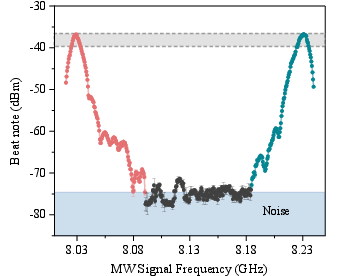
- They generated a microwave frequency comb with 21 tones spaced by 10 MHz (centered around ~8.13 GHz).
- Each “cell position” had an instantaneous bandwidth of about ±5 MHz. With 21 positions, that covers 21 × 10 MHz = 210 MHz continuously.
- They tested reception using a real microwave signal, measured the beat notes, and stitched the results together (as if many cells were working in parallel).
- They also tested a two-cell version working at the same time to show how the method scales.
- They measured sensitivity (how faint a field they can detect). Their overall sensitivity was about 3.27 × 10⁻⁷ volts per centimeter per √Hz (written as 326.6 nV/cm/√Hz). In simple terms, it can detect very weak microwaves.
What were the main findings and why do they matter?
Main results:
- Instantaneous bandwidth: 210 MHz in their proof-of-principle test (about 8.03 to 8.23 GHz).
- Sensitivity: As low as about 2.53 × 10⁻⁷ V/cm/√Hz in the best spot; the overall worst-case across the whole band was 3.27 × 10⁻⁷ V/cm/√Hz.
- Scalability: The method is designed so you can add more cells and more comb tones to cover more bandwidth. In principle, this could be extended to much larger ranges (even beyond 1 GHz) by adding more “teeth” and power.
Why it matters:
- Traditional microwave receivers face trade-offs: going wide in bandwidth can be hard without heavy processing and can be limited by electronics.
- Atom-based receivers are precise and can be traceable to fundamental physics (no factory calibration drift).
- This approach breaks past the usual bottleneck in atom-based sensors (which often only see tens of MHz at once) and shows a clear path to very wide, flexible, and sensitive receivers.
What could this lead to?
This technique could help in:
- Radar and electronic warfare: catching fast-changing or hidden signals over a wide band.
- Communications (including 5G and beyond): monitoring many channels at once.
- Spectrum monitoring: real-time watch over wide frequency ranges.
- Scientific measurements: sensitive, accurate microwave sensing tied to atomic standards.
Future improvements the authors suggest:
- Use higher Rydberg states to boost sensitivity.
- Add more comb lines and more cells to expand bandwidth.
- Combine with other tricks (like multi-dressed states) to push instantaneous bandwidth above 1 GHz.
- Build compact, integrated arrays using microfabricated vapor cells for real-world devices.
In short, the paper presents a clever way to turn a line of atom-filled cells into a wideband, super-sensitive microwave “ear,” using a carefully shaped electric field and a microwave comb as a set of reference tones. It works now at 210 MHz and can be scaled much wider, opening doors to powerful new receivers.
Collections
Sign up for free to add this paper to one or more collections.