Performance of Antenna-based and Rydberg Quantum RF Sensors in the Electrically Small Regime
Abstract: Rydberg atom electric field sensors are tunable quantum sensors that can perform sensitive radio frequency (RF) measurements. Their qualities have piqued interest at longer wavelengths where their small size compares favorably to impedance-matched antennas. Here, we compare the signal detection sensitivity of cm-scale Rydberg sensors to similarly sized room-temperature electrically small antennas with active and passive receiver backends. We present and analyze effective circuit models for each sensor type, facilitating a fair sensitivity comparison for cm-scale sensors. We calculate that contemporary Rydberg sensor implementations are less sensitive than unmatched antennas with active amplification. However, we find that idealized Rydberg sensors operating with a maximized atom number and at the standard quantum limit may perform well beyond the capabilities of antenna-based sensors at room temperature, the sensitivities of both lying below typical atmospheric background noise.
Paper Prompts
Sign up for free to create and run prompts on this paper using GPT-5.
Top Community Prompts
Explain it Like I'm 14
Easy-to-Understand Summary of the Paper
Overview: What is this paper about?
This paper compares two different kinds of tiny radio-wave sensors to see which one can pick up weaker signals when the sensor is much smaller than the radio wave itself:
- Small metal antennas (like tiny versions of the ones in radios)
- Rydberg atom sensors (clouds of atoms used as “quantum antennas”)
Think of trying to listen for a whisper in a big, noisy room. The researchers ask: which kind of tiny “ear” hears the whisper better?
Key questions the paper asks
The authors focus on questions that matter when the sensor is only about 1 centimeter in size and listening to low radio frequencies (about 30 kHz to 30 MHz):
- Which sensor can detect smaller signals: a tiny antenna or a Rydberg atom sensor?
- How do different kinds of “noise” (random unwanted signals) limit what each sensor can hear?
- What’s the best we can ever do with a perfect, quantum-limited atom sensor?
- How do realistic, easy-to-build devices compare with that “perfect world” limit?
How they did it (methods in simple terms)
To compare the sensors fairly, the authors build simple “electrical cartoons” (models) of each sensor and calculate how small a signal each could detect before it gets lost in noise. Here’s how they set it up:
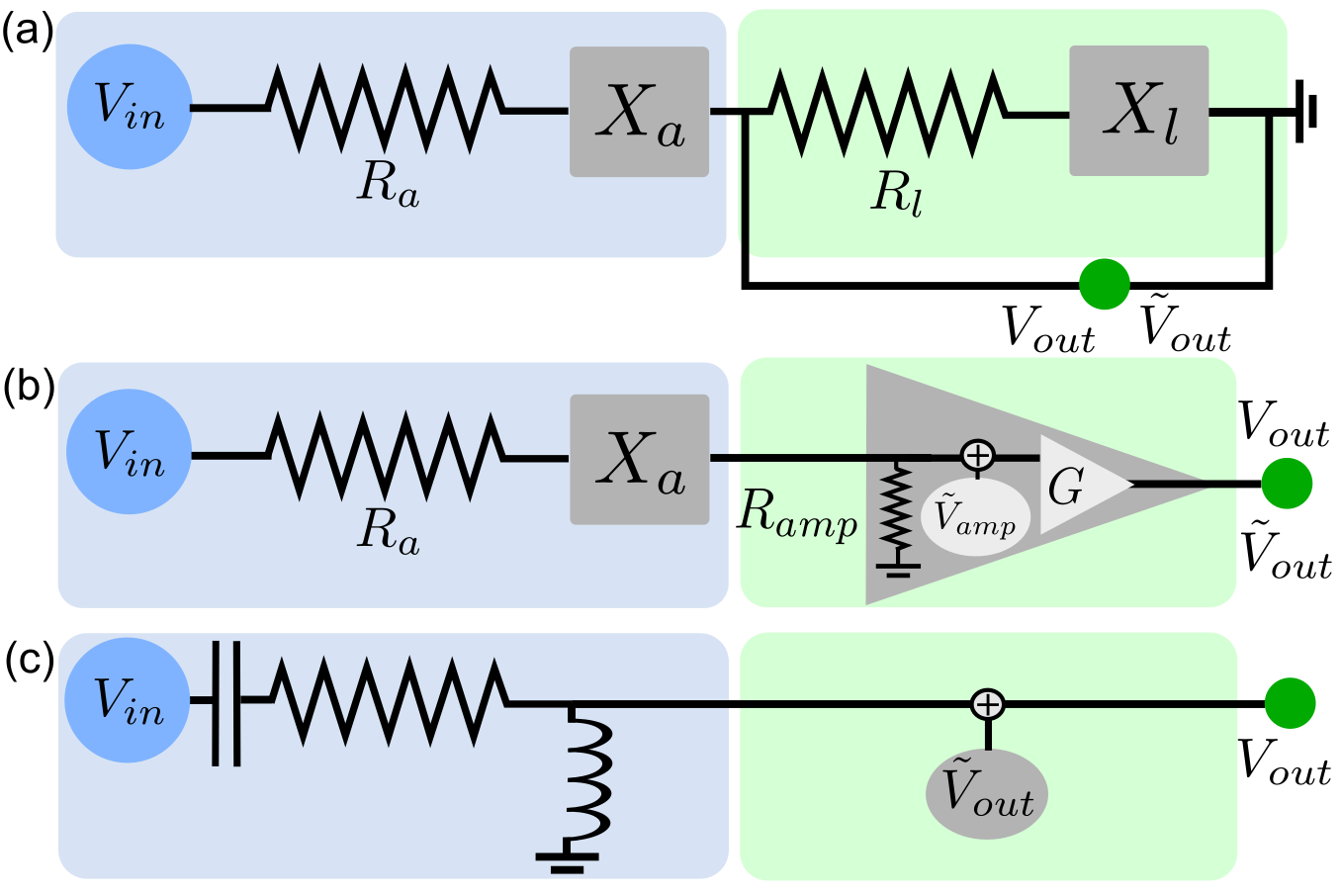
- They treat each sensor as if it were an electrical circuit with a signal coming in and noise added along the way. This lets them compare them “apples to apples.”
- They consider two types of noise:
- External noise: radio noise from the environment (like atmospheric static)
- Internal noise: the sensor’s own noise (like thermal “hiss” in electronics or quantum randomness in atoms)
They test several versions of the tiny antenna:
- A resonant, “matched” antenna that absorbs energy efficiently but only over a very narrow range of frequencies (like a tuning fork tuned to one note)
- An “unmatched” antenna with:
- A simple passive readout (no amplifier)
- An active readout with a low-noise amplifier (like a microphone preamp)
They also test two versions of Rydberg atom sensors:
- An ideal, quantum-limited sensor (the “best physics could allow” if everything is optimized). This is called the standard quantum limit.
- A practical, warm-vapor sensor that uses a laser trick called electromagnetically induced transparency (EIT) to read the atoms—this is what labs typically build today.
To make the comparison realistic, they:
- Fix the sensor size to about 1 cm
- Use standard copper wire for antennas
- Use a common low-noise amplifier (1 nV/√Hz, 100 MΩ input impedance)
- Use real atomic data (for rubidium atoms) to get the atom properties
- Limit how many atoms they use so they don’t interfere with each other too much
What they found and why it matters
Here are the main results in simple terms:
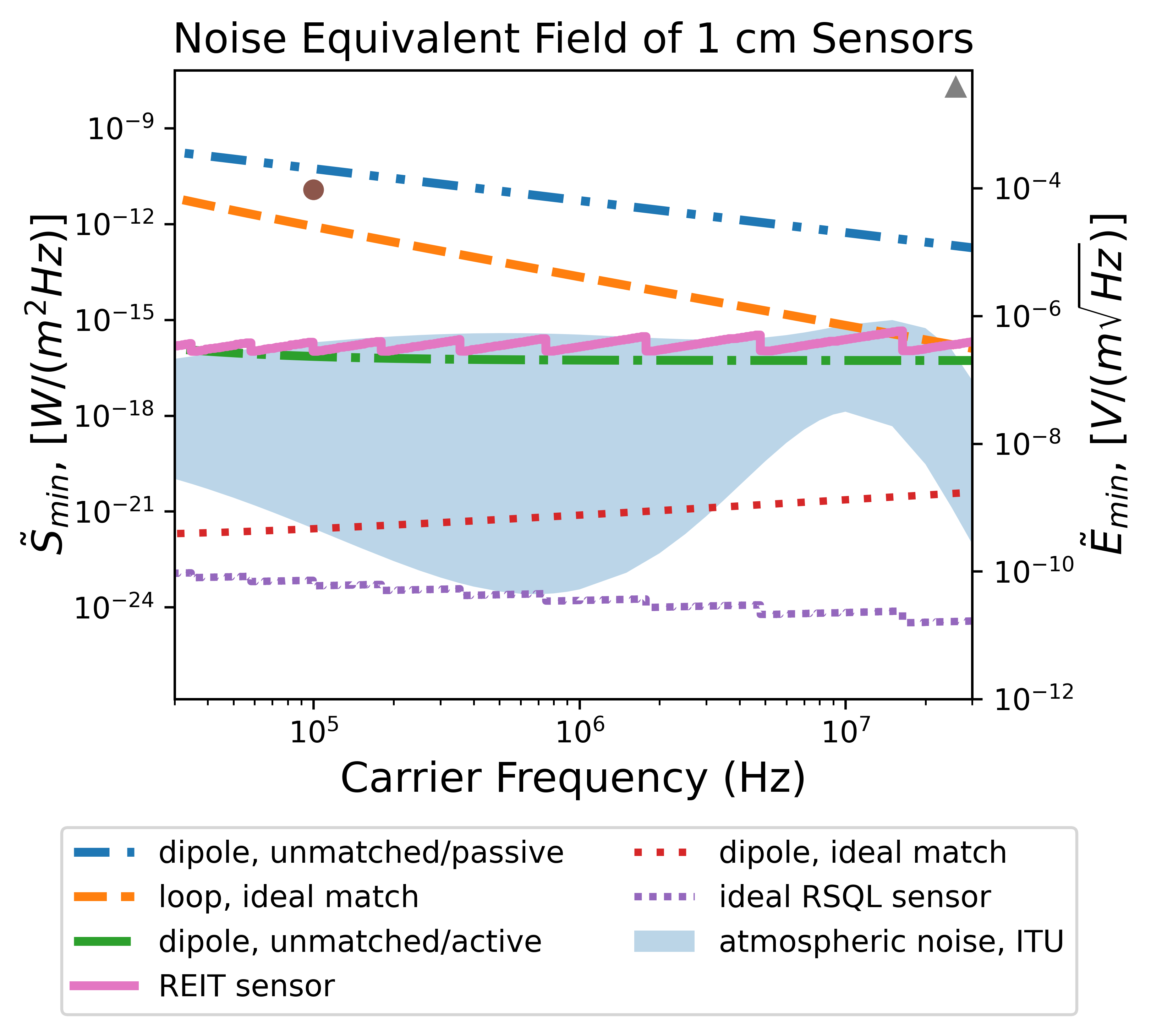
- Today’s tiny antennas with a good amplifier can detect very weak signals and can get close to the level where the Earth’s atmosphere itself becomes the limiting noise. That means, in many outdoor cases, you can’t do better because nature is noisy.
- Today’s warm Rydberg atom sensors (practical ones used in labs) are less sensitive than those tiny amplified antennas. They measure weaker signals than many antennas, but not the weakest possible.
- However, an ideal Rydberg atom sensor operating at the quantum limit, with many atoms and minimal decoherence, could beat any room-temperature antenna in sensitivity—by a lot. In their estimates, it could detect electric fields as small as about 10-11 V/(m·√Hz). That’s outstanding, but very hard to achieve in practice right now.
- Resonant “matched” tiny antennas can also look great on paper, but they’re hard to build well and only work over a very narrow frequency range. That makes them less practical for wideband sensing.
- Loop antennas (magnetic sensors) are less sensitive than small dipoles for this frequency range, though they are often easier to tune and match.
Why this matters:
- If you need the smallest, most sensitive sensor and can tolerate complexity, quantum sensors could one day win big.
- If you want something you can build today with great performance, a small antenna plus a good amplifier is still the best bet.
- In many real-world situations, environmental noise (like atmospheric static) is the ultimate limit—so getting sensitivity far below that won’t help unless you’re in a very quiet place (like a shielded room).
What this could lead to (implications and impact)
- Near-term: Small antennas with good amplifiers are likely the practical choice for very sensitive, small RF sensors.
- Medium-term: There’s a large “gap” between today’s Rydberg sensors and their ideal quantum-limited potential. That gap motivates research into:
- Using more atoms without them disturbing each other
- Reducing decoherence (keeping atoms “quiet” for longer)
- Advanced techniques like entanglement to beat standard quantum limits
- Long-term: If Rydberg sensors reach their potential, they could enable ultra-precise radio measurements, especially in shielded labs or special environments. They also offer extra advantages beyond sensitivity, like:
- Easy tuning across wide frequency ranges
- Measuring both signal strength and phase
- Large dynamic range
- Built-in accuracy (atoms are identical and reliable)
- Possibilities for imaging at very high frequencies
In short: Right now, tiny antennas with amplifiers are the champions for small, sensitive RF sensing. But quantum Rydberg sensors have the potential to become even better in the future—if researchers can close the gap between today’s devices and the quantum limit.
Collections
Sign up for free to add this paper to one or more collections.