Atom-Based Sensing of Weak Radio Frequency Electric Fields Using Homodyne Readout
Abstract: We utilize a homodyne detection technique to achieve a new sensitivity limit for atom-based, absolute radio-frequency electric field sensing of $\mathrm{5 μV cm{-1} Hz{-1/2} }$. A Mach-Zehnder interferometer is used for the homodyne detection. With the increased sensitivity, we investigate the dominant dephasing mechanisms that affect the performance of the sensor. In particular, we present data on power broadening, collisional broadening and transit time broadening. Our results are compared to density matrix calculations. We show that photon shot noise in the signal readout is currently a limiting factor. We suggest that new approaches with superior readout with respect to photon shot noise are needed to increase the sensitivity further.
Paper Prompts
Sign up for free to create and run prompts on this paper using GPT-5.
Top Community Prompts
Explain it Like I'm 14
What this paper is about
This paper shows a new way to measure very weak radio waves (radio‑frequency electric fields) using atoms instead of metal antennas. The researchers use special “big” atoms called Rydberg atoms in a tiny gas cell and shine lasers through them. By adding a clever light‑based measuring tool (a Mach–Zehnder interferometer with homodyne readout), they make the measurement much more sensitive than before.
The main questions the paper asks
- Can we use atoms as tiny, accurate “electric field meters” to detect very weak radio signals?
- How much can we improve sensitivity by reading the signal with an optical interferometer (a device that compares two light beams to cancel noise)?
- What things blur or weaken the atomic signal (like too much laser power, atoms bumping into each other, or atoms moving through the laser too fast)?
- What’s currently limiting the sensitivity, and how could we push it even further?
How they did it (in everyday language)
Think of each atom like a tiny, perfectly tuned antenna or tuning fork. When a radio wave passes by, it “wiggles” the atom in a way we can detect using laser light.
- Rydberg atoms: These are atoms with one electron far from the nucleus, so they are extra sensitive to electric fields—like giant, easy‑to‑wiggle tuning forks.
- Electromagnetically Induced Transparency (EIT): Normally, the gas would block (absorb) a laser beam. But if you use two laser colors together in the right way, the gas becomes transparent at just the right frequency—like a secret door that opens only when you play the right musical chord. A radio wave changes how wide or where that “door” is, and we watch those changes to measure the field.
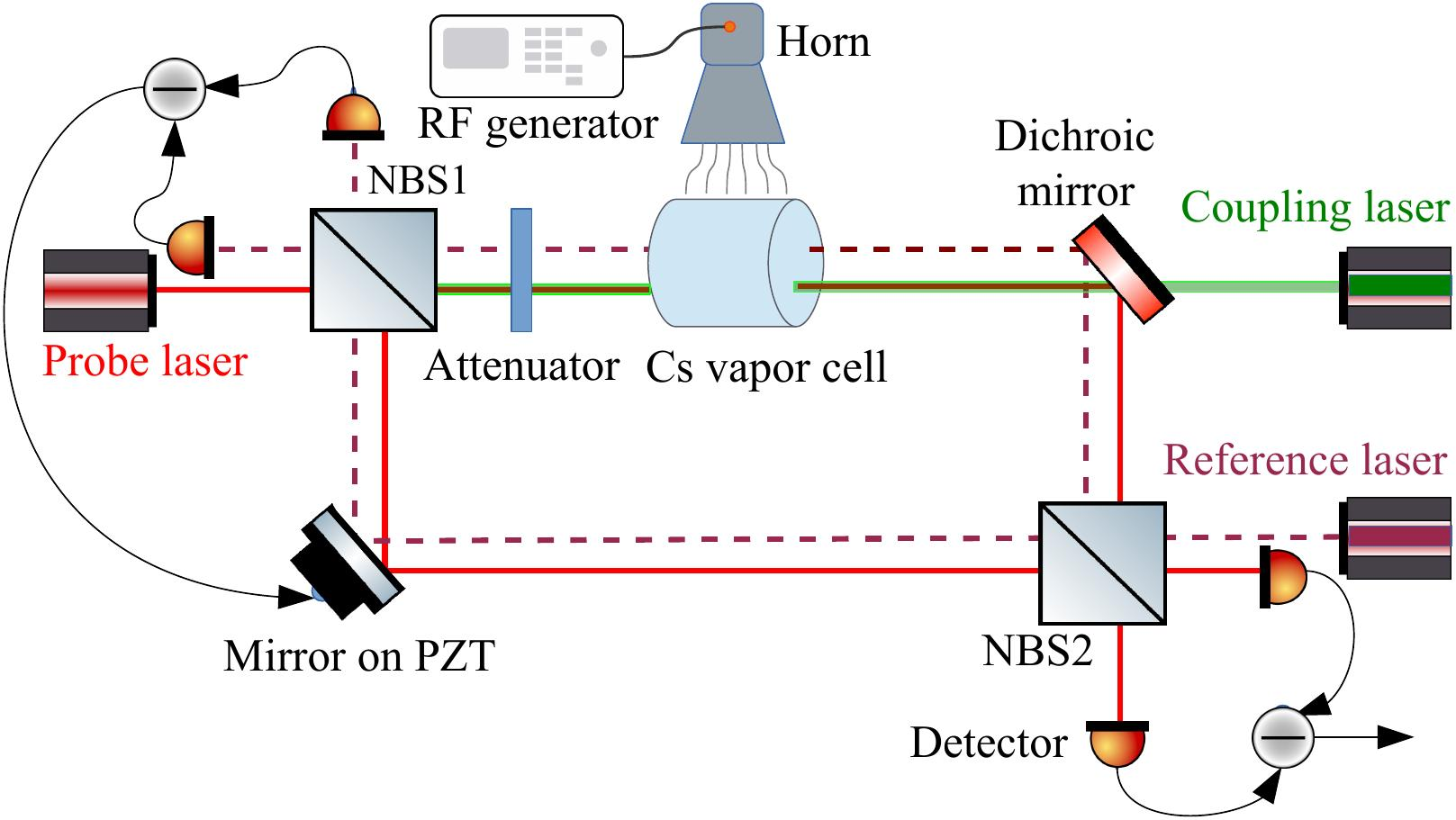
- Mach–Zehnder interferometer (MZI) and homodyne readout: Split the laser beam into two paths. One path goes through the atoms (the “signal”), the other is a clean reference (the “local oscillator”). Bring them back together and subtract them. This is like noise‑cancelling headphones for light: common noise is removed, and tiny changes caused by the radio wave stand out.
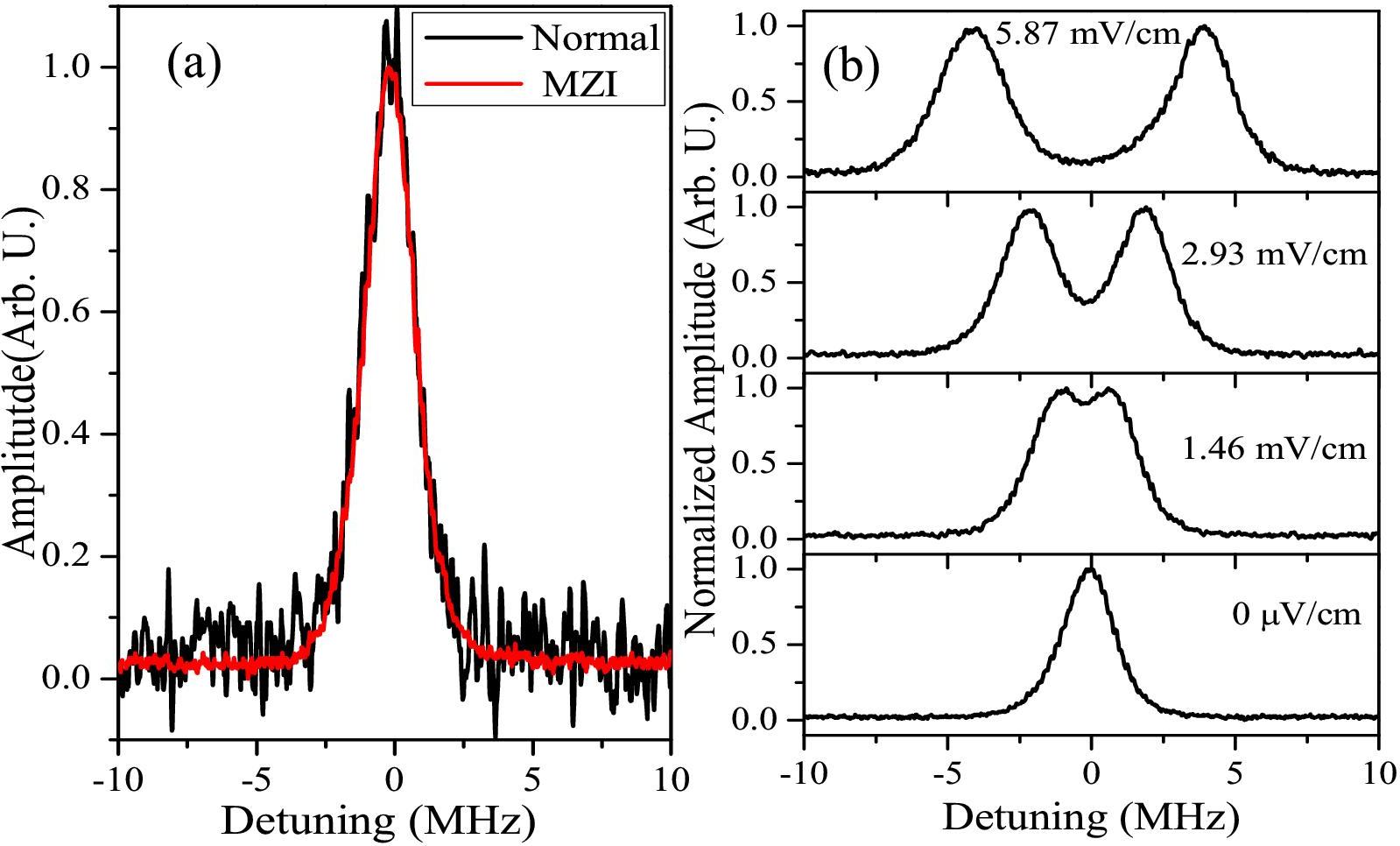
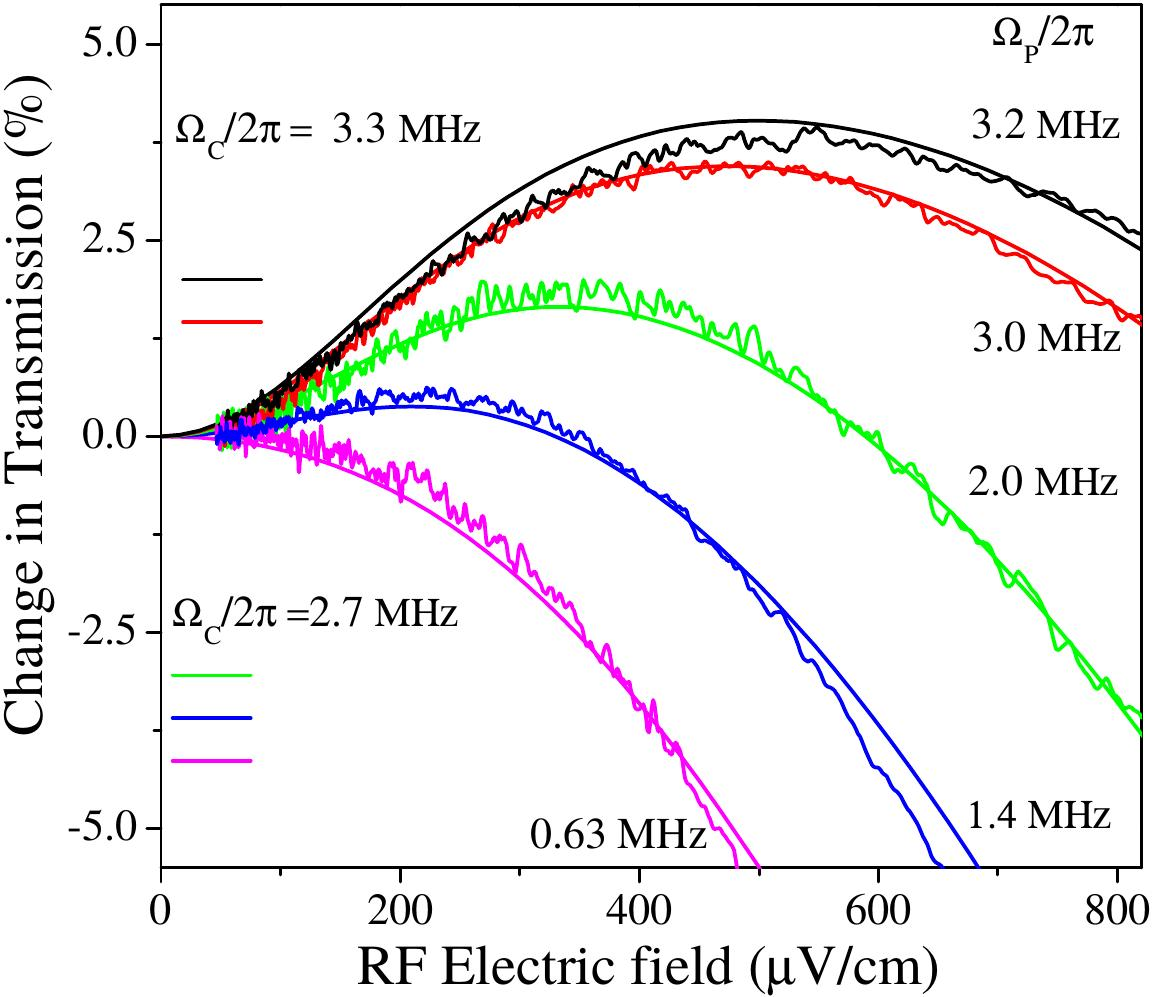
- Measuring strong vs. weak fields: When the radio wave is strong, it splits one transmission peak into two (called Autler–Townes splitting—imagine one hill turning into two hills). The distance between those hills tells you the field strength. When the field is very weak, the peak doesn’t split; instead, it just changes height a little. Then you must measure small height changes very precisely, which is where the interferometer helps.
- Computer modeling: They used a standard physics model (density matrix calculations) to predict and match what the atoms should do, helping them separate different blurring effects.
What they found and why it matters
Here are the main results:
- Much better sensitivity: They reached about 5 microvolts per centimeter per square‑root of Hertz (5 μV/cm/√Hz). That’s roughly 6 times better than their previous record (~30 μV/cm/√Hz). In simple terms, if you measure for 1 second, you can detect fields of just a few microvolts per centimeter; longer averaging lets you see even weaker fields.
- Big jump in signal clarity: The interferometer improved the signal‑to‑noise ratio by about 20× for the optical readout, letting them see effects faster (often under a second) and with lower laser power (which helps keep signals sharp).
- What blurs the signal (the “dephasing” effects):
- Power broadening: Turning laser power up too much is like shouting into a microphone—louder isn’t clearer; it makes the feature wider and fuzzier.
- Collision broadening: When atoms bump into each other more often (higher temperature/density), the signal broadens. They measured how the width grows with density and extracted a collision cross‑section that matches known values.
- Transit time broadening: Atoms drift through the thin laser beam. If the beam is very skinny, atoms pass quickly and don’t “ring” long enough—like a bell tapped too briefly—so the signal widens. Making the beam larger reduces this effect.
- What’s limiting them now: Photon shot noise on the photodetector. Shot noise is like counting raindrops hitting a bucket: even with a steady rain, the exact number per second jiggles randomly. This randomness in detected light limits how small a change they can see. They show that this detector shot noise—not the atoms’ own quantum noise—is the current roadblock.
- A path to go further: They propose a “three‑photon” laser scheme that better matches wavelengths and shrinks motion‑related blurring. Their calculations suggest this could improve sensitivity by about 10× more, to roughly 200–500 nanovolts per centimeter per √Hz. In the long run, using “squeezed light” (special light with reduced randomness) could push sensitivity toward the atoms’ fundamental limits.
Why this research matters
- Toward an “atomic ruler” for radio fields: Using atoms as a standard can give measurements that are absolute (no need to calibrate against a metal antenna) and highly stable.
- Practical uses: Better antenna calibration, detecting weak signals, terahertz sensing, and testing electronic materials—all with a sensor that could be miniaturized on a chip or in optical fiber.
- New science possibilities: If sensitivity gets close to the atoms’ ultimate limit, we could measure incredibly faint, fundamental signals, like the tiny electric fields from thermal (blackbody) radiation, opening doors to precision tests in physics.
In short, the team built a kind of light‑based, noise‑cancelling “stethoscope” for atoms, making them much better at hearing the faintest radio whispers. They mapped out what still muffles the sound and laid out a clear plan for making it even sharper.
Collections
Sign up for free to add this paper to one or more collections.