- The paper demonstrates ESS's capability to achieve a ±0.011 precision on sin²θW and tighter neutron rms radius limits via multi-target detector analysis.
- It employs a detailed EFT framework to assess scalar, vector, axial, and tensor non-standard interactions, outperforming previous CEνNS results in specific mass ranges.
- The study probes sterile neutrino oscillations and dipole portal scenarios, establishing ESS as a key facility for exploring conventional and new neutrino physics.
Probing Standard Model and New Physics at ESS Using Coherent Elastic Neutrino-Nucleus Scattering
Introduction: ESS as a High-Statistics CEνNS Facility
This study examines the sensitivity of the European Spallation Source (ESS) to both Standard Model (SM) and beyond-the-Standard-Model (BSM) phenomena via coherent elastic neutrino-nucleus scattering (CEνNS). Leveraging the intense neutrino flux generated by the ESS's superconducting proton accelerator, the work quantifies the expected event yields and evaluates projected constraints for various detectors employing CsI, Xe, Ge, Si, Ar, and C3F8 nuclear targets. Both classic SM tests—such as precision measurement of the weak mixing angle and neutron rms radius—and diverse BSM physics scenarios including neutrino generalized interactions (NGIs), sterile neutrino/neutral lepton production, and lepton unitarity violation are systematically addressed.
The underlying physics is formulated by reviewing the coherent SM cross section at tree level, mediated by Z exchange and proportional to the square of the neutron number, with nuclear form factors parametrized via the Helm model. The analysis incorporates both vector and suppressed axial-vector SM contributions, accounting for target-specific nuclear spin dependencies. For new physics probes, a model-independent effective field theory approach is adopted, capturing all Lorentz-invariant four-fermion operators relevant for NGI: scalar (S), pseudoscalar (P), vector (V), axial-vector (A), and tensor (T). The study evaluates both light and heavy mediator cases, parameterizing interaction strengths through generic couplings and masses.
The simulation pipeline utilizes detailed detector specifications—mass, threshold, resolution, and backgrounds—derived from available ESS proposals. Signal and background rates are statistically treated using Poisson χ2 fits, and spectral smearing is incorporated via energy-dependent Gaussian functions. Flat systematic uncertainties of 10% for signal and 1% for background are imposed following prior experimental guidance.
SM Parameter Projections: Weak Mixing Angle and Neutron RMS Radius
A principal focus is the low-energy determination of sin2θW, a benchmark electroweak parameter. The combined ESS analysis yields a projected 1σ uncertainty on sin2θW of ±0.011, representing substantial improvement over current CEνNS-based limits (e.g., ∼60% tighter than COHERENT and 80% over Dresden-II). The ESS detectors' statistical power and diversified nuclear targets enable robust cross-verification of SM predictions and complement high-precision atomic parity violation (APV) results.
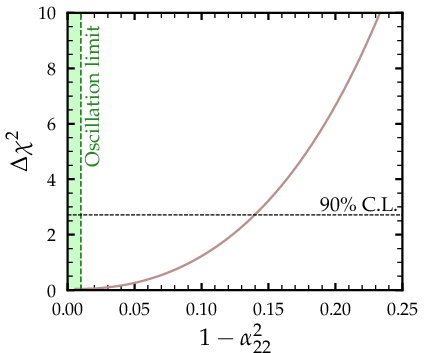
Figure 1: Projected sensitivity on the weak mixing angle from the combined analysis of the proposed ESS detectors.
The neutron rms radius (Rn), poorly constrained especially for non-lead isotopes, is analyzed for each target. The expected 1σ ranges for Rn show marked improvement over existing constraints, with ESS projected to tighten CsI limits by ∼40% and provide first-time sensitivity for Si and C3F8. Simultaneous fitting of sin2θW and Rn reveals weak parameter correlations except for heavy nuclei, where form factor effects at low recoil energies become more pronounced.
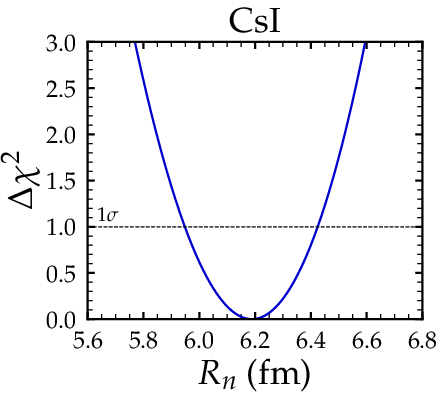
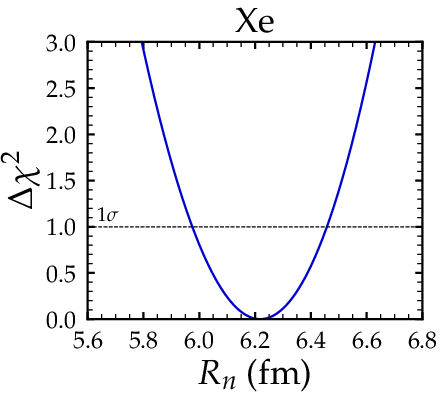
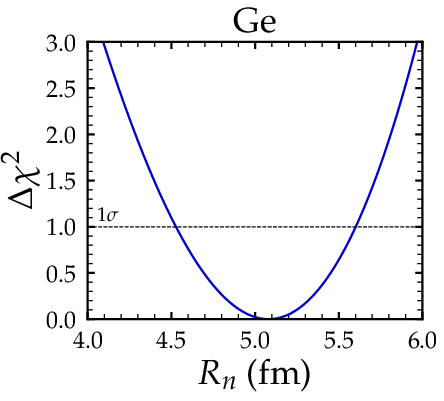
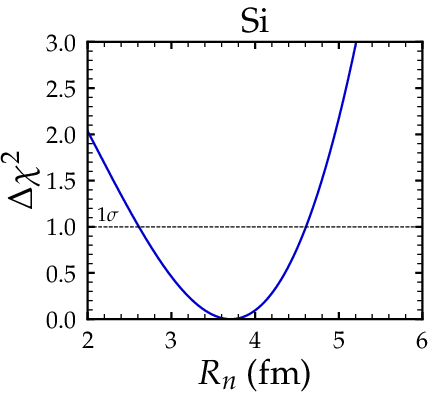
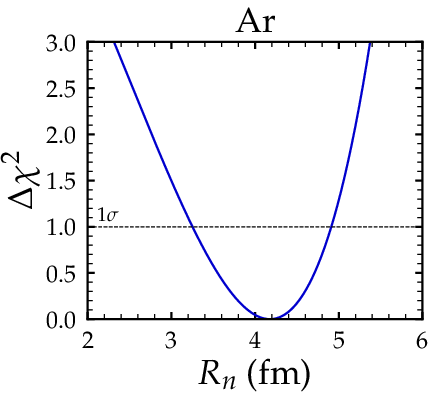
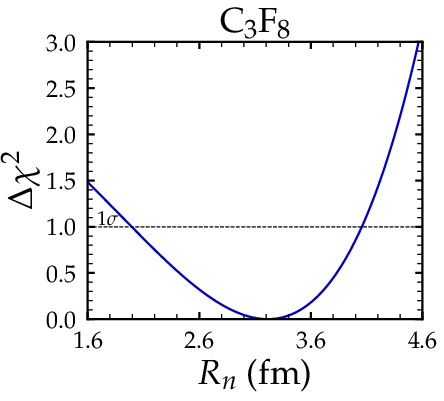
Figure 2: Projected sensitivity on the neutron rms radii of different detectors at the ESS.
NGI Sensitivities: Scalar, Vector, Axial-Vector, and Tensor Channels
ESS CEνNS is shown to be competitive or leading for constraining NGIs in specific parameter spaces. Combined ESS detector analysis projects competitive 90% C.L. sensitivity contours for scalar and vector interactions, especially in the MS>40 MeV and 25<MV<200 MeV ranges, outperforming bounds from existing CEνNS (COHERENT), elastic ν-e scattering, dark matter experiments, beam-dump, collider, and astrophysical supernova data. Axial-vector and tensor channels, being nuclear-spin suppressed, are less competitive against electron-scattering-derived limits, although ESS provides the strongest CEνNS-only constraints.
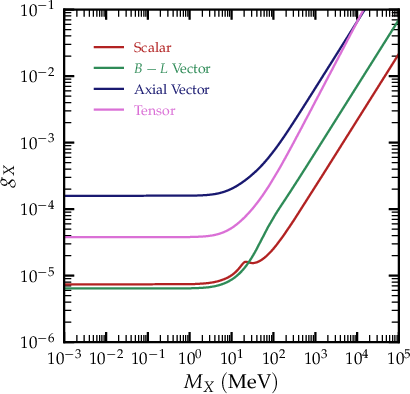
Figure 3: Projected sensitivities at 90% C.L. for the various X={S,V,A,T} interactions in a combined detector analysis.
Probing Sterile Neutrino and Neutral Lepton Phenomenology
The study systematically addresses CEνNS sensitivity to sterile neutrino oscillations, lepton unitarity violation (through parameters α11,α22), electromagnetic upscattering (“sterile dipole portal”), and production of massive sterile neutral leptons via various NGIs.
Lepton unitarity violation: CEνNS is insensitive to α11 but retains moderate sensitivity to α22, projecting 1−α222<0.14 at 90% C.L.; oscillation experiments remain dominant.
Figure 4: Projected sensitivity on the NU parameter α22.
Sterile oscillations: ESS CEνNS can probe active-sterile mixing in the (sin22θ14,Δm2) and (sin22θ24,Δm2) planes, but the sensitivity is limited compared to dedicated short-baseline experiments.
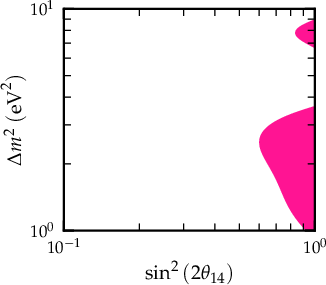
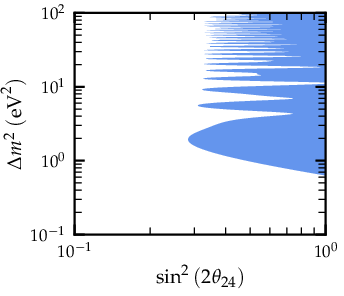
Figure 5: Projected 90% C.L. sensitivity regions for sterile neutrino oscillations.
Sterile dipole portal: By leveraging upscattering with transition magnetic moments (TMMs), ESS excludes μνe (μνμ) down to 8×10⁻¹⁰μB (6×10⁻¹⁰μB) for sub-10 MeV SNL masses, improving COHERENT bounds by a factor of five and extending reach up to 50 MeV SNL masses—a regime unprobed by reactors or current solar/DM experiments.
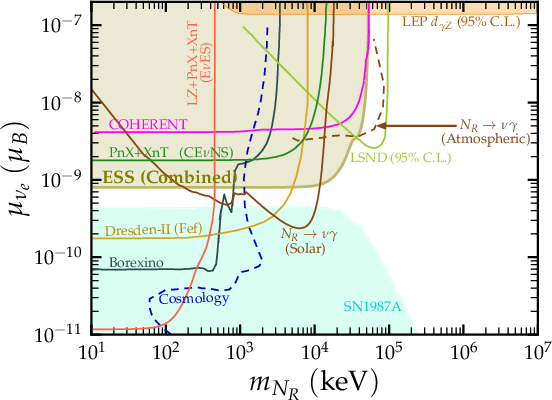
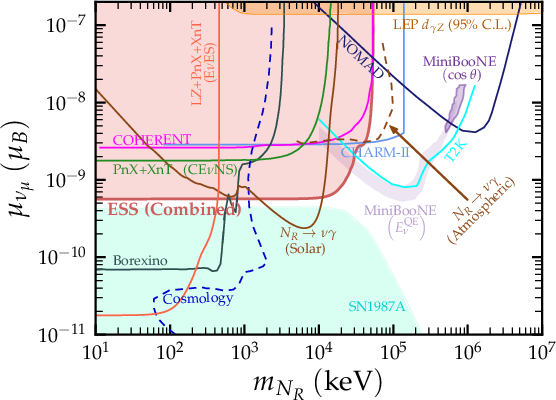
Figure 6: Projected 90% C.L. sensitivity on the sterile dipole portal scenario in (mNR,μνe/μ).
NGI-mediated SNL production: For the upscattering scenario with Lorentz-invariant scalar, vector, axial-vector, or tensor mediation, ESS matches or exceeds current XENONnT and COHERENT sensitivity for mediator/SNL masses above a few MeV. DUNE Near Detector measurements will outperform ESS for SNL masses above ∼50 MeV owing to higher-energy fluxes and improved nuclear spin coverage.
Discussion: Interplay, Complementarity, and Future Prospects
The combined-multitarget ESS strategy enables both cross-checks and global fits of SM parameters, essential for reducing model/systematic uncertainties in nuclear and weak interactions. For BSM physics, CEνNS at ESS will provide a critical complement to reactor, solar, and accelerator-based searches. The ability to test light, weakly-coupled mediators and massive SNL scenarios in previously inaccessible regimes is notable.
These improvements are not solely technical; the refined constraints can inform model building (e.g., UV completions with light/hidden sector mediators, sterile neutrino mass models) and have relevance for astrophysical phenomena—such as SN1987A cooling and BBN dynamics—via feedback on Neff, supernova energy loss rates, and lepton-number violation effects.
Conclusion
ESS's high-intensity neutrino flux and multiple advanced detector concepts will significantly extend precision low-energy neutrino physics. The projected improvements in sin2θW and Rn measurements, and competitive exclusion regions for NGI, sterile neutrino oscillations, and SNL production, establish ESS CEνNS as a leading probe of both conventional and novel interactions. The multitarget paradigm, robust statistical methods, and diverse physics case studies suggest that ESS will play a central role in next-generation neutrino and weak sector physics, bridging gaps between nuclear, accelerator, and cosmology-based experiments.

