Papers
Topics
Authors
Recent
Search
2000 character limit reached

Reqo: A Robust and Explainable Query Optimization Cost Model

Published 29 Jan 2025 in cs.DB, cs.AI, and cs.LG | (2501.17414v1)

Abstract: In recent years, there has been a growing interest in using ML in query optimization to select more efficient plans. Existing learning-based query optimizers use certain model architectures to convert tree-structured query plans into representations suitable for downstream ML tasks. As the design of these architectures significantly impacts cost estimation, we propose a tree model architecture based on Bidirectional Graph Neural Networks (Bi-GNN) aggregated by Gated Recurrent Units (GRUs) to achieve more accurate cost estimates. The inherent uncertainty of data and model parameters also leads to inaccurate cost estimates, resulting in suboptimal plans and less robust query performance. To address this, we implement a novel learning-to-rank cost model that effectively quantifies the uncertainty in cost estimates using approximate probabilistic ML. This model adaptively integrates quantified uncertainty with estimated costs and learns from comparing pairwise plans, achieving more robust performance. In addition, we propose the first explainability technique specifically designed for learning-based cost models. This technique explains the contribution of any subgraphs in the query plan to the final predicted cost, which can be integrated and trained with any learning-based cost model to significantly boost the model's explainability. By incorporating these innovations, we propose a cost model for a Robust and Explainable Query Optimizer, Reqo, that improves the accuracy, robustness, and explainability of cost estimation, outperforming state-of-the-art approaches in all three dimensions.
Summary

  • The paper introduces Reqo, a novel approach using Bi-GNN and GRU to improve query plan representation and cost estimation.
  • The paper demonstrates that integrating an explainability module quantifies subgraph contributions, thereby enhancing model transparency.
  • The paper validates Reqo’s robust plan selection under uncertainty, achieving superior performance on benchmarks like TPC-H and TPC-DS.

Reqo: A Robust and Explainable Query Optimization Cost Model

Introduction

Reqo proposes a novel approach for cost estimation in query optimization, advancing the capabilities of Database Management Systems (DBMS) in handling complex queries. It addresses significant challenges in query optimization: the accurate representation of query plans, the explainability of cost models, and the robustness of plan selection amidst inherent uncertainties.

Query Plan Representation

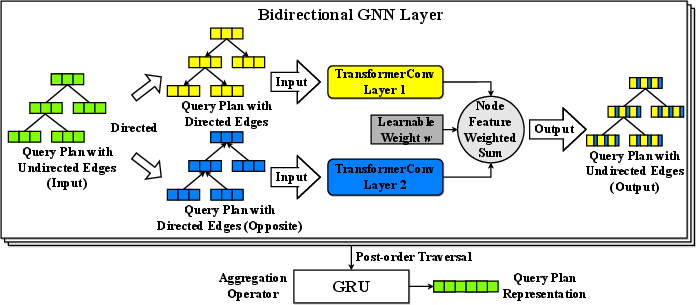
A query execution plan in DBMS is conventionally represented as a tree, with nodes indicating operators for accessing or transforming data, and edges denoting parent-child dependencies. Translating these structures into features suitable for ML tasks requires preserving node-level and structural information accurately. Reqo employs a Bidirectional Graph Neural Network (Bi-GNN) aggregated by Gated Recurrent Units (GRU) to enhance the representation learning process. Figure 1

Figure 1: The architecture of BiGG using bidirectional GNN with a GRU-based aggregator.

Explainability of Cost Models

Traditional cost models offer modular transparency, allowing developers to track how local costs relate to a query plan’s total cost. Contemporary learning-based models often sacrifice this transparency for accuracy. Reqo introduces an innovative explainability technique quantifying the contribution of subgraphs within query plans to the predicted cost, helping to restore some of this lost transparency by evaluating subtree contributions to cost predictions.

Robust Plan Selection

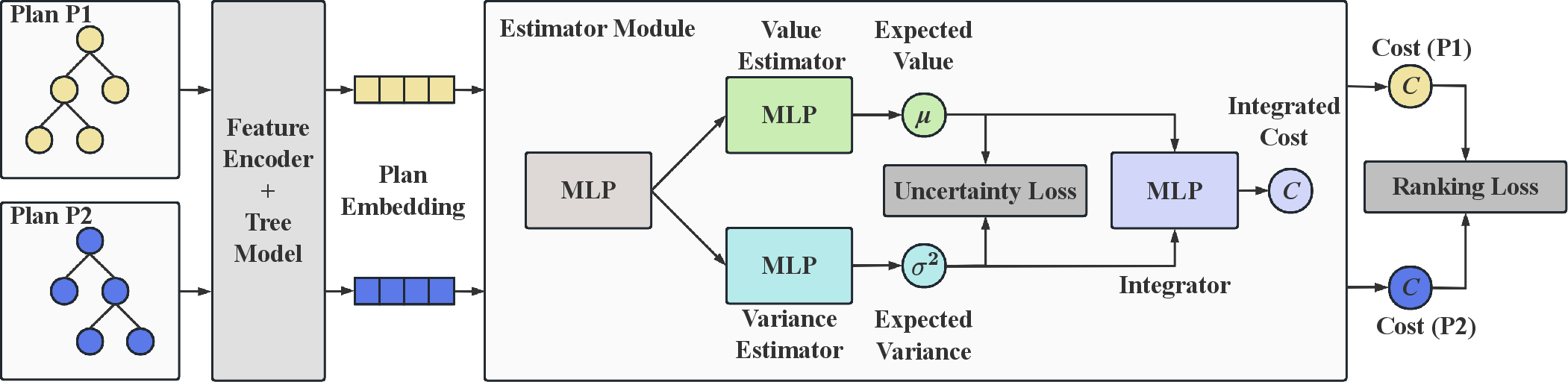
The process of selecting the optimal query plan is often hindered by uncertainties inherent in execution time estimations. Reqo integrates an adaptive learning-to-rank cost model, effectively combining cost predictions and quantified uncertainties. This approach employs a ranking loss with pairwise plan comparisons, which augments the model's capacity to discern optimal plans under uncertain conditions. Figure 2

Figure 2

Figure 2: The architecture of the learning-to-rank robust cost model.

Model Architecture

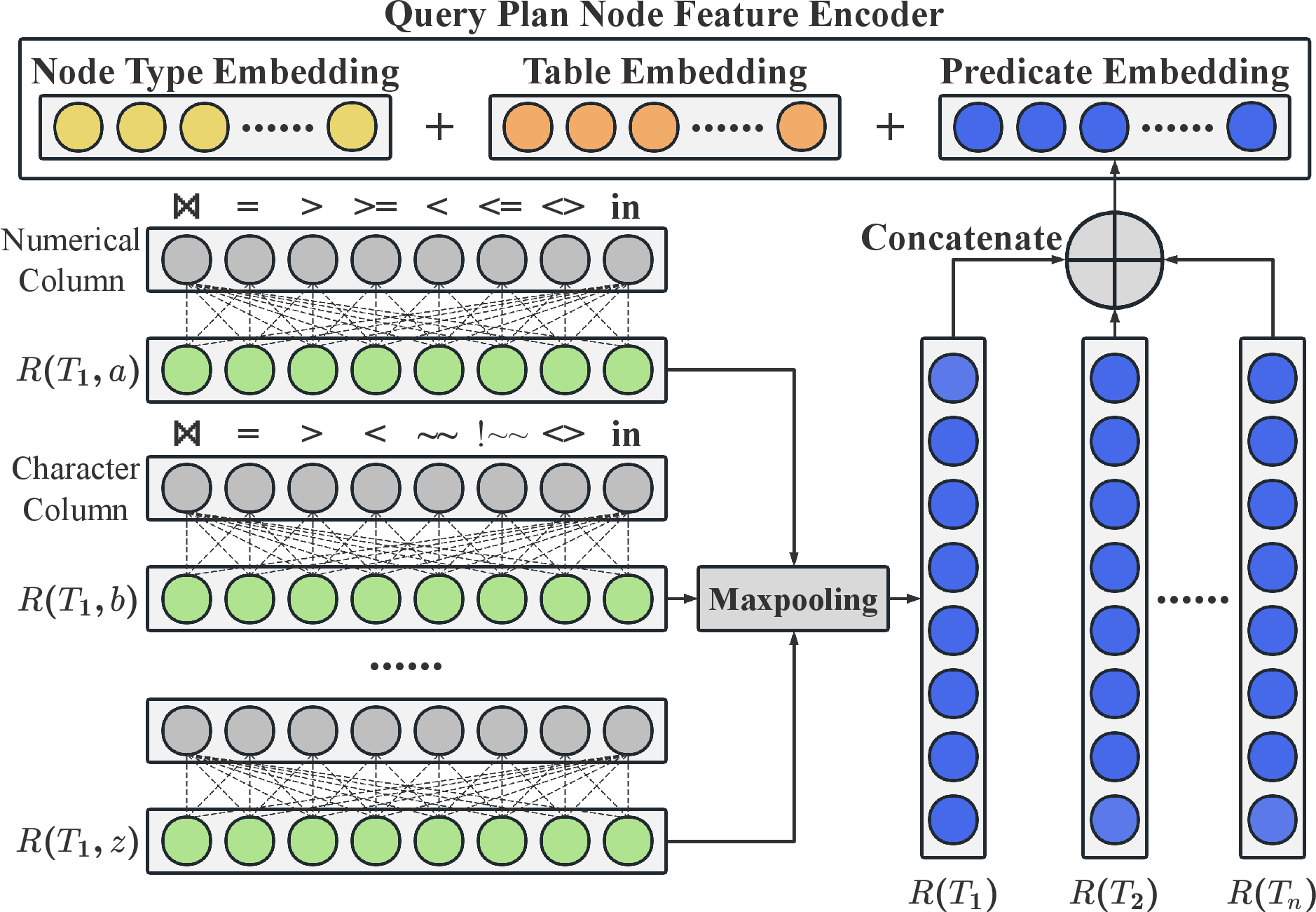
Reqo's architecture comprises distinct modules for feature encoding, representation learning, estimation, and explanation. Each query plan node is encoded into features, which are then processed by a Bi-GNN-based tree model, producing a fixed-size plan-level representation. The estimation module predicts costs and quantifies uncertainty, while an explanation module deciphers the contributions of subgraphs.

Experimental Evaluation

Extensive evaluations were conducted using diverse benchmarks such as STATS, JOB-light, TPC-H, and TPC-DS:

  • Cost Estimation Accuracy: Reqo demonstrated improved accuracy, with median Q-error consistently lower than existing models, showcasing its superior predictive power.
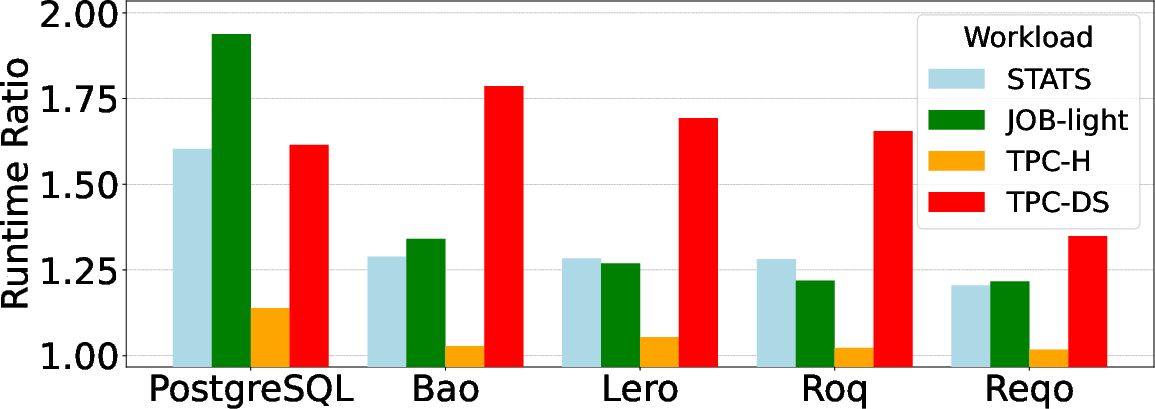
  • Robustness in Plan Selection: Reqo exhibited higher robustness in plan selection under varying workload complexities, evidenced by superior runtime ratio performance.
  • Explainability Performance: The integrated explainability technique significantly enhanced Reqo’s capability to elucidate cost predictions, achieving high top-K subgraph accuracy. Figure 3

    Figure 3: Comparing the total runtime ratio performance of various models across different workloads.

Conclusion

Reqo represents an advancement toward more reliable and interpretable learning-based query optimization. By combining strong representation learning, robust plan selection through quantifying uncertainty, and providing critical explainability insights, Reqo surpasses current state-of-the-art models, promising enhanced accuracy and robustness without sacrificing transparency. This positions Reqo as a valuable tool in real-world database optimization applications.

Paper to Video (Beta)

No one has generated a video about this paper yet.

Whiteboard

No one has generated a whiteboard explanation for this paper yet.

Open Problems

We haven't generated a list of open problems mentioned in this paper yet.

Collections

Sign up for free to add this paper to one or more collections.